
For years, Nepal’s Himalayan trails carried a paradox at the heart of their global reputation. The country marketed itself as the ultimate destination for freedom, adventure, and independent trekking yet every trekking season also brought stories of missing hikers, expensive helicopter evacuations, altitude emergencies, and complex rescue missions in some of the world’s most unforgiving terrain.
Now, after years of controversy, Nepal’s mandatory guide policy appears to be producing measurable results. According to trekking industry data and tourism operators across Nepal, search and rescue (SAR) operations involving solo trekkers have dropped by nearly 60 percent since the government began strictly enforcing its no-solo-trekking regulations across major trekking corridors in 2025 and 2026.
The numbers are fueling a major policy debate inside Nepal’s tourism industry: was the controversial solo trekking ban ultimately the right decision?
Supporters say the results are undeniable. Guides are spotting altitude sickness earlier, trekkers are being tracked more efficiently, and emergency response coordination has improved dramatically. Critics, however, argue the restrictions undermine Nepal’s long-standing backpacking culture and risk pushing independent travelers toward competing Himalayan destinations.
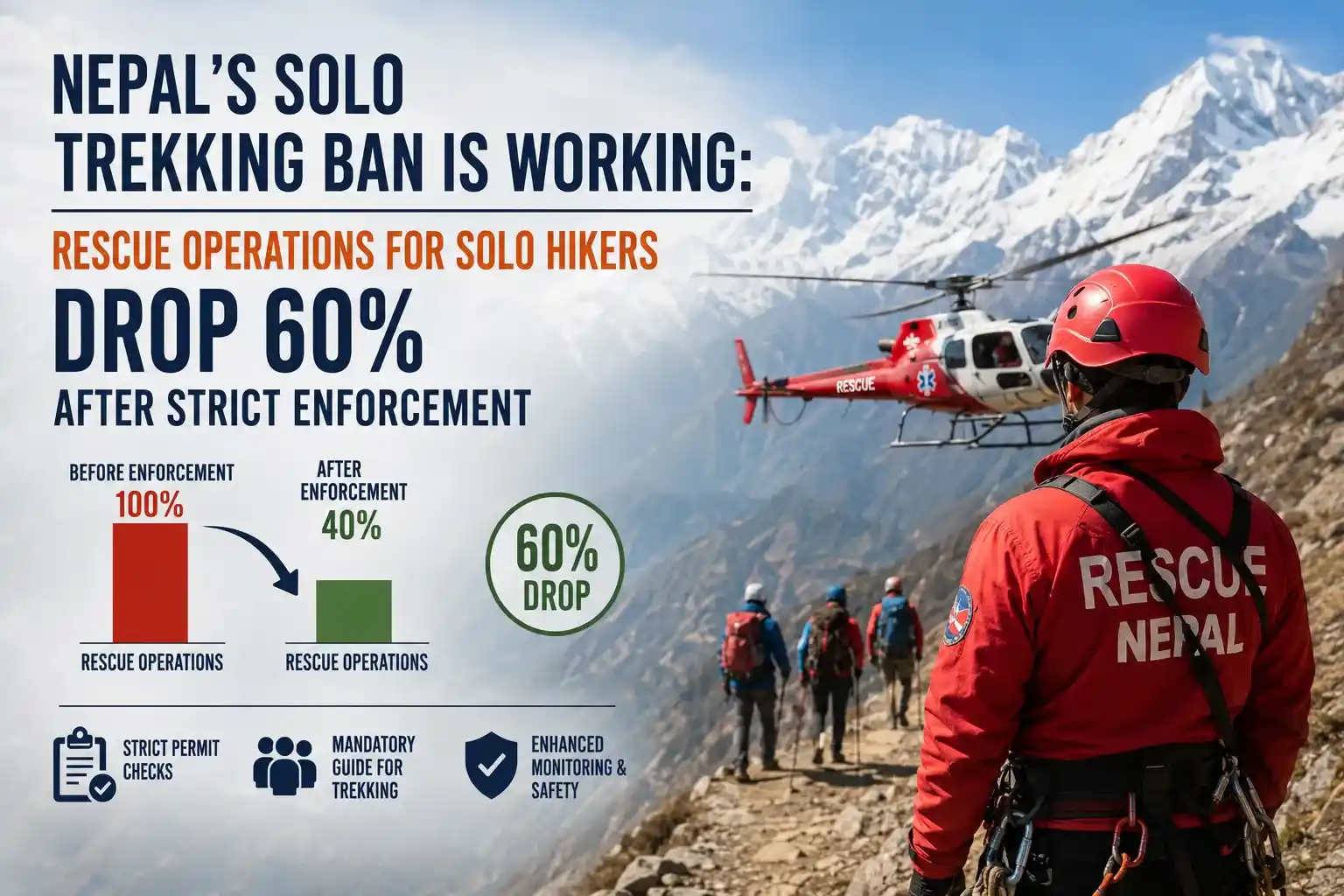
Nepal’s Solo Trekking Ban Is Working: Rescue Operations for Solo Hikers Drop 60% After Strict Enforcement
Three years after Nepal first introduced mandatory guide rules in April 2023, the policy has evolved from a loosely enforced regulation into a nationwide operational system backed by digital permit checks, checkpoint verification, and tighter rescue coordination. And in the mountains, the effects are becoming increasingly visible.
From Controversial Policy to Enforced Reality
When the Nepal Tourism Board (NTB) and the Trekking Agencies’ Association of Nepal (TAAN) announced the mandatory guide rule in 2023, backlash came quickly.
Independent trekkers accused Nepal of commercializing the Himalayas. Online trekking communities warned the country could lose its reputation among budget travelers and long-distance hikers. Many travelers believed the rule would never actually be enforced. For a while, they were partly correct.
Throughout 2023 and much of 2024, enforcement remained inconsistent. On some routes, solo trekkers continued passing checkpoints without difficulty. In other areas, local authorities looked the other way. Discussions across trekking forums and Reddit were filled with contradictory reports from hikers who had completed routes independently despite the official ban.
But by late 2025 and into the 2026 spring trekking season, the situation changed significantly. Checkpoint systems were digitized. TIMS registration procedures became linked directly with guide credentials. Conservation area officials began conducting stricter permit verification, and agencies issuing unauthorized permits faced penalties.
Today, on most major trekking routes including Annapurna, Langtang, Everest, and restricted regions such as Manaslu and Upper Mustang foreign trekkers are expected to travel with licensed guides registered through government-approved agencies. The result has been a fundamental operational shift in how trekking safety works in Nepal.
The Statistics Behind the Shift
Tourism officials and trekking operators say rescue data began improving noticeably after stricter enforcement measures were introduced. According to multiple trekking industry sources in 2026, SAR incidents involving solo trekkers have fallen by approximately 60 percent since mandatory guide enforcement became systematic across regulated trekking areas.
While Nepal does not yet maintain a fully centralized real-time public SAR database, rescue operators, helicopter companies, trekking agencies, and local authorities report several consistent changes:
- Fewer “missing trekker” incidents
- Faster reporting of altitude sickness cases
- Reduced emergency helicopter deployments for preventable cases
- Improved location tracking through guide-linked permits
- Earlier evacuations before medical conditions become critical
The government initially justified the policy by citing a decade of increasing rescue complexity in Nepal’s mountains. Between 2015 and 2025, rescue operations involving solo trekkers reportedly rose by nearly 40 percent.
Many emergencies followed a similar pattern.
Trekkers traveling alone would develop acute mountain sickness (AMS), lose trails during snowstorms, underestimate weather conditions, or fail to communicate itinerary changes. In high-altitude areas with weak cellular coverage and rapidly changing weather, rescue coordination often became extremely difficult.
“When trekkers go missing in remote trails, it becomes immensely challenging for authorities to conduct search-and-rescue operations,” tourism officials told international media during the original rollout of the policy. In the Everest and Annapurna regions especially, rescue delays could quickly become life-threatening.
What Changed Operationally on the Trails
The biggest transformation has not simply been the presence of guides it has been the creation of a more traceable trekking system. Previously, many solo trekkers moved through the Himalayas with minimal oversight beyond permit registration. If someone failed to arrive at a teahouse or disappeared between villages, rescue teams often had only rough itinerary information.
Now, licensed guides are expected to maintain active coordination with agencies, checkpoints, and local rescue systems. Under the newer enforcement model:
- Guide details are tied to trekking permits
- Agencies maintain itinerary records
- Checkpoints digitally verify trekkers and guide status
- Insurance verification has become stricter
- Rescue coordination begins faster when contact is lost
In practical terms, this means authorities can identify missing trekkers earlier and narrow search areas more quickly. Guides themselves have also become frontline safety monitors.
Across high-altitude routes such as Everest Base Camp, Annapurna Circuit, and Langtang Valley, guides now routinely carry pulse oximeters to monitor oxygen saturation and identify early signs of AMS. Many agencies also conduct daily altitude assessments for clients above 3,000 meters.
“A guide able to check blood oxygen levels, identify the initial symptoms of acute mountain sickness, and request helicopter evacuation via a direct agency connection radically alters the fate of an emergency at high altitude,” one 2026 trekking regulations report noted.
The operational culture of trekking in Nepal has therefore shifted from reactive rescue toward preventative monitoring.
Guides Are No Longer Just Navigators
For decades, many travelers viewed hiring guides primarily as logistical support or cultural interpretation. Today, guides increasingly function as risk managers. Trekking companies say guides are receiving additional training in altitude illness recognition, emergency communication, evacuation coordination, weather interpretation, and route adaptation.
Several agencies have also started emphasizing “dynamic itinerary management,” where guides adjust acclimatization schedules in response to weather and client health instead of rigidly following pre-booked plans. This matters because many Himalayan emergencies begin with small decisions.
A solo trekker may push too high too quickly, continue walking despite headaches, or underestimate incoming weather systems. Experienced local guides are often able to recognize danger signs before trekkers themselves do.
Even simple trail hazards have become part of safety discussions. On online trekking forums, guides increasingly warn about risks many inexperienced trekkers overlook including mule caravans, unstable trails, sudden snow accumulation, and dangerous cliff-edge passing conditions.
Local guide associations say the profession itself is evolving. Instead of merely “leading” trekkers, guides are becoming integrated into Nepal’s mountain safety infrastructure.
The Himalayan Rescue Association’s Perspective
Organizations involved in mountain rescue and high-altitude medicine have long supported stronger safety coordination in Nepal’s trekking industry. The Himalayan Rescue Association has repeatedly warned about the dangers of altitude sickness, delayed evacuations, and insufficient acclimatization among inexperienced trekkers.
Medical professionals working in mountain aid posts say solo trekkers often arrive later in the progression of AMS because no one is present to identify behavioral or cognitive symptoms early.
One of the biggest dangers of severe altitude illness is impaired judgment meaning trekkers themselves may not recognize the seriousness of their condition. Guides can intervene before situations become critical.
Rescue organizations also point out that weather-related emergencies in Nepal can escalate extremely quickly. A route considered safe in the morning can become hazardous by afternoon due to snow, landslides, fog, or rapidly changing mountain weather. For rescue teams, having registered guides attached to trekkers creates a far clearer communication chain during emergencies.
That operational clarity saves time and in the Himalayas, time can save lives.
Economic Effects Across Mountain Communities
The mandatory guide system has also produced economic consequences far beyond rescue statistics. The trekking industry employs thousands of guides, porters, teahouse operators, transport workers, and logistics staff across Nepal’s mountain regions. Officials originally argued the policy would distribute tourism income more directly into local economies.
In many trekking regions, that appears to be happening. Local agencies report increased demand for licensed guides, particularly in Annapurna and Langtang. Younger Nepalis in mountain districts are increasingly entering guide training programs due to more stable employment opportunities.
For communities still recovering from pandemic-era tourism collapse, the policy has provided a partial economic buffer. But the financial argument remains controversial. Independent trekkers traditionally represented a major part of Nepal’s backpacking tourism economy. Some travelers now choose shorter treks, cheaper destinations, or different countries altogether to avoid guide requirements.
Critics argue Nepal risks losing part of the independent travel culture that helped define its trekking identity for decades.
The Debate Over Expansion
Now that rescue statistics appear to support stricter regulation, tourism authorities face another question:
Should mandatory guide enforcement expand even further?
Some officials and trekking operators argue yes.
They believe Nepal should apply uniform enforcement across all major trekking regions rather than allowing inconsistencies between routes. Advocates say partial enforcement creates confusion and weakens safety systems.
Others argue for a more nuanced approach.
They suggest experienced trekkers with proven mountaineering backgrounds, GPS tracking systems, and emergency communication devices should still be allowed limited independent access on certain lower-risk routes.
The debate has become even more complicated after the Department of Immigration revised restricted-area permit rules in 2026, allowing solo travelers to obtain permits for some previously group-only areas though licensed guides remain mandatory.
That policy shift suggests Nepal may be moving toward a hybrid model:
- More flexibility in permit structures
- Continued mandatory guide requirements
- Stronger digital monitoring systems
- Expanded rescue accountability
In effect, Nepal appears less interested in banning independent-style travel entirely than in eliminating completely unsupported trekking.
Has Nepal Changed Himalayan Trekking Forever?
Whether travelers support or oppose the policy, one reality is increasingly clear: Nepal’s trekking system is unlikely to return to the old model of unrestricted solo Himalayan trekking.
The combination of safety data, rescue cost reduction, economic incentives, and improved operational control has strengthened support for mandatory guides among many Nepali tourism stakeholders. For Nepal, the issue is not simply tourism freedom it is national rescue logistics in some of the most dangerous terrain on Earth.
Every missing trekker triggers helicopter coordination, mountain police deployment, local volunteer mobilization, insurance disputes, and emergency medical response. In severe cases, rescue missions themselves expose pilots, guides, and rescuers to substantial danger.
From the government’s perspective, reducing preventable emergencies has become both a public safety objective and an economic necessity. The Himalayas remain unpredictable. Weather shifts instantly. Trails collapse. Altitude sickness can become fatal within hours.
But on Nepal’s trails this year, one trend has become difficult to ignore: Fewer solo trekkers are needing rescue. And for many in Nepal’s mountain communities, that statistic matters more than the debate surrounding the ban itself.
