Deep in the forests of western Nepal, a small Indigenous community continues to live in a way that has almost disappeared from the modern world. The Raute people are often described as Nepal’s last nomadic hunter-gatherers a people who still move through forests, build temporary camps, carve wooden bowls by hand, and resist permanent settlement despite decades of pressure from modernization.
In a country rapidly transforming through migration, roads, urbanization, tourism, and digital culture, the Raute stand apart. Their existence challenges the assumption that all societies must eventually become urban, agricultural, or industrial. The Raute have long believed that their identity depends on mobility, forest life, and independence from settled society.
But today, that world is shrinking.
Their population is critically small, their forests are disappearing, their youth are increasingly exposed to outside influences, and government “development” policies have created both support and dependency. Anthropologists, rights advocates, and local observers now warn that the Raute way of life may be approaching a breaking point.
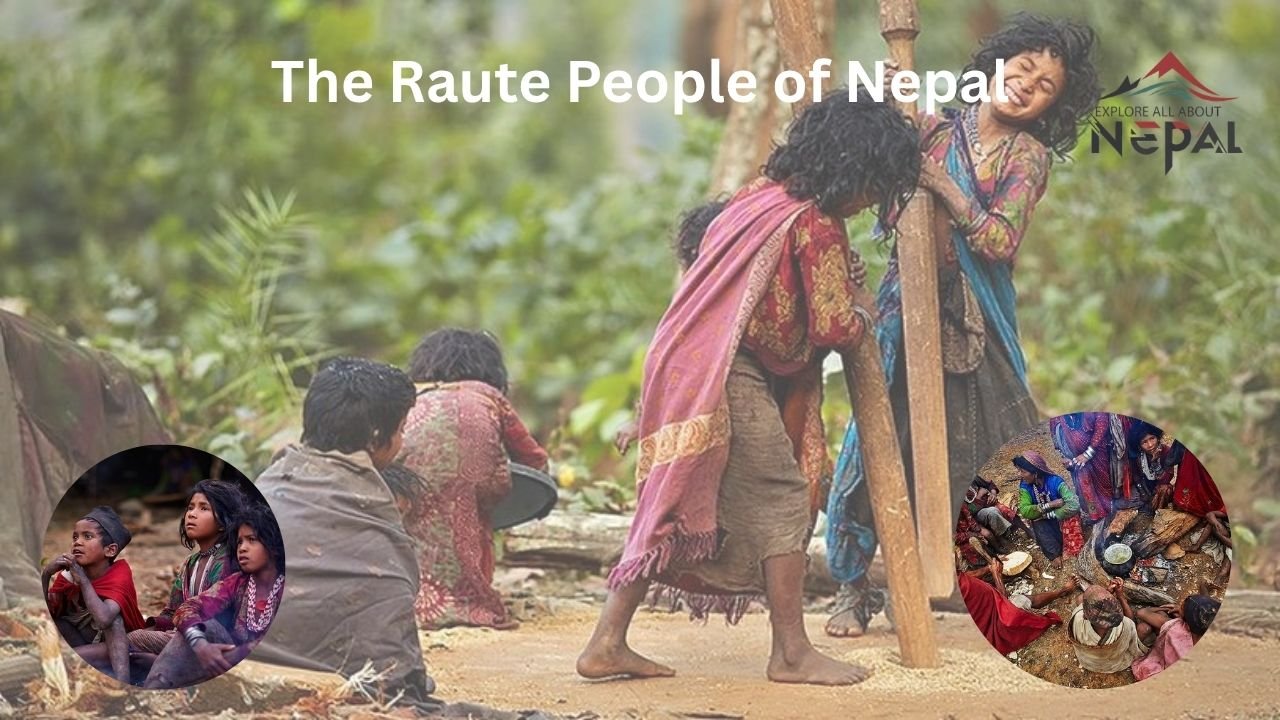
The Raute People of Nepal: Image credits goes to original owners
Who Are the Raute?
The Raute are an Indigenous nomadic community primarily found in Nepal’s Karnali region and surrounding western hill districts, including Surkhet, Dailekh, Jajarkot, Salyan, and Accham. They are officially recognized by the Government of Nepal as a highly endangered Indigenous group.
Unlike most communities in Nepal, the Raute traditionally reject permanent settlement, farming, formal schooling, and wage labor. Instead, they maintain a semi-nomadic forest-based lifestyle rooted in hunting, gathering, and woodworking. Their movements follow seasonal patterns and access to forests, water, and nearby villages where they barter handmade wooden goods for essentials like rice, flour, cloth, and tools.
The Raute speak their own language, often referred to simply as Raute or Khamci, which belongs to the Tibeto-Burman language family and is closely related to the languages of the Raji and Ban Raji peoples.
Anthropologists have often noted that the Raute do not see themselves as “poor” or “backward.” In their worldview, forest life represents freedom and dignity, while settled village life can be viewed as dependence or loss of identity. Many Raute elders have historically resisted attempts to settle them permanently because they believe abandoning nomadic life would mean abandoning what it means to be Raute.
How Many Raute Remain?
Exact numbers vary depending on whether researchers count only fully nomadic groups or include settled Raute families.
Nepal’s 2011 census recorded around 618 Raute people nationwide. However, recent reports suggest the population of actively nomadic Raute may now be closer to 130–150 individuals. A 2026 report by the Center for Investigative Journalism Nepal stated that a count conducted in early 2025 found only 165 Raute remaining in the nomadic community.
For such a small population, even minor demographic changes can have major consequences. Recent reporting has highlighted declining birth rates, health issues, alcohol abuse, and a rising number of widowed women unable to remarry under traditional customs.
The Raute are therefore not just culturally endangered they are demographically fragile.
Life in Motion: The Semi-Nomadic Forest Lifestyle
The Raute do not traditionally build permanent houses. Instead, they construct temporary camps from branches, leaves, bamboo, and forest materials. Their settlements may remain in one place for a few weeks or several months before moving again. Historically, some migration cycles stretched across multiple districts over many years.
Mobility is not incidental to Raute life it is central to it.
Moving through the forest allows the community to maintain hunting routes, gather wild foods, access woodworking materials, and avoid overusing any one location. Their deep ecological knowledge includes understanding seasonal forest changes, wildlife behavior, edible plants, and water sources.
Traditionally, the Raute hunted langur and macaque monkeys using handmade nets rather than firearms. They also gathered roots, fruits, tubers, and greens from the forest. Hunting was not merely about food; it carried social and cultural meaning connected to masculinity, skill, and tradition.
Today, however, hunting has become far less common due to wildlife decline, conservation laws, and changing lifestyles. Many Raute now rely more heavily on government allowances and trade.
Despite outside assumptions, Raute camps are highly organized social spaces governed by customary leadership and internal rules. The Mukhiya, or chief, traditionally acts as the primary mediator with outsiders. Decisions about movement, disputes, and interactions with non-Raute communities are often collective and carefully managed.
The Art of Woodworking
Perhaps the most recognizable aspect of Raute culture is their woodworking tradition.
For generations, Raute men have carved wooden bowls, boxes, plates, containers, and utensils from soft forest wood using hand tools. These objects are both practical and culturally symbolic. The Raute historically exchanged them with nearby villagers through barter rather than cash trade. In return, they received grain, cloth, metal items, and daily necessities.
The bowls are known not only for their functionality but also for their craftsmanship. Carving techniques are passed orally and through practice across generations. The work reflects an intimate understanding of forest materials, wood grain, moisture, durability, and portability.
Yet this woodworking culture is under pressure. Plastic containers and industrial goods have reduced demand for traditional wooden products. Restrictions on forest access have made it harder to gather raw materials. Younger Raute exposed to phones, markets, and urban life may no longer see woodworking as economically sustainable.
Some Raute themselves have reportedly expressed frustration that outsiders now photograph their crafts more often than they buy them. That shift symbolizes a deeper transformation: the movement of Raute culture from lived tradition toward cultural spectacle.
The Government’s Relationship With the Raute
Nepal’s relationship with the Raute has long been complicated.
On one hand, the state officially recognizes the Raute as a protected Indigenous community and provides social security allowances, healthcare access, and periodic aid programs. Provincial authorities in Karnali have also discussed policies aimed at cultural preservation and support, including the proposed “Raute Corridor” initiative.
On the other hand, many researchers argue that state policies have often pushed the Raute toward forced integration into mainstream society. Historically, forest regulations and community forestry programs restricted the Raute’s access to forest resources. Since their survival depends heavily on mobility and forest materials, these policies disrupted traditional life patterns.
Cash allowances introduced by the government have also become controversial. While intended as support for an endangered community, critics argue they have unintentionally increased dependency, weakened traditional barter systems, and accelerated cultural erosion.
Some observers believe the state’s long-term goal has been gradual settlement and assimilation. Others argue that without state intervention, the Raute might face even more severe poverty and health crises.
The truth is likely somewhere between these positions. The Raute exist in a difficult space where both isolation and integration carry risks.
Tourism, Social Media, and the Ethics of Interaction
As awareness of the Raute has spread online, more outsiders have begun visiting their camps. Some arrive out of curiosity. Others come as vloggers, documentary creators, researchers, aid workers, or tourists seeking “authentic” experiences.
This raises a major ethical question:
Should outsiders interact with the Raute at all?
There is no simple answer.
Responsible interaction begins with recognizing that the Raute are not a tourist attraction. They are a vulnerable Indigenous community whose social structure, health, and autonomy can be harmed by unmanaged outside contact.
Recent reporting in Nepal has warned that increasing contact with outsiders especially content creators seeking viral videos has contributed to cultural disruption and exploitation. The Raute themselves are increasingly photographed, filmed, and uploaded to social media without meaningful consent or understanding of how those images are used.
Responsible engagement therefore means:
- Avoiding intrusive visits to Raute camps
- Not photographing people without consent
- Not treating the community as an exotic spectacle
- Not distributing alcohol or inappropriate gifts
- Respecting community boundaries and leadership
- Supporting Indigenous rights organizations rather than “poverty tourism”
- Understanding that preservation does not mean freezing people in time
For many experts, the most ethical approach is one centered on consent, dignity, and minimal intrusion. The Raute should have the right to determine how much interaction they want with the outside world.
The Threats Facing the Raute
The Raute face multiple overlapping threats, many of which reinforce each other.
1. Loss of Forests
Deforestation, road construction, settlement expansion, and changing land-use policies continue to shrink the forests that sustain nomadic life. Without forests, the Raute lose not only food and materials, but also the geographic space required for mobility.
2. Economic Collapse of Traditional Crafts
Plastic and factory-made products have reduced the value of handmade wooden goods. Younger generations may struggle to see traditional woodworking as viable.
3. Cultural Assimilation
Phones, markets, social media, outside schooling pressures, and prolonged contact with settled communities all increase cultural assimilation. Languages and oral traditions can disappear quickly in very small populations.
4. Dependency and Aid Politics
Government allowances provide immediate support but may also undermine traditional systems of exchange and independence. Several recent reports suggest that “mainstreaming” policies risk accelerating cultural disappearance rather than preventing it.
5. Public Health and Alcohol Abuse
Health challenges, poor access to long-term healthcare, alcoholism, and demographic decline have become serious concerns. Reports from 2026 also noted social issues linked to widowhood and rigid marriage customs.
6. Cultural Objectification
The Raute are increasingly treated as visual subjects for documentaries, TikToks, and travel content. While visibility can sometimes increase awareness, it can also reduce living communities into consumable “content.”
What Would Nepal Lose if the Raute Disappeared?
If the Raute disappear, Nepal would lose far more than a small ethnic population. It would lose an entire worldview.
The Raute represent one of the last surviving examples of nomadic hunter-gatherer life in South Asia. Their ecological knowledge, oral traditions, language, woodworking techniques, migration systems, and forest relationship preserve forms of human experience that modern society has almost erased.
Their disappearance would mean:
- The extinction of a unique Indigenous language tradition
- The loss of centuries-old woodworking knowledge
- The disappearance of Nepal’s only remaining nomadic culture
- The erosion of Nepal’s cultural diversity
- The loss of alternative understandings of land, mobility, and community
In a broader sense, losing the Raute would also reveal something troubling about the modern world: that societies unable or unwilling to conform to dominant economic systems may no longer have space to survive.
Nepal often celebrates its cultural diversity as part of its national identity. The country is home to dozens of ethnic groups, languages, and belief systems. But diversity is meaningful only if vulnerable cultures are allowed to exist on their own terms not simply absorbed into a single model of development.
The future of the Raute therefore raises difficult questions for Nepal itself.
Can modernization coexist with cultural autonomy?
Can development occur without forced assimilation?
Can a nation protect Indigenous people without transforming them into museum pieces or tourist symbols?
The answers remain uncertain. But for now, in the forests of western Nepal, the Raute continue to move from camp to camp, carving wood, preserving memory, and carrying forward one of the oldest surviving ways of life in the Himalayas.
