
Throughout Nepal’s long and proud history, many warriors, kings, and leaders have left lasting marks on the nation. However, few names command as much respect and admiration as Balbhadra Kunwar. More than two centuries after his most famous military campaign, Balbhadra remains a symbol of courage, patriotism, sacrifice, and unwavering determination.
His story is most closely associated with the famous Battle of Nalapani, one of the earliest and most celebrated battles of the Anglo-Nepalese War. During this conflict, Balbhadra and a small force of Nepali defenders resisted a much larger and better-equipped army of the British East India Company. Despite facing overwhelming odds, shortages of food and water, and relentless attacks, Balbhadra refused to surrender.
What makes his story extraordinary is not simply that he fought bravely. Military history contains many examples of courageous soldiers. Balbhadra’s significance lies in the fact that his leadership transformed a small defensive action into a legendary symbol of resistance. His actions earned admiration not only from Nepal but also from his enemies. British officers who fought against him later praised his courage, discipline, and determination.
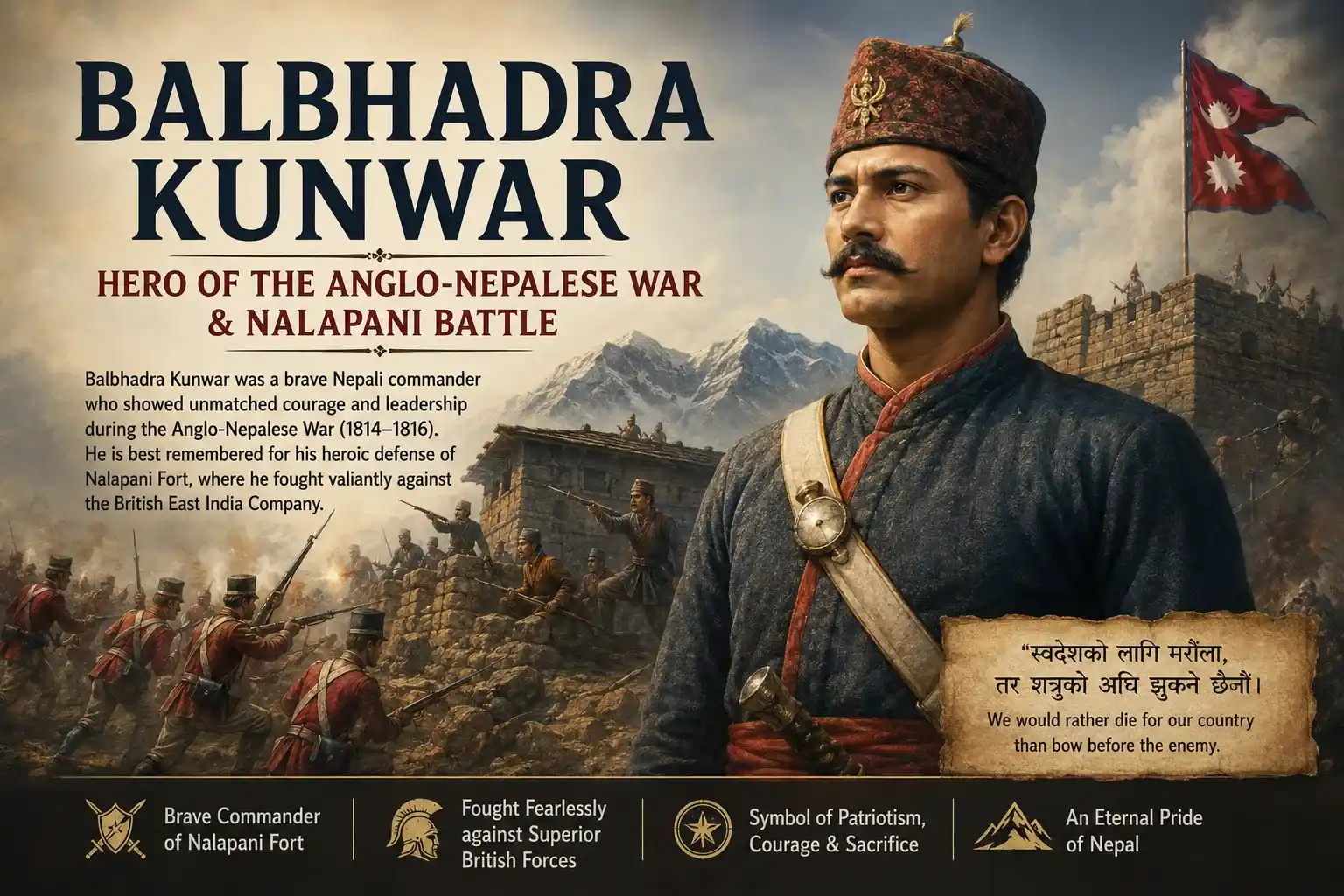
Balbhadra Kunwar Biography
Today, Balbhadra Kunwar is remembered as one of Nepal’s greatest military heroes. His legacy is taught in schools, celebrated in military institutions, and honored through monuments and historical writings. His life represents the spirit of the Gorkhali warrior tradition, which later became famous throughout the world.
Beyond military history, his story offers timeless lessons about leadership, resilience, and national pride. He demonstrated that true strength is not measured solely by numbers or weapons but by determination, unity, and belief in a cause.
For modern Nepal, Balbhadra Kunwar serves as a reminder that courage can inspire generations. His stand at Nalapani continues to symbolize the willingness of ordinary people to defend their homeland against extraordinary challenges. More than two hundred years later, his legacy remains one of the brightest chapters in Nepalese history.
Who Was Balbhadra Kunwar?
Balbhadra Kunwar was a distinguished military commander of the Gorkhali Army who became famous for his leadership during the Anglo-Nepalese War of 1814–1816. Although historical records about some aspects of his early life remain limited, his achievements on the battlefield have secured his place among Nepal’s most respected national heroes.
Balbhadra belonged to the influential Kunwar family, which later produced several important military and political figures in Nepal. He grew up during a period when the Kingdom of Nepal was rapidly expanding under the leadership of the Shah rulers. Military service was highly respected, and many young men from prominent families were trained in warfare from an early age.
As a commander, Balbhadra quickly developed a reputation for courage, discipline, and strong leadership. These qualities would later prove essential during one of the most challenging periods in Nepalese military history.
His most famous role came when he was appointed commander of the Nalapani fort near Dehradun. At the time, tensions between Nepal and the British East India Company had escalated due to territorial disputes along the frontier. War eventually became unavoidable, and Nalapani emerged as one of the first major battlefields.
Balbhadra commanded a relatively small force consisting of soldiers, civilians, women, and children sheltering within the fort. Despite limited resources, he organized an effective defense against a much larger British army equipped with superior artillery and manpower.
What distinguished Balbhadra from many military leaders was his refusal to surrender even when victory appeared impossible. His determination inspired those under his command and impressed even the British officers opposing him.
Historians often describe him as the embodiment of Gorkhali bravery. His actions during the Anglo-Nepalese War became legendary, influencing how future generations viewed military service, patriotism, and sacrifice.
Today, Balbhadra Kunwar is remembered not merely as a soldier but as a national symbol of resilience and honor. His life story continues to inspire military personnel, students, historians, and citizens across Nepal.
Early Life and Family Background
The exact details of Balbhadra Kunwar’s birth remain uncertain, as historical records from that era are often incomplete. However, historians generally agree that he was born in the late eighteenth century into the respected Kunwar family, which played an important role in Nepal’s military and political affairs.
The Kunwar family was closely connected to the military traditions of the expanding Gorkha Kingdom. During Balbhadra’s youth, Nepal was undergoing significant territorial expansion under the Shah dynasty. Military service was regarded as both an honor and a duty, particularly among influential families.
Growing up in such an environment likely had a major influence on Balbhadra’s character and ambitions. From an early age, he would have been exposed to stories of military campaigns, strategic leadership, and the responsibilities associated with defending the kingdom.
Training for young men in military families often included physical conditioning, weapons handling, horseback riding, and tactical instruction. These experiences helped prepare future officers for leadership roles within the army.
Balbhadra’s upbringing also emphasized values that later became evident during his military career: loyalty, discipline, courage, and devotion to the nation. These principles formed the foundation of the Gorkhali warrior tradition and shaped the behavior of many Nepalese soldiers.
The broader social environment of Nepal during this period further reinforced military ideals. Expansion campaigns and border conflicts required capable commanders and motivated soldiers. As a result, leadership skills were highly valued.
Although specific details about his education and personal life remain limited, historical accounts consistently portray Balbhadra as a disciplined and capable individual. His later performance at Nalapani suggests that he possessed not only physical courage but also strong organizational and strategic abilities.
His family background provided him with opportunities to develop these skills, but his later achievements resulted from personal determination and leadership. Many individuals came from military families, yet few achieved the lasting fame and admiration that Balbhadra earned through his actions.
The values instilled during his youth would later guide him during one of the most difficult military confrontations in Nepalese history. His early experiences helped prepare him for the challenges that lay ahead during the Anglo-Nepalese War.
Nepal During Balbhadra’s Time
To understand Balbhadra Kunwar’s significance, it is important to understand the Nepal in which he lived. The late eighteenth and early nineteenth centuries were a transformative period for the country.
Under the leadership of Prithvi Narayan Shah and his successors, the small Kingdom of Gorkha had expanded dramatically. Through military campaigns and political alliances, Nepal unified many smaller kingdoms and principalities into a larger state.
This expansion transformed Nepal into a significant regional power. The Gorkhali Army became one of the kingdom’s most important institutions, responsible not only for defense but also for territorial expansion.
As Nepal’s borders grew, tensions with neighboring powers increased. To the south, the British East India Company was rapidly expanding its influence across the Indian subcontinent. Both Nepal and the Company sought control over strategic territories along their shared frontier.
These competing ambitions led to disputes over land, trade routes, and political authority. Diplomatic efforts often failed to resolve disagreements, creating an atmosphere of increasing hostility.
Within Nepal, military culture flourished during this period. Soldiers were respected members of society, and military service was considered an honorable profession. Commanders who demonstrated courage and effectiveness often gained considerable prestige.
At the same time, Nepal faced significant logistical challenges. The country’s mountainous terrain made transportation and communication difficult. Maintaining control over distant territories required strong leadership and disciplined military forces.
The political environment also demanded capable officers who could adapt to changing circumstances. Border conflicts, regional rivalries, and external threats created constant pressure on military leaders.
It was within this dynamic and often challenging context that Balbhadra Kunwar developed his career. The skills, values, and experiences shaped by this era prepared him for the conflict that would define his legacy: the Anglo-Nepalese War.
The circumstances of Nepal during Balbhadra’s lifetime explain why his actions resonated so deeply with future generations. He emerged at a moment when the nation’s independence and territorial integrity faced one of their greatest tests.
The Anglo-Nepalese War (1814–1816)
The defining conflict in the life of Balbhadra Kunwar was the Anglo-Nepalese War, a major military confrontation between the expanding Gorkhali Kingdom and the powerful British East India Company.
By the early 19th century, both Nepal and the British had expanded their territories significantly. Nepal, under the unification campaign of Prithvi Narayan Shah and his successors, had extended its control across much of the Himalayan foothills. At the same time, the British East India Company was consolidating its dominance over large parts of the Indian subcontinent.
As both powers expanded, their borders eventually came into direct contact. This led to disputes over strategically important regions such as Kumaon, Garhwal, Sikkim, and areas in present-day Uttarakhand. These disagreements gradually escalated into military confrontation.
The British viewed Nepal as a challenging but strategically important neighbor due to its control of key Himalayan trade routes. Meanwhile, the Gorkhali leadership viewed British expansion as a direct threat to their sovereignty.
In 1814, tensions finally erupted into open war. The British launched coordinated military campaigns along multiple fronts, aiming to push Nepal back from disputed territories. The Gorkhali Army, although smaller in size and lacking advanced artillery, was highly experienced in mountain warfare and known for its discipline and resilience.
Despite early setbacks, Nepali forces demonstrated strong resistance across various battlefronts. The war quickly became a test of endurance, terrain advantage, and military strategy. The mountainous geography of Nepal made direct British advances extremely difficult.
It was within this broader conflict that Balbhadra Kunwar emerged as a central figure. His leadership at Nalapani would soon become one of the most famous episodes of the entire war.
The Anglo-Nepalese War ultimately lasted until 1816 and ended with the Treaty of Sugauli. Although Nepal lost some territory, the war established the reputation of Gorkhali soldiers as formidable warriors respected even by their opponents.
The Battle of Nalapani
The Battle of Nalapani stands as the most iconic moment in the military career of Balbhadra Kunwar. It was here that his leadership, courage, and determination became legendary.
Nalapani Fort was located near Dehradun in present-day India. It held strategic importance as it controlled access routes through the region. Recognizing this, the British East India Company targeted the fort early in the war.
Balbhadra was appointed commander of the garrison defending Nalapani. His force was relatively small and included not only soldiers but also civilians who had taken refuge inside the fort. Despite limited manpower and supplies, he prepared to defend the position against a much larger British force.
The British army, equipped with superior artillery and organized regiments, expected a quick victory. However, they soon encountered unexpected resistance. The Nepali defenders used the terrain to their advantage, fortifying positions and resisting repeated assaults.
Balbhadra’s leadership played a crucial role in organizing the defense. He maintained discipline among his troops, encouraged resistance, and ensured that the fort remained operational even under intense pressure.
The battle quickly turned into a prolonged siege. The British underestimated the determination of the defenders, and what was expected to be a short engagement became a drawn-out and costly confrontation.
Nalapani became the first major test of strength in the Anglo-Nepalese War. It also set the tone for future engagements, demonstrating that Gorkhali forces were capable of resisting a technologically superior army through tactical skill and determination.
The battle would later become one of the most celebrated episodes in Nepalese military history, symbolizing resistance against overwhelming odds.
Defending Nalapani Against a Powerful Empire
As the siege of Nalapani intensified, Balbhadra Kunwar and his small force faced one of the most difficult military challenges in Nepalese history. The British East India Company brought in reinforcements, heavy artillery, and sustained bombardment in an attempt to break the fort’s defenses.
Despite being heavily outnumbered, the defenders showed remarkable resilience. The Nepali forces relied on their knowledge of terrain, fortified positions, and close-range combat tactics to resist repeated attacks. Every assault by British troops was met with determined resistance.
Balbhadra’s leadership was critical during this phase. He organized his forces efficiently, ensuring that every available resource was used effectively. He also maintained morale among soldiers and civilians, who were enduring extreme hardship inside the fort.
One of the greatest challenges faced by the defenders was the destruction caused by British artillery. Continuous shelling damaged fort walls and reduced defensive cover, forcing the Nepali defenders to constantly adapt their positions.
Despite these difficulties, Balbhadra refused multiple British demands for surrender. His determination became a defining feature of the battle. Even as conditions worsened, he remained committed to defending the fort until the end.
The British commanders, although confident in their military superiority, began to recognize the extraordinary resistance they were facing. Nalapani was not just another battlefield—it had become a symbol of determined resistance.
This phase of the battle demonstrated the effectiveness of Gorkhali defensive warfare and highlighted the leadership qualities of Balbhadra Kunwar under extreme pressure.
The Famous Siege and Water Shortage
As the siege continued, one of the most severe challenges faced by the defenders was the water shortage inside Nalapani Fort. The British forces strategically targeted the fort’s water supply, cutting off access to nearby sources and surrounding the area completely.
This tactic placed immense pressure on the defenders. Without sufficient water, both soldiers and civilians inside the fort began to suffer from dehydration and exhaustion. The harsh conditions made the defense increasingly difficult.
Despite this, Balbhadra Kunwar maintained his refusal to surrender. His leadership during this period became a powerful example of determination under extreme hardship. He continued to encourage his forces and organize defensive efforts even as conditions deteriorated.
The British expected that the lack of water would force a quick surrender. However, the defenders’ resolve surprised them. Instead of capitulating, they continued to resist, demonstrating extraordinary endurance.
Historical accounts suggest that the suffering inside the fort was severe. However, rather than weakening morale entirely, it strengthened the defenders’ determination to resist until no option remained.
This phase of the siege became one of the most dramatic elements of the entire battle. It highlighted both the harsh realities of siege warfare and the extraordinary resilience of Balbhadra and his forces. The water shortage eventually became one of the key factors leading to the final decision to abandon the fort, but only after prolonged resistance that earned admiration from both sides.
The Legendary Final Breakout
The final chapter of the Battle of Nalapani is one of the most legendary episodes in Nepalese military history. After enduring weeks of siege, heavy bombardment, and severe shortages, Balbhadra Kunwar made a decisive choice.
Rather than surrendering to the British forces, he chose to lead his surviving troops in a bold breakout from the fort. This decision reflected his unwavering commitment to honor and resistance, even in the face of overwhelming odds.
According to historical accounts, Balbhadra and his remaining fighters cut their way through enemy lines and successfully escaped from Nalapani. This act surprised the British commanders, who had expected surrender rather than escape.
The breakout became a symbol of Gorkhali bravery and determination. Although the fort eventually fell to the British, the resistance displayed by Balbhadra and his forces left a lasting impression on military observers.
British officers reportedly expressed respect for his leadership and courage, acknowledging the difficulty of facing such determined resistance. This recognition from adversaries further strengthened his legendary status.
The escape from Nalapani marked the end of one of the most famous sieges in South Asian military history. However, it also ensured that Balbhadra Kunwar’s name would be remembered for generations as a symbol of courage and defiance.
Why Even the British Respected Balbhadra Kunwar
One of the most remarkable aspects of Balbhadra Kunwar is that his reputation extended beyond Nepal and was acknowledged even by his former adversaries. During and after the Battle of Nalapani, British officers who had fought against him recorded their respect for his leadership, discipline, and courage.
In military history, it is relatively rare for an opposing commander to be openly admired by the enemy. However, Balbhadra’s defense of Nalapani was so determined and strategically challenging that British commanders recognized the exceptional nature of his resistance. Despite having superior numbers, artillery, and supplies, the British forces faced unexpectedly strong opposition from a much smaller defending force.
Historical accounts from British officers describe the defenders of Nalapani as highly disciplined and deeply committed to their commander. Balbhadra’s ability to maintain morale under extreme pressure impressed many observers. Even when the fort was heavily bombarded and resources were exhausted, he refused to surrender easily.
British recognition of Balbhadra’s leadership was not based on sympathy but on military respect. His tactical decisions, use of terrain, and ability to organize defense against a modern army demonstrated significant strategic intelligence. The prolonged resistance also caused unexpected delays and casualties for British forces, which added to their admiration.
In some accounts, British officers referred to the defenders as “brave Gorkhas,” a term that later became widely associated with Nepalese soldiers. This reputation eventually contributed to the recruitment of Gorkhali soldiers into British military service in later years.
Balbhadra’s legacy, therefore, is unique. He is remembered not only as a national hero in Nepal but also as a respected figure in military history more broadly. His reputation among former enemies highlights the universal recognition of courage and leadership in warfare.
Later Military Career
After the fall of Nalapani, Balbhadra Kunwar continued his involvement in military service, although historical records about his later life are less detailed compared to his famous stand during the Anglo-Nepalese War.
Following the conclusion of the Anglo-Nepalese War, Nepal signed the Treaty of Sugauli in 1816. This treaty resulted in territorial losses for Nepal but also marked a new phase in its diplomatic and military history.
Despite the outcome of the war, Balbhadra’s reputation as a capable and courageous commander remained strong. He continued to serve in military roles within the Gorkhali system, contributing his experience to other assignments and defensive preparations.
Some historical references suggest that he may have been involved in military activities along Nepal’s western frontiers after the war. However, detailed records of these later campaigns are limited.
What remains clear is that his legacy was already firmly established by the time the Anglo-Nepalese War ended. His actions at Nalapani had secured his place in Nepalese history, and no later military activity diminished his reputation.
Balbhadra’s later years were likely spent in service and reflection during a period when Nepal was adapting to new geopolitical realities following its conflict with the British Empire.
Death and Historical Legacy
The exact details surrounding the death of Balbhadra Kunwar are not fully documented in historical records. However, it is generally believed that he passed away in the early 19th century, not long after the Anglo-Nepalese War.
Despite limited information about his final years, his legacy is clearly defined and widely celebrated. His most significant contribution remains his leadership during the Battle of Nalapani, which continues to be studied as one of the most iconic examples of defensive warfare in South Asian history.
Over time, Balbhadra Kunwar became more than a historical figure. He evolved into a symbol of national pride, representing the values of bravery, sacrifice, and resistance against overwhelming odds. His story is frequently included in Nepalese school curricula and military education programs.
Monuments, historical writings, and cultural references continue to preserve his memory. His legacy is particularly strong within Nepal’s military traditions, where he is regarded as an example of ideal leadership in combat situations.
Modern historians view him as one of the key figures who shaped the perception of Gorkhali soldiers internationally. His actions contributed to the long-standing reputation of Nepalese warriors as disciplined and highly capable fighters.
Balbhadra Kunwar in Modern Nepal
In contemporary Nepal, Balbhadra Kunwar is widely honored as a national hero. His legacy is preserved through education, military traditions, and public memory. Schools across Nepal teach the story of the Battle of Nalapani as an important example of courage and national resistance. Students learn about his leadership and the significance of his stand against the British East India Company.
Within the Nepalese Army, Balbhadra is regarded as a model of military leadership. His ability to maintain discipline, organize defense under pressure, and inspire loyalty among troops is studied as part of military history and leadership training.
His story is also reflected in cultural memory. Songs, literature, documentaries, and historical discussions continue to highlight his bravery. Nalapani itself has become a symbolic site representing Nepal’s military heritage.
In modern Nepal, Balbhadra Kunwar represents more than a historical figure. He symbolizes the enduring spirit of resilience and independence. His legacy continues to inspire discussions about national identity, sovereignty, and the importance of leadership during crisis.
Leadership Lessons From Balbhadra Kunwar
The life of Balbhadra Kunwar offers several important leadership lessons that remain relevant today.
1. Courage Under Pressure
His refusal to surrender at Nalapani demonstrates the importance of staying firm in difficult situations.
2. Leading by Example
Balbhadra remained with his troops during the siege, showing personal commitment to his mission.
3. Strategic Use of Resources
Despite limited supplies, he managed to organize an effective defense against a larger army.
4. Morale and Motivation
He maintained the fighting spirit of his soldiers even in extreme hardship.
5. Integrity and Honor
His decision to resist surrender until the final breakout reflects strong moral conviction.
These lessons continue to be studied in leadership training, military education, and historical analysis.
Interesting Facts About Balbhadra Kunwar
The life of Balbhadra Kunwar is filled with powerful and lesser-known details that continue to attract historians and readers interested in Nepal’s military heritage.
1. He Defended Nalapani Against a Much Larger Army
During the Battle of Nalapani, Balbhadra commanded a small force of roughly a few hundred defenders against a far larger British East India Company army equipped with artillery and reinforcements.
2. Nalapani Included Civilians
Unlike a purely military garrison, his force also included women, children, and non-combatants who had taken shelter inside the fort, making his defensive responsibility even more complex.
3. He Never Officially Surrendered
Even under extreme conditions, Balbhadra did not formally surrender to the British forces. Instead, he chose a tactical breakout from the fort.
4. He Earned Respect From His Enemies
British officers who fought at Nalapani acknowledged the extraordinary resistance shown by Balbhadra and his troops, which was rare in colonial military records.
5. Nalapani Became a Symbol of Gorkhali Courage
The battle established the global reputation of Gorkhali soldiers as highly disciplined and fearless warriors.
6. His Story Is Still Taught in Nepal
His biography is included in Nepal’s school curriculum as part of national history education.
7. He Represents Early Military Leadership in Nepal
Balbhadra is often studied alongside other early Gorkhali commanders as a model of battlefield leadership.
8. His Legacy Influenced Later Military Traditions
The reputation of Gorkhali bravery, partly shaped by his actions, later influenced the recruitment of Nepalese soldiers in foreign armies.
9. Nalapani Is Now a Historical Site
The battlefield remains an important heritage site representing Nepal’s resistance history.
10. He Is Considered a National Hero
In modern Nepal, Balbhadra is honored as one of the country’s most important military figures.
Timeline of Balbhadra Kunwar
- Late 18th century – Born into the Kunwar family
- Early life – Raised in a military environment in Nepal
- Early 1800s – Joins Gorkhali military service
- 1814 – Anglo-Nepalese War begins
- 1814 – Appointed commander of Nalapani fort
- 1814 – Leads heroic defense during the Battle of Nalapani
- Late 1814 – Executes tactical breakout from the fort
- 1816 – Treaty of Sugauli concludes the war
- Post-war period – Continues military service
- Early 19th century – Death (exact date not fully recorded)
- Modern era – Recognized as a national hero of Nepal
Frequently Asked Questions (FAQ)
Who was Balbhadra Kunwar?
Balbhadra Kunwar was a Gorkhali military commander best known for his leadership during the Battle of Nalapani in the Anglo-Nepalese War.
Why is Balbhadra Kunwar famous?
He is famous for defending Nalapani Fort against the British East India Company with a small force, showing extraordinary courage and leadership.
What was the Battle of Nalapani?
The Battle of Nalapani was a major siege where Nepali forces led by Balbhadra resisted a much larger British army.
Did Balbhadra Kunwar surrender?
No, he did not formally surrender. Instead, he led a breakout from the fort after prolonged resistance.
How many soldiers did he command?
He commanded a small defensive force, including soldiers and civilians, against a much larger British army.
Why did the British respect him?
British officers respected him because of his discipline, leadership, and the strong resistance he led despite being heavily outnumbered.
What happened after Nalapani?
He continued military service after the battle, and his legacy grew as one of Nepal’s greatest war heroes.
Is Balbhadra Kunwar a national hero?
Yes, he is widely recognized in Nepal as a national hero and symbol of bravery.
Conclusion
The story of Balbhadra Kunwar is one of the most powerful examples of courage and leadership in Nepalese history. His legendary stand during the Battle of Nalapani has become a defining moment in the nation’s military legacy. Although he commanded a small force and faced one of the world’s most powerful colonial armies, Balbhadra Kunwar never gave up. His leadership transformed Nalapani into a symbol of resistance, honor, and sacrifice.
What makes his legacy truly remarkable is not only his military success but also the respect he earned from his enemies. The British recognition of his bravery shows that true leadership transcends borders and conflicts.
Today, Balbhadra Kunwar remains a source of inspiration for Nepalese citizens, students, and soldiers. His story teaches that courage, discipline, and determination can create history even in the most difficult circumstances. For Nepal, he represents more than a warrior—he represents the spirit of resilience that continues to define the nation.
