
When discussing Nepal’s greatest historical figures, names such as Buddha, Prithvi Narayan Shah, Tenzing Norgay, and Pasang Lhamu Sherpa often come to mind. However, one of the most remarkable individuals in Nepal’s history remains surprisingly unknown to many people today. That individual is Araniko, the visionary architect, artist, engineer, and cultural ambassador whose work transformed architecture across Tibet, China, and much of East Asia.
Born in the 13th century in the Kathmandu Valley, Araniko emerged from Nepal’s rich Newar artistic tradition and became one of the most influential architects of his era. At a time when travel between kingdoms was difficult and dangerous, he journeyed from Nepal to Tibet and eventually to the court of the powerful Mongol ruler Kublai Khan. There, his extraordinary talents earned him recognition as one of the most respected architects and artists in the Yuan Empire.
Araniko’s achievements extended far beyond the construction of individual buildings. He introduced sophisticated Newar architectural principles to regions far beyond Nepal, helping shape the development of Buddhist architecture in Tibet and China. His most famous masterpiece, the White Stupa in Beijing, remains one of the most important examples of his architectural genius and continues to attract visitors centuries after its construction.
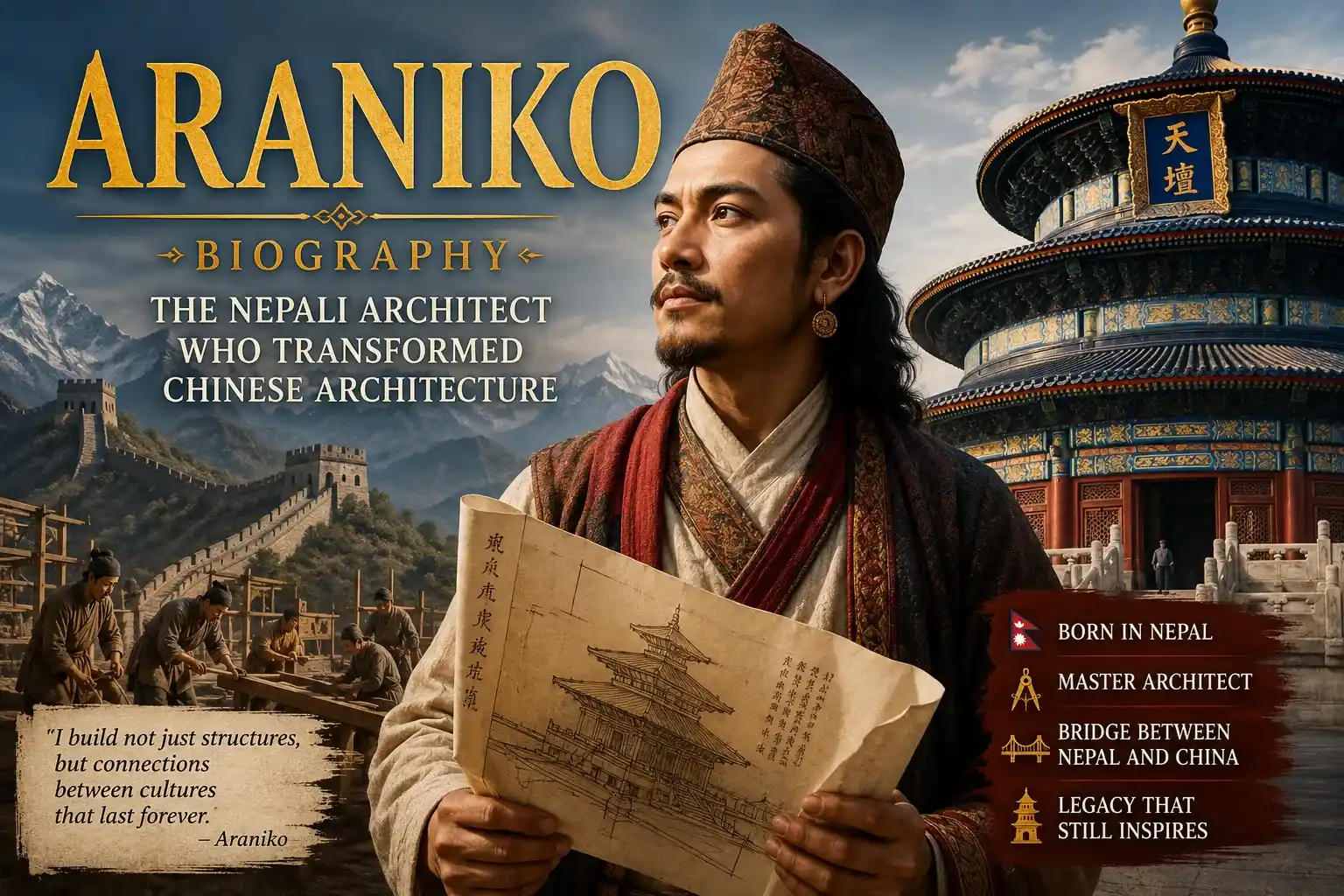
Araniko Biography: The Nepali Architect Who Transformed Chinese Architecture
What makes Araniko’s story especially inspiring is that he achieved international recognition long before globalization existed. Through skill, creativity, and determination, he became a bridge between civilizations, helping foster cultural exchange between Nepal, Tibet, and China. His work demonstrated that Nepal’s influence extended far beyond the Himalayas and played a significant role in shaping Asian art and architecture.
Today, Araniko remains a symbol of Nepal’s artistic excellence and cultural heritage. His life story serves as a reminder that Nepal has produced individuals whose contributions have influenced world history. For students, architects, historians, and anyone interested in Nepal’s rich past, the story of Araniko offers valuable lessons about creativity, cultural diplomacy, and the power of artistic vision.
Who Was Araniko?
Araniko, also known as Arniko, Balabahu, or Anige in Chinese historical records, was a renowned Nepali architect, artist, engineer, sculptor, and cultural ambassador who lived during the 13th and early 14th centuries. Historians generally believe he was born around 1245 in the Kathmandu Valley, which was then one of the most vibrant centers of art, architecture, and craftsmanship in South Asia.
Araniko is widely regarded as one of the greatest artists in Nepalese history because of his extraordinary contributions to architecture and cultural exchange. Although he began his life in Nepal, his influence eventually extended across Tibet, Mongolia, and China. His achievements became so significant that he earned high-ranking positions within the court of Kublai Khan, one of the most powerful rulers in world history.
What distinguished Araniko from many other architects of his time was his ability to combine artistic beauty with engineering expertise. He was not simply a designer of temples and monuments; he was also a master organizer capable of managing large construction projects involving hundreds of workers and artisans. His skills included architecture, sculpture, painting, bronze casting, and urban design.
Historical records from China describe Araniko as an exceptionally talented individual whose intelligence and creativity impressed both religious leaders and political rulers. Despite his young age when he first traveled to Tibet, he quickly demonstrated leadership abilities that helped him gain the trust of influential patrons.
Perhaps his greatest significance lies in his role as a cultural bridge. Through his work, Newar artistic traditions from Nepal reached new audiences across Asia. Elements of Nepalese craftsmanship became integrated into Tibetan and Chinese architectural styles, creating a lasting legacy that continues to be visible today.
Modern historians often view Araniko as one of Nepal’s earliest international ambassadors. Long before diplomatic missions and cultural exchange programs existed, he helped build connections between civilizations through art and architecture. His story illustrates how creativity can transcend borders and create lasting relationships between different cultures. Today, Araniko is celebrated not only as an architect but also as a symbol of Nepal’s contribution to global civilization.
Early Life and Childhood in Nepal
The early life of Araniko remains partly shrouded in mystery, but historians generally agree that he was born in the Kathmandu Valley around 1245. During this period, the valley was one of the most important cultural and artistic centers in the Himalayan region. It was home to the Newar people, whose artistic traditions were already highly respected throughout South Asia and Tibet.
Growing up in such an environment likely had a profound influence on Araniko’s development. The Kathmandu Valley was filled with temples, palaces, courtyards, sculptures, and religious monuments that showcased extraordinary craftsmanship. Young artists were often exposed to sophisticated techniques in woodcarving, metalwork, painting, and architecture from an early age.
The Newar community had developed a rich tradition of artistic excellence over many centuries. Skilled artisans were highly valued members of society, and artistic knowledge was often passed down through families and guilds. Although specific details about Araniko’s parents remain uncertain, historians believe he likely grew up in an environment that encouraged artistic training and craftsmanship.
According to historical accounts, Araniko demonstrated exceptional talent while still very young. His abilities reportedly attracted attention from teachers and community leaders who recognized his potential. Such recognition was important because large architectural projects required years of specialized training and practical experience.
The Kathmandu Valley also served as an important crossroads for trade and cultural exchange. Merchants, pilgrims, monks, and travelers frequently moved between Nepal, Tibet, and India. These interactions exposed local artists to diverse cultural influences and broadened their understanding of different artistic traditions.
Religion played a major role in artistic life during Araniko’s childhood. Buddhist and Hindu institutions commissioned temples, statues, and religious artworks that provided opportunities for skilled craftsmen. These projects allowed young artists to develop both technical skills and aesthetic sensibilities.
The combination of cultural richness, artistic excellence, and educational opportunities helped create the conditions that nurtured Araniko’s remarkable talent. His early experiences in Nepal provided the foundation for achievements that would eventually earn him recognition across much of Asia.
Nepal During Araniko’s Time
To fully understand Araniko’s achievements, it is important to understand the Nepal in which he lived. During the 13th century, the Kathmandu Valley was experiencing a period of significant cultural and artistic development. The region was governed by local rulers who supported religious institutions, artistic projects, and trade networks connecting Nepal with neighboring regions.
The valley’s strategic location made it an important center for commerce and cultural exchange. Trade routes linked Nepal with Tibet to the north and India to the south, allowing goods, ideas, technologies, and artistic traditions to flow across the Himalayas. These interactions helped create a vibrant and cosmopolitan society.
Newar artisans enjoyed particularly high status because their skills were in demand throughout the region. Their expertise in architecture, sculpture, painting, and metalwork earned admiration from foreign rulers and religious leaders. As a result, Nepalese craftsmen were frequently invited to work on major projects outside Nepal.
Buddhism played an especially important role in these cultural exchanges. Tibetan religious leaders often sought Nepalese artists to help construct monasteries, create statues, and decorate sacred spaces. This demand created opportunities for talented individuals like Araniko to gain international experience.
The artistic traditions of the Kathmandu Valley combined influences from India, Tibet, and local Newar culture while maintaining a distinctive identity. Buildings were known for their intricate wood carvings, elegant proportions, and careful attention to detail. Metal sculptures and religious artworks produced in Nepal were considered among the finest in Asia.
Political stability within the valley also contributed to artistic growth. Wealth generated through trade and agriculture supported large-scale construction projects and encouraged investment in cultural development.
This environment helped produce a generation of exceptionally skilled artists and architects. Araniko emerged from this tradition at a time when opportunities for cultural exchange were expanding. His later success abroad reflected not only his individual talent but also the remarkable artistic heritage of medieval Nepal.
By understanding the cultural landscape of Nepal during Araniko’s youth, we gain a deeper appreciation for how a young artist from the Kathmandu Valley became one of the most influential architects in Asian history.
The Mission to Tibet: A Young Nepali Artist Begins His Historic Journey
One of the most remarkable chapters in the life of Araniko began when he was still a teenager. During the 13th century, Tibet was experiencing a period of significant religious and cultural development. Buddhist monasteries were expanding, and important religious leaders sought highly skilled artisans capable of creating temples, stupas, sculptures, and sacred artworks.
At that time, the artistic reputation of Nepal’s Newar craftsmen had already spread throughout the Himalayan region. Nepalese artisans were known for their exceptional skill in architecture, metal casting, painting, and sculpture. As a result, Tibetan religious authorities frequently requested assistance from Nepal for major construction projects.
Historical records indicate that around 1260 CE, a request was made for a team of skilled Nepalese artists to travel to Tibet and help complete an important religious monument. The Nepalese ruler approved the request and selected a group of approximately eighty artisans for the mission. Surprisingly, the leader chosen for this prestigious assignment was the young Araniko, who was believed to be only about seventeen years old.
The decision to place such responsibility on someone so young demonstrates the extraordinary confidence people already had in his abilities. Leading a large team of craftsmen across the Himalayas was not a simple task. The journey involved crossing difficult mountain passes, navigating unfamiliar territories, and managing complex construction projects far from home.
The expedition’s journey through the Himalayas would have been physically demanding and potentially dangerous. Travelers faced harsh weather conditions, steep terrain, and limited infrastructure. Yet Araniko successfully guided his team and arrived in Tibet ready to begin work.
Once in Tibet, he quickly impressed local religious leaders with his technical expertise and artistic vision. His ability to organize workers, solve engineering problems, and create aesthetically beautiful structures earned widespread admiration.
The success of the Tibetan mission proved to be a turning point in his life. What began as a construction assignment soon became an opportunity that would change the course of his career and ultimately influence the architectural history of Asia. Through his achievements in Tibet, Araniko gained recognition that would eventually reach one of the most powerful rulers in the world: Kublai Khan.
Journey to the Court of Kublai Khan
The success of Araniko’s work in Tibet attracted attention far beyond the Himalayan region. During the 13th century, much of Asia was under the influence of the vast Mongol Empire, which stretched across enormous territories and connected diverse cultures under a single political system.
At the center of this empire stood Kublai Khan, grandson of the famous Mongol conqueror Genghis Khan. Kublai Khan was not only a powerful ruler but also a patron of art, architecture, religion, and cultural exchange. He actively sought talented individuals from different regions to serve in his court and contribute to the development of his empire.
Through Tibetan Buddhist connections and reports of Araniko’s achievements, news of the young Nepali architect eventually reached Kublai Khan. Recognizing his extraordinary abilities, the emperor invited Araniko to join the imperial court.
For Araniko, this invitation represented an extraordinary opportunity. Very few individuals from Nepal had access to such a powerful ruler, and even fewer would go on to influence the cultural development of an entire empire.
Upon arriving at the Yuan court, Araniko quickly distinguished himself. His technical knowledge, artistic creativity, and leadership skills impressed both imperial officials and the emperor himself. Historical accounts describe him as intelligent, disciplined, and exceptionally talented.
Kublai Khan valued practical expertise and often rewarded individuals based on merit rather than social status. This environment allowed Araniko to rise rapidly within the imperial administration despite being a foreigner. His work extended beyond architecture. He contributed to sculpture, painting, religious art, engineering projects, and urban planning initiatives. As his responsibilities grew, he became one of the most respected artisans and architects in the empire.
The relationship between Araniko and Kublai Khan highlights the importance of cultural exchange during the Mongol era. The empire’s extensive connections allowed ideas, technologies, and artistic traditions to travel across vast distances. Through his service at the Yuan court, Araniko became one of the most influential participants in this process.
His journey from the Kathmandu Valley to the court of Kublai Khan remains one of the most remarkable success stories in Nepalese history and demonstrates how talent can transcend geographic and cultural boundaries.
Araniko’s Rise as Master Architect
Once established at the Yuan court, Araniko’s reputation continued to grow. What began as recognition for a successful project in Tibet evolved into a distinguished career that placed him among the leading architects and artists of his time.
Kublai Khan entrusted Araniko with increasingly important assignments. These projects required not only artistic skill but also advanced knowledge of engineering, construction management, and design. Large-scale imperial projects often involved hundreds of workers and substantial resources, making effective leadership essential.
Araniko excelled in these responsibilities. His ability to combine creativity with practical problem-solving distinguished him from many of his contemporaries. He demonstrated a unique talent for integrating different architectural traditions while maintaining aesthetic harmony and structural stability.
One reason for his success was his Newar artistic background. Nepalese architecture was already renowned for its sophisticated craftsmanship and careful attention to detail. Araniko adapted these principles to suit the cultural and religious needs of the Yuan Empire, creating innovative designs that appealed to diverse audiences.
Historical records indicate that he supervised numerous construction projects, including temples, monasteries, stupas, and sculptures. His work often combined elements from Nepalese, Tibetan, and Chinese artistic traditions, resulting in distinctive creations that reflected the multicultural character of the empire.
As his influence expanded, Araniko received prestigious titles and honors from the imperial court. Such recognition was rare for a foreign-born artisan and reflected the exceptional value placed on his contributions.
Beyond architecture, he also played an important role in artistic education and cultural transmission. By training local craftsmen and introducing Nepalese techniques, he helped ensure that his influence would continue long after individual projects were completed.
His rise from a young artisan in Nepal to an imperial master architect stands as one of the most extraordinary professional achievements in Asian history. Through dedication, innovation, and leadership, Araniko transformed himself into a figure whose work would shape architectural traditions across multiple civilizations.
The White Stupa of Beijing: Araniko’s Greatest Masterpiece
Among all of Araniko’s achievements, none is more famous than the magnificent White Stupa, also known as the White Dagoba, located in Beijing.
Constructed during the Yuan Dynasty under the patronage of Kublai Khan, the White Stupa became one of the most important Buddhist monuments in China. It remains one of the clearest examples of Araniko’s architectural genius and his ability to blend artistic traditions from different cultures.
The structure was built as part of a larger Buddhist temple complex and served both religious and symbolic purposes. Stupas are sacred Buddhist monuments that often contain relics and represent spiritual concepts related to enlightenment and the teachings of the Buddha.
Araniko’s design incorporated influences from Nepalese and Tibetan Buddhist architecture while adapting them to the local context. The resulting structure was elegant, balanced, and visually striking. Its smooth white exterior, graceful proportions, and sophisticated engineering made it unlike many other buildings of its time.
Constructing such a monument required extensive planning and technical expertise. The project involved complex calculations, material sourcing, labor management, and structural engineering. Araniko successfully coordinated these efforts while maintaining high artistic standards.
The White Stupa quickly became an important religious landmark and attracted admiration from visitors, scholars, and pilgrims. Its influence extended beyond Beijing, inspiring later Buddhist architecture throughout China and other parts of East Asia.
Remarkably, the White Stupa has survived for more than seven centuries despite earthquakes, political changes, and the passage of time. Today it remains one of Beijing’s most important historical monuments and a lasting testament to Araniko’s talent.
For Nepal, the White Stupa serves as a powerful symbol of the country’s historical contribution to global civilization. It demonstrates that a Nepali architect played a major role in shaping one of Asia’s most significant architectural traditions.
Transforming Chinese Architecture
The influence of Araniko extended far beyond individual buildings. Through decades of work in the Yuan Empire, he helped transform the development of Chinese Buddhist architecture and introduced artistic concepts that continued to shape design practices long after his lifetime.
Before Araniko’s arrival, Chinese architecture already possessed a rich and sophisticated tradition. However, his exposure to Newar and Tibetan artistic techniques allowed him to introduce new ideas and perspectives. Rather than replacing existing traditions, he blended them with local practices, creating innovative forms that reflected cultural exchange and collaboration.
One of his most important contributions was the introduction of Nepalese architectural aesthetics into large-scale imperial projects. Features such as decorative elements, structural proportions, and Buddhist design principles influenced numerous constructions during the Yuan period.
His work also contributed to the spread of Himalayan artistic traditions across East Asia. Through apprentices, craftsmen, and subsequent projects, techniques originating in Nepal reached audiences far beyond their original geographic context.
Araniko’s influence extended to sculpture and religious imagery as well. Many artistic styles associated with Tibetan and Chinese Buddhism during the Yuan era show evidence of Nepalese craftsmanship and design principles.
Historians often describe Araniko as a cultural bridge between civilizations. His career illustrates how artistic innovation frequently emerges through interaction between different traditions rather than isolation. By combining Nepalese, Tibetan, Mongolian, and Chinese influences, he helped create a richer and more diverse architectural landscape.
The impact of his work remained visible for centuries after his death. Numerous structures, artistic traditions, and architectural concepts continued to reflect his influence long into later dynasties.
Today, scholars recognize Araniko as one of the most important figures in the history of Asian architecture. His achievements demonstrate that Nepal’s cultural contributions reached far beyond its borders and played a meaningful role in shaping the artistic heritage of an entire region.
Contributions to Art, Sculpture, and Engineering
Although Araniko is most famous for his architectural achievements, limiting his legacy to architecture alone would overlook the extraordinary range of his talents. Throughout his career in Tibet and China, Araniko demonstrated remarkable abilities as a sculptor, painter, engineer, urban planner, and master craftsman. His influence extended across multiple artistic disciplines, making him one of the most versatile creative figures in Asian history.
The Newar artistic tradition in which Araniko was trained emphasized mastery of several interconnected crafts. Artists were expected to understand architecture, sculpture, metal casting, painting, wood carving, and religious symbolism. This broad education allowed Araniko to approach projects holistically, ensuring harmony between structures and decorative elements.
Historical records from the Yuan Dynasty indicate that Araniko supervised the creation of numerous Buddhist statues, sacred images, and ceremonial artworks. These works often combined Nepalese artistic techniques with local traditions, creating distinctive styles that influenced generations of artists.
One area in which he particularly excelled was metal sculpture. Nepal’s Newar craftsmen were already renowned for producing high-quality bronze and copper religious images. Araniko introduced these sophisticated techniques to workshops in Tibet and China, helping improve local craftsmanship and artistic standards.
His engineering abilities were equally impressive. Large construction projects required advanced knowledge of structural design, material properties, and project management. The successful completion of monumental structures such as the White Stupa demonstrates his understanding of both artistic beauty and practical engineering principles.
Araniko also contributed to urban and religious planning. His projects were often designed not simply as individual buildings but as components of larger spiritual and cultural landscapes. This comprehensive approach reflected a deep understanding of how architecture could influence religious experience and community life.
Perhaps most importantly, Araniko trained and mentored local craftsmen, ensuring that his knowledge would continue beyond his own lifetime. Through education and collaboration, he helped establish artistic traditions that survived for centuries.
Today, art historians regard him not only as a master architect but also as a multidisciplinary genius whose work shaped the development of Asian art, engineering, and religious culture.
Araniko and Nepal-China Relations
Long before modern diplomacy, embassies, and international agreements, Araniko served as one of the most successful cultural ambassadors in Nepalese history. His achievements helped establish connections between Nepal and China that continue to be celebrated more than seven hundred years later.
During the 13th century, relations between Nepal, Tibet, and China were often facilitated through trade, religion, and cultural exchange. Buddhism provided a common spiritual foundation that encouraged cooperation among these regions. Within this environment, Araniko emerged as a key figure who strengthened mutual understanding through artistic collaboration.
His work at the court of Kublai Khan introduced Chinese society to the artistic excellence of Nepal’s Newar tradition. Through architecture, sculpture, and engineering projects, he demonstrated the sophistication of Nepalese craftsmanship and earned admiration from imperial authorities.
The success of his projects enhanced Nepal’s reputation abroad. Chinese rulers and officials came to recognize Nepal not merely as a neighboring Himalayan kingdom but as a source of exceptional artistic talent. This recognition contributed to stronger cultural and diplomatic relationships.
Araniko’s career also encouraged further exchanges between Nepal and China. Artists, monks, merchants, and scholars continued to travel between the regions, sharing knowledge and fostering cooperation. These interactions enriched both societies and helped spread ideas across Asia.
In modern times, Araniko is often celebrated as a symbol of Nepal-China friendship. His life story illustrates how cultural exchange can build lasting relationships between nations. Rather than relying on political negotiations alone, he demonstrated the power of art and creativity to connect people across geographic and cultural boundaries.
His importance is reflected in the many institutions, roads, and cultural programs named in his honor. The famous Arniko Highway, which connects Kathmandu to the Chinese border, serves as a modern reminder of his role in linking Nepal and China.
For both countries, Araniko represents a shared historical figure whose achievements continue to inspire cooperation and mutual respect.
Honors and Recognition
The extraordinary achievements of Araniko did not go unnoticed during his lifetime. In fact, he became one of the few foreign-born individuals to achieve significant recognition and influence within the powerful Yuan Dynasty.
As his projects gained acclaim, Kublai Khan increasingly relied on Araniko for important architectural and artistic assignments. The emperor recognized not only his technical abilities but also his leadership skills and dedication. This trust allowed Araniko to assume responsibilities that would normally be reserved for highly respected officials.
Historical records suggest that he received prestigious titles and honors from the Yuan court. These appointments reflected his elevated status and demonstrated the value the empire placed on his contributions. Few foreign artisans achieved comparable levels of recognition during this period.
His reputation extended beyond architecture. Religious leaders, government officials, and fellow artists admired his work and sought his expertise. His projects became symbols of both spiritual devotion and imperial prestige.
Even after his death, Araniko’s achievements continued to be celebrated. Chinese historical texts preserved accounts of his life and documented the importance of his contributions. This preservation has been invaluable for modern historians seeking to understand his legacy.
In Nepal, recognition of Araniko has grown significantly in recent decades. Educational institutions, cultural organizations, and historians have worked to highlight his achievements and introduce his story to new generations. He is now widely regarded as one of the most important figures in Nepalese cultural history.
The construction of monuments, commemorative events, and educational programs dedicated to his memory reflects the enduring significance of his accomplishments. His name has become synonymous with artistic excellence, innovation, and international influence.
Today, Araniko stands among the greatest cultural ambassadors Nepal has ever produced, and his recognition continues to grow both nationally and internationally.
Death and Historical Legacy
After decades of remarkable service as an architect, artist, and cultural ambassador, Araniko spent his final years continuing to contribute to the artistic and architectural development of the Yuan Empire. Although exact details about some aspects of his later life remain uncertain, historical sources generally indicate that he remained active and respected until his death around 1306.
By the time of his passing, Araniko had already achieved a legacy that few individuals in history can match. He had transformed from a young artisan in the Kathmandu Valley into one of the most influential architects in Asia. His work had shaped religious monuments, inspired artistic movements, and strengthened cultural ties between multiple civilizations.
The impact of his death was felt throughout the regions where he had worked. His projects continued to stand as visible reminders of his talent and vision. Students and craftsmen who had learned from him carried his techniques forward, ensuring that his influence would survive for generations.
One of the most remarkable aspects of Araniko’s legacy is its durability. More than seven centuries after his death, structures associated with his work continue to attract scholars, tourists, architects, and historians. The White Stupa in Beijing remains one of the most famous examples of his genius and serves as a symbol of his enduring influence.
Modern historians often describe Araniko as one of the greatest architects in Asian history. His contributions are significant not only because of their artistic quality but also because they demonstrate the importance of cultural exchange in shaping civilizations.
For Nepal, his legacy represents proof that the country has contributed to global history in ways that extend far beyond its geographic size. His story challenges narrow views of history and highlights the international impact of Nepalese creativity and innovation.
Today, Araniko’s achievements continue to inspire pride among Nepalis and admiration among people interested in architecture, art, and cultural history.
Why Araniko Is Still Relevant Today
More than seven hundred years after his death, the life of Araniko remains remarkably relevant. His story offers valuable lessons for students, artists, architects, policymakers, and anyone interested in understanding how creativity can influence the world.
One reason for his continuing importance is his role as a global cultural ambassador. In an era when international travel was difficult and communication was limited, Araniko demonstrated that talent and dedication could transcend borders. His ability to succeed in different cultural environments remains an inspiring example of adaptability and open-mindedness.
For architects and designers, his work highlights the value of blending traditions rather than viewing them as competing influences. Araniko successfully combined Nepalese, Tibetan, Mongolian, and Chinese artistic principles to create something innovative and enduring. His approach offers a powerful lesson about the benefits of cultural collaboration.
His story is also important for Nepal’s national identity. Many people associate Nepal primarily with Mount Everest or natural beauty. While these are important aspects of the country’s heritage, Araniko reminds us that Nepal has also made significant contributions to world civilization through art, architecture, and intellectual achievement.
In educational settings, his biography provides an opportunity to explore themes such as cultural exchange, leadership, innovation, and international cooperation. Students can learn how one individual’s talents helped shape relationships between nations and influenced artistic traditions across an entire region.
The modern world increasingly values cross-cultural understanding and global collaboration. Araniko’s life serves as an early example of these principles in action. Through creativity, respect, and excellence, he built bridges between societies and left a legacy that continues to inspire.
For these reasons, Araniko remains not only a historical figure but also a timeless example of what can be achieved when talent is combined with vision, perseverance, and a willingness to engage with the wider world.
Interesting Facts About Araniko
The life of Araniko is filled with fascinating details that highlight why he remains one of Nepal’s most extraordinary historical figures. Despite living more than seven centuries ago, many aspects of his story continue to inspire people today.
1. He Left Nepal as a Teenager
One of the most remarkable facts about Araniko is that he led a major artistic mission to Tibet when he was believed to be only around seventeen years old. Most people at that age are still learning their craft, but Araniko was already trusted with leading dozens of skilled artisans across the Himalayas.
2. He Became an International Celebrity of His Era
In the 13th century, there was no internet, television, or modern communication. Yet Araniko became famous across Nepal, Tibet, Mongolia, and China because of the quality of his work. His reputation spread entirely through word of mouth and official records.
3. He Worked Directly for Kublai Khan
Very few Nepalese individuals in history have worked directly under one of the world’s most powerful rulers. Araniko earned the trust and admiration of Kublai Khan through his talent and professionalism.
4. He Introduced Nepalese Art to East Asia
His work helped spread Newar artistic traditions far beyond Nepal. Many architectural and artistic influences visible in parts of China and Tibet can be traced back to the techniques introduced by Araniko and his team.
5. The White Stupa Still Exists Today
More than 700 years after its construction, the White Stupa in Beijing remains one of the city’s most important historical monuments and one of Araniko’s greatest achievements.
6. He Was More Than an Architect
Araniko was also a sculptor, painter, engineer, urban planner, project manager, and cultural ambassador. His abilities extended far beyond building design.
7. He Helped Strengthen Nepal-China Relations
His achievements became an early symbol of friendship and cultural exchange between Nepal and China, a legacy that continues to be celebrated today.
8. His Name Lives On Through the Arniko Highway
One of Nepal’s most important highways, connecting Kathmandu to the northern border, was named in his honor, ensuring that future generations remember his contributions.
9. He Is Often Called Nepal’s Greatest Cultural Ambassador
Long before formal diplomacy existed, Araniko represented Nepal abroad through his creativity and achievements.
10. He Influenced Architecture for Centuries
Many historians believe his impact on Buddhist architecture continued long after his death and can still be seen in structures throughout East Asia.
Timeline of Araniko’s Life
Understanding the key milestones in Araniko’s life helps illustrate the incredible journey he undertook from a young artisan in Nepal to one of Asia’s most respected architects.
Around 1245 – Birth in Nepal
Araniko is believed to have been born in the Kathmandu Valley, the cultural and artistic center of medieval Nepal.
Childhood and Training
He grows up within the rich Newar artistic tradition and receives education in architecture, sculpture, and craftsmanship.
Around 1260 – Mission to Tibet
As a teenager, he is selected to lead a group of Nepalese artisans to Tibet for an important religious construction project.
Early Success in Tibet
His work impresses Tibetan religious leaders and establishes his reputation as an exceptionally talented architect.
Arrival at Kublai Khan’s Court
His achievements attract the attention of Kublai Khan, who invites him to serve in the Yuan imperial court.
Rise as Imperial Architect
Araniko gains recognition through major architectural, artistic, and engineering projects throughout the empire.
Construction of the White Stupa
He designs and oversees the construction of the White Stupa in Beijing, which becomes his most famous masterpiece.
Recognition Across the Empire
Araniko receives honors, titles, and responsibilities reflecting his importance within the Yuan Dynasty.
Around 1306 – Death
After decades of service and achievement, Araniko passes away, leaving behind an extraordinary legacy.
Legacy Continues
For more than seven centuries, his influence remains visible in architecture, art, and Nepal-China cultural relations.
Frequently Asked Questions (FAQ)
Who was Araniko?
Araniko was a famous Nepali architect, artist, engineer, and cultural ambassador who became one of the most influential figures in the Yuan Dynasty and helped shape architecture in Tibet and China.
When was Araniko born?
Historians generally believe Araniko was born around 1245 in the Kathmandu Valley of Nepal.
Why is Araniko famous?
He is famous for introducing Nepalese architectural traditions to Tibet and China and for designing the famous White Stupa in Beijing.
What was Araniko’s profession?
He worked as an architect, sculptor, painter, engineer, project manager, and cultural ambassador.
What is the White Stupa?
The White Stupa is a famous Buddhist monument in Beijing designed by Araniko during the Yuan Dynasty. It remains one of his most celebrated works.
Did Araniko work for Kublai Khan?
Yes. Araniko served at the court of Kublai Khan and became one of the most respected architects and artists in the Yuan Empire.
What impact did Araniko have on Chinese architecture?
He introduced Newar and Himalayan artistic influences that helped shape Buddhist architecture and religious art throughout parts of China.
Why is Araniko important to Nepal?
He represents Nepal’s historical contribution to global art, architecture, and cultural exchange. He is considered one of Nepal’s greatest historical personalities.
Is Arniko Highway named after Araniko?
Yes. The Arniko Highway in Nepal is named in honor of Araniko and his contributions to Nepal-China relations.
Why should students learn about Araniko?
His story teaches valuable lessons about creativity, leadership, cultural exchange, and how one individual can influence history across multiple countries.
Conclusion
The story of Araniko is one of the most inspiring and important chapters in Nepal’s history. Born in the Kathmandu Valley during the 13th century, he rose from humble beginnings to become one of the most influential architects, artists, and cultural ambassadors in Asia.
His journey from Nepal to Tibet and eventually to the court of Kublai Khan demonstrates the extraordinary opportunities that talent, dedication, and vision can create. At a time when travel was difficult and cultural barriers were significant, Araniko succeeded in earning the respect of emperors, religious leaders, and fellow craftsmen across multiple civilizations.
Through architecture, sculpture, engineering, and artistic innovation, he left a lasting mark on the cultural landscape of Asia. His masterpiece, the White Stupa in Beijing, continues to stand as a symbol of his genius and the enduring influence of Nepalese craftsmanship.
Beyond his physical creations, Araniko’s greatest achievement may have been his role as a bridge between cultures. He showed that art and architecture can connect people from different backgrounds, foster understanding, and create lasting relationships between nations. His contributions strengthened ties between Nepal, Tibet, and China in ways that continue to resonate today.
For modern Nepal, Araniko represents a source of immense pride. His life reminds us that Nepal’s contributions to world civilization extend far beyond its mountains and natural beauty. Through individuals like Araniko, Nepal has played a meaningful role in shaping global history.
More than seven centuries after his death, his legacy remains alive in monuments, historical records, educational institutions, and cultural exchanges. His story continues to inspire architects, artists, students, and anyone who believes in the power of creativity to change the world.
As interest in Nepal’s history grows, Araniko deserves greater recognition as one of the most accomplished and influential Nepalese figures of all time. His life is proof that true greatness is not measured by fame alone but by the lasting impact one leaves on future generations.
