
The Kathmandu Valley was a lake once. This is not mythology geological evidence confirms it. What mythology does is tell you what happened next.
According to the Swayambhu Purana, a Buddhist sacred text, a bodhisattva named Manjushri arrived at the rim of the ancient lake, saw a flame of divine light blazing from a lotus in its centre, and cut the surrounding hills with a holy sword. The water drained. The lake became a valley. The lotus became the hill of Swayambhunath, where one of the world’s oldest Buddhist stupas stands today.
Newari people Nepal culture
The people who built that stupa and the hundreds of temples, courtyards, water fountains, palaces, and carved wooden windows that make the Kathmandu Valley unlike any other place on earth are the Newar. They are the valley’s indigenous civilisation, its original architects, its oldest memory. The Newar are the historical inhabitants of the Kathmandu Valley and the creators of its historic heritage and civilisation they pride themselves as the true custodians of the religion, culture and civilisation of Nepal.
They are also one of the most fascinating and least understood peoples in South Asia.
Origins: Where the Newar Come From
The question of Newar origins is the most complex and contested question in Nepal’s anthropological history. Unlike most ethnic groups, the Newar are not a group defined by ethnicity or race, but rather people from diverse ethnic, social and geographical origins who have all come, over the course of time, to share the same language, culture and homeland the Kathmandu Valley.
The name Newar has no ethnic implications, but refers to the mixed peoples of both Mongoloid and Mediterranean stock who have settled the region over a period of more than 2,000 years the beginnings of Newar civilisation may date back as far as the 8th or 7th century BC, when the Kathmandu Valley was conquered by the Kirati tribe. Since then, waves of migration brought Licchavi rulers from north India around 400 CE, Malla kings who shaped the medieval city-states, refugees from Muslim invasions of the Indian subcontinent, and Tibetan traders who came through the high passes and never left.
What bound these diverse peoples into a single civilisation was not blood but language, geography, and a shared cultural framework that proved strong enough to absorb everything that arrived and make it Newar.
Nepal Bhasa, also known as Newar, belongs to the Tibeto-Burman branch of the Sino-Tibetan language family and is predominantly spoken by Newars in Nepal’s Kathmandu Valley. This is the linguistic foundation: a Tibeto-Burman tongue that, over two millennia of contact with Sanskrit, Maithili, Pali, and eventually Nepali, absorbed thousands of loanwords while retaining its own grammatical structure, its own literary tradition, and its own script.
The Nepal Bhasa language produced a rich literary tradition: chronicles (vamsavalis), historical writings, religious texts and epic poetry — Newari writers composed Buddhist tantric texts and Hindu hymns alike, blending Sanskritic and local influences. The Rañjana script, used to write Nepal Bhasa, became an art form on its own its elegant curves embellish temple inscriptions and paintings throughout the valley.
The script itself tells the story of the civilisation. Walk through Patan or Bhaktapur and look at the stone inscriptions on the oldest temple walls. What you are reading in those curling, intricate letters is a language that was the official tongue of the valley for more than a millennium, in a script that its own people developed to write it.
The Caste System: 70 Castes, Two Religions, One Valley
The Newar caste system is one of the most elaborate social structures in Asia approximately 70 distinct castes, each with hereditary occupations, ritual roles, and specific relationships to the valley’s religious life.
Rājopādhyāya Kānyakubja Brahmins sit at the top of the Hindu Newar social hierarchy referred to as Deva Brahman or God Brahmin serving as family priests primarily to the Hindu Shrestha clans and as Vedic temple priests of some of the most important temples in the valley, including Krishna Mandir and the four cardinal Vishnu temples.
The Jyapu group comprising several sub-castes including Maharjan, Dangol, Awale, and others forms close to 45% of the entire Newar population and constitutes the farming and agriculturalist backbone of Newar society. Jyapu literally means “competent worker” in Nepal Bhasa.
The Urāy or Udās group consists of hereditary merchants and artisans the Tuladhars, Kansakars, Tamrakars, Sthapits who were the primary carriers of trade between Nepal and Tibet. Some Tuladhars are among the most prosperous people in Nepal and historically had property interests in Lhasa, Darjeeling, Kalimpong, and various trade centres outside Nepal.
What makes the Newar caste system unusual perhaps unique in South Asia is that it runs simultaneously through two separate religious traditions. There are Buddhist Newar castes and Hindu Newar castes, occupying parallel hierarchies that interact, overlap, and occasionally merge in ways that confound anyone expecting neat religious boundaries.
King Sthitimalla (1382–1395) is said to have codified the caste system with the help of Indian Brahmans, encouraging social stability during a period when Muslims had conquered north India and caused many Hindus and Buddhists to flee to Nepal. Nepalese Buddhism lost its celibate monks and accepted caste norms, becoming increasingly ritualised and closer to Tantric Hinduism than to the monastic Buddhism of India.
The result of this history conquest, codification, Buddhist-Hindu syncretism is a social system unlike any other in the world.
Two Religions, One Household: The Dual Faith of the Newar
Perhaps the most remarkable feature of Newar civilisation is this: for over a millennium, Hinduism and Vajrayana Buddhism have not merely coexisted in the Kathmandu Valley they have intertwined so completely in Newar religious practice that the distinction between them frequently dissolves at the level of the household.
The major cults are Vajrayana Buddhism and Tantric Hinduism both creeds have been established since antiquity in the valley. Both Buddhamargi and Sivamargi Newars are Tantricists. Hindu and Buddhist alike always worship Ganesh first in every ritual, and every locality has its local Ganesh shrine.
Only the higher echelons in the caste system claim to be exclusively Buddhist or Hindu the Vajracharyas (Buddhist priests) will adamantly maintain that they are Buddhists, and so will the Shakyas (goldsmith-priest caste). But further down in the caste hierarchy no distinction is made between Buddhists and Hindus, and both worship at each other’s shrines without contradiction.
Newar Buddhism is a specific form of Vajrayana, different from Tibetan Buddhism or tantric Japanese practices. Buddhism in the valley evolved from Hinayana and Mahayana to Vajrayana at the end of the first millennium, Newar Buddhism became completely dominated by Tantrayana teachings, and Buddhist monks were replaced by married priestly castes (Vajracharyas) who inherited their ritual authority through bloodline rather than ordination.
The practical consequence of this centuries-long fusion is visible on any street in the old city. A painted image of Ganesh beside a shrine of Dipankara Buddha. A family that lights lamps for Lakshmi at Tihar and offers flowers at the Buddhist vihara on the same morning. A festival that draws both Buddhist priests and Hindu Brahmin priests to perform parallel rituals at adjacent shrines, neither tradition troubled by the proximity of the other.
The most important shrines in the Valley are Swayambhu Maha Chaitya or Swayambhunath (Buddhist) and Pashupatinath (Hindu) and both are attended by Newar devotees regardless of their nominal religious affiliation.
The Architects of the Valley: Newar Temple Building
When visitors stand in Patan’s Durbar Square surrounded by interlocking pagodas, or walk through Bhaktapur’s Pottery Square while brick temples line every sight line, they are inside the physical legacy of the Newar architectural tradition one of the most technically sophisticated and aesthetically distinctive building cultures in all of Asia.
The Newar have traditionally been noted as architects and artisans, the builders of the famous temples and shrines of Kathmandu. From the 10th to the 16th century, painting and sculpture flourished among the Newar, along with crafts such as pottery making, paper production, wood carving, and metallurgy.
The pagoda the multi-tiered roofed tower that has become the defining silhouette of Hindu and Buddhist religious architecture across Asia very possibly originated in the Kathmandu Valley. The Kathmandu Valley’s trademark multiple-roofed pagoda may have originated in this area and expanded to India, China, Indochina, and Japan.
Arniko, a Newar youth who journeyed to the court of Kublai Khan in the 13th century AD, was the most famous artisan who impacted aesthetic advancements in China and Tibet he is most renowned for constructing the white stupa at Beijing’s Miaoying Temple. A Newar craftsman built one of Beijing’s most significant Buddhist monuments in the thirteenth century. This is the reach of the tradition.
The specific crafts that produced the valley’s built environment are still practised:
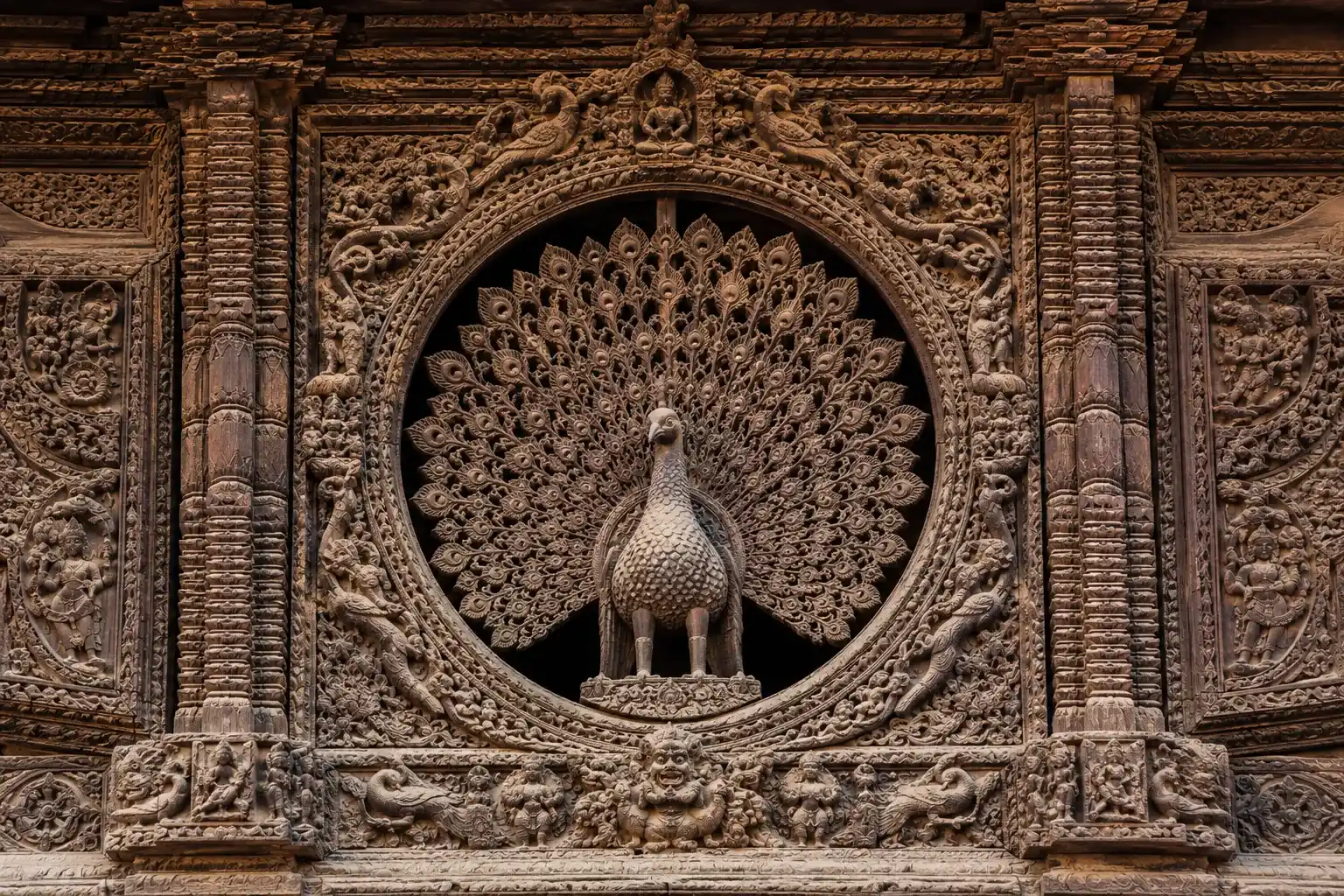
Wood carving: The elaborately carved windows, door frames, roof struts, and erotic carvings on temple bases that you see throughout the old cities are products of a specialist woodcarving tradition carried by the Shilpakar caste. The struts supporting the tiered roofs of temples typically depict deities, demons, or scenes from sacred texts each figure carved according to precise iconographic specifications that have been transmitted between masters and apprentices for generations.
Metal casting and repoussé: The gilded roofs, copper-clad door frames, and metal deity images that define the valley’s temples are produced by Newar metalworkers the Tamrakars (coppersmiths) and Kansakars (bronzesmiths) using techniques of repoussé (hammering metal from behind into relief shapes) and lost-wax casting that have not changed in their fundamentals for a millennium.
Paubha painting: A distinctly Newar tradition of religious scroll painting on cotton cloth mandala compositions, deity images, narrative scenes from Buddhist and Hindu texts produced by the Chitrakar caste. Paubha paintings use mineral pigments, gold leaf, and a strict iconographic canon. The finest examples are indistinguishable in sophistication from Tibetan thangka painting, though they have their own distinct stylistic lineage.
Newar settlements abound with temples and other religious places that form a sacred microcosm. Major settlements have politico-religious centres and are protected not only by surrounding walls but also by temples of eight goddesses placed in proper directions.
The architecture of the old Newar cities is not decorative. It is a physical cosmology a city laid out as a diagram of the universe, with sacred geometry determining the placement of temples, water fountains (hitis), rest houses (sattals), and residential courtyards (bahals) in relationship to each other and to the surrounding landscape.
The Guthi: The Social Institution That Holds Everything Together
Newar society is organised not just through caste hierarchy but through a parallel institution called the guthi a kinship-based social organisation that funds and manages the valley’s religious and cultural life.
Religious endowments called guthi arrange for long-term support of traditional forms of worship or ritual by allowing temple or vihara lands to pass down through generations of the same families this support results in the preservation of a conservative art, architecture, and religious literature that has disappeared in other areas of South Asia.
Every significant festival in the Kathmandu Valley is organised, funded, and performed by specific guthis whose responsibilities have been inherited for generations. The chariot processions of Indra Jatra. The masked dances of Bisket Jatra. The feeding rituals at temple courtyards during Dasain. These events happen not because of government organisation or tourist industry incentive they happen because specific Newar families are obligated by their guthi membership to make them happen, this year and every year, as their ancestors did before them.
The guthi system is under pressure from urbanisation, emigration, and the economic unsustainability of maintaining large landholdings for religious purposes in a modern property market. In Kathmandu especially, younger Newar generations who have moved to other neighbourhoods or other cities no longer participate in guthis with the same regularity. The festivals continue but the community infrastructure behind them is thinning.
Newari Cuisine: Food as Ritual
Newar cuisine is inseparable from ceremony. Every significant life passage, every major festival, every gathering of the community is marked by specific foods that carry ritual weight alongside nutritional content.
A Samay Baji platter is perhaps the most emblematic: a circular steel tray piled with beaten rice (chiura), a meat curry (often buffalo), vegetable curries, crispy crisps, boiled egg, spicy potato, sautéed greens, lentils, and Juju Dhau (sweet buffalo yoghurt). This platter is served for celebrations, and each element has its symbolic place.
Buff chhoila grilled water buffalo marinated in mustard oil, fresh garlic, and spices is the definitive Newar meat dish. Buffalo, rather than beef (which Hindu tradition restricts) or pork, is the sacred meat of Newar culinary culture: present at festivals, offered at sacrifices, and served as the centrepiece of any serious Newar feast.
Chatamari a rice flour crepe topped with minced meat, egg, or vegetables is sometimes called the Newari pizza, which understates its antiquity. It is a very old dish, eaten as a ritual food at festivals, that happens to resemble a flatbread only in its physical form.
Yomari a steamed dough dumpling filled with chaku (molasses) or sweet khuwa is the iconic sweet of the Newar, tied specifically to the festival of Yomari Punhi (the full moon of the rice harvest month). The dough is shaped into a specific pointed form that represents the deity Kumari. You cannot fully separate the food from the ritual that gives it meaning.
Juju Dhau the “king curd” of Bhaktapur, set in traditional clay pots, thick and slightly sweet in a way that yoghurt from other regions never achieves is specific to Bhaktapur. The clay of Bhaktapur’s specific pots, the buffalo milk of the valley, and the fermentation culture that has been maintained in Bhaktapur’s dairy tradition for centuries produce something that cannot be replicated elsewhere. It is not marketing language to say that Juju Dhau from Bhaktapur tastes different from yoghurt anywhere else it genuinely does.
Aila the distilled rice spirit of the Newar, clear and sharp, served in small clay vessels is the traditional alcohol of Newar festivals and the accompaniment to any serious Newar meal. It is home-distilled by specific castes and available at Newar restaurants throughout the valley.
Indra Jatra and the Living Goddess: How Newar Festivals Work
Through all Newar celebrations, what stands out is the spirit of inclusivity and continuity. Different castes and districts each contribute their roles from pouring sacred milk to organising music but everyone shares in the pageantry. A traveller observing these events witnesses living history: each dance step, each clanging bell, and each communal meal connects to centuries of valley tradition.
Indra Jatra the eight-day festival of rain, harvest, and divine kingship that fills Kathmandu Durbar Square each September is the Newar festival that most clearly demonstrates how the community’s religious, social, and political life functions as a single integrated system.
The festival honours Indra, the Hindu god of rain. It requires Kumari the living goddess, a pre-pubescent Newar Shakya girl chosen through ritual examination to embody the deity Taleju to emerge from her residence in Kumari Ghar and be carried through the streets in a gilded chariot. It involves masked dances (Lakhe) by performers from specific Newar castes whose hereditary duty is to embody these figures. It includes the display of massive sacred masks Swet and Rato Bhairava that are kept hidden throughout the year. It requires a wooden pole (the Yosin) to be erected and then toppled in a ceremony that marks the festival’s close.
Every one of these elements is managed by a specific guthi, a specific caste, a specific family whose obligation this is. The Kumari selection process is conducted by Newar Buddhist priests (Vajracharyas) from the Shakya goldsmith caste. The mask dances are performed by families whose great-grandparents performed them. The chariot is built by Newar carpenters whose craft knowledge is transmitted through apprenticeship rather than any formal institution.
The festival works because the Newar social system was designed, over centuries, to make it work.
The Newar Today: Between Continuity and Change
Although Nepal Bhasa was suppressed under the Shah dynasty, its revival in recent decades has been strong it is still spoken by Newar communities and featured in Newar media and education.
The suppression of Nepal Bhasa under the Shah dynasty which established Nepali (Khas Kura) as the sole national language and relegated Nepal Bhasa to second-class status is a foundational wound in Newar cultural memory. The language survived because Newar communities maintained it at home, in guthi meetings, in temple rituals, and in the private sphere that no government policy could reach.
Today, approximately 846,000 people speak Nepal Bhasa as a native language. The revival movement which gained momentum after the 1990 democratic transition has produced a Newar-language press, a Newar-language radio and television presence, and a growing body of contemporary literature. Young Newar writers and musicians are creating in Nepal Bhasa with an energy that surprised even the language revival’s most optimistic advocates.
The guthi system faces genuine pressure from urbanisation but has not collapsed. Newar communities in Kathmandu, Patan, and Bhaktapur maintain their festival obligations with a consistency that sometimes surprises outside observers. The festivals of Indra Jatra, Bisket Jatra, and Yomari Punhi are not performed for tourists they are performed because the Newar social contract requires them to be performed, and because the communities that would lose them know exactly what would be lost.
The food survives most robustly of all. Newar restaurants in Patan and Kathmandu serve samay baji, chhoila, chatamari, and aila to local families celebrating life passages with the same centrality as they did three generations ago. The restaurant industry has commercialised some of this there are now Newar food courts in Kathmandu malls but the food’s ritual function in actual family celebrations has not diminished.
What the Newar have done, across two millennia of invasions, dynastic changes, cultural suppression, and modernisation, is what the finest civilisations do: they have held the essential things the language, the festivals, the architecture, the food, the religious syncretism while adapting everything else to the conditions of survival.
The valley that Manjushri supposedly drained with his holy sword is still full of the people he found there. Their temples are still standing. Their festivals still stop traffic. Their food still requires buffalo.
The Explore All About Nepal team is based in Kathmandu, inside the Kathmandu Valley that this article is about. For questions about Newar culture, where to witness festivals, or how to eat well in the old city, leave a comment below.
