
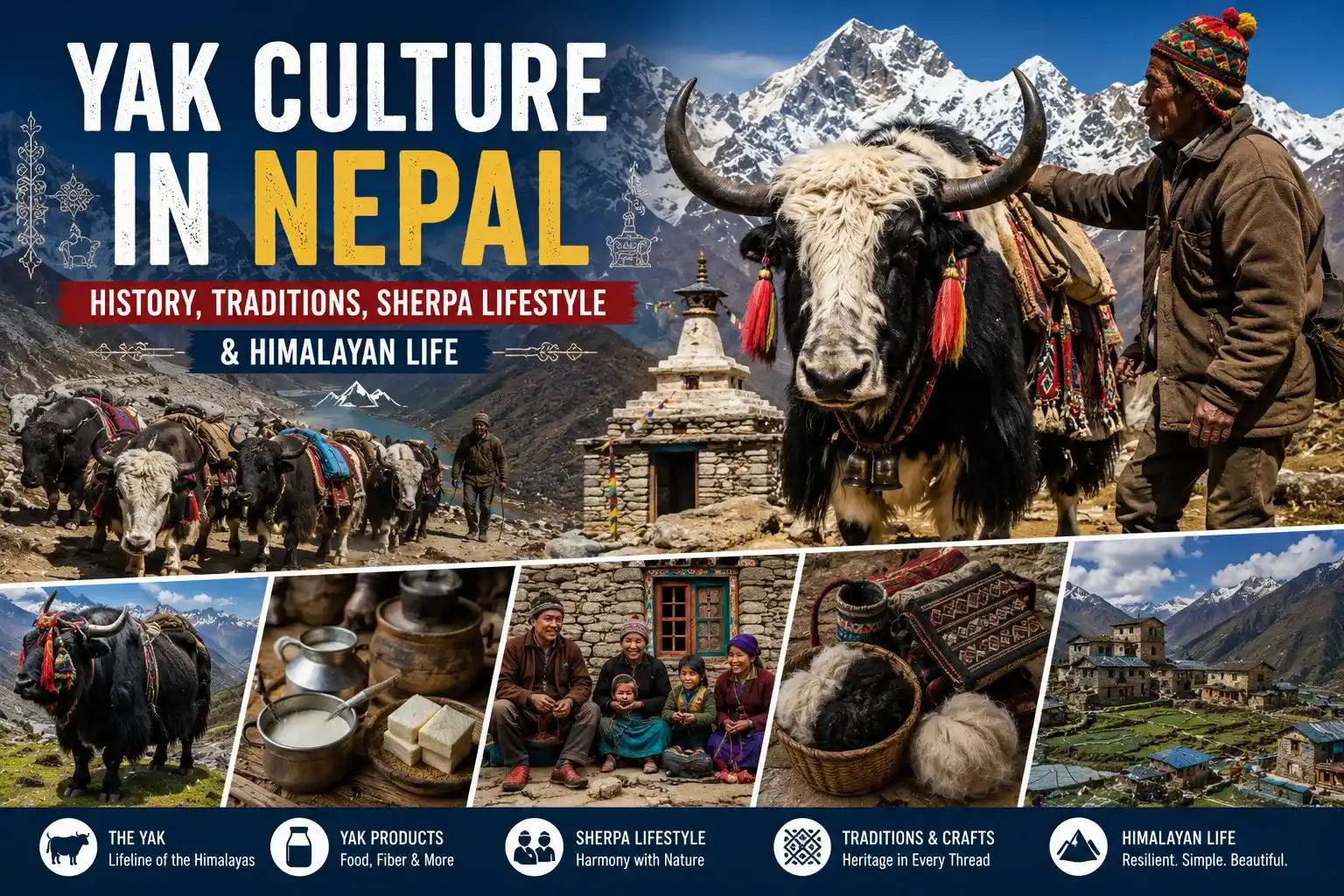
High in the rugged Himalayas, where snow-covered peaks dominate the horizon and oxygen levels are significantly lower than at sea level, one animal has played a crucial role in human survival for centuries the yak. More than just livestock, yaks are deeply woven into the cultural, economic, and spiritual fabric of Nepal’s mountain communities. Understanding Yak Culture in Nepal offers valuable insight into how people have adapted to life in some of the world’s harshest environments.
Yaks have been part of Himalayan civilization for thousands of years. In Nepal, they are primarily found in high-altitude regions such as Khumbu, Dolpo, Mustang, Humla, Manang, and other Himalayan districts where conventional farming and transportation are often difficult. These remarkable animals provide transportation, food, clothing materials, fuel, and income for local communities.
For generations, yak herding has been a way of life passed down through families. In remote mountain villages, yaks remain essential for transporting goods across steep trails that vehicles cannot access. Long before modern roads connected mountain settlements, yak caravans served as the backbone of trade between Nepal and Tibet. Even today, they continue to carry supplies to remote settlements and trekking destinations.
The importance of yak culture extends beyond economics. Yaks feature prominently in local traditions, religious ceremonies, folklore, and community celebrations. Many Himalayan communities view yaks as symbols of resilience, prosperity, and harmony with nature. Their presence is deeply connected to the identity of mountain peoples, particularly Sherpas and other high-altitude ethnic groups.
Modernization and climate change are gradually transforming traditional lifestyles in Nepal’s mountain regions. However, yak culture remains an important part of the country’s living heritage. Visitors trekking through remote Himalayan regions often encounter yak caravans, traditional herders, and mountain settlements where these animals continue to play a central role in everyday life.
As interest in sustainable tourism and cultural experiences grows, understanding yak culture provides travelers with a deeper appreciation for the people and traditions that have shaped Nepal’s Himalayan landscape. It is a story of adaptation, endurance, and the enduring relationship between humans and one of the Himalayas’ most iconic animals.
What Is a Yak? Understanding Nepal’s Himalayan Animal
To fully appreciate Yak Culture in Nepal, it is important to understand the animal itself. The yak is a large bovine species specially adapted to life at high altitudes. Unlike ordinary cattle, yaks thrive in cold environments where temperatures can drop far below freezing and oxygen levels are significantly reduced.
Scientifically classified as the wild and domestic forms of Bos grunniens, yaks are native to the Himalayan region and the Tibetan Plateau. Their physical characteristics make them uniquely suited for survival in mountain environments. They possess thick, shaggy coats that provide insulation against extreme cold, large lungs that help them process oxygen efficiently at high elevations, and strong hooves that allow them to navigate rocky terrain.
Adult yaks can weigh several hundred kilograms and are capable of carrying heavy loads across difficult mountain trails. Their strength and endurance have made them indispensable companions for Himalayan communities for centuries.
One of the most noticeable differences between yaks and cattle is their adaptation to altitude. While cattle often struggle above 3,000 meters, yaks can comfortably live and work at elevations exceeding 5,000 meters. This makes them particularly valuable in regions where other livestock cannot survive.
Yaks are herbivores that feed primarily on grasses, herbs, and alpine vegetation. During summer months, they graze in high mountain pastures, while winter often requires movement to lower elevations where forage remains available. This seasonal movement has influenced traditional herding practices throughout Nepal.
In Nepal, people also raise hybrid animals created by crossing yaks with cattle. These hybrids combine the hardiness of yaks with some of the productivity characteristics of cattle, making them useful in a wider range of environments.
Beyond their practical value, yaks have become symbols of Himalayan life. Their image appears in tourism materials, cultural festivals, local artwork, and countless photographs from Nepal’s mountain regions. For many visitors, seeing a yak grazing beneath snow-covered peaks represents one of the most authentic images of the Himalayas.
Understanding the biology and adaptations of yaks helps explain why they became so important to mountain communities and why they continue to play a central role in Nepal’s high-altitude culture.
History of Yak Culture in Nepal
The history of Yak Culture in Nepal stretches back centuries and is closely linked with the settlement of Himalayan communities across the high mountain regions. Long before modern transportation, roads, and tourism transformed the mountains, yaks served as essential companions that made life possible in harsh alpine environments.
Historical evidence suggests that yak domestication originated on the Tibetan Plateau thousands of years ago. As trade, migration, and cultural exchange spread across the Himalayas, yak husbandry became deeply integrated into the lifestyles of communities living in Nepal’s northern regions.
For centuries, mountain communities depended on yaks for survival. The challenging geography of the Himalayas made transportation difficult, and yaks provided a reliable means of moving goods across high mountain passes. They carried salt, grain, wool, tea, and other essential commodities between Nepal and Tibet, helping sustain important trade networks that connected distant settlements.
Many ethnic groups in Nepal, including Sherpas, Dolpo-pa, Lopa, and communities in Humla and Mustang, developed traditions centered around yak herding. These traditions evolved alongside seasonal migration patterns, religious beliefs, and local economies.
The historical importance of yak caravans cannot be overstated. Before the development of modern roads, caravans of yaks traversed some of the world’s most challenging terrain. Their ability to carry heavy loads at high altitudes made them invaluable for commerce and communication between isolated communities.
Yak culture also became intertwined with religious practices. In Buddhist communities, animals were often treated with respect and compassion, and yaks frequently appeared in ceremonies, festivals, and local folklore. Many mountain communities viewed them not only as livestock but as partners in survival.
The arrival of mountaineering expeditions during the twentieth century further increased the importance of yaks. Explorers attempting peaks such as Everest relied heavily on yak caravans to transport equipment and supplies to remote base camps. This role continues today, particularly in regions where roads do not reach trekking routes.
Despite changes brought by modernization, the historical legacy of yak culture remains visible across Nepal’s Himalayan districts. Ancient herding traditions, seasonal grazing practices, and community knowledge continue to connect present-day mountain life with centuries of Himalayan history.
Why Yaks Are Essential to Life in the Himalayas
In the high mountains of Nepal, where environmental conditions can be extreme and infrastructure is often limited, yaks remain among the most important animals for local communities. Their contribution goes far beyond transportation, making them essential to both survival and economic stability.
One of the primary reasons yaks are so valuable is their ability to transport goods across difficult terrain. Many remote villages remain accessible only by foot trails, and yaks can carry food, construction materials, fuel, and household supplies where vehicles cannot go. Even today, trekking routes leading toward Everest Base Camp and other remote destinations depend heavily on yak transport.
Yaks also provide a reliable source of food. Their milk is used to produce butter, cheese, yogurt, and other dairy products that are staples of mountain diets. Yak butter tea, a traditional beverage consumed throughout Himalayan regions, remains an important source of energy during cold weather.
Their wool and hair are used to create clothing, ropes, blankets, tents, and other essential items. The thick fibers provide excellent insulation, making them ideal for high-altitude environments where temperatures can be extremely low.
Another critical contribution comes from yak dung, which serves as a valuable fuel source. In regions where firewood is scarce, dried yak dung is commonly used for cooking and heating. This sustainable resource has supported mountain communities for generations.
Economically, yaks provide income through the sale of dairy products, meat, wool, and transportation services. Tourism has created additional opportunities, as yak caravans continue to play an important role in trekking and mountaineering logistics.
The adaptability of yaks allows communities to maintain livelihoods in areas where conventional agriculture is limited. Their ability to graze on alpine vegetation transforms otherwise marginal landscapes into productive resources.
Perhaps most importantly, yaks symbolize resilience. They embody the capacity of Himalayan communities to thrive in challenging environments through cooperation with nature rather than domination of it. Their continued importance demonstrates how traditional knowledge and sustainable practices remain relevant even in a rapidly changing world.
Yak Herding Traditions in Nepal
Yak herding is one of the oldest and most important traditions associated with Yak Culture in Nepal. For centuries, families living in the high Himalayan regions have relied on yak husbandry not only as a source of income but also as a way of life. In districts such as Solukhumbu, Mustang, Dolpa, Humla, Manang, and Mugu, yak herding remains a vital part of local culture and identity.
Traditional yak herding follows a seasonal migration system known as transhumance. During the warmer months of spring and summer, herders move their animals to higher alpine pastures where fresh grasses and herbs are abundant. As winter approaches and snowfall covers the grazing lands, the animals are brought to lower elevations where food is more accessible. This seasonal movement helps maintain healthy pastures while ensuring sufficient nutrition for the herds.
Yak herding is often a family-based occupation. Knowledge about breeding, grazing routes, weather patterns, animal health, and pasture management is passed down through generations. Young family members learn from elders by accompanying them during grazing seasons, helping preserve traditional skills and knowledge.
Life as a yak herder can be challenging. Herders often spend weeks or months in remote mountain areas, living in simple shelters and facing unpredictable weather conditions. They must protect their animals from harsh climates, disease, and predators while managing difficult terrain. Despite these challenges, many herders view their work with pride because it connects them to their heritage and community.
The relationship between herders and their animals is often very close. Unlike large-scale commercial livestock operations found elsewhere in the world, Himalayan yak herding typically involves smaller herds and a more personal approach to animal care. Herders know the behavior and needs of individual animals and often treat them as valued members of their livelihood system.
Today, modernization and changing economic opportunities are affecting traditional yak herding. Some younger generations are pursuing education and employment outside mountain communities, leading to a decline in the number of active herders. Climate change is also altering grazing patterns and pasture availability.
Despite these challenges, yak herding remains one of the most authentic expressions of Himalayan life. It continues to sustain communities while preserving traditions that have shaped Nepal’s mountain regions for centuries.
The Role of Yaks in Sherpa Culture
No discussion of Yak Culture in Nepal would be complete without exploring the deep connection between yaks and the Sherpa people. The Sherpas, who are internationally known for their mountaineering expertise and contributions to Himalayan expeditions, have long depended on yaks as an essential part of daily life in the Everest region.
The Sherpa homeland, located in the Khumbu region of northeastern Nepal, is characterized by high elevations, rugged terrain, and a challenging climate. In such an environment, yaks have traditionally provided the resources necessary for survival and prosperity.
Historically, yaks were central to Sherpa households. They transported goods between villages, carried supplies for traders, and supported agricultural activities. Before tourism became a major industry in the Everest region, yak husbandry was one of the primary economic activities for many Sherpa families.
The arrival of mountaineering expeditions in the twentieth century further increased the importance of yaks. Climbers attempting Everest and other Himalayan peaks required large quantities of food, equipment, and supplies to be transported into remote mountain areas. Yak caravans became the backbone of expedition logistics, carrying loads through the Khumbu Valley to base camps and high mountain settlements.
Even today, visitors trekking toward Everest Base Camp frequently encounter yaks carrying fuel, food, building materials, and trekking supplies. These animals continue to play a vital role in supporting tourism and maintaining local economies.
Beyond their practical uses, yaks hold cultural and symbolic significance in Sherpa society. They are often associated with strength, endurance, and prosperity. Traditional ceremonies may include blessings for livestock, reflecting the spiritual relationship between people and animals.
Sherpa cuisine also reflects the importance of yaks. Butter, cheese, yogurt, and milk produced from yaks remain important components of local diets. Yak butter tea, known locally as su cha, is a traditional beverage consumed to provide warmth and energy in cold mountain environments.
The enduring connection between Sherpas and yaks highlights the importance of traditional knowledge and sustainable living practices. As tourism and modernization continue to reshape the Everest region, yaks remain a powerful symbol of Sherpa identity and Himalayan resilience.
Yak Caravans: The Ancient Trade Routes of Nepal
Long before modern roads and air transportation connected Nepal’s mountain regions, yak caravans served as the primary means of moving goods across the Himalayas. These caravans played a crucial role in shaping economic and cultural relationships between Nepal, Tibet, and other neighboring regions.
For centuries, traders relied on yaks to transport commodities through some of the world’s most challenging terrain. Salt, wool, tea, grains, medicinal herbs, and household goods were carried across high mountain passes connecting remote communities. These trade routes became lifelines that sustained local economies and facilitated cultural exchange.
Yak caravans were particularly important in regions such as Mustang, Humla, Dolpo, and the Everest area. The animals’ strength, endurance, and ability to thrive at high elevations made them uniquely suited for long-distance travel across difficult landscapes.
Traveling with a caravan required careful planning and extensive local knowledge. Traders needed to understand weather patterns, grazing availability, river crossings, and mountain pass conditions. Journeys could take weeks or even months depending on the route and destination.
These trade networks influenced the development of many Himalayan communities. Villages located along major caravan routes often became important commercial centers where traders exchanged goods, information, and cultural practices. The movement of yak caravans helped spread religious ideas, technologies, and traditions across the region.
Although modern infrastructure has reduced the economic importance of traditional trade routes, yak caravans remain relevant in some remote areas. They continue to transport supplies to villages, monasteries, and trekking destinations where road access is unavailable or limited.
For travelers, encountering a yak caravan on a mountain trail offers a glimpse into Nepal’s historical past. The sight of animals carrying goods across rugged landscapes reflects centuries of Himalayan commerce and human adaptation.
Today, these caravans serve as living reminders of the role that yaks played in connecting communities across one of the world’s most challenging environments. They remain an enduring symbol of resilience, trade, and cultural exchange in the Himalayas.
Yak Products and Their Importance
One of the reasons Yak Culture in Nepal has endured for centuries is the remarkable range of products that yaks provide. In remote Himalayan communities, nearly every part of the animal contributes to daily life, making yaks among the most valuable livestock in the region.
Yak Milk
Yak milk is highly nutritious and contains higher fat content than ordinary cow’s milk. It is widely used to produce butter, yogurt, cheese, and traditional beverages. For many mountain communities, dairy products derived from yak milk serve as important sources of protein and energy.
Yak Butter
Yak butter plays a central role in Himalayan cuisine and religious practices. It is used to make butter tea, a warm and energy-rich drink consumed throughout high-altitude regions. Yak butter is also used in monasteries to create traditional butter lamps that symbolize spiritual devotion.
Yak Cheese
Yak cheese has become one of Nepal’s most famous mountain products. Produced in regions such as Solukhumbu, Langtang, and Dolpa, it is known for its rich flavor and long shelf life. Many trekkers consider yak cheese a must-try local delicacy.
Yak Wool and Hair
The thick wool and hair of yaks provide valuable raw materials for clothing, blankets, ropes, tents, and other household items. These fibers offer excellent insulation, making them particularly useful in cold mountain environments.
Yak Meat
In some communities, yak meat is consumed as a source of nutrition. It is rich in protein and often used in traditional dishes. However, practices vary depending on local customs and cultural beliefs.
Yak Dung
One of the most practical contributions of yaks is their dung, which is dried and used as fuel. In treeless high-altitude regions where firewood is scarce, yak dung provides an essential energy source for cooking and heating.
Together, these products demonstrate why yaks are often described as the lifeline of Himalayan communities. Their versatility supports food security, economic activity, cultural traditions, and daily survival across Nepal’s mountain regions.
Yak Cheese: Nepal’s Famous Mountain Delicacy
Among the many products associated with Yak Culture in Nepal, yak cheese stands out as one of the most famous and widely recognized. Produced in high-altitude regions where yaks graze on alpine pastures, this unique cheese has become popular among both locals and international visitors.
The history of yak cheese production in Nepal dates back several decades. Efforts to improve dairy production in mountain regions led to the establishment of cheese factories in areas such as Solukhumbu and Langtang. Over time, yak cheese gained a reputation for its distinctive taste, nutritional value, and connection to Himalayan traditions.
The production process begins with fresh yak milk collected from herds grazing in mountain pastures. The milk is processed using techniques that combine traditional knowledge with modern dairy practices. The resulting cheese is often aged to develop its flavor and texture.
One reason yak cheese is highly valued is its nutritional content. Rich in protein, calcium, and healthy fats, it provides an important source of nourishment for people living in high-altitude environments. Its durability also makes it practical for transport and storage in remote regions.
For travelers trekking through Nepal’s mountains, yak cheese has become a popular culinary experience. Many tea houses and lodges offer locally produced cheese as part of meals or snacks. Visitors often purchase it as a souvenir that reflects the culture and traditions of the Himalayas.
The growing popularity of yak cheese has created economic opportunities for mountain communities. Dairy cooperatives and local producers generate income while preserving traditional livestock practices. In some regions, cheese production has become an important component of sustainable rural development.
More than just a food product, yak cheese represents the ingenuity and resilience of Himalayan communities. It demonstrates how local resources can be transformed into products that support livelihoods while preserving cultural heritage.
Want to learn more about how the Yak Cheese made? Read our full guide about how yak cheese made in himalayas
Festivals and Cultural Traditions Connected to Yaks
In Nepal’s Himalayan regions, yak culture is not only economic it is deeply spiritual and cultural. Across high-altitude districts such as Solukhumbu, Mustang, Dolpo, and Manang, yaks are closely linked with local festivals, rituals, and seasonal traditions. These practices reflect how mountain communities view yaks as more than livestock—they are considered essential companions in life, livelihood, and spirituality.
One of the most important traditions connected to yak culture is the seasonal blessing of animals. In many villages, monks or village elders perform rituals to protect yaks from disease, harsh weather, and misfortune. These ceremonies often involve prayer flags, incense, and offerings made at local monasteries. Such rituals reflect the belief that animals and humans share a spiritual connection in the Himalayan ecosystem.
In Sherpa regions, particularly in the Everest area, yaks are often included in Lhosar celebrations, the Tibetan New Year festival. During this time, families offer prayers for prosperity and healthy livestock. Yaks are sometimes decorated with colorful ornaments or butter-based markings as part of festive traditions.
Another important cultural practice is the summer migration blessing ceremony, where herders prepare to move their yak herds to higher pastures. Before departure, families gather to seek protection and safe grazing conditions for the season ahead. This reflects the deep dependence of communities on seasonal yak movements.
In Dolpo and Mustang, yak-related rituals are often influenced by the ancient Bon religion and Tibetan Buddhism. Yaks are seen as sacred animals that help sustain human life in harsh environments. Monasteries often keep symbolic associations with livestock, reflecting their importance in survival and trade.
Yak races and local fairs are also part of Himalayan cultural life in some regions. These events celebrate strength, endurance, and the bond between herders and their animals. While not as widespread today, they remain an important part of cultural identity in certain villages.
Through these traditions, yak culture becomes a living expression of Himalayan heritage blending spirituality, survival, and community life in one of the world’s most challenging environments.
Yak Culture in Mustang, Dolpo, Humla, and Manang
Yak culture varies across Nepal depending on geography, climate, and ethnic communities. In regions such as Mustang, Dolpo, Humla, and Manang, yak herding is not just a livelihood but a defining feature of local identity.
Mustang
In Mustang District, yak culture is strongly influenced by Tibetan traditions. The semi-arid landscape of Upper Mustang makes yak herding ideal, as yaks can survive in dry, high-altitude conditions. Local communities use yaks for transport, dairy production, and trade. Ancient trade routes connecting Nepal and Tibet historically passed through Mustang, making yak caravans essential for commerce.
Dolpo
In Dolpa District, particularly Upper Dolpo, yak culture is deeply connected to the Bon religion and ancient Tibetan Buddhism. Yaks are central to survival in this remote rain-shadow region. They provide transportation across barren mountain terrain and support the traditional salt trade with Tibet. Life in Dolpo remains one of the most isolated in Nepal, and yak herding continues to define daily existence.
Humla
In Humla District, yak herding is a primary economic activity due to extreme remoteness and limited agricultural opportunities. Communities rely heavily on yaks for carrying goods, milk production, and trade with Tibetan border regions. Seasonal migration is an important part of life, with families moving across high pastures in search of grazing land.
Manang
In Manang District, yak culture is closely tied to the Annapurna trekking region. Yaks are widely used for transporting goods along trekking routes such as Thorong La Pass. While tourism has influenced the region’s economy, traditional yak herding remains an important part of local livelihoods.
Across all these regions, yaks are more than animals—they are a foundation of survival, culture, and identity in Nepal’s high Himalayas.
Challenges Facing Yak Culture in Nepal Today
Despite its deep historical and cultural importance, yak culture in Nepal is facing several modern challenges that threaten its long-term sustainability.
One of the biggest challenges is climate change. Rising temperatures are affecting alpine grazing lands, altering vegetation patterns, and reducing the availability of natural pastures. This forces herders to travel longer distances or adjust traditional migration routes.
Another major issue is youth migration. Many younger generations from mountain communities are leaving rural areas in search of education and employment opportunities in cities or abroad. As a result, fewer people are continuing traditional yak herding practices.
Economic changes also play a significant role. While tourism has created new income opportunities, it has also shifted local economies away from traditional livestock-based systems. In some areas, yak herding is becoming less profitable compared to tourism-related jobs.
Infrastructure development is another factor. Roads and modern transport systems are gradually reaching remote regions, reducing the need for yak caravans. While this improves accessibility, it also decreases reliance on traditional yak-based trade systems.
Additionally, land-use pressure and restricted grazing areas due to conservation policies can limit available pastureland for herders. Balancing conservation and traditional livelihoods remains an ongoing challenge.
Despite these difficulties, yak culture is still resilient. Many communities are adapting by combining traditional herding with tourism, dairy cooperatives, and sustainable livestock management practices. Efforts to preserve this heritage are increasingly important for maintaining Himalayan cultural identity.
The Future of Yak Culture in Nepal
The future of yak culture in Nepal depends on a balance between tradition and modernization. While challenges exist, there are also promising opportunities for preservation and sustainable development.
One of the most important developments is the growth of eco-tourism and adventure tourism. Trekkers visiting regions like Everest, Dolpo, and Mustang often encounter yak caravans and traditional herding practices. This creates economic incentives for communities to continue yak-based livelihoods.
Government and NGO-led initiatives are also supporting livestock health programs, pasture management, and dairy cooperatives. These efforts help improve productivity and ensure that yak herding remains economically viable.
There is increasing recognition of yak culture as part of Nepal’s intangible cultural heritage. Documentation, research, and cultural preservation programs are helping record traditional knowledge before it disappears.
In addition, yak-based products such as cheese, butter, and wool are gaining popularity in both domestic and international markets. This creates new opportunities for rural income generation.
If managed properly, yak culture can continue to thrive as a model of sustainable mountain living. It represents a unique relationship between humans, animals, and nature that is increasingly relevant in discussions about climate resilience and sustainable development.
Interesting Facts About Yaks in Nepal
- Yaks can survive at altitudes above 5,000 meters.
- They have thick coats with multiple layers to withstand extreme cold.
- Yak butter tea is a traditional energy drink in Himalayan regions.
- Yak dung is widely used as a renewable fuel source in mountain villages.
- Hybrid animals called “dzo” are created by crossing yaks with cattle.
- Yak caravans historically connected Nepal and Tibet trade routes.
- Yaks play a key role in supporting Everest trekking logistics.
- One yak can carry loads of up to 80–100 kg depending on terrain.
- Yak cheese from Nepal is exported and valued for its unique taste.
- In many Himalayan communities, yaks are considered a symbol of prosperity and survival.
FAQs About Yak Culture in Nepal
What is yak culture in Nepal?
Yak culture refers to the traditional lifestyle, practices, and economy built around yak herding in Nepal’s Himalayan regions.
Where are yaks found in Nepal?
Yaks are mainly found in high-altitude regions such as Solukhumbu, Mustang, Dolpo, Humla, and Manang.
Why are yaks important in Nepal?
They provide transportation, milk, meat, wool, fuel, and economic support to remote mountain communities.
Do Sherpas still use yaks?
Yes, Sherpa communities in the Everest region still rely heavily on yaks for transport and livelihoods.
What is yak cheese?
Yak cheese is a traditional dairy product made from yak milk, commonly produced in Himalayan regions.
Preserving Nepal’s Living Himalayan Heritage
Yak culture in Nepal is far more than a traditional livelihood—it is a living heritage that represents survival, adaptation, and harmony with one of the most extreme environments on Earth. For centuries, yaks have supported Himalayan communities through transportation, food production, trade, and cultural traditions.
From the remote valleys of Dolpo to the bustling trekking routes of Everest, yaks continue to shape daily life and identity in Nepal’s high mountains. They are not only essential for economic survival but also deeply embedded in spiritual beliefs, festivals, and cultural practices.
However, modern challenges such as climate change, migration, and economic transformation are slowly reshaping this traditional way of life. Preserving yak culture requires a careful balance between development and conservation, ensuring that future generations can continue to benefit from this unique Himalayan heritage.
As Nepal continues to grow as a global tourism destination, yak culture remains one of its most authentic and powerful symbols a reminder of the deep connection between people, animals, and the mountains they call home.
