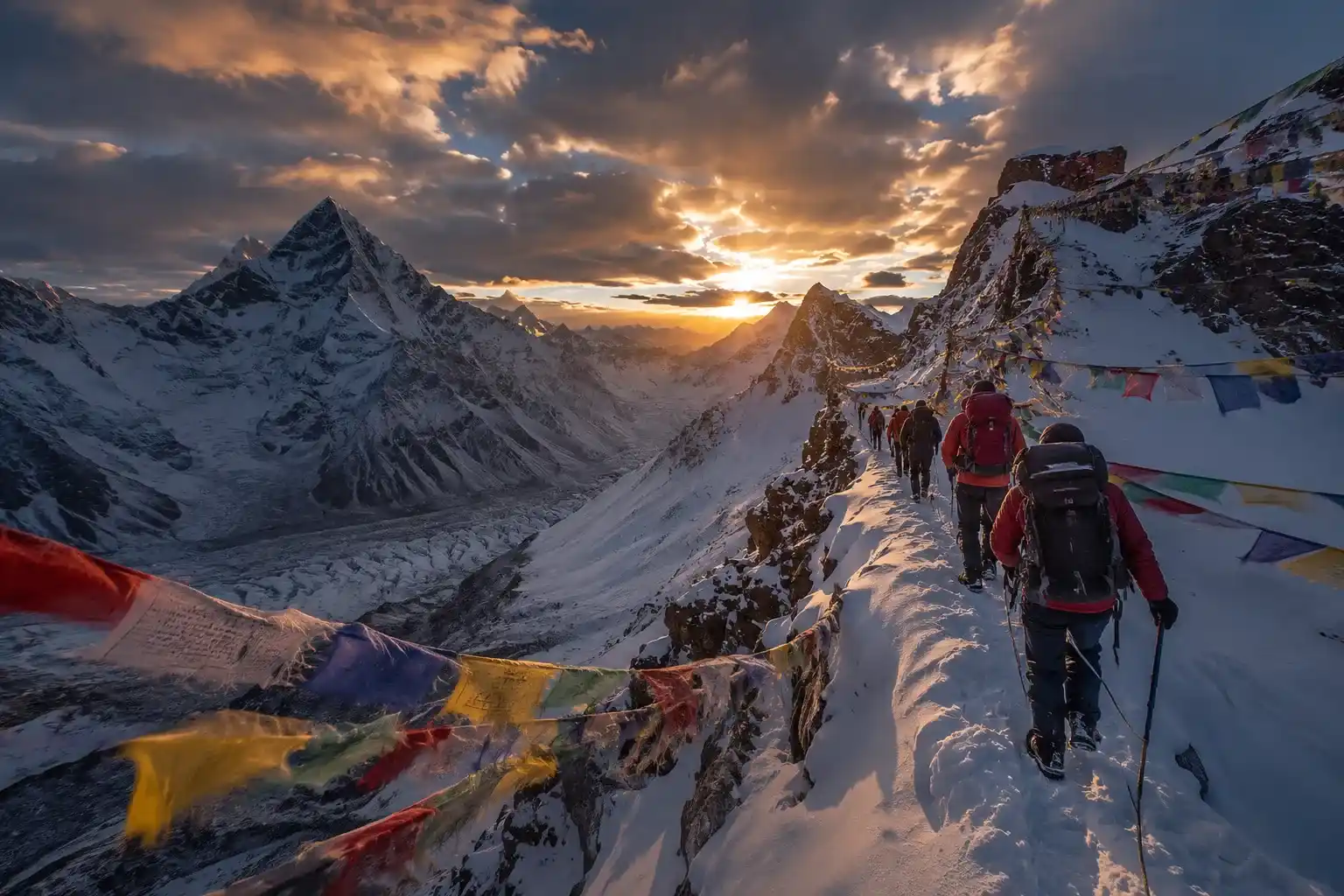
In the thin air above the clouds, where prayer flags snap violently against icy winds and every breath feels painfully earned, Nepal’s most dangerous mountain passes reveal a side of the Himalayas few travelers ever truly experience. These are not ordinary trekking trails.
They are high-altitude crossings carved through glaciers, avalanche zones, frozen ridges, and isolated Himalayan wilderness where weather changes in minutes and a single wrong step can become life-threatening. Yet every year, trekkers, climbers, porters, and Sherpas continue to cross these dangerous mountain passes in Nepal drawn by something impossible to explain until you stand there yourself.
The silence.
The fear.
The beauty.
And the overwhelming feeling of being very small beneath the tallest mountains on Earth.
Dangerous Mountain Passes in Nepal
From the icy slopes of Thorong La to the terrifying glacier crossings of Amphu Lapcha, Nepal’s high mountain passes are among the most extreme trekking experiences in the world. Some routes test physical endurance. Others challenge mental resilience. A few have become legendary because of sudden snowstorms, altitude sickness, and dangerous Himalayan weather that can trap trekkers overnight at nearly 6,000 meters.
For many adventurers, crossing these risky Himalayan passes becomes the defining moment of their lives. For others, the mountains demand retreat. This is the story of Nepal’s most dangerous mountain passes the thrilling, beautiful, and unforgiving routes hidden deep in the Himalayas.
Why Nepal’s Mountain Passes Are So Dangerous
Nepal’s geography creates some of the most extreme trekking conditions on Earth.
Many dangerous trekking routes in Nepal sit above 5,000 meters, where oxygen levels drop dramatically and the body struggles to function normally. At these elevations, even experienced trekkers can suffer from Acute Mountain Sickness (AMS), dizziness, confusion, or exhaustion.
What makes these Himalayan passes even more dangerous is how quickly conditions change. A bright blue morning can turn into a whiteout snowstorm by afternoon. Strong winds can erase trails. Glaciers shift. Ice becomes unstable. Avalanches can occur without warning.
In remote regions like Dolpo, Manaslu, or the Everest high passes, rescue operations are difficult and weather-dependent. Some trekkers spend days away from proper medical facilities. Helicopter rescues may not always be possible due to cloud cover or high winds.
Did you know?
At elevations above 5,500 meters, the human body slowly begins to deteriorate because of low oxygen exposure. Trekkers crossing Nepal’s highest mountain passes often face exhaustion simply from taking a few steps uphill.
Another hidden danger is isolation. Many risky Himalayan crossings pass through remote valleys with little communication access. A twisted ankle, snowstorm, or navigation mistake can quickly become serious.
Yet despite the dangers, these routes remain some of the most sought-after adventure experiences in the world. Because nowhere else combines danger, spirituality, culture, and raw Himalayan beauty quite like Nepal.
Most Dangerous Mountain Passes in Nepal
Thorong La Pass: The Legendary Frozen Gateway
Altitude: 5,416 meters
Region: Annapurna Circuit
The journey to Thorong La Pass begins long before sunrise.
Trekkers leave Thorong Phedi in darkness, headlamps glowing beneath the stars as freezing winds sweep across the barren Himalayan slopes. The climb is slow, silent, and mentally exhausting.
Every breath feels thinner.
Every step heavier.
Thorong La is one of the most famous high mountain passes in Nepal, but its popularity often hides its dangers. Sudden snowstorms, altitude sickness, and freezing temperatures have trapped trekkers here multiple times over the years.
In winter and early spring, deep snow can completely cover the trail.
There have been seasons when rescue helicopters struggled to reach stranded trekkers because visibility disappeared within minutes.
The emotional moment at the summit is unforgettable. Prayer flags whip violently in icy winds while exhausted trekkers stare across endless Himalayan peaks stretching toward Tibet.
For many, Thorong La becomes the first true encounter with the brutal reality of extreme trekking Nepal experiences.
Cho La Pass: The Glacier Crossing of Everest
Altitude: 5,420 meters
Region: Everest
Cho La Pass feels different from most trekking routes in Nepal. The trail is steeper. The terrain harsher. And the glacier crossing near the top can become dangerously icy.
Connecting the Everest Base Camp route with the Gokyo Valley, Cho La is considered one of the most dangerous Himalayan passes for independent trekkers without proper preparation.
Loose rocks, hidden ice, and unstable snowfields create constant risk. During bad weather, visibility disappears almost instantly. Trekkers often rely on footprints left by earlier groups to navigate the glacier safely.
One of the most frightening moments comes during descent. Many accidents occur not while climbing upward, but while descending icy slopes when exhausted legs lose stability.
Sherpa guides frequently remind trekkers to move slowly, stay hydrated, and avoid overconfidence. In the Everest region, the mountain always decides the outcome.
Did You Know?
Cho La Pass was historically used by traders and yak caravans moving between isolated Himalayan settlements long before modern trekking routes existed.
Kongma La Pass: The Highest Everest Pass
Altitude: 5,535 meters
Region: Everest Three Passes Trek
Among the dangerous trails in Nepal, Kongma La stands out because of its brutal altitude and isolation.
Unlike the busier Everest Base Camp trail, Kongma La often feels empty and intimidating. The route crosses remote glacial terrain with loose rocks, icy sections, and dramatic exposure.
Trekkers frequently underestimate how physically demanding this pass becomes after days of trekking at altitude.
The oxygen shortage is intense.
Simple actions become exhausting.
Some trekkers report headaches, nausea, or confusion while approaching the summit.
What makes Kongma La particularly risky is its unpredictability. Snow accumulation can make the trail nearly invisible, while frozen lakes and hidden crevasses add further danger during colder months.
But the reward is surreal.
From the top, towering Himalayan giants surround you in every direction — including views toward Everest, Lhotse, Nuptse, and Makalu.
The silence feels almost spiritual.
Renjo La Pass: Beauty Hiding Real Danger
Altitude: 5,360 meters
Region: Gokyo Valley
Renjo La is often described as one of the most beautiful mountain passes in Nepal. But beauty in the Himalayas can be deceptive. The steep stone staircases leading toward the summit become slippery during snow or ice conditions. Winds can become dangerously powerful, especially in late afternoon.
Many trekkers crossing Renjo La experience emotional overwhelm at the summit viewpoint. Below lies the turquoise Gokyo Lakes. Ahead rise Everest and surrounding Himalayan peaks. Behind stretches a vast wilderness of snow-covered ridges disappearing into Tibet.
It feels unreal. Yet even this breathtaking route carries genuine danger. Sudden storms can trap trekkers between villages, and freezing temperatures during shoulder seasons create hazardous conditions after sunset. Experienced guides always recommend starting early in the morning before weather systems build later in the day.
Larkya La Pass: The Storm Corridor of Manaslu
Altitude: 5,106 meters
Region: Manaslu Circuit
The Manaslu Circuit remains one of Nepal’s most adventurous trekking regions, and Larkya La Pass is its ultimate test. The crossing is long, cold, and extremely exposed to harsh Himalayan weather. Trekkers often begin before dawn because afternoon winds near the pass can become dangerously strong. During winter and post-storm conditions, heavy snow transforms the trail into a slow and exhausting expedition.
What makes Larkya La unique is its feeling of remoteness. Unlike Everest or Annapurna, there are fewer villages and less infrastructure here. The isolation adds psychological intensity to the experience. Many trekkers describe hearing nothing except wind and crunching snow for hours. This is one of Nepal’s true wilderness crossings.
Did You Know?
The Manaslu region only opened to foreign trekkers in the 1990s, which means many ancient mountain traditions remain deeply preserved.
Hidden Himalayan Trails Few Dare to Cross
Tashi Lapcha Pass: A Mountaineering Challenge
Altitude: 5,755 meters
Region: Rolwaling to Everest
Tashi Lapcha is not simply a trekking pass. It is a technical Himalayan crossing requiring mountaineering skills, glacier travel experience, and proper equipment. The route traverses dangerous ice fields, crevasses, and steep snowy terrain between the remote Rolwaling Valley and Everest region.
Weather windows are short. Navigation is difficult. And rescue access is extremely limited. Trekkers attempting Tashi Lapcha often travel with experienced Sherpa climbing teams because conditions can shift dramatically within hours. This route represents the raw, untamed side of Himalayan adventure routes in Nepal.
Amphu Lapcha Pass: Nepal’s Extreme Ice Crossing
Altitude: 5,845 meters
Region: Everest / Hunku Valley
Amphu Lapcha is widely considered one of the most dangerous passes in Nepal.
Steep ice walls.
Technical rope sections.
Avalanche exposure.
Massive crevasses.
This is where trekking begins to resemble serious alpine climbing.
Crossing Amphu Lapcha often requires fixed ropes, crampons, and experienced mountain guides. In poor conditions, the pass becomes nearly impossible for standard trekking groups.
The psychological pressure is immense.
Trekkers must remain focused for hours while navigating unstable ice and high-altitude terrain with little room for error.
Yet the surrounding scenery is almost beyond imagination.
Jagged peaks rise like frozen towers above untouched Himalayan valleys rarely seen by ordinary travelers.
French Pass: The Isolated Giant of Dolpo
Altitude: 5,360 meters
Region: Upper Dolpo
Far from Nepal’s famous trekking regions lies French Pass — one of the most isolated dangerous Himalayan passes in the country.
The Upper Dolpo landscape feels ancient.
Dry valleys.
Hidden monasteries.
Wind-swept plateaus.
Snow-covered peaks.
Because of its remoteness, French Pass becomes especially dangerous during sudden weather changes or medical emergencies.
Trekkers may walk for days through isolated terrain with limited communication access.
But the cultural depth of Dolpo is extraordinary.
Ancient Tibetan Buddhist traditions remain deeply alive here, and many local communities still rely on old trade routes across the mountains.
Crossing French Pass feels like entering another century.
Kang La Pass and Mesokanto La Pass
Both Kang La and Mesokanto La are lesser-known but physically demanding high passes in Nepal.
Kang La connects remote Mustang and Nar Phu regions, offering dramatic canyon landscapes and isolated Himalayan culture.
Mesokanto La, meanwhile, is famous for rugged terrain linking Tilicho Lake with Jomsom. Trekkers crossing this pass face unstable trails, rockfall zones, and high-altitude exhaustion.
Unlike more commercial routes, these dangerous trekking routes Nepal experiences require stronger preparation and greater self-sufficiency.
Survival Challenges in Nepal’s Extreme Passes
The biggest threat in Nepal’s dangerous mountain passes is often not the trail itself.
It is the combination of altitude, exhaustion, weather, and decision-making.
Trekkers who ignore symptoms of altitude sickness place themselves at serious risk. Headaches can progress into dangerous conditions like High Altitude Pulmonary Edema (HAPE) or High Altitude Cerebral Edema (HACE).
At high altitude, small mistakes become dangerous quickly.
Poor hydration.
Skipping acclimatization days.
Crossing too late in the afternoon.
Ignoring weather warnings.
Even experienced trekkers sometimes underestimate the Himalayas.
Sherpa guides often say the mountains reward patience but punish ego.
Deadly Snowstorms and Avalanches in the Himalayas
Nepal’s mountain weather is among the most unpredictable in the world.
Storm systems moving from Tibet or the Indian subcontinent can transform stable conditions into life-threatening blizzards within hours.
Heavy snowfall increases avalanche risk across many high mountain passes Nepal trekkers attempt every year.
Thorong La and Everest region passes have both experienced severe storms that stranded trekkers in dangerous conditions.
Local guides constantly monitor wind direction, cloud patterns, and temperature changes.
Sometimes the safest decision is turning back.
That emotional moment deciding whether to continue or retreat becomes one of the defining psychological challenges of extreme trekking Nepal adventures.
Sherpa Knowledge and Mountain Survival
Long before international trekkers arrived, Himalayan communities were already surviving these dangerous routes.
Sherpas, mountain guides, yak herders, and traders developed deep environmental knowledge passed down through generations.
They understand snow texture.
Wind behavior.
Safe glacier timing.
And the subtle mountain signs outsiders rarely notice.
Many trekking expeditions rely heavily on local expertise during dangerous Himalayan crossings.
In villages near Everest, Annapurna, and Dolpo, mountain spirituality also remains deeply connected to survival.
Prayer flags, mani stones, monasteries, and blessing ceremonies are not simply traditions.
For many locals, they are expressions of respect toward powerful mountains that demand humility.
The Emotional Reality of Crossing a Himalayan Pass
Few experiences compare to standing on a Himalayan pass after hours of climbing through exhaustion and freezing winds.
Trekkers often cry unexpectedly at the summit.
Not from sadness.
But from relief, adrenaline, beauty, and emotional overload.
The Himalayas have a strange ability to strip life down to essentials.
Breath.
Movement.
Survival.
Presence.
At 5,000 meters, the modern world feels incredibly far away.
There are no traffic sounds.
No city lights.
Only snow, silence, and mountains stretching endlessly toward the horizon.
For many travelers, these dangerous trails in Nepal become transformative life experiences rather than simple adventures.
Best Time to Cross Nepal’s High Passes
Timing is critical when attempting risky treks in Nepal.
Spring (March to May)
- Stable weather
- Rhododendron forests in bloom
- Moderate temperatures
- Popular trekking season
Autumn (September to November)
- Clear mountain views
- Dry conditions
- Best overall visibility
- Lower avalanche risk
Winter (December to February)
- Extreme cold
- Heavy snow risks
- Dangerous pass closures possible
Monsoon (June to August)
- Poor visibility
- Landslides
- Unstable trails
- High weather unpredictability
Experienced guides usually recommend spring and autumn for dangerous Himalayan passes.
Safety Tips for Trekking Dangerous Himalayan Passes
Acclimatize Properly
Never rush altitude gain.
Take rest days and monitor symptoms carefully.
Start Early
Weather conditions worsen later in the day.
Many pass crossings begin before sunrise.
Hire Experienced Local Guides
Guides understand changing mountain conditions and emergency decision-making.
Carry Proper Gear
Essential equipment includes:
- Layered clothing
- Waterproof boots
- Trekking poles
- Headlamp
- Microspikes or crampons where needed
- Emergency medical supplies
Respect the Mountains
The Himalayas are unpredictable. Turning back is sometimes the smartest and safest decision.
Why These Dangerous Passes Continue to Fascinate Travelers
There is something deeply human about crossing a dangerous mountain pass.
It represents uncertainty.
Courage.
Curiosity.
And the desire to experience landscapes larger than ourselves.
Nepal’s dangerous mountain passes are not just trekking destinations.
They are emotional frontiers.
Places where beauty and danger exist side by side beneath the highest mountains on Earth.
And perhaps that is exactly why travelers continue returning to them year after year.
Because somewhere beyond the glaciers, prayer flags, storms, and exhaustion, the Himalayas offer a rare feeling modern life often cannot:
True adventure.
FAQ About Dangerous Mountain Passes in Nepal
Which is the most dangerous mountain pass in Nepal?
Amphu Lapcha is often considered one of the most dangerous due to its technical ice climbing sections, crevasses, and avalanche exposure.
What is the highest trekking pass in Nepal?
Several trekking passes exceed 5,500 meters, including Kongma La and Tashi Lapcha.
Is Thorong La Pass dangerous?
Yes. Thorong La can become dangerous because of altitude sickness, snowstorms, freezing temperatures, and sudden weather changes.
Do I need a guide for Nepal’s dangerous passes?
For technical and remote passes like Amphu Lapcha or Tashi Lapcha, experienced guides are strongly recommended.
When is the safest time to cross Nepal’s high passes?
Spring and autumn generally offer the safest and most stable trekking conditions.
