
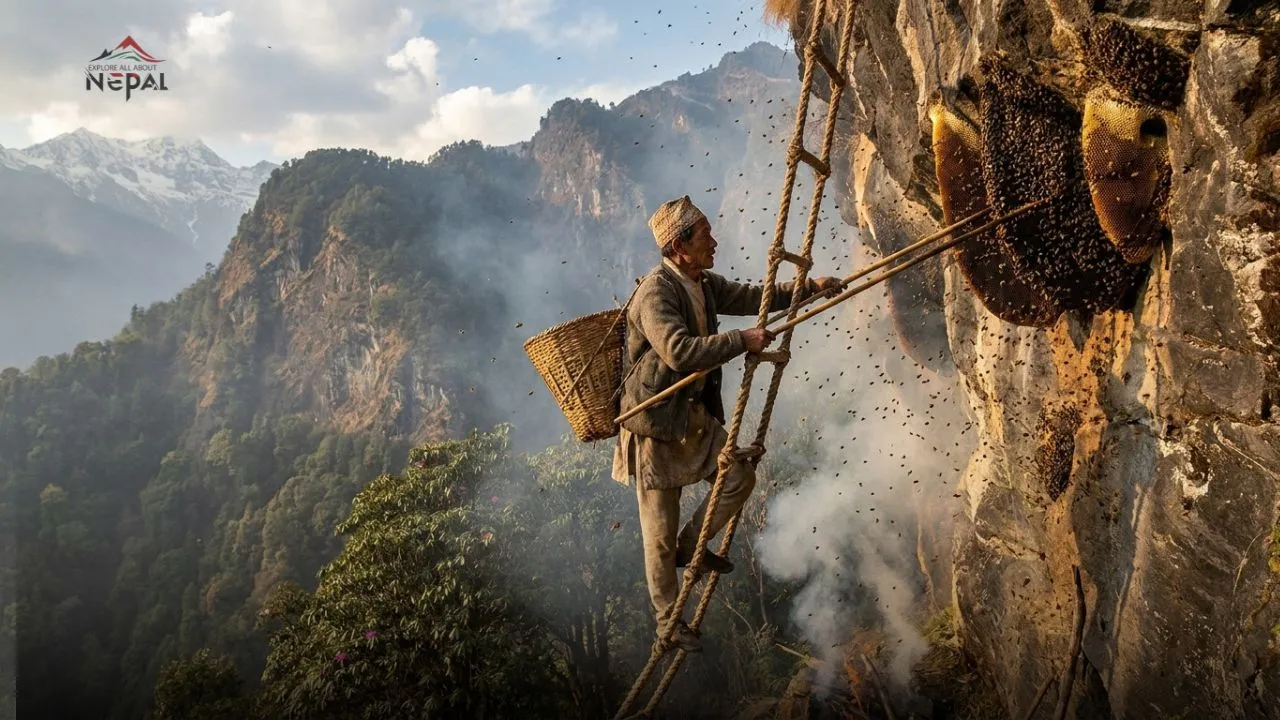
High in the cliffs of Nepal’s Lamjung district, Gurung honey hunters lower themselves down hand-knotted rope ladders over 300-foot drops to reach the nests of the world’s largest honeybee Apis dorsata laboriosa and harvest what locals call maule and the rest of the world has come to know as mad honey. It is the only honey on Earth that causes hallucinations. It has been used medicinally for centuries in Nepal, sold at extraordinary prices to buyers in South Korea and China, and documented in photographs that have become some of the most shared adventure images in modern media.
This is the complete guide to Nepal’s mad honey what it is, why it does what it does, where it comes from, who harvests it, and everything you need to know before considering seeking it out.
What Is Mad Honey?
Mad honey is a rare variety of honey produced by bees that feed predominantly on rhododendron flowers containing grayanotoxins naturally occurring neurotoxic compounds found in the nectar of Rhododendron ponticum and related species. When bees collect nectar from these flowers and process it into honey, the grayanotoxins are concentrated rather than neutralized, producing honey with genuinely psychoactive properties.
Nepal’s mad honey comes specifically from the cliff nests of Apis dorsata laboriosa the Himalayan giant honeybee, the world’s largest bee species, which builds massive exposed comb nests on vertical cliff faces at elevations of 2,500–3,500m. These bees forage extensively in the rhododendron forests that blanket Nepal’s mid-hills during spring flowering season, producing honey with the highest grayanotoxin concentration of any mad honey found anywhere in the world.
The result is a honey unlike any other reddish in color rather than golden, slightly bitter in taste, and capable at small doses of producing genuine altered states including dizziness, visual disturbances, slowed heart rate, and a warmth described by many users as deeply relaxing. At higher doses it causes vomiting, loss of coordination, and in rare cases cardiac arrhythmia serious enough to require medical intervention.
Where Does Nepal’s Mad Honey Come From?
The geographical source of Nepal’s mad honey is remarkably specific. The primary production areas are:
Lamjung District the epicenter of Nepal’s mad honey trade, where the Gurung communities of the Annapurna foothills have harvested cliff honey for generations. The village of Bhujung in Lamjung is widely cited as the heart of the traditional honey hunting culture.
Kaski and Parbat Districts neighboring areas with similar cliff topography and rhododendron forest coverage, producing smaller quantities of mad honey.
Dolakha and Sindhupalchok Districts eastern Nepal also has populations of Apis dorsata laboriosa and produces some mad honey, though in smaller quantities than the Lamjung region.
The critical environmental factor is the altitude-rhododendron combination the nests must be at elevations where rhododendrons are the dominant flowering plant during spring foraging season, and where cliff faces are steep enough to be inaccessible to most predators. Nepal’s mid-Himalayan geography, with its combination of sheer cliff faces and dense rhododendron forest at 2,500–3,500m, creates ideal conditions found in very few other places on Earth.
The Gurung Honey Hunters: A Tradition Centuries Old
The harvest of cliff honey in Nepal’s Lamjung district is performed by Gurung men members of the Gurung ethnic community who have maintained this specific tradition across generations, passing knowledge of nest locations, harvest timing, and technique from father to son.
The process is genuinely extraordinary by any measure of human risk tolerance.
The equipment: Handmade bamboo or hemp rope ladders up to 100m long, woven by the hunters themselves. A long bamboo pole fitted with a cutting tool at one end the tangay used to slice sections of honeycomb from the nest. Smoke pots to calm the bees. Traditional wicker baskets to receive the falling honeycomb sections. No modern climbing equipment, no harness, no backup rope system by traditional practice.
The process: The honey hunter descends the ladder to the cliff face level of the nest often hanging free in open air hundreds of feet above the valley floor. The smoke calms the bees, buying a narrow working window. The hunter cuts sections of comb with the tangay pole, directing falling pieces into baskets below managed by assistants on the valley floor or cliff ledge above. Meanwhile, the colony sometimes containing 100,000+ bees responds to the intrusion with increasing intensity. The experienced hunter works quickly, reading the colony’s behavior and knowing when to retreat before the defensive response becomes overwhelming.
The risk: Falls, bee stings at sufficient volume to cause anaphylactic responses, and equipment failure are the primary dangers. Serious accidents do occur this is not a romanticized risk but a genuine one. The hunters manage it through experience, collective knowledge, and traditional protocols built over generations.
The harvest timing: Mad honey is harvested twice a year spring (April–June) and autumn (September–November). The spring harvest is considered more potent because rhododendrons are in full bloom during the spring foraging period, producing honey with higher grayanotoxin concentration. Autumn honey from the same nests is typically milder.
The Science Behind the Hallucination
Grayanotoxins work by binding to sodium channels in cell membranes and preventing them from closing normally keeping nerve and muscle cells in a persistently activated state. This affects both the nervous system and the cardiovascular system simultaneously.
In the nervous system: Altered sensory perception, dizziness, numbness or tingling in extremities, visual disturbances, and at higher doses, genuine hallucinatory states. Users consistently describe a warming sensation spreading through the body followed by a dreamlike detachment from physical sensations the effect described in traditional Gurung medicinal use as deeply relaxing and therapeutic.
In the cardiovascular system: Bradycardia (slowed heart rate) and hypotension (lowered blood pressure) are the primary effects. At low doses these are mild and transient typically resolving within 24 hours without intervention. At higher doses, particularly in individuals with pre-existing cardiac conditions, grayanotoxin poisoning can cause cardiac arrhythmia serious enough to require atropine treatment or hospitalization.
Why it doesn’t affect bees: Honeybees process grayanotoxins through enzymatic pathways that neutralize their effects the same mechanisms that allow bees to handle many toxic plant compounds that would harm mammals.
Why the effects are dose-dependent: A teaspoon of genuine high-potency Lamjung mad honey is a medicinal dose producing mild warmth and relaxation. A tablespoon may produce significant dizziness, nausea, and visual disturbance lasting several hours. Three tablespoons can cause clinical grayanotoxin poisoning requiring medical management. The margin between therapeutic and toxic dose is narrower than most users expect.
Traditional Medicinal Uses
In the Gurung communities of Lamjung and among traditional healers across Nepal’s mid-hills, mad honey has been used medicinally for centuries not recreationally. The traditional applications include:
Hypertension treatment: Small daily doses (approximately half a teaspoon) are used to lower blood pressure a pharmacologically plausible application given grayanotoxin’s documented hypotensive effects.
Diabetes management: Traditional use as a glucose-regulating substance, though clinical evidence for this application is limited.
Wound treatment: Topical application to skin conditions and minor wounds consistent with honey’s general antimicrobial properties.
Gastrointestinal complaints: Used for stomach complaints and as a general digestive aid at sub-psychoactive doses.
Sexual enhancement: A widely reported traditional use that has driven significant commercial demand from South Korean and Chinese buyers the grayanotoxin-induced vasodilation and altered sensation being the proposed mechanism.
The key distinction is dose and intention traditional Gurung medicinal use involves small, carefully calibrated quantities for specific health purposes, managed by people with generational knowledge of appropriate dosing. The recreational use that’s driven modern international attention involves larger quantities taken by people with no cultural knowledge of appropriate dosing a genuinely different and higher-risk use pattern.
The Global Market: From Cliff Face to Seoul
The international market for Nepal’s mad honey has grown dramatically in the past decade, driven primarily by demand from South Korea and China where it’s marketed as a sexual enhancement product and alternative medicine, and increasingly from Western markets where it’s sought by the alternative wellness and psychedelic-adjacent communities.
The price: Genuine, high-potency Lamjung mad honey sells for $60–$80 per kilogram at the source in Lamjung. By the time it reaches urban Nepali markets (Kathmandu’s Thamel district, Pokhara) the price rises to $100–$150/kg. International shipping to South Korea, China, or the US pushes retail prices to $200–$400/kg or higher for verified authentic product.
The counterfeit problem: The price differential and international demand have created a significant counterfeit market. Much of what’s sold as “mad honey” online, in Kathmandu tourist shops, and in international markets is standard honey mixed with herbs or simply ordinary honey repackaged with mad honey branding. Genuine grayanotoxin-containing honey from wild cliff nests is produced in limited quantities the global supply cannot satisfy the demand that internet attention has created.
How to verify authenticity: Genuine mad honey should have:
- A distinctly reddish or reddish-amber color rather than golden yellow
- A slightly bitter or astringent taste alongside the sweetness
- A specific warmth sensation beginning within 20–30 minutes of consumption
- Sourcing documentation from Lamjung or verified Gurung honey hunter cooperatives
Legal status: Mad honey is not a controlled substance in Nepal, the US, UK, Australia, or most Western countries. It occupies a legal grey area it’s not regulated as a drug, but its grayanotoxin content means it can technically be classified as an adulterant to food at high concentrations. International shipping of mad honey is generally legal but sits in a regulatory ambiguity that varies by destination country.
Where to Find Mad Honey in Nepal
Lamjung District directly: The most authentic and most affordable source. The village of Bhujung in Lamjung is the heart of the honey hunting community reaching it requires a 2–3 day trek from Besisahar (the same starting point as the Manaslu Circuit), and visiting during harvest season (April–June or September–November) offers the possibility of witnessing the honey hunt itself.
Pokhara markets: Pokhara’s Lakeside area has several shops selling mad honey with varying authenticity the proximity to Lamjung means Pokhara is a more reliable source than Kathmandu for genuine product. Ask specifically for honey from Lamjung’s Gurung hunters and look for the reddish color.
Kathmandu (Thamel): Available but higher counterfeit risk. Thamel shops catering to tourists carry mad honey at tourist prices verify carefully before purchasing.
Online from Nepal: Several Gurung honey hunter cooperatives now sell directly online with international shipping search specifically for Lamjung Gurung honey cooperatives rather than generic “mad honey Nepal” results, which are dominated by resellers and counterfeit products.
The Photography That Made Mad Honey Famous
The global awareness of Nepal’s mad honey owes an enormous debt to a specific body of photography primarily the work of photographer Eric Valli, whose 1988 National Geographic feature on the Gurung honey hunters of Lamjung produced images of extraordinary power that introduced the world to this tradition.
Valli’s photographs of elderly Gurung men descending rope ladders above near-vertical cliff faces, surrounded by enormous bee swarms, harvesting comb from nests larger than dining tables — created a visual vocabulary for the honey hunt that has made these images some of the most reproduced adventure photography in the world.
The photography has since attracted numerous documentary filmmakers, adventure photographers, and travel journalists to Lamjung and has been both a blessing and a complication for the Gurung communities, bringing economic attention to a tradition that might otherwise have remained entirely local while also creating commercial pressures that have begun to change the practice itself.
Safety: What You Need to Know Before Trying Mad Honey
Given the global recreational interest, this section addresses the genuine safety considerations directly rather than either sensationalizing or dismissing the risks.
The dose question is critical. There is no universally safe dose because grayanotoxin concentration varies significantly between batches spring harvest from peak-rhododendron-bloom areas is meaningfully stronger than autumn harvest or honey from areas with lower rhododendron density. Starting with a very small quantity (a quarter teaspoon or less) and waiting a full hour before considering more is the minimum harm-reduction approach.
Cardiac risk is real. People with pre-existing heart conditions, arrhythmias, or hypertension face genuinely elevated risk from grayanotoxin’s cardiovascular effects. Mad honey is not appropriate for anyone with cardiac history this is not a precautionary disclaimer but a physiologically significant risk.
Drug and medication interactions. Grayanotoxin’s cardiovascular effects can interact with beta-blockers, calcium channel blockers, and other cardiac medications in ways that potentiate both the medication and the grayanotoxin effects.
If poisoning occurs: Symptoms of grayanotoxin poisoning include significant bradycardia, hypotension, excessive salivation, vomiting, and loss of coordination. Medical treatment involves atropine administration and supportive care hospitals in Kathmandu and Pokhara are familiar with grayanotoxin poisoning cases given Nepal’s tourist interest in the product.
Seek medical attention if: Heart rate drops significantly below your resting rate, you experience chest pain, you cannot stand without assistance, or symptoms don’t begin improving within 4–6 hours.
The Future of the Honey Hunt
The Gurung honey hunting tradition faces genuine pressures in 2026 that threaten its continuation in its traditional form:
Commercial demand changing the harvest: International demand has incentivized some communities to harvest more frequently and from previously protected nests, potentially disrupting the bee populations that make the tradition possible.
Climate change affecting rhododendron timing: Shifting bloom seasons affect when and where bees can forage on rhododendrons, potentially altering grayanotoxin concentrations and harvest timing in ways that traditional knowledge doesn’t fully account for.
Younger generation migration: Many young Gurung men are choosing education and urban employment over learning the honey hunting tradition the knowledge transfer that has sustained the practice across generations is becoming less reliable.
Tourism interest: The photography-driven fame of the honey hunt has brought tourist interest to Lamjung that some communities welcome (income diversification) and others find disruptive to traditional practice.
The honey hunt continues but the version that exists in 2026 is already different from what Eric Valli photographed in 1988, and the trajectory suggests further change regardless of what conservation efforts are made.
Frequently Asked Questions
What is Nepal’s mad honey?
Mad honey is a rare hallucinogenic honey produced by the Himalayan giant honeybee (Apis dorsata laboriosa) from rhododendron nectar containing grayanotoxins naturally occurring neurotoxic compounds that cause altered states, dizziness, visual disturbances, and slowed heart rate when consumed. Nepal’s Lamjung district produces the world’s highest-potency mad honey.
Is mad honey legal?
In Nepal and most Western countries including the US, UK, and Australia, mad honey is not a controlled substance. It occupies a legal grey area as a food product not regulated as a drug but containing a substance (grayanotoxin) that can be classified as an adulterant at high concentrations. International shipping is generally legal but varies by destination country.
How much does Nepal’s mad honey cost?
At source in Lamjung: $60–$80/kg. In Kathmandu and Pokhara tourist markets: $100–$150/kg. International retail: $200–$400/kg or higher for verified authentic product.
What does mad honey do to you?
At small doses: warmth, relaxation, mild dizziness, and a dreamlike quality lasting 2–6 hours. At moderate doses: significant dizziness, nausea, visual disturbances, and slowed heart rate. At high doses: clinical grayanotoxin poisoning requiring medical management including atropine treatment.
Where can I buy authentic mad honey in Nepal?
The most reliable sources are Lamjung district directly during harvest season, Pokhara’s Lakeside market (closer to source than Kathmandu), and verified Gurung honey hunter cooperatives selling online. Thamel’s tourist shops carry it but with higher counterfeit risk.
Can you watch the honey hunt in Nepal?
Yes visiting Lamjung during harvest season (April–June or September–November) and arranging a visit through community tourism programs in Bhujung village gives access to the honey hunt. Some photographers and documentary makers have embedded with hunting teams for extended periods.
Is mad honey safe?
At very small doses and in healthy individuals without cardiac conditions, the risk is low. The primary genuine risks are cardiac bradycardia and hypotension at higher doses that can be serious in people with pre-existing heart conditions. Start with an extremely small quantity, never consume alone, and avoid entirely if you have any cardiac history or take cardiac medications.
Why is Nepali mad honey more potent than other mad honeys?
Nepal’s Apis dorsata laboriosa the world’s largest honeybee forages at higher altitudes and in denser rhododendron forest than most other grayanotoxin-honey-producing bee populations globally. The combination of species, altitude, and rhododendron density produces higher grayanotoxin concentrations than Turkish mad honey or other known sources.
