
Spectacular panoramic view from Gokyo Ri summit
In the vast theater of the Himalayas, where every turn of the trail offers a new peak, the Gokyo Ri view stands as the undisputed masterpiece of the Everest region. While the Everest Base Camp (EBC) trek holds the name recognition, seasoned adventurers and professional photographers know a secret: if you want to actually see the mountains rather than just stand at their feet, you must climb Gokyo Ri.
Standing at an elevation of $5,357$ meters ($17,575$ feet), the Gokyo Ri view provides a 360-degree amphitheater of ice and stone. From this single point, you can witness four of the world’s fourteen “eight-thousanders” in a single panoramic sweep: Mount Everest ($8,848$m), Lhotse ($8,516$m), Makalu ($8,485$m), and Cho Oyu ($8,188$m). But the Gokyo Ri view is more than just a list of high altitudes; it is the unique composition of the turquoise Gokyo Lakes and the massive Ngozumpa Glacier,the longest in Nepal,that makes this vista the most photogenic in the world.
For many, the journey starts in the vibrant streets of the capital. If you find yourself with a free evening before your flight to Lukla, experiencing the jazz festivals and live music in Kathmandu is the perfect way to soak in the local culture before the silence of the high mountains takes over.
Chapter 1: The Geography of the Gokyo Ri View
The Gokyo Ri view is defined by three distinct geographical layers that work in perfect harmony to create a visual feast. To understand the scale, one must look at the official Nepal Tourism Map to see how the Gokyo Valley sits parallel to the main EBC trail.
1. The Turquoise Lakes (The Foreground)

Close-up of the turquoise Gokyo Lakes reflecting Himalayan peaks, captured from the Gokyo Ri view
Directly beneath the peak lie the sacred Gokyo Lakes. These are oligotrophic glacial lakes, meaning they are crystal clear and low in nutrients, resulting in a deep, sapphire-blue color. When looking down from the summit, the Gokyo Ri view allows you to see the Third Lake (Dudh Pokhari) reflecting the surrounding peaks like a mirror. The spiritual significance of these lakes is immense, often attracting pilgrims during the Janai Purnima festival.
2. The Ngozumpa Glacier (The Midground)
Stretching for $36$ kilometers ($22$ miles), the Ngozumpa Glacier is a living, breathing river of ice. From the Gokyo Ri view, the glacier looks like a rugged, debris-covered scar across the landscape, contrasting sharply with the smooth, white summits above. It is the longest glacier in the Himalayas, and its slow, grinding movement is audible if you sit quietly at the summit.
3. The Himalayan Giants (The Background)
The horizon is dominated by the “Big Four.” Unlike the view from Kala Patthar, where Everest is partially obscured by the West Shoulder, the Gokyo Ri view offers a more balanced perspective, showing the full bulk of Everest and the dramatic ridge line connecting it to Lhotse. The sight of Cho Oyu, the sixth-highest mountain in the world, standing like a sentinel to the north, completes this unmatched Gokyo Ri view.
Chapter 2: Essential 2026 Logistics: Permits and Rules
Navigating the logistics for the Gokyo Ri view in 2026 involves strict adherence to the latest government safety mandates.
The Mandatory Guide Regulation
As of 2026, the Nepal government has strictly implemented the Mandatory Guide Rule for all high-altitude trekking regions. You can no longer trek to the Gokyo Ri view solo. This regulation was introduced to minimize search-and-rescue operations and support the local economy. For more on this, read our guide on how to hire a porter in Nepal.
Permits Required
To stand and witness the Gokyo Ri view, you must secure two main permits:
Khumbu Pasang Lhamu Rural Municipality Permit: Approx. 3,000 NPR.
Sagarmatha National Park Entry Permit: Approx. 3,000 NPR.
These can be obtained in Lukla or Monjo. Note that the old TIMS card is largely replaced by these local permits in the Everest region.
Chapter 3: The 14-Day Itinerary for the Best Gokyo Ri View
A successful trek to the Gokyo Ri view requires a slow, calculated ascent. Pushing too fast will almost certainly result in Acute Mountain Sickness (AMS).
Day 1: Arrival in Kathmandu ($1,400$m): Gear shopping in Thamel and perhaps some live music.
Day 2: Kathmandu to Lukla and Phakding ($2,610$m): The famous flight to the world’s most dangerous airport.
Day 3: Phakding to Namche Bazaar ($3,440$m): Crossing high suspension bridges over the Dudh Koshi.
Day 4: Acclimatization in Namche: Hike to the Everest View Hotel for a “preview” of the Gokyo Ri view.
Day 5: Namche to Dole ($4,200$m): Leaving the main EBC trail for the quieter Gokyo path.
Day 6: Dole to Machhermo ($4,470$m): A steady climb through rhododendron forests.
Day 7: Machhermo to Gokyo Village ($4,790$m): Walking alongside the first and second lakes to reach the third lake.
Day 8: The Summit of Gokyo Ri ($5,357$m): The day you finally achieve the Gokyo Ri view.
Day 9: Fifth Lake and Scoundrel’s Viewpoint: An extra day to see the north face of Everest.
Day 10-14: The Descent: Returning via Phortse or retracing your steps to Lukla.
Chapter 4: Photography Tips: Capturing the Gokyo Ri View
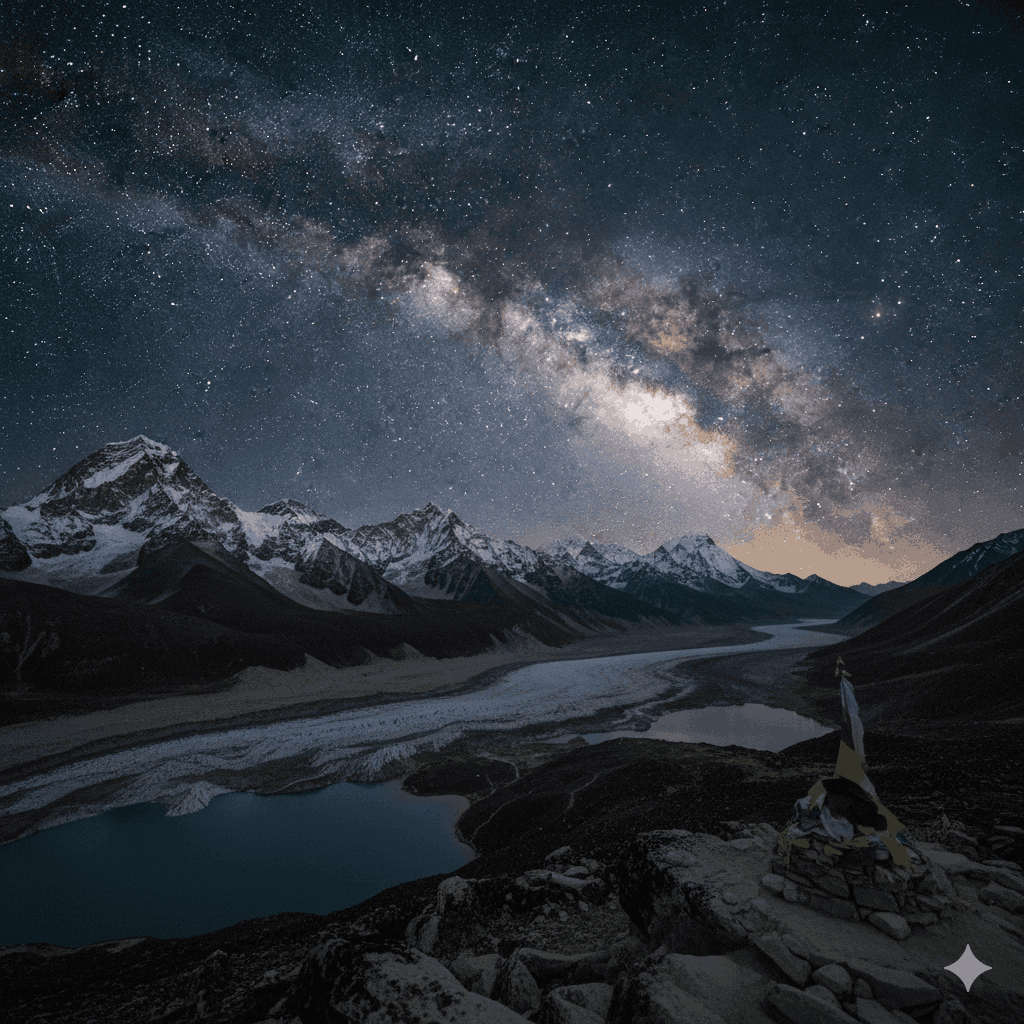
Nighttime view from Gokyo Ri showcasing the Milky Way over the Himalayan peaks
The Gokyo Ri view is widely considered the best landscape photography spot in Nepal. To capture it effectively:
Golden Hour: The sun rises behind Mount Everest. While this creates a silhouette, the light hitting the Gokyo Lakes below is magical. For a direct light on Everest, the Gokyo Ri view at sunset is actually superior.
Astro-Photography: Because of the zero light pollution, the Gokyo Ri view at night offers a clear window into the Milky Way.
Filters: Use a Circular Polarizer to cut the glare on the glacial lakes and make that turquoise color “pop” in your photos of the Gokyo Ri view.
Equipment: The cold at $5,357$m will kill your batteries. Keep them in your sleeping bag at night.
Chapter 5: Financial Blueprint: Costs for 2026
The Gokyo Ri view comes at a price. In 2026, the average cost for a 14-day trek ranges from $1,400 to $2,200 USD.
| Expense | Estimated Cost | Notes |
| Lukla Flights | $360 Round Trip | Often departs from Ramechhap in peak season. |
| Guide & Porter | $30 – $50 / Day | Mandatory for 2026. |
| Food & Lodge | $40 – $60 / Day | Prices increase as you get closer to the Gokyo Ri view. |
You might wonder, “Are there ATMs in the mountains of Nepal?” There are ATMs in Namche Bazaar, but they are notoriously unreliable. It is best to carry all your cash from Kathmandu. Also, check if you can use your credit card in Nepal for initial bookings.
Chapter 6: Health, Safety, and Altitude Sickness
Reaching the Gokyo Ri view is a physical feat. You are ascending to an altitude where oxygen is 50% thinner than at sea level.
Acclimatization Principles
Walk Slow: Your guide will tell you “Bistari, Bistari” (Slowly, Slowly). Listen to them.
Hydration: Drink at least 4 liters of water daily. The dry mountain air dehydrates you faster than you realize.
Hike High, Sleep Low: Use your rest days in Namche and Gokyo to hike a few hundred meters higher than where you will sleep. This prepares your blood for the Gokyo Ri view altitude.
When to Turn Back
If you experience persistent headaches, nausea, or loss of coordination, you must descend. No Gokyo Ri view is worth a life-threatening case of HAPE or HACE. We recommend checking Himalayan Rescue Association for the latest safety protocols.
Frequently Asked Questions (FAQs)
Q1: Is the Gokyo Ri view better than Kala Patthar?
Most seasoned trekkers and photographers prefer the Gokyo Ri view. While Kala Patthar is closer to Everest, the Gokyo Ri view offers a 360-degree panorama including four $8,000$m peaks and the stunning lakes, which Kala Patthar lacks.
Q2: Can I do this trek without a guide in 2026?
No. New regulations for 2026 make it mandatory to have a licensed guide for all treks in the Sagarmatha National Park area, including the route to the Gokyo Ri view.
Q3: Is there Wi-Fi at Gokyo?
Yes, most lodges in Gokyo village offer “Everest Link” cards. However, the connection is often blocked by the mountains that make the Gokyo Ri view so famous.
Q4: What should I wear for the summit climb?
The climb to get the Gokyo Ri view usually starts at 3 or 4 a.m. Temperatures can be as low as $-15$°C. You will need a heavy down jacket, thermal layers, and windproof trousers.
Q5: Are the lakes always blue?
In winter (December-February), the lakes are frozen and covered in snow. To see the turquoise water in your Gokyo Ri view, visit in late Spring or Autumn.
Standing on the summit of Gokyo Ri, the world feels both infinite and intimate. The Gokyo Ri view is more than just a reward for a long walk; it is a perspective shift. You see the fragility of the glaciers, the strength of the Sherpa culture, and the sheer majesty of the highest points on Earth. In 2026, as the world becomes busier, the silence found while gazing at the Gokyo Ri view is perhaps the most valuable thing you can bring home.
