
📋 Quick Reference The 10 Mistakes
- 🏔️ Underestimating altitude sickness
- 🏢 Not verifying your trekking agency
- 📋 Getting TIMS and permits wrong
- 💵 Arriving unprepared for Nepal’s cash economy
- 🎉 Not understanding what Dashain closes
- ✈️ The Manthali airport surprise
- ⏰ Leaving permits too late
- 💰 Misunderstanding tipping culture
- 🚗 Underestimating Kathmandu traffic
- 📅 Mistiming the seasons
Nepal has a seductive way of appearing straightforward from a distance.
The Instagram feed makes it look like a sequence of dramatic mountain views, smiling teahouse hosts, and photogenic monastery courtyards accessible to anyone willing to lace up a pair of boots. The travel blogs many of them written after a single visit by someone who got lucky with weather, logistics, and a good guide tend to compress the genuine complexity of Nepal travel into a reassuring narrative of effortless adventure.
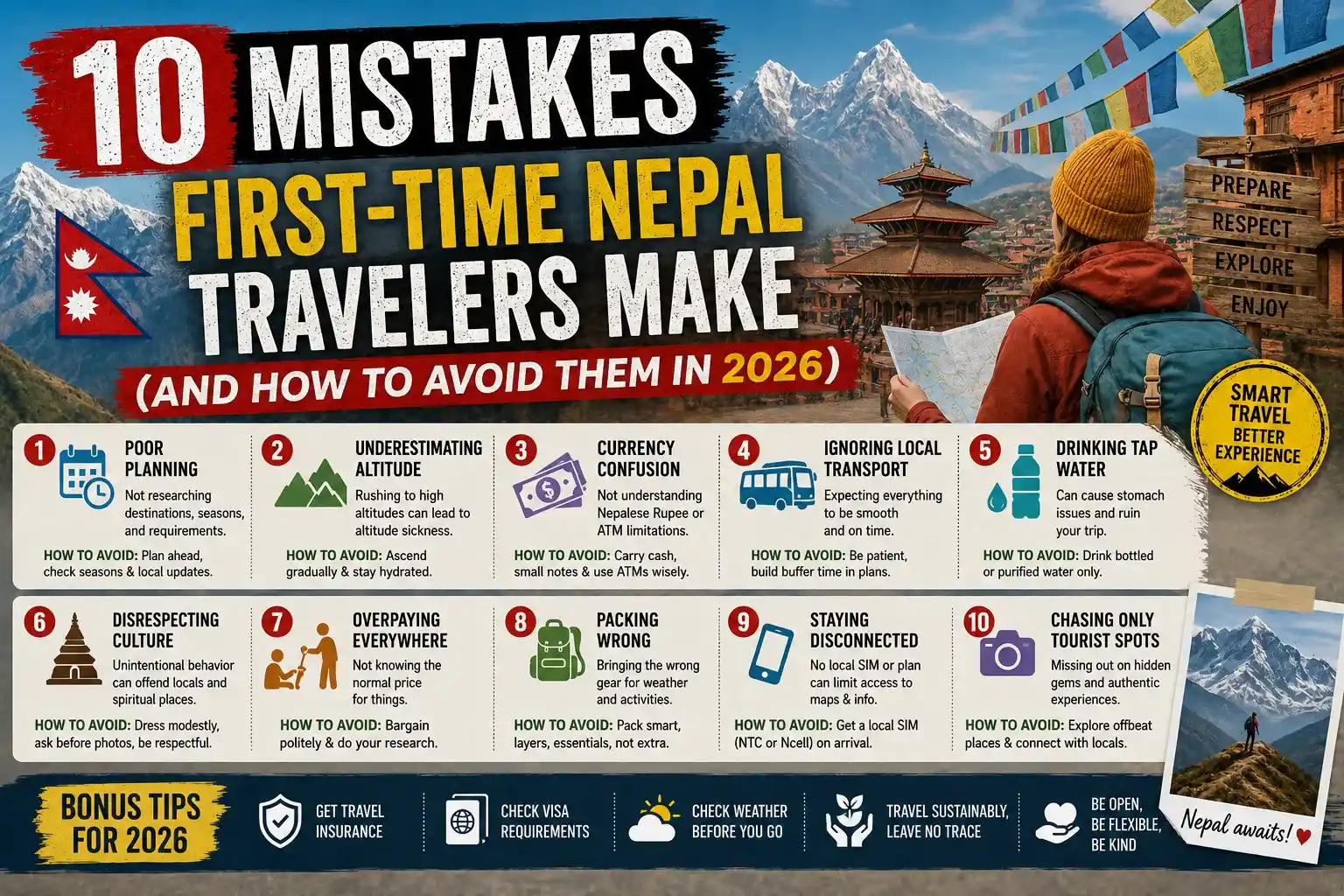
10 Things Every First-Time Nepal Visitor Gets Wrong And How to Avoid Each One
Then first-time visitors arrive. And they discover, sometimes in uncomfortable ways, that Nepal rewards preparation in a manner that few destinations on Earth quite match and punishes the lack of it with an efficiency that feels almost personal.
The mistakes that follow are not obscure edge cases. They are the consistent, recurring, entirely avoidable errors that experienced Nepal trekking operators, Kathmandu-based guides, and veteran Himalayan travelers observe first-time visitors making season after season. Each one is fixable with the right information which is precisely what this guide provides.
Mistake 1 Underestimating Altitude Sickness
What First-Timers Get Wrong
Altitude sickness is the single most dangerous mistake on this list and the most consistently underestimated. First-time trekkers arrive in Nepal having read that “acclimatisation is important” and interpret this as a vague general principle rather than a non-negotiable physiological reality.
The specific error takes several forms:
- Believing that physical fitness provides protection against altitude sickness it does not. Acute Mountain Sickness (AMS) is a democratic affliction. Elite marathon runners, experienced mountaineers making their first Himalayan visit, and 25-year-olds in peak physical condition develop AMS at exactly the same statistical rate as unfit sedentary travelers. Fitness determines how fast you hike; it has no bearing on how your body responds to reduced atmospheric oxygen
- Underestimating how rapidly altitude increases on the EBC trail. Trekkers fly into Lukla at 2,860m and, if they follow an aggressive schedule, can reach Namche Bazaar (3,440m) in two days and Dingboche (4,410m) within five days. This ascent profile driven by schedule pressure or overconfidence is how AMS cases and, in serious instances, High Altitude Cerebral Oedema (HACE) and High Altitude Pulmonary Oedema (HAPE) develop
- Ignoring early symptoms. Mild headache, slight nausea, disrupted sleep, and reduced appetite are not “just tiredness from trekking.” They are the body communicating that acclimatisation is incomplete. Trekkers who push through these signals instead of resting frequently report a dramatic deterioration within 24 hours
How to Get It Right
Follow the golden rule of Himalayan altitude management without exception: never ascend more than 300–500 vertical metres per day above 3,000m, and build in a rest day every three days of climbing.
The standard EBC itinerary builds these acclimatisation days in the mandatory rest day in Namche Bazaar is not an optional buffer, it is a physiological requirement. Do not negotiate it away to save a day.
Carry a personal pulse oximeter (available for under $25) and check your blood oxygen saturation (SpO2) each morning. Readings above 90% at altitude are generally acceptable; readings below 85% combined with symptoms warrant serious attention. Discuss Diamox (acetazolamide) prophylaxis with your doctor before travel it is not mandatory but is a proven preventive tool for altitude-susceptible individuals.
The definitive rule: if symptoms develop, do not ascend. If symptoms worsen, descend immediately. No summit, no schedule, no sunk cost justifies ignoring that rule.
Mistake 2 Not Verifying Your Trekking Agency
What First-Timers Get Wrong
Nepal’s trekking agency landscape is vast, largely unregulated at its lower end, and populated by a spectrum ranging from superbly professional operators with decades of experience to recently formed enterprises with minimal guide training, inadequate emergency protocols, and insurance arrangements that exist on paper rather than in practice.
First-time visitors frequently book trekking agencies based on:
- The lowest price on a comparison website
- A persuasive response to a WhatsApp enquiry
- A recommendation from a travel forum post written three years ago
- A friendly approach from a tout in Thamel
None of these selection methods adequately assess whether an agency will provide a qualified guide, appropriate emergency support, genuine insurance coverage, and the institutional knowledge to manage the genuine risks of high-altitude trekking.
How to Get It Right
Nepal’s legitimate trekking industry has a straightforward verification infrastructure use it:
- ✅ Check the agency’s registration with the Trekking Agencies’ Association of Nepal (TAAN) taan.org.np maintains a searchable member database
- ✅ Verify their Nepal Tourism Board (NTB) registration
- ✅ Confirm your assigned guide holds a Nepal Government Licensed Trekking Guide certificate guides are required to complete government-approved training and certification
- ✅ Ask explicitly for their emergency evacuation protocol and the name of their helicopter rescue insurance provider
- ✅ Request client references from the previous 12 months specifically, and contact them
Price is a signal, not just a comparison point. A reputable agency providing a licensed guide, proper insurance, quality gear, and genuine emergency support cannot deliver that package for $30 per day. If the quote seems implausibly cheap, it is because something essential has been removed from the package.
Mistake 3 Getting TIMS and Permits Wrong
What First-Timers Get Wrong
Nepal’s trekking permit system confuses first-time visitors more consistently than almost any other logistical element of the trip and the confusion has real consequences. Trekkers are turned back at checkpoints. Fines are issued. Itineraries are disrupted. In some cases, trekkers have paid for duplicate permits they didn’t need or skipped permits they did.
The specific confusions:
- Believing TIMS (Trekkers’ Information Management System) is a universal single permit covering all trekking it is not. TIMS is a registration system, not a conservation area permit, and the two are different documents serving different purposes
- Not understanding that different trekking regions require entirely different permit combinations. The Annapurna region requires a TIMS card plus an ACAP (Annapurna Conservation Area Permit). The Everest region requires a TIMS card plus a Sagarmatha National Park Entry Permit. Restricted areas including Upper Mustang and Manaslu require additional Restricted Area Permits available only through registered trekking agencies not independently
- Attempting to purchase permits at the trailhead rather than in Kathmandu or Pokhara, where processing is slower, less certain, and sometimes unavailable
How to Get It Right
Before finalising your trekking itinerary, map the specific permit requirements for your exact route:
- Annapurna Circuit / ABC / Poon Hill: TIMS card + ACAP permit
- EBC / Gokyo / Three Passes: TIMS card + Sagarmatha National Park permit
- Langtang Valley: TIMS card + Langtang National Park permit
- Manaslu Circuit: Manaslu Conservation Area permit + Restricted Area permit (agency-only)
- Upper Mustang: Annapurna Conservation Area permit + Upper Mustang Restricted Area permit ($500)
Obtain all permits in Kathmandu or Pokhara before reaching the trailhead. TIMS cards are issued at the Nepal Tourism Board offices in both cities. Budget a full morning for the permit process queues in peak October season are substantial.
Mistake 4 Arriving Unprepared for Nepal’s Cash Economy
What First-Timers Get Wrong
Nepal operates, outside Kathmandu’s tourist core, as an almost entirely cash-based economy. Trekkers who arrive expecting to manage their mountain expenses on a Visa card, Apple Pay, or Revolut make an error that becomes increasingly problematic the further from Kathmandu they travel.
The specific failures:
- Assuming ATMs are reliably available in Namche Bazaar, Pokhara’s lakeside, or trail towns ATMs exist in these locations but carry daily withdrawal limits of NPR 35,000–50,000 (approximately $260–$375), frequently run out of cash during peak season, and occasionally experience multi-day technical outages
- Not accounting for the USD cash premium at Nepal’s money changers crisp, undamaged USD bills (post-2009 issue, no tears, no pen marks) receive significantly better exchange rates than worn notes or other currencies; arriving with damaged dollars costs real money
- Underestimating total cash requirements for a two-week EBC trek teahouse accommodation, meals, hot showers, charging fees, porter tips, guide tips, and incidental purchases on a 14-day EBC trek can total NPR 80,000–150,000 (approximately $600–$1,100) beyond pre-paid package costs
How to Get It Right
Withdraw substantial Nepali Rupees in Kathmandu before leaving for the trailhead. Thamel has multiple reliable ATMs and money changers with competitive rates. The standard guidance from experienced operators: carry more cash than you think you need, because running short above Namche has no good solution.
Bring USD cash as backup clean, post-2009 bills in $50 and $100 denominations exchange at the best rates. Many teahouses above 4,000m will accept USD directly for larger bills if your NPR runs short.
Mistake 5 Not Understanding What Dashain Closes
What First-Timers Get Wrong
Dashain Nepal’s most important Hindu festival, occurring over approximately 15 days in September or October is one of the most spectacular cultural events in the Himalayan calendar and a genuinely enriching time to be in Nepal.
It is also a period during which significant portions of Nepal’s service economy close or operate at dramatically reduced capacity, and first-time visitors who arrive without understanding the festival’s practical implications frequently find themselves facing closed government offices, unavailable domestic flights, inaccessible permit offices, and staffing shortages at hotels and agencies.
Specific Dashain disruptions that catch visitors unprepared:
- NTB permit offices reduce hours or close entirely during the main Dashain days (the 7th–10th day are particularly observed); trekking permits cannot be obtained
- Domestic airlines operate at reduced frequency; Lukla and Pokhara flights book out weeks in advance around Dashain as Nepali diaspora travel home
- Trekking agency staff including guides and porters take Dashain leave to return to family villages; staffing agencies during Dashain requires advance planning and often premium rates
- Government offices including immigration and the Department of National Parks operate on reduced hours; any administrative task requiring a government counter becomes significantly harder
How to Get It Right
Check the Dashain dates for your travel year before finalising your itinerary. Dashain falls on different Gregorian calendar dates each year (determined by the lunar Nepali calendar). In 2026, Dashain falls in October squarely within Nepal’s peak trekking season.
If your trip falls around Dashain: obtain all permits and complete all administrative requirements before the festival begins, book domestic flights 8–10 weeks in advance rather than the standard 4–6, and discuss your guide and porter arrangements with your agency well in advance to confirm staff availability.
Mistake 6 The Manthali Airport Surprise
What First-Timers Get Wrong
This is perhaps the most operationally surprising item on this entire list and the one that causes the most acute logistical distress among unprepared visitors.
First-time Nepal trekkers research the EBC route, learn that the approach begins with a flight to Lukla (Tenzing-Hillary Airport), book their trekking package, and assume they will depart from Tribhuvan International Airport in Kathmandu.
Many of them arrive at Tribhuvan to discover their Lukla flight departs from Manthali Airport in Ramechhap a facility located approximately 4–5 hours by road from Kathmandu, in an entirely different district.
Why does this happen? Tribhuvan International Airport’s runway capacity and airspace congestion is genuinely insufficient to handle the volume of small aircraft Lukla flights during Nepal’s peak October trekking season. To manage the congestion, the Civil Aviation Authority of Nepal periodically and in recent years, increasingly systematically during the October–November peak mandates that Lukla flights operate from Manthali rather than Tribhuvan.
This means a 4 AM hotel departure, a 4–5 hour mountain road drive to Ramechhap, and an arrival at Manthali a small, basic facility for a morning flight. It adds a full pre-dawn transit day to the EBC itinerary that appears nowhere in simplified trek descriptions.
How to Get It Right
Ask your trekking agency explicitly, at the time of booking, which airport your Lukla flights operate from during your travel dates. If your dates fall within the October–November peak window, assume Manthali operations and build the road transfer into your itinerary. Add at least one buffer night in Kathmandu before your Lukla flight date to absorb any road or weather delays.
Mistake 7 Leaving Permits Too Late
What First-Timers Get Wrong
Nepal’s most popular trekking routes operate under annual permit quotas and in peak season, those quotas fill faster than most first-time visitors anticipate.
The EBC route’s Sagarmatha National Park permit has no hard cap, but the practical constraint is Lukla flight availability which operates as a de facto capacity limit. Lukla flights in October book out 6–10 weeks in advance in strong tourism years. Trekkers who decide in August that they want an October EBC trek frequently find themselves unable to secure the Lukla flights that make it possible.
The Manaslu and Upper Mustang restricted area permits do carry daily visitor caps that genuinely sell out in peak season.
How to Get It Right
The optimal booking timeline for a peak-season Nepal trek:
- 6–8 months ahead: Agency selection, itinerary finalisation, deposit payment
- 3–4 months ahead: Domestic flight booking (Lukla especially)
- 4–8 weeks ahead: Permit acquisition in Kathmandu or through your agency
- 2–4 weeks ahead: Final gear checklist, travel insurance confirmation, currency preparation
Mistake 8 Misunderstanding Tipping Culture
What First-Timers Get Wrong
Tipping in Nepal’s trekking industry is not optional social grace it is a structural component of guide and porter income that the industry’s economics are built around. First-time visitors either skip tipping entirely (causing genuine economic harm to the individuals who made their trek possible), tip at inappropriate Western restaurant percentages (creating awkward mismatches with industry norms), or tip the guide generously while entirely forgetting the porter.
How to Get It Right
The industry-standard tipping benchmarks endorsed by the Trekking Agencies’ Association of Nepal and the International Porter Protection Group:
- Licensed trekking guide: $15–$25 USD per day (of the full trek duration, not just hiking days)
- Assistant guide: $10–$15 USD per day
- Porter: $7–$12 USD per day
Present tips in cash, in an envelope, on the final day of the trek ideally in a brief group gathering that acknowledges each individual’s contribution. Do not tip via agency bank transfer expecting it to reach field staff; hand it directly to the individuals concerned.
Tip porters directly and individually do not hand a lump sum to the guide to distribute. Porters are the most economically vulnerable members of the trekking workforce and the most frequently undertipped.
Mistake 9 Underestimating Kathmandu Traffic
What First-Timers Get Wrong
Kathmandu’s traffic is not merely busy it is, on specific routes at specific times, among the most genuinely gridlocked urban traffic in Asia. The Kathmandu Valley’s road network was never designed for its current vehicle volume, and the combination of narrow streets, frequent intersection bottlenecks, lack of traffic signal compliance, and the periodic road blockages caused by festivals, political demonstrations, or VIP motorcades creates conditions where a journey appearing to be 20 minutes on Google Maps takes 90 minutes in practice.
The consequences: missed domestic flights, missed permit office opening hours, missed tour departure times, and the specific stress of sitting in a taxi watching a Lukla flight time approach.
How to Get It Right
Apply a minimum 2x multiplier to any Kathmandu journey time estimate during morning peak hours (8:00–10:30) and evening peak (16:30–19:30). For airport transfers ahead of domestic flights, depart 3 hours before your flight time regardless of apparent distance. Ask your hotel or agency for a departure time recommendation they know the current traffic patterns and will give you a more honest estimate than any mapping application.
Mistake 10 Mistiming the Seasons
What First-Timers Get Wrong
Nepal has two outstanding trekking seasons and two periods that range from challenging to genuinely inadvisable for high-altitude trekking. First-time visitors, driven by flight deals, school holiday constraints, or simple lack of research, frequently arrive during monsoon season (June–September) expecting the mountain views that define Nepal’s promotional imagery and find cloud, rain, leeches on lower trails, and zero Himalayan visibility.
The monsoon is not universally negative Mustang and Dolpo, lying in the Himalayan rain shadow, are actually best visited in July–August when the rest of Nepal is wet. But first-time visitors planning a standard EBC or Annapurna Circuit trek need to understand the seasonal reality clearly.
How to Get It Right
The definitive Nepal trekking season guide:
| Season | Months | Verdict |
|---|---|---|
| Autumn | Oct–Nov | ⭐⭐⭐⭐⭐ Best overall crystal skies, stable weather, peak trail conditions |
| Spring | Mar–May | ⭐⭐⭐⭐ Excellent rhododendrons in bloom, good visibility, slightly more cloud than autumn |
| Winter | Dec–Feb | ⭐⭐⭐ Good for lower routes; EBC possible but cold; Annapurna Circuit snow-affected above 3,500m |
| Monsoon | Jun–Sep | ⭐ Avoid for Annapurna and Khumbu unless specifically targeting rain-shadow regions |
The One Thing That Unites All Ten Mistakes
Every error on this list shares a common root: the assumption that Nepal’s extraordinary accessibility as a travel destination no language barrier, welcoming people, well-established trekking infrastructure, straightforward e-visa translates into a destination that requires minimal preparation.
It does not. Nepal is one of the world’s great rewards for the traveler who arrives informed, flexible, and genuinely respectful of the environment, culture, and logistical complexity that makes it extraordinary. The preparation this guide describes is not bureaucratic burden it is the difference between a trip that transforms you and a trip that merely frustrates you.
The mountains will exceed every expectation you arrive with. Make sure the logistics allow you to reach them. 🏔️🙏
Explore All About Nepal provides pre-trek consultation, agency verification support, permit guidance, and seasonal planning advice for first-time and returning Nepal visitors. Get in touch before you book the best Nepal experiences begin with the right information.
