
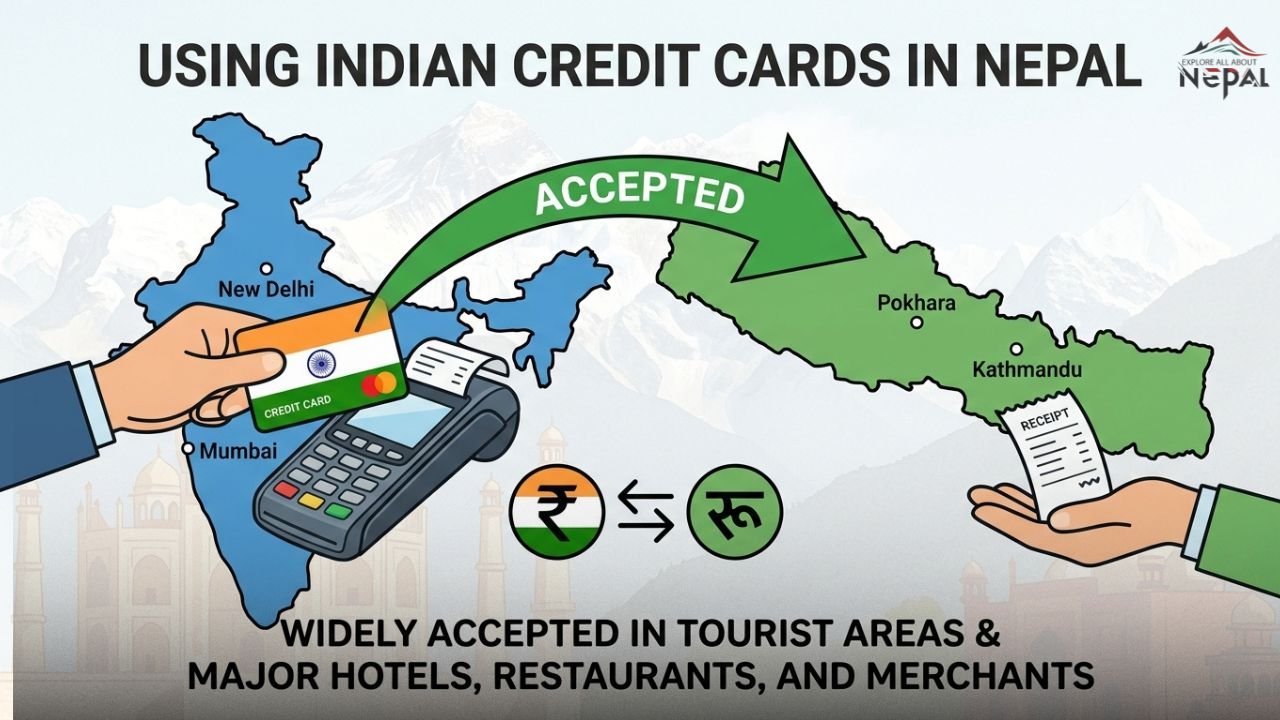
One of the most searched questions among Indian travelers planning a Nepal trip is also one of the most misunderstood: are Indian credit cards accepted in Nepal?
The honest answer requires more than a simple yes or no because the reality of using Indian cards in Nepal in 2026 is nuanced, rapidly evolving, and critically important to get right before you board your flight. Get it wrong, and you could find yourself scrambling for cash in front of a monastery, an ATM queue at 8 PM, or worse at a trekking checkpoint with no NPR in your pocket.
Get it right, and you can navigate Nepal’s payment landscape confidently knowing exactly when your Visa credit card works, when your RuPay debit card saves the day, when to scan a Fonepay QR with PhonePe, and most importantly when nothing replaces Nepali Rupees in cold hard cash.
This is your definitive, completely updated guide to the question every Indian traveler is asking: are Indian credit cards accepted in Nepal in 2026 and everything you need to know to handle money smartly on your Nepal trip.
The Short Answer: Are Indian Credit Cards Accepted in Nepal?
Yes but with important limitations.
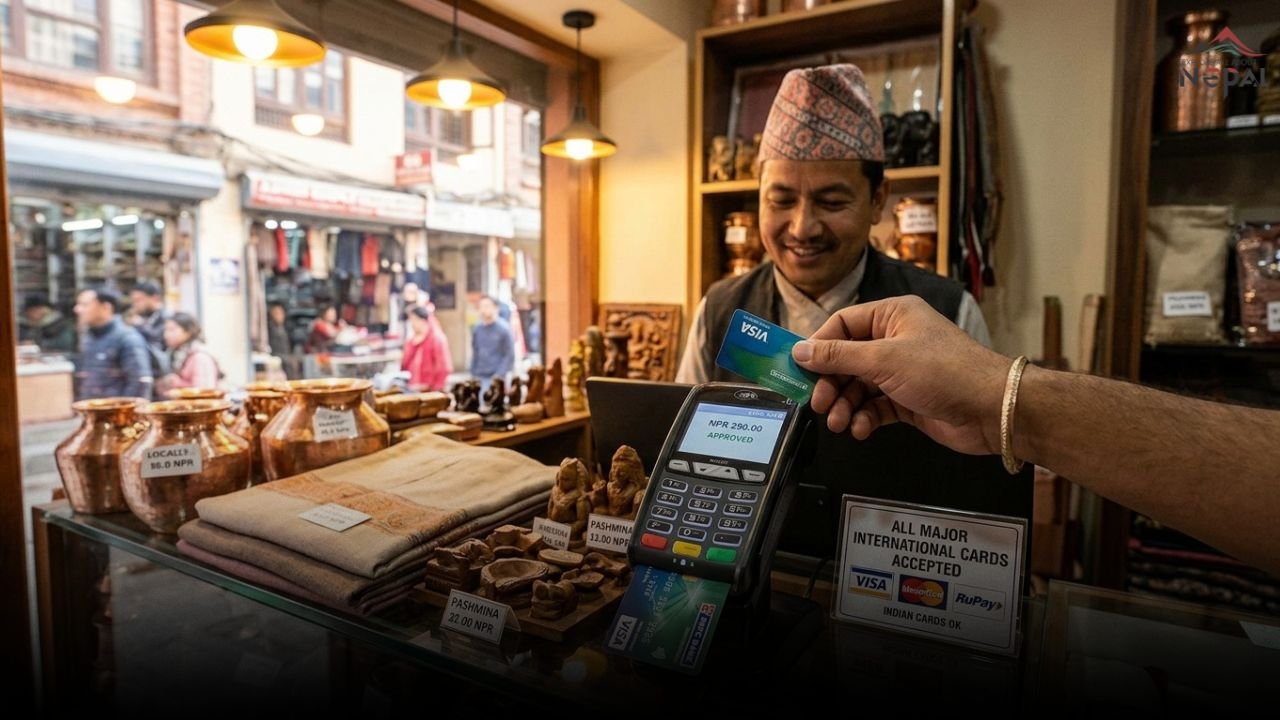
Indian credit cards bearing Visa or Mastercard network logos are accepted at selected establishments in Nepal’s major cities primarily upscale hotels, larger restaurants, established tour operators, and international-brand retail outlets in Kathmandu, Pokhara, and Chitwan tourist zones.
However, Indian Visa/Mastercard credit cards face a major structural restriction: most Indian banks do not enable international transactions on their cards for use in Nepal and Bhutan by default, due to Reserve Bank of India (RBI) regulations governing SAARC country transactions. This means many Indian travelers arrive in Nepal with perfectly functional-looking Visa or Mastercard credit cards that simply do not work at either POS terminals or ATMs not because Nepal won’t accept them, but because their Indian bank has not enabled international usage for the Nepal/Bhutan corridor.
Beyond this fundamental issue, even when Indian credit cards do work in Nepal, they carry additional costs (3–5% merchant surcharges, foreign transaction fees, currency conversion charges) that make understanding your card’s exact international policy essential before you travel.
The payment landscape for Indian travelers in Nepal in 2026 has also been transformed by two major developments:
- RuPay cards are now actively accepted at many Nepal SBI ATMs and POS terminals
- UPI (via PhonePe, Google Pay, BHIM, Paytm) is now live at Fonepay-networked merchants across Nepal
These two additions have substantially changed how Indian travelers can manage payments in Nepal making 2026 arguably the best year yet for Indians visiting Nepal in terms of payment flexibility.
Understanding Why Many Indian Credit Cards Don’t Work in Nepal
Before exploring what does work, it’s essential to understand this critical reality.
Are Indian Credit Cards Accepted in Nepal
Nepal and India share a currency relationship that is unique in global banking. The Indian Rupee (INR) and the Nepalese Rupee (NPR) are pegged at a fixed rate of 1 INR = 1.60 NPR. Because of this currency relationship and RBI regulations under the Foreign Exchange Management Act (FEMA), Indian banks treat Nepal (and Bhutan) differently from other international destinations.
The practical consequence: most standard Indian credit and debit cards bearing Visa or Mastercard logos are not enabled for international use in Nepal by default. The back of many Indian-issued Visa cards explicitly states “not valid for payment in Nepal and Bhutan.”
This is not a Nepal problem it is an Indian banking policy issue. The card network (Visa, Mastercard) would accept the transaction; it is the Indian issuing bank that has blocked the card for SAARC-corridor use.
What this means for your trip:
- If you carry an HDFC, ICICI, SBI, Axis, Kotak, or any other Indian bank-issued Visa or Mastercard credit card, you should call your bank before traveling to confirm whether your specific card is enabled for international use in Nepal
- Some premium cards (travel credit cards, super-premium categories) are enabled for international use including Nepal but this varies by card product, not by bank
- Even if the card is “internationally enabled,” actual acceptance at Nepali terminals can vary
- Debit cards from Indian banks are even more commonly restricted for SAARC international use than credit cards
Action item before your trip: Call your bank’s customer care (the number on the back of your card) and specifically ask: “Is my card enabled for international transactions in Nepal? Will it work at POS terminals and ATMs in Nepal?” Get a clear yes or no. Do not assume.
Indian Credit Cards That Generally Work in Nepal (Visa/Mastercard)
For the Indian credit cards that are internationally enabled for Nepal, here is what to expect:
Where They Are Accepted
Major hotels and resorts all 3-star, 4-star, and 5-star hotels in Kathmandu, Pokhara, and Chitwan readily accept Visa and Mastercard. Large restaurants and cafes upscale dining establishments, popular tourist cafes, and international chain outlets in areas like Thamel, Lakeside Pokhara, and Durbar Marg also accept these cards.
In practice, the establishments where internationally-enabled Indian Visa/Mastercard credit cards work in 2026 include:
- Major hotels (3-star and above) in Kathmandu (Thamel, Durbar Marg, Jhamsikhel) and Pokhara (Lakeside)
- Upscale and tourist-facing restaurants in Thamel and Lakeside
- Established trekking agencies and tour operators in Kathmandu
- Large souvenir and carpet shops catering specifically to international tourists
- International airline offices and travel booking agencies
- Some mid-range hotels in major tourist zones
Where They Are NOT Accepted
This is the more important list for trip planning:
- Teahouses and lodges on trekking routes — cash only, no exceptions
- Local restaurants and dhabas throughout Nepal
- Street food vendors and bazaar stalls
- Small and independent shops in Thamel and elsewhere
- Local transport (buses, microbuses, shared jeeps)
- National Park and permit offices at trailheads
- Most ATMs outside Kathmandu and Pokhara
- Nepal Visa on Arrival — cannot be paid by Indian credit card; USD cash only
The Merchant Surcharge Reality
The typical surcharge is 3% to 4% of the transaction value when paying by credit card (Visa/Mastercard) at hotels, restaurants, and trekking agencies. This surcharge covers the fee charged by the local bank to the merchant, and unlike in many Western countries where the merchant absorbs the transaction fee, in Nepal it is standard practice for the merchant to pass this fee directly to the customer.
On top of this Nepali merchant surcharge, your Indian bank will also apply its own foreign transaction fee typically 1.5% to 3.5% depending on your card. The combined cost of using an Indian Visa or Mastercard credit card in Nepal can therefore reach 5–7% above the actual transaction value. Always ask about the surcharge before completing a card transaction.
Pro Tip: Always select NPR (Nepalese Rupees) when paying at a terminal never choose “INR” or the Dynamic Currency Conversion (DCC) option. If you ‘Accept’ the conversion offered at ATMs or POS terminals, the machine converts your money at its own set exchange rate and you pay an extra percentage fee for currency conversion. If you ‘Decline’, the conversion happens at your card network’s (Visa, Mastercard) rate, which is almost always better.
RuPay Cards in Nepal: The Best Option for Indian Travelers in 2026
Here is one of the most significant and underreported developments for Indian travelers visiting Nepal in 2026: RuPay cards are now accepted at Nepal SBI ATMs and many POS terminals across Nepal.
Nepal SBI Bank confirms that all their ATM and POS terminals accept RuPay cards issued by Indian banks. Their POS terminals accept both domestic and international RuPay cards, whereas ATM terminals accept only international transaction-enabled RuPay cards for cash withdrawal.
NPCI International has facilitated the acceptance of UPI and RuPay for seamless cross-border transactions in Nepal, among other countries including Singapore, UAE, France, Bhutan, Mauritius, and Sri Lanka.
Why RuPay Is the Smart Card Choice for India-Nepal Travel
RuPay is India’s own domestic card payment network, created by NPCI (National Payments Corporation of India). Unlike Visa and Mastercard-branded Indian cards that face SAARC corridor restrictions at the issuing bank level, RuPay cards operate through a different framework for India-Nepal transactions one that has been specifically enabled for cross-border use.
Key advantages of using RuPay in Nepal:
- Accepted at Nepal SBI ATMs (one of the most widespread bank networks in Nepal) and many other partner POS terminals
- No SAARC-corridor blocking issue that affects Visa/Mastercard Indian cards
- Potentially lower foreign transaction fees compared to Visa/Mastercard equivalents
- Backed by NPCI International’s growing network in Nepal
Critical requirement: Your RuPay card must have international transactions enabled for ATM use. This is not enabled by default on most RuPay debit cards. Enable international usage through your bank’s net banking app or by visiting a branch before you travel.
Banks whose RuPay cards work in Nepal (ATMs and POS):
- State Bank of India (SBI) RuPay debit cards
- Bank of Baroda RuPay cards
- Punjab National Bank RuPay cards
- Canara Bank RuPay cards
- HDFC Bank RuPay debit cards (with international enabled)
- Most other major Indian banks issuing RuPay debit cards
Best practice: Before your Nepal trip, enable international transactions on your RuPay debit card via your bank’s mobile app. Test it with a small online international transaction. Carry it as a backup to your primary payment method.
UPI in Nepal: The Game Changer for Indian Travelers (2026)
The most transformative development for Indian travelers in Nepal in recent years is the launch of UPI (Unified Payments Interface) payments at Fonepay-networked merchants across Nepal.
Indian users with UPI-enabled apps such as PhonePe, Google Pay, Paytm, and BHIM can now scan QR codes displayed by Fonepay-affiliated merchants across Nepal to complete payments instantly. Payments are processed in Indian Rupees (INR) and converted instantly into Nepalese Rupees (NPR) for the merchant. The facility is live across various sectors, including hospitality, retail, travel services, and restaurants.
NPCI International Payments Limited (NIPL) and Nepal’s largest payment network, Fonepay Payment Service, announced that UPI is now live for cross-border transactions between India and Nepal. “Merchants acquired by the participating members of Fonepay Network can seamlessly accept UPI payments from Indian customers,” NPCI said.
How UPI Works in Nepal: Step-by-Step
- Enable international UPI in your PhonePe, Google Pay, or BHIM app before traveling. This is not enabled by default. Go to Settings → International Payments → Enable.
- In Nepal, look for the Fonepay QR code displayed at merchant counters. This is the standard payment QR used by most Nepali digital-payment-accepting merchants.
- Open your UPI app, select “Scan QR,” and scan the Fonepay merchant QR code.
- Enter the amount and confirm with your UPI PIN.
- The payment is deducted from your Indian bank account in INR and the merchant receives the equivalent in NPR at the current exchange rate.
- Transaction is complete instant, cashless, and without any card swipe.
The Critical PhonePe / UPI Limitation You Must Know
This is one of the most important clarifications for Indian travelers in 2026:
PhonePe UPI payments in Nepal work ONLY at Fonepay merchant QR codes. They do NOT work for person-to-person (P2P) transfers to individual Nepali mobile numbers or personal Fonepay accounts.
UPI in Nepal is strictly Person-to-Merchant (P2M) meaning you can pay a hotel, restaurant, tour agency, or shop that is registered as a merchant on the Fonepay network. You cannot send money to an individual Nepali person’s Fonepay wallet or mobile number the way you would send a UPI payment to a friend in India.
This distinction matters practically:
- ✅ Paying a hotel bill at the front desk → PhonePe/UPI works (if hotel is Fonepay merchant)
- ✅ Paying at a Thamel restaurant with a Fonepay QR code displayed → works
- ✅ Paying a registered trekking agency → works
- ❌ Sending money to your Nepali guide’s personal Fonepay account → does NOT work
- ❌ Paying a street vendor who shows you their personal QR code → does NOT work
- ❌ Splitting a bill with a Nepali friend by sending to their number → does NOT work
Which UPI Apps Work for Nepal Payments?
Indian users with UPI-enabled apps such as PhonePe, Google Pay, Paytm, and BHIM can scan QR codes displayed by Fonepay-affiliated merchants.
All major Indian UPI apps work for Nepal merchant payments PhonePe, Google Pay, Paytm, BHIM, Amazon Pay provided international UPI is enabled within the app before use.
Where UPI (Fonepay Merchant QR) is Accepted in Nepal
UPI acceptance has expanded significantly since launch in 2024 and continues to grow through 2026:
- Kathmandu: Hotels and guesthouses in Thamel, restaurants, tour operators, travel agencies, souvenir shops (look for Fonepay QR sticker at counter)
- Pokhara: Lakeside hotels, restaurants, paragliding operators, boat rental, cafes
- Chitwan: Resort hotels, safari operators
- Religious sites: Some fee-collection points at major temples
- Retail: Some supermarkets and larger retail stores in cities
Practical reality in 2026: UPI via Fonepay QR is widely accepted in tourist-facing establishments in Kathmandu and Pokhara, but penetration drops significantly in smaller towns, off-the-beaten-path areas, and trekking regions. Always confirm before assuming a merchant accepts UPI.
Indian Currency (INR) in Nepal: What’s Accepted in 2026
Understanding what Indian currency itself can and cannot do in Nepal is equally important for Indian travelers.
Following the RBI’s FEMA amendment in November 2025, Indian currency notes of all denominations (INR500, INR200, INR100, INR50, INR20) can be carried into Nepal. Notes above ₹100 denomination can be carried up to a total value of INR25,000. Notes of INR100 and below can be carried in any amount.
Indian currency notes currently accepted in Nepal:
- INR500, INR200, INR100, INR50, INR20 notes widely accepted across Nepal
- The INR2,000 note was withdrawn by RBI in 2023 and is no longer in circulation
Indian currency notes NOT accepted in Nepal:
- The INR2,000 note (demonetized; no longer valid anywhere)
- Any torn, defaced, or very worn notes may be refused or given a poor exchange rate
Indians can carry a maximum of NPR 25,000 (approximately INR15,625) into Nepal in Nepali currency.
The fixed INR-NPR exchange rate (1 INR = 1.60 NPR) means calculations are straightforward. A hotel room priced at NPR 3,200 costs exactly INR2,000. Most merchant-level exchanges in Nepal use this official rate.
ATMs in Nepal for Indian Travelers: What to Know
Which ATMs Accept Indian Cards
Automated Teller Machines are available throughout Nepal. However, only Kathmandu and Pokhara have regular “working” machines that accept international cards. Throughout the rest of the country, they exist for national banks, but not all international bank cards are accepted. Popular ATMs that accept international credit cards (Visa, Mastercard) in Kathmandu and Pokhara include Standard Chartered, Everest Bank, Nabil Bank, and Himalaya Bank.
For RuPay card ATM withdrawals specifically, Nepal SBI Bank ATMs are the most reliably confirmed network. Given that Nepal SBI is a joint venture of SBI India, the RuPay acceptance infrastructure is particularly robust at their machines.
Other ATMs in Nepal that accept international cards (Visa/Mastercard/RuPay where applicable):
- Global IME Bank — good for smaller withdrawal amounts
- Laxmi Sunrise Bank — good for larger withdrawal amounts
- NIC Asia Bank, Citizens Bank, NMB Bank — accept international cards but with varying fee structures
- Standard Chartered Nepal — reliable international card acceptance
ATM Withdrawal Limits in Nepal (2026)
ATM withdrawals are limited to NPR 20,000 per transaction, NPR 50,000 per day, and NPR 300,000 per month for foreigners and locals in Nepal.
Some ATMs (particularly Laxmi Sunrise and a few others) allow up to NPR 35,000 per transaction. The per-transaction limit varies by ATM machine and bank.
Nepal SBI Bank specific limits for international cards: The transaction limits and charges for international cards at Nepal SBI ATMs are: Access fee per withdrawal of NPR 500, with a limit of NPR 20,000 per transaction.
ATM Fees in Nepal
Cards are accepted in Nepal, but not everywhere, and it is common for places to add a surcharge for card payments, often between 3% and 5%. ATM fees are the biggest downside of using cash machines in Nepal. There is always a withdrawal fee, and there are limits on how many withdrawals you can make in a day.
The cost breakdown for each ATM withdrawal in Nepal with an Indian card:
- Nepal local bank ATM fee: NPR 500–800 (~INR312–₹INR500) per withdrawal charged by the Nepali bank regardless of which ATM you use
- Your Indian bank’s foreign transaction fee: 1.5%–3.5% of the withdrawal amount
- Currency conversion fee: 0%–2% depending on whether you accept or decline DCC
Golden rule: Always withdraw the maximum amount allowed per transaction to minimize the fixed NPR 500–800 ATM fee relative to the total withdrawal. Making five small withdrawals of NPR 4,000 costs the same in fixed fees as one large withdrawal of NPR 20,000 but five times more in total.
Always decline DCC (Dynamic Currency Conversion): When the ATM asks whether you want to proceed “with conversion” (in INR) or “without conversion” (in NPR), always choose without conversion / charge in NPR. The ATM’s own conversion rate is consistently worse than your bank’s rate.
Complete Payment Method Comparison for Indian Travelers in Nepal
Here is a comprehensive comparison of every payment method available to Indian travelers in Nepal in 2026:
| Payment Method | Where It Works | Fees/Charges | Reliability | Verdict |
|---|---|---|---|---|
| Indian Visa/Mastercard Credit Card | Major hotels, tourist restaurants, travel agents | 3–5% merchant surcharge + 1.5–3.5% bank forex fee | Moderate (if internationally enabled) | Use for large hotel bills only |
| Indian Visa/Mastercard Debit Card (ATM) | International-accepting ATMs in KTM/Pokhara | NPR 500–800 ATM fee + bank forex fee | Moderate | Withdraw max per transaction |
| RuPay Debit Card (POS) | Nepal SBI POS terminals, many partner merchants | Generally lower forex fees than Visa/MC | Good (growing network) | Strong option enable before travel |
| RuPay Debit Card (ATM) | Nepal SBI ATMs (international-enabled cards only) | NPR 500 ATM fee (Nepal SBI) | Good | Enable international use first |
| UPI via PhonePe/GPay (Fonepay QR) | Fonepay-registered merchants in KTM/Pokhara | Minimal (real-time INR-NPR conversion) | Good in tourist zones | Best for cashless urban payments |
| Indian Rupee Cash (₹500 and below) | Most shops, restaurants, local vendors | Fixed 1:1.60 exchange rate | Excellent | Keep for small purchases |
| Nepali Rupee Cash (NPR) | Everywhere trekking, local, rural | N/A local currency | Excellent | Essential; primary payment method |
| Forex Prepaid Card (Wise, etc.) | International ATMs, some merchants | Best exchange rates, low fees | Good | Best for longer stays |
| Traveler’s Cheques | Almost nowhere | Commission + time | Very poor | Do not use |
Region-by-Region Payment Reality in Nepal
Kathmandu
The most digitally advanced payment environment in Nepal. Large hotels, restaurants, and malls in Kathmandu accept major credit cards, but paying cash saves the 3–4% merchant surcharge. UPI via Fonepay QR is increasingly common in Thamel and Durbar Marg. RuPay is accepted at Nepal SBI ATMs. Indian Rupees (INR500 and below) are widely accepted in shops and restaurants. For truly local experiences street food, bazaar shopping, auto-rickshaws NPR cash is essential.
Pokhara
Similar to Kathmandu in tourist zones (Lakeside/Baidam area). Major hotels, restaurants, and paragliding/adventure operators accept Visa/Mastercard with surcharges. Fonepay QR and UPI are increasingly available. Beyond the Lakeside area, cash dominates.
Chitwan National Park
Larger resort hotels accept Visa/Mastercard. Safari operators in Sauraha increasingly accept cards for pre-booked packages. Day-to-day expenses (local restaurants, street food, village market) are cash only. NPR is essential.
Trekking Routes (Everest, Annapurna, Langtang)
Trekking in Nepal requires cash exclusively. Teahouses, lodges, and local shops do not accept cards. ATMs exist only in Lukla and Namche Bazaar (Everest region) but frequently malfunction. Carry sufficient NPR cash from Kathmandu.
The Annapurna region has some ATMs at Besisahar and Besi Sahar, but they are unreliable and frequently out of service. The Langtang and Manaslu regions have no reliable ATM infrastructure at all.
Rule for trekkers: Withdraw all the NPR you will need for your entire trek in Kathmandu or Pokhara before departing. Budget NPR 3,000–5,000 per day for teahouse accommodation and meals on moderate treks.
Bhaktapur and Patan (Kathmandu Valley)
Entry fee counters at Bhaktapur Durbar Square and Patan Durbar Square accept cash only. Within the cities, some upscale restaurants and hotels accept cards. Local shops, pottery markets, and smaller restaurants are cash only.
Lumbini
The pilgrimage city has limited card infrastructure. Larger hotels and the Lumbini Development Trust office accept cards. For local restaurants, monasteries, and transport, NPR cash is essential.
The Best Strategy: Indian Traveler’s Payment Plan for Nepal 2026
Based on all the above, here is the optimal payment strategy for Indian travelers visiting Nepal in 2026:
Before Leaving India
Step 1 — Enable international UPI Open PhonePe, Google Pay, or BHIM. Go to Settings → International Payments → Enable. Do this while you have a reliable Indian internet connection.
Step 2 — Check and enable your RuPay card for international use Log into your bank’s mobile app. Find your RuPay debit card settings and enable “international transactions.” If you cannot find this option, call your bank.
Step 3 — Check your Visa/Mastercard credit card’s Nepal status Call your bank: “Is my credit card enabled for international use in Nepal?” If yes, confirm the foreign transaction fee percentage. Note your international credit limit.
Step 4 — Carry Indian Rupees (₹500 and below) Carry INR 10,000–15,000 in ₹500 and smaller denominations. These are widely accepted in Nepal’s cities and exchange seamlessly. Crucially, remember the FEMA limit: notes above ₹100 denomination are capped at ₹25,000 total value.
Step 5 — If carrying a forex prepaid card Cards like Wise or similar multi-currency prepaid cards offer excellent ATM withdrawal rates in Nepal and bypass many of the SAARC-corridor restrictions. Load USD or EUR before travel.
On Arrival in Nepal
Step 6 — Withdraw NPR from a Nepal SBI ATM (or other international ATM) Use your RuPay (international-enabled) or internationally-enabled Visa/Mastercard debit card to withdraw NPR. Always withdraw the maximum per transaction to minimize the fixed ATM fee. Always choose charge in NPR (decline DCC conversion). Withdraw enough for your first 3–4 days.
Step 7 — Use UPI for Fonepay merchant payments in tourist areas In Thamel, Pokhara Lakeside, and other tourist zones, look for Fonepay QR stickers at establishments. Pay with PhonePe/Google Pay for convenience no surcharges, no cash handling.
Step 8 — Keep NPR cash for everything else Street food, local transport, smaller guesthouses, trekking teahouses, permits, temple entry (some), tips for guides and porters these are all cash transactions. Never leave Kathmandu or Pokhara for a trek without sufficient NPR.
Common Mistakes Indian Travelers Make with Money in Nepal
Mistake 1: Assuming your Indian credit card will work at any ATM Many Indian Visa/Mastercard cards are blocked for Nepal/Bhutan use at the issuing bank level. Test before you travel, not after.
Mistake 2: Trying to pay the Nepal visa on arrival with an Indian credit card Nepal visa fees must be paid in foreign hard currency cash only (USD, EUR, or GBP). Credit cards, Indian Rupees, and Nepalese Rupees are not accepted for visa payment. Bring USD 50 in clean, undamaged bills for a standard 30-day tourist visa.
Mistake 3: Not enabling international UPI before arriving in Nepal UPI international payments must be enabled in your app before use. You cannot enable this in Nepal if you have a poor internet connection or have switched to a Nepali SIM.
Mistake 4: Thinking PhonePe can pay individual Nepali people PhonePe works only for Fonepay-registered merchant QR codes — not personal accounts. You cannot send money to your guide’s personal Fonepay number.
Mistake 5: Making multiple small ATM withdrawals Each withdrawal carries a fixed NPR 500–800 fee. Making five withdrawals of NPR 4,000 costs NPR 2,500–4,000 in fixed ATM fees alone. Always withdraw the maximum per transaction.
Mistake 6: Starting a trek without enough NPR cash The most consequential mistake Indian travelers make in Nepal. Once you leave Kathmandu or Pokhara for a trekking route, reliable cash access effectively ends. ATMs on trekking routes are rare, frequently empty, and not reliably compatible with Indian cards.
Mistake 7: Accepting DCC at ATMs or POS terminals Always select “charge in NPR” / “decline conversion.” The machine’s DCC rate is consistently 3–7% worse than your card network’s rate a significant hidden cost.
Mistake 8: Carrying worn or heavily folded ₹500 notes Nepali merchants and money changers regularly refuse poorly conditioned Indian currency notes. Carry clean, relatively new notes.
Frequently Asked Questions
Can I use my SBI credit card in Nepal?
SBI-issued Visa or Mastercard credit cards face the same SAARC-corridor restrictions as other Indian bank cards. Call SBI to confirm whether your specific card product is internationally enabled for Nepal. SBI’s RuPay debit cards, however, are accepted at Nepal SBI ATMs and many POS terminals which is a different and more reliable option.
Does PhonePe work in Nepal?
Yes PhonePe works at Fonepay-registered merchant QR codes in Nepal for paying businesses (P2M transactions). It does not work for sending money to individual Nepali Fonepay accounts (P2P). International UPI must be enabled in the PhonePe app before you arrive in Nepal.
Can I use Google Pay in Nepal?
Yes, with the same conditions as PhonePe at Fonepay merchant QR codes only, with international UPI enabled in the app before travel.
Is UPI accepted everywhere in Nepal?
No. UPI via Fonepay is accepted at enrolled merchants in tourist areas of Kathmandu and Pokhara. Acceptance drops significantly outside major cities and is essentially absent on trekking routes and in rural areas.
Which is better using Indian Rupees or converting to NPR?
Both work in Nepal’s cities. The fixed rate (1 INR = 1.60 NPR) makes the calculation simple. For larger purchases (hotels, tours), NPR is preferred as it avoids any ambiguity. For small day-to-day expenses, INR500 and smaller notes are widely accepted without conversion.
Is RuPay card accepted in Nepal ATMs?
Yes RuPay cards issued by Indian banks are accepted at Nepal SBI ATMs and POS terminals. For ATM cash withdrawals, your RuPay card must have international transactions enabled (not the default setting). Check with your bank before traveling.
What is the ATM withdrawal limit in Nepal for Indian cards?
The standard limit is NPR 20,000 per transaction (approximately ₹12,500) with a maximum of NPR 50,000 per day. Some ATMs allow up to NPR 35,000 per transaction. A fixed fee of NPR 500–800 applies to each withdrawal regardless of amount.
Can I use Paytm in Nepal?
Yes Paytm’s UPI-enabled payment function works at Fonepay merchant QR codes in Nepal, with international UPI enabled. Paytm Wallet functionality does not work in Nepal.
Do Indian credit cards work for booking hotels in Nepal online?
Generally yes international hotel booking platforms (Booking.com, Agoda, MakeMyTrip for Nepal properties) typically process in USD or INR and accept Indian credit cards, as these are international transactions processed by the booking platform, not by the Nepali hotel directly.
2026 Payment Landscape: What’s Changed and What’s Coming
The India-Nepal digital payments integration has accelerated significantly in 2025–2026:
- UPI launched commercially in Nepal (March 2024) via NIPL–Fonepay partnership, and merchant enrollment has grown substantially through 2025–2026
- RuPay acceptance at Nepal SBI ATMs and POS terminals is confirmed and functional
- FEMA amendment (November 2025) clarified and liberalized the rules for carrying Indian currency to Nepal
- Ongoing expansion: Fonepay continues enrolling new merchants, expanding UPI acceptance beyond Kathmandu and Pokhara to secondary cities
- Future: Reciprocal UPI allowing Nepali tourists to use Fonepay QR codes in India via UPI is in development and expected to launch progressively
The trajectory is clearly toward greater India-Nepal digital payment integration. By 2027, Indian travelers may find UPI acceptance in Nepal nearly as seamless as in Indian cities. In 2026, the infrastructure is solid in tourist zones but cash remains essential everywhere else.
Complete Payment Checklist for Indian Travelers in Nepal
Before Leaving India:
- Enable international UPI in PhonePe/Google Pay/BHIM
- Enable international transactions on RuPay debit card
- Confirm Visa/Mastercard credit card is enabled for Nepal (if relying on it)
- Carry ₹10,000–15,000 in ₹500 and smaller denomination notes (clean condition)
- Prepare USD 50–125 in clean bills for Nepal visa on arrival
- Inform your bank you are traveling to Nepal (prevents fraud blocks)
In Nepal (Kathmandu/Pokhara):
- Withdraw NPR at Nepal SBI ATM (RuPay) or other international ATM
- Always withdraw the maximum per transaction to minimize ATM fees
- Always choose “charge in NPR” / decline DCC at every ATM and POS
- Use UPI/PhonePe for Fonepay merchant QR payments in tourist areas
- Keep NPR cash for local restaurants, transport, and smaller purchases
Before Any Trek:
- Withdraw ALL NPR you need for the entire trek duration in Kathmandu or Pokhara
- Budget NPR 3,000–5,000 per day minimum for teahouse expenses
- Do not rely on trekking route ATMs treat them as unavailable
- Keep some INR as backup for border areas or emergencies
So, are Indian credit cards accepted in Nepal?
Yes but only in specific circumstances, only at specific establishments, and only if your bank has enabled the card for Nepal use. The smarter question in 2026 is: what is the best payment strategy for Indian travelers in Nepal?
And the answer is a well-planned combination of international-enabled RuPay, UPI via PhonePe for Fonepay merchants, and sufficient NPR cash for everything that digital payments can’t yet reach. Master that combination, and money will be the last thing you worry about on what will undoubtedly be an extraordinary Nepal journey.
For the most current information on UPI acceptance in Nepal, visit Fonepay’s official website at fonepay.com. For RuPay international acceptance, visit NPCI International at nipl.com. For currency regulations, refer to the Reserve Bank of India’s official FEMA guidelines at rbi.org.in.
