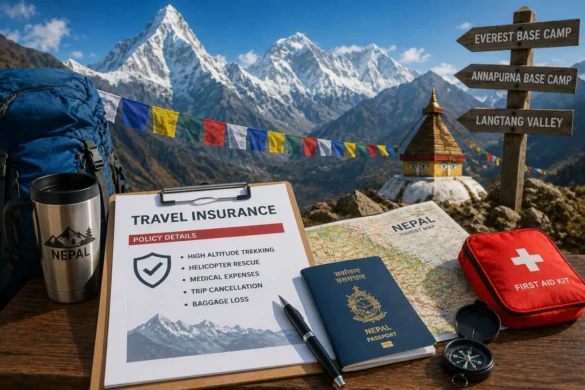
Here’s something that surprises most trekkers: Nepal now legally requires travel insurance to get a trekking permit.
Since 2024–2025, you cannot obtain a permit for the Everest, Annapurna, or Langtang regions without proof of adequate insurance. At checkpoints, rangers scan a QR code linked to your insurance details. No valid cover, no permit. No exceptions.
But there’s a bigger problem than the rule itself: most standard travel insurance doesn’t actually cover Nepal trekking. People carry a policy, feel safe, then discover at 4,800m that a single line of fine print makes it worthless.
This guide covers exactly what Nepal requires, what your policy must include, and the clauses that decide whether a claim gets paid.
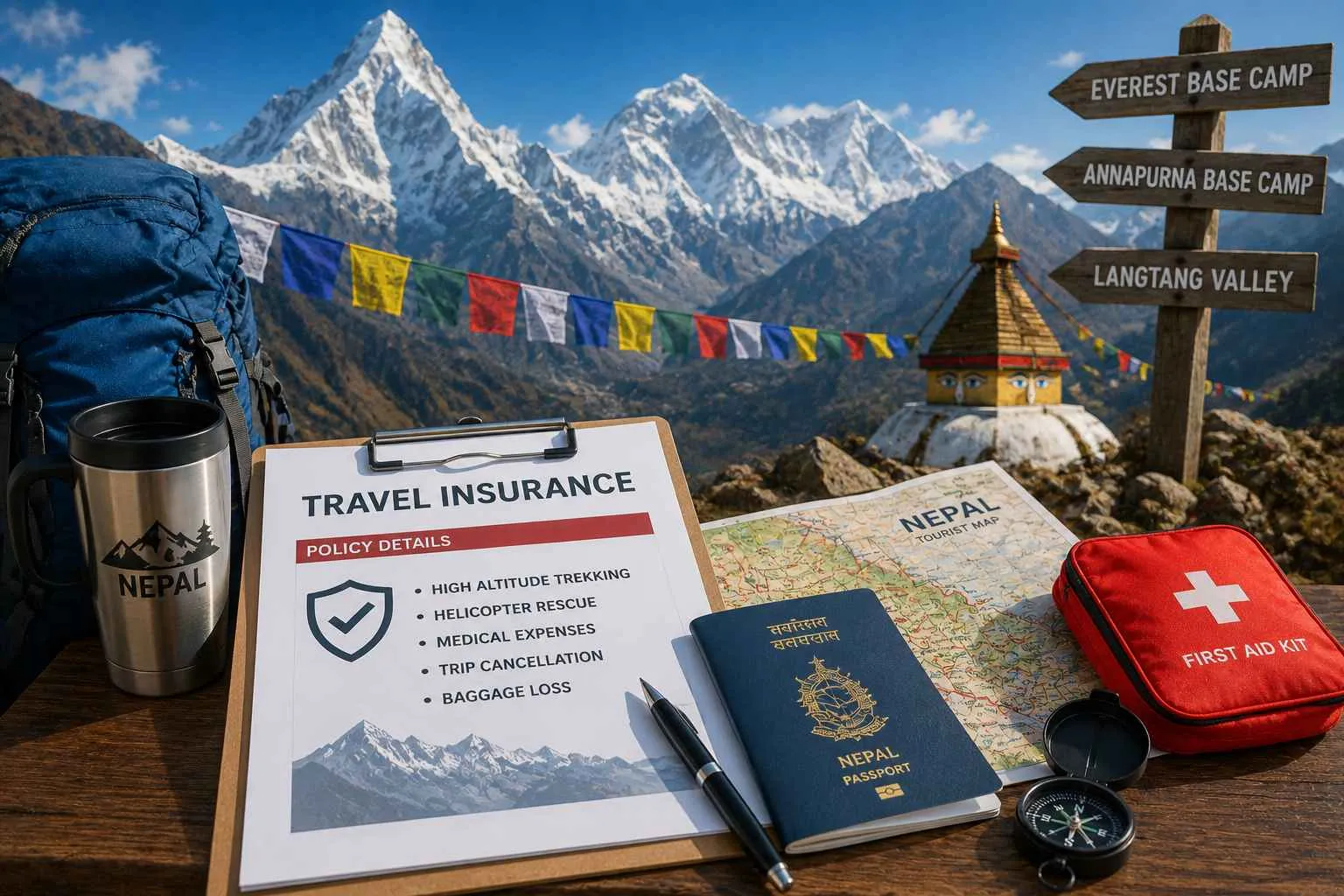
nepal travel insurance requirements
Quick Reference: Nepal Insurance Requirements
| Requirement | What You Need |
|---|---|
| Legal status (2026) | Mandatory for trekking permits |
| Minimum altitude cover | To 6,000m (matches or exceeds your trek) |
| Helicopter evacuation | Explicitly listed as covered |
| Medical coverage | At least $100,000–$200,000 |
| Altitude sickness (AMS/HAPE/HACE) | Explicitly covered |
| Typical cost | $80–$300 for a 2–3 week trip |
| Activity named | “Trekking” (or “mountaineering” for peaks) |
Is Travel Insurance Mandatory in Nepal?
Yes this changed recently, and it’s important.
As of 2024–2025, Nepal made valid travel insurance a requirement for obtaining trekking permits in its national parks and conservation areas including the Everest (Sagarmatha), Annapurna, and Langtang regions.
Here’s how it now works:
- Digital trekking permits carry a QR code linked to your insurance details
- At park gates and ranger stations, this code is scanned
- If your insurance doesn’t cover helicopter evacuation to your trek’s altitude, you’re not allowed to proceed
Beyond the law: Every reputable trekking agency also requires proof of insurance before confirming your booking. For restricted areas like Upper Mustang, Manaslu, and Dolpo, no responsible operator will proceed without verified helicopter evacuation cover.
The bottom line: insurance in Nepal has gone from “strongly recommended” to genuinely mandatory.
Why Standard Travel Insurance Isn’t Enough
This is the mistake that catches thousands of trekkers.
Most standard travel insurance policies exclude altitude above 3,000–4,000m.
Look at what that means for Nepal’s popular treks:
| Trek | Max Altitude | Standard Policy? |
|---|---|---|
| Annapurna Base Camp | 4,130m | ❌ Not covered |
| Everest Base Camp | 5,545m (Kala Patthar) | ❌ Not covered |
| Annapurna Circuit | 5,416m (Thorong La) | ❌ Not covered |
| Manaslu Circuit | 5,160m | ❌ Not covered |
| Langtang Valley | 4,984m (Tserko Ri) | ❌ Not covered |
Your policy number feels reassuring. But the moment you develop HAPE at 4,800m and need an emergency helicopter, the insurer points to one line of fine print “does not cover trekking above 3,000m” and denies the claim.
Suddenly that $5,000–$8,000 rescue is coming straight out of your bank account.
Understand what altitude does to you in our what happens to your body at 5,000 meters guide.
What Helicopter Rescue Actually Costs
This is why the coverage matters so much.
Helicopter evacuation is common in Nepal the Khumbu region alone sees hundreds of rescues every season. And ground evacuation often isn’t an option; there are no roads, and a stretcher carry can take days.
2026 rescue costs, uninsured:
| Evacuation From | Approximate Cost |
|---|---|
| Namche Bazaar / mid-altitude to Kathmandu | $2,500–$5,000 |
| Above 5,000m (Lobuche, Gorakshep, EBC) | $6,000–$10,000 |
| Above 6,000m (trekking peaks) | $10,000–$15,000+ |
| Plus Kathmandu hospital treatment | $1,000–$3,000 |
And here’s the catch that shocks people: helicopter operators often require payment upfront, before the aircraft takes off. Without insurance (or the cash), the rescue may not launch.
Nepal Travel Insurance Requirements
What Your Nepal Policy Must Cover
These are the non-negotiable elements. Check every one before buying.
1. Altitude Coverage (The Critical One)
Your policy must cover the maximum altitude of your specific trek — and ideally to 6,000m for flexibility.
- EBC: needs cover to at least 5,545m
- Annapurna Circuit: to at least 5,416m
- Trekking peaks (Mera, Island): to 6,500m
Get this in writing. Email the insurer, quote your exact maximum altitude, and keep their reply. That email is gold if a claim is ever disputed.
2. Helicopter Evacuation — Explicitly Named
Don’t accept “emergency evacuation” alone. The policy must specifically list helicopter evacuation as covered, and search and rescue must not be excluded.
3. Altitude Sickness Treatment
The policy must explicitly cover AMS, HAPE, and HACE the most common serious conditions on Nepal treks. These aren’t rare exotic risks; nearly half of trekkers above 3,000m experience some AMS.
4. Adequate Medical & Repatriation Limits
- Emergency medical: at least $100,000–$200,000
- Medical repatriation to your home country included
5. “Trekking” Named as a Permitted Activity
The policy must list your activity usually “trekking” or “hiking” as covered. For climbing Mera or Island Peak, you need “mountaineering” cover instead.
6. Trip Interruption (Highly Recommended)
Nepal’s mountain flights get cancelled constantly. Trip-interruption cover can pay for a helicopter to keep your itinerary on track when Lukla flights are grounded.
See our Lukla airport guide on why flights get delayed.
The Fine-Print Traps That Sink Claims
Even a “good” policy can fail on the details. Watch for these:
The cheap tier trap. The cheapest tier of a good insurer is often worthless for high treks. It’s usually the upgrade/adventure tier that carries the altitude cover. Buying the base plan is a common, costly mistake.
The residence trap. The same insurer sells different policies by country. A brand that covers 6,000m for UK travellers may not for Americans. Search for your country’s specific version, not the brand generally.
The pay-first trap. Many international policies make you pay the rescue operator, then reimburse you later leaving you owing thousands upfront on a remote trail. Check whether your insurer has direct-billing arrangements in Nepal.
The pre-authorisation trap. Some policies require you to call their emergency line for approval before a helicopter is dispatched. Know your policy’s process and save the 24/7 number offline and on paper.
The acclimatisation/alcohol clauses. Some policies exclude claims if you ascended too fast or were drinking. Read these, don’t skim them.
How Much Does Nepal Trekking Insurance Cost?
Reassuringly affordable, given what it protects you from.
Typical cost: $80–$300 for a 2–3 week trip, depending on your age, nationality, trek altitude, and coverage level.
Compare that to a $5,000–$10,000 uninsured helicopter bill, and it’s the best-value purchase of your entire trip.
Choosing a Provider
We don’t recommend specific insurers by name, because terms, altitude limits, and country availability change constantly and the right choice depends heavily on your nationality.
Instead, follow this process:
- Search “[your country] + high-altitude trekking insurance + 6,000m”
- Choose the adventure/upgrade tier, not the base plan
- Confirm all six requirements above are explicitly covered
- Email the insurer quoting your exact maximum trek altitude, and keep the written reply
- Send your policy to your trekking agency before departure good agencies review it and flag gaps
Providers commonly used by Nepal trekkers include adventure-focused and mountaineering-specific insurers, but always verify the current altitude clause yourself it’s your responsibility, and it changes.
What to Do Before You Fly
A simple pre-departure checklist:
- ✅ Policy covers your trek’s exact maximum altitude (in writing)
- ✅ Helicopter evacuation explicitly listed
- ✅ AMS/HAPE/HACE covered
- ✅ Medical limit $100,000+ with repatriation
- ✅ “Trekking” (or “mountaineering”) named
- ✅ 24/7 emergency number saved offline AND on paper
- ✅ Policy copy sent to your trekking agency
- ✅ Insurance details ready for permit/QR verification
Frequently Asked Questions
Is travel insurance mandatory for Nepal trekking?
Yes. As of 2024–2025, Nepal requires proof of valid travel insurance to obtain trekking permits in the Everest, Annapurna, and Langtang regions. Digital permits carry a QR code that checkpoints scan, and without adequate helicopter evacuation cover to your trek’s altitude, you won’t be issued a permit.
Does normal travel insurance cover trekking in Nepal?
Usually not. Most standard policies exclude altitude above 3,000–4,000m, which means every major Nepal trek including Everest Base Camp (5,545m) and Annapurna Circuit (5,416m) falls outside their coverage. You need a specific high-altitude trekking policy.
What altitude coverage do I need for Everest Base Camp?
At least 5,545m (Kala Patthar, the trek’s highest point), though a policy covering to 6,000m gives useful flexibility. Confirm this altitude in writing with your insurer before buying.
How much does a helicopter rescue cost in Nepal?
In 2026, $2,500–$5,000 from mid-altitude areas, $6,000–$10,000 from above 5,000m, and $10,000–$15,000+ from trekking peaks above 6,000m plus $1,000–$3,000 for hospital treatment. Operators often require payment before the flight departs.
How much does Nepal trekking insurance cost?
Typically $80–$300 for a 2–3 week trip, depending on your age, nationality, trek altitude, and coverage tier. It’s the best-value purchase of your trip given the potential rescue costs it covers.
What must my Nepal trekking insurance cover?
Six essentials: altitude coverage matching or exceeding your trek’s highest point, explicitly-named helicopter evacuation, altitude sickness (AMS/HAPE/HACE) treatment, medical coverage of at least $100,000, “trekking” as a named activity, and ideally trip interruption. Get the altitude clause confirmed in writing.
Can I buy trekking insurance after arriving in Nepal?
It’s risky and often too late Nepal now checks insurance at the permit stage, and many international policies must be purchased before you leave home. Some local agencies offer Nepal-based rescue insurance, but for full medical and repatriation cover, buy a proper policy before departure.
Do I need special insurance for climbing peaks like Mera or Island Peak?
Yes you need “mountaineering” cover, not just “trekking,” with altitude coverage to 6,500m for these peaks. Standard trekking policies exclude peak climbing. See our Mera Peak climbing guide.