
They watch over all of Nepal.
Painted on the golden towers of Boudhanath, Swayambhunath, and stupas across the country, a pair of giant eyes gazes out in every direction. Calm. Knowing. Slightly hypnotic.
These are the Buddha Eyes one of Nepal’s most recognisable symbols. You’ll see them on postcards, souvenirs, and a thousand travel photos.
But what do they actually mean? Every detail the eyes, the strange “nose,” the dot between them carries deep meaning. Here’s the full story.
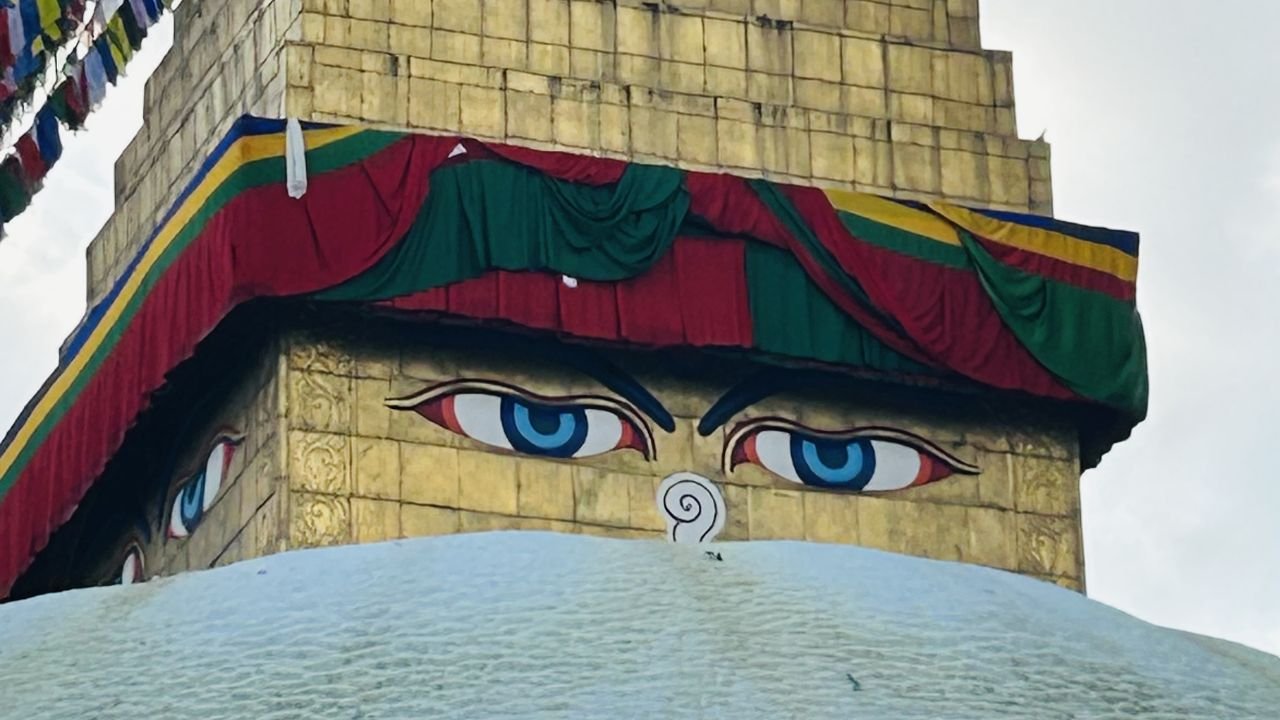
Buddha Eyes
Quick Reference: Buddha Eyes at a Glance
| Feature | Meaning |
|---|---|
| The two eyes | Wisdom and compassion, watching all directions |
| Gaze in four directions | The Buddha sees everything, everywhere |
| Curly “nose” symbol | The Nepali number 1 unity of all things |
| Dot on forehead (third eye) | Spiritual awakening, seeing beyond the material |
| Missing ears/mouth | The Buddha needs no words or sound to teach |
| Also called | Wisdom Eyes |
What Are the Buddha Eyes?
The Buddha Eyes also called the Wisdom Eyes are painted on the four sides of the square tower (called the harmika) that sits atop many Nepali stupas.
Because they face all four directions, they represent the Buddha watching over everything, everywhere, at once. Nothing escapes his compassionate gaze.
They’re most famous on the great stupas of the Kathmandu Valley Boudhanath and Swayambhunath but you’ll find them on stupas across Nepal and the Himalayan Buddhist world.
The eyes are unmistakable: half-closed, serene, gazing with a calm that seems to hold all the wisdom of the universe.
The Meaning Behind Each Feature
Every element of the Buddha Eyes carries meaning. Nothing is decorative.
The Two Eyes — Wisdom and Compassion
The main eyes represent the Buddha’s all-seeing nature.
They look outward in every direction, symbolising that the Buddha sees all beings and watches over everyone with wisdom and compassion. The half-closed, meditative gaze reflects looking both outward at the world and inward in contemplation at the same time.
The Curly “Nose” — The Number One
Look between and below the eyes. You’ll see what looks like a curly question mark or a stylised nose.
It’s not a nose. It’s the Nepali number 1 (१).
This symbolises unity the idea that all things are one, and that there is a single path to enlightenment. It’s a reminder that reality is interconnected and undivided.
The Third Eye — Spiritual Awakening
Above and between the two eyes sits a dot or spiral — the “third eye.”
This represents spiritual awakening: the ability to see beyond the physical, material world into deeper truth. It symbolises the wisdom that looks past appearances to reality itself.
No Ears, No Mouth — Why?
Notice something missing? The Buddha Eyes have no ears and no mouth.
This is deliberate. It teaches that the Buddha’s wisdom is beyond words and sound. Enlightenment isn’t reached through speech or hearing alone it’s realised through inner understanding. The Buddha needs no mouth to teach and no ears to listen; his presence alone conveys the teaching.
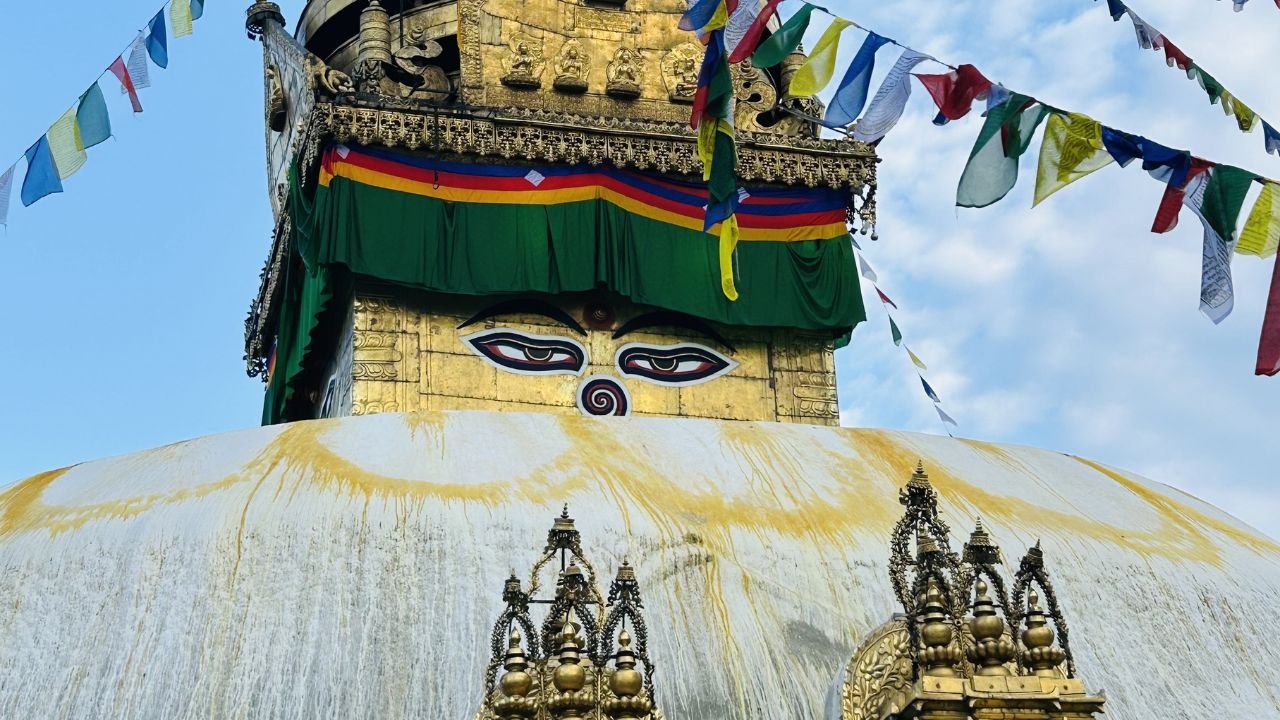
Buddha Eyes
Why the Eyes Face Four Directions
The four-directional gaze is central to the symbol’s power.
By looking north, south, east, and west simultaneously, the Buddha Eyes express that the Buddha’s awareness is total. His compassion has no blind spots. Wherever you stand, the eyes are watching over you a comforting, ever-present reminder of wisdom and protection.
For pilgrims walking the kora (the clockwise path) around a stupa, the eyes are always present, always watching, from every angle of the walk.
Where to See the Buddha Eyes in Nepal
Some stupas make the eyes unforgettable.
Boudhanath Stupa (Kathmandu) — the most famous of all. One of the largest stupas on Earth, its eyes gaze out over a sea of prayer flags and circling pilgrims. Best at sunset. See our places to visit in Kathmandu guide.
Swayambhunath (Monkey Temple) — perched on a hilltop, the eyes here watch over the entire Kathmandu Valley. Iconic and dramatic.
Stupas across the trekking regions — from Namche Bazaar to the monasteries of Mustang and Dolpo, the eyes appear throughout Buddhist Nepal.
See our Buddhist Monasteries in Nepal guide for more.
The Buddha Eyes as a Symbol of Nepal
Over time, the Buddha Eyes have become something bigger than a religious symbol they’ve become an emblem of Nepal itself.
You’ll see them on tourism logos, souvenirs, T-shirts, tea packaging, and countless travel photos. For many people around the world, the Buddha Eyes are the visual shorthand for Nepal and the Himalayas.
That popularity is why treating the symbol with understanding matters. Behind the postcard image sits centuries of profound Buddhist meaning.
A Note on Respect
The Buddha Eyes are a sacred religious symbol, not just decoration.
When visiting stupas:
- Walk clockwise around the stupa (keep it on your right)
- Dress modestly
- Photograph respectfully photos are welcome, but be mindful during prayers and ceremonies
- Don’t climb on stupas or treat them as photo props
Understanding what the eyes mean deepens the experience of standing beneath them turning a photo opportunity into a genuine moment of connection with Nepal’s living spiritual culture.
Frequently Asked Questions
What do the Buddha eyes mean?
The Buddha Eyes, or Wisdom Eyes, represent the Buddha’s all-seeing wisdom and compassion, watching over all beings in every direction. Painted on the four sides of a stupa’s tower, they symbolise that the Buddha sees everything, everywhere.
What is the curly symbol between the Buddha’s eyes?
It looks like a nose but is actually the Nepali number 1 (१). It symbolises unity the idea that all things are one and that there is a single path to enlightenment.
What is the dot above the Buddha eyes?
It represents the third eye spiritual awakening and the ability to see beyond the physical world into deeper truth and wisdom.
Why do the Buddha eyes have no mouth or ears?
This is intentional. It teaches that the Buddha’s wisdom transcends words and sound. Enlightenment is realised through inner understanding rather than speech or hearing, so no mouth or ears are needed.
Where can I see the Buddha eyes in Nepal?
The most famous are at Boudhanath Stupa and Swayambhunath (Monkey Temple) in Kathmandu. You’ll also find them on stupas throughout Nepal’s Buddhist regions, from the Everest trail to Mustang and Dolpo.
Why do the Buddha eyes face four directions?
To show that the Buddha’s awareness and compassion are total, with no blind spots. Whichever direction you approach from, the eyes watch over you a symbol of ever-present wisdom and protection.
Are the Buddha eyes only found in Nepal?
They’re most associated with Nepal but appear across the Tibetan Buddhist world, including Tibet, Bhutan, and Himalayan India. However, the great stupas of Kathmandu made them world-famous, and they’ve become an emblem of Nepal itself.
What is the difference between the Buddha eyes and the third eye?
The two main eyes represent outward wisdom and compassion watching the world. The third eye the dot above them represents inner spiritual awakening and the ability to perceive truth beyond the material world.
