
📋 Airport Status Quick Reference
- Official Name: Pokhara International Airport(पोखरा अन्तर्राष्ट्रिय विमानस्थल)
- IATA Code: PKR
- Location: Pokhara-32, Kaski District, Gandaki Province
- Construction Cost: Approximately $216 million USD (Chinese EXIM Bank loan)
- Domestic Operations: Active since January 1, 2023
- International Operations: Not yet commenced as of 2026
- Runway Length: 2,500 metres (capable of handling wide-body aircraft)
- Designed Annual Capacity: 1 million passengers (expandable to 2 million)
The Airport That Was Supposed to Change Everything
When Pokhara International Airport opened its gleaming new terminal on January 1, 2023, the ceremony was magnificent.
Nepal’s Prime Minister was present. Chinese officials representing the EXIM Bank which had financed the $216 million project attended in delegation. There were speeches about regional connectivity, about economic transformation, about the Annapurna region finally receiving the direct international air access that its extraordinary tourism potential had always deserved.
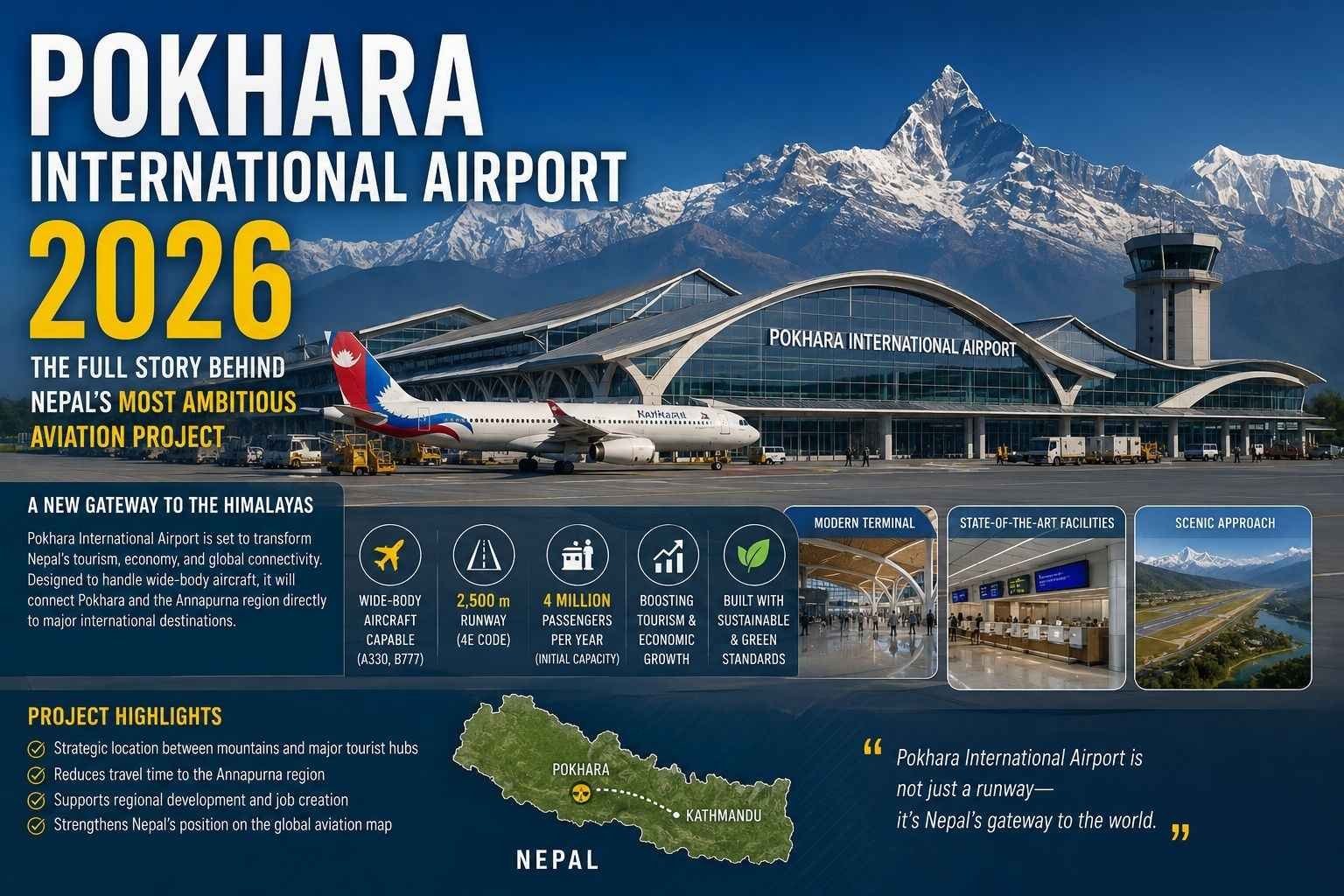
Pokhara International Airport 2026: The Full Story Behind Nepal’s Most Ambitious Aviation Project
| Metric | Status |
|---|---|
| Airport Name | Pokhara International Airport (PIA) |
| Status | Domestic-only; no international flights |
| ICAO Category | 4C (needs 4R for international) |
| Runway Length | 2,500 m (8,202 ft 1 in) |
| ILS Installed? | Yes, February 26, 2023 |
| Customs/Immigration | Not yet operational |
| Domestic Flights | 12+ daily to Kathmandu, Bharatpur, etc. |
| International Interest | Vietnam Airlines, China Southern, IndiGo, Biman Bangladesh |
| Opening Date | January 1, 2023 |
| Impact on Trekkers | Faster access, lower costs, more direct routes |
And then the international flights didn’t come.
Three years later, as 2026 unfolds, Pokhara International Airport remains one of the most expensive, most strategically important, and most consistently frustrated aviation projects in South Asian history. The terminal building all 79,000 square metres of it, modern and well-equipped and largely quiet handles a modest schedule of domestic flights between Pokhara and Kathmandu while its international gates await an operational future that has proved far more complicated to deliver than anyone anticipated when the ribbon was cut.
Understanding why requires understanding a collision between geopolitics, aviation safety bureaucracy, airline economics, and the specific challenges of operating international air services in and out of Nepal a country whose aviation sector has spent years navigating one of the most difficult regulatory situations in the world.
History and Construction
The concept of building an international airport in Pokhara was first proposed in 1971 as Nepal began exploring ways to strengthen tourism infrastructure outside Kathmandu. Due to Pokhara’s growing reputation as the gateway to the Annapurna region, the city was viewed as a strategic location for international air connectivity.
In 1976, the Government of Nepal officially acquired land for the proposed airport project. A few years later, in 1989, the Japan International Cooperation Agency (JICA) conducted a feasibility study to evaluate the airport’s technical and economic potential. Despite early planning efforts, the project remained stalled for decades because of political instability, funding challenges, and limited aviation demand at the time.
The project regained momentum in 2009 after Nepal and India signed a revised air service agreement that opened opportunities for expanded regional air connectivity. In 2013, Nepal’s Civil Aviation Authority of Nepal (CAAN) signed a construction agreement with China CAMC Engineering to develop the airport.
Construction officially began in April 2016 after then Prime Minister K. P. Sharma Oli laid the foundation stone for the project. The airport was initially expected to be completed within five years, targeting operations by July 2021.
The total project cost was originally estimated at around USD 305 million. However, after negotiations and revisions, the final estimated cost was reduced to approximately USD 216 million. Financing for the project came primarily through a concessional loan from the Export-Import Bank of China, which provided roughly USD 215 million in preferential financing. Additional support included funding from the Asian Development Bank (ADB) and the OPEC Fund for International Development.
Construction faced several delays due to engineering adjustments, terrain challenges, and the COVID-19 pandemic. One major issue involved Rithepani Hill near the eastern end of the runway. Aviation authorities determined that parts of the hill needed to be flattened to improve aircraft approach safety, but the decision triggered strong protests from local residents and delayed work until late 2022.
During the pandemic, construction deadlines were repeatedly extended. In 2021, officials announced that the airport would open in phases, with domestic operations beginning first and international services following later after additional technical approvals and inspections.
Calibration flights and navigation testing were conducted in late 2022 as authorities prepared the airport for commercial operation. On August 8, 2022, CAAN officially confirmed January 1, 2023, as the final opening date.
Pokhara International Airport was formally inaugurated on January 1, 2023, by then Prime Minister Pushpa Kamal Dahal. To mark the occasion, Pokhara Metropolitan City declared a public holiday. The first aircraft to land at the new airport was a Buddha Air flight carrying the Prime Minister and senior officials.
Even after the inauguration, development work continued. Early operations faced challenges including limited customs infrastructure and the absence of a dedicated aviation fuel depot, requiring fuel transportation from the old Pokhara Airport by truck.
In June 2023, the airport handled its first international flight. The inaugural international service was a chartered Sichuan Airlines Airbus A319 flight from China carrying athletes and officials attending a goodwill dragon-boat event in Pokhara. The flight
What Flights Currently Operate in 2026
To be clear: Pokhara International Airport is a functioning, operational airport. It is not abandoned or mothballed. Domestic services connect Pokhara to Kathmandu multiple times daily, and the airport handles its existing traffic with the efficiency of a facility built for significantly larger volumes.
Current Domestic Route Operations (2026):
| Route | Operating Airlines | Frequency | Flight Time |
|---|---|---|---|
| Pokhara ↔ Kathmandu | Buddha Air, Yeti Airlines, Shree Airlines | 10–14 flights daily | 25–30 minutes |
| Pokhara ↔ Jomsom | Tara Air, Summit Air | 2–4 flights daily (weather dependent) | 20 minutes |
| Pokhara ↔ Manang | Tara Air | Seasonal / charter basis | 15 minutes |
| Pokhara ↔ Bharatpur | Buddha Air | Limited schedule | 30 minutes |
The Kathmandu–Pokhara route is the airport’s genuine workhorse. With tourist arrivals to the Annapurna region recovering strongly post-COVID and the domestic aviation market growing, the frequency and reliability of this connection has improved meaningfully since the airport opened. The new terminal represents a significant upgrade over Pokhara’s cramped old airport check-in, baggage handling, and passenger facilities are all substantially better.
But domestic connectivity, however improved, was never the point of a $216 million international airport. The point was direct flights from Delhi, Mumbai, Doha, Dubai, Kuala Lumpur, and eventually further and those flights have not materialised.
Why International Flights Have Not Started The Full Picture
The absence of international services at Pokhara is not a single-cause problem. It is the product of at least four distinct, overlapping issues that have proved collectively resistant to the optimistic timelines that Nepali aviation authorities have announced and then revised on multiple occasions since 2023.
⚠️ Issue 1: The ICAO Safety Category The Root of Everything
This is the issue that underlies all others and without which no honest discussion of Pokhara’s international prospects is possible.
In 2022, the International Civil Aviation Organization (ICAO) the United Nations body that sets global aviation safety standards conducted a safety audit of Nepal’s Civil Aviation Authority (CAAC) and found it non-compliant with international safety oversight standards. As a direct consequence, the European Union Aviation Safety Agency (EASA) maintained Nepal’s airlines on the EU Air Safety List effectively a ban on Nepali carriers operating flights to European destinations and the United States Federal Aviation Administration (FAA) placed Nepal in Category 2 under its International Aviation Safety Assessment (IASA) programme.
FAA Category 2 designation means Nepal’s aviation authority does not meet ICAO safety oversight standards a finding that prevents Nepali airlines from adding new routes to the United States and subjects existing operations to increased scrutiny. More broadly, it signals to the global aviation industry that Nepal’s regulatory framework requires significant improvement before international airlines can comfortably operate new routes under its jurisdiction.
The direct consequence for Pokhara: No major international carrier European, American, or Gulf-based will commit to launching routes into a new, unproven airport in a country carrying active ICAO safety concerns. The liability exposure, the insurance implications, and the reputational risk are simply too significant.
Nepal has been aware of this problem and working toward resolution. The CAAC has implemented a series of regulatory reforms, hired additional safety inspectors, and engaged with ICAO technical assistance programmes. As of early 2026, Nepal remains in active dialogue with both ICAO and the FAA regarding Category 2 reclassification but the process is methodical and cannot be accelerated beyond the pace that genuine institutional reform allows.
⚠️ Issue 2: Technical and Operational Certification Challenges
Beyond the national-level ICAO concerns, Pokhara International Airport itself has faced a series of airport-specific technical certification requirements that have delayed international readiness:
- Instrument Landing System (ILS) calibration The ILS, which guides aircraft to safe landings in low-visibility conditions, required extended calibration and certification testing; this process was completed later than originally scheduled
- Air Traffic Control (ATC) staffing and certification International operations require ATC personnel trained and certified to international standards; recruitment and training of qualified staff for a new international facility takes time that initial projections underestimated
- Rescue and Fire Fighting (RFF) category upgrade International airport regulations require higher-category rescue and firefighting capability than domestic-only operations; equipment procurement and crew training extended the timeline
- NOTAM compliance International airlines require comprehensive Notice to Airmen documentation covering all operational parameters; gaps in initial documentation required correction
Each of these items sounds technical and procedural because it is. But international aviation safety is built entirely on technical and procedural compliance, and the cumulative effect of multiple parallel certification gaps has been a consistent pattern of revised and extended timelines.
⚠️ Issue 3: The Debt and Geopolitical Dimension
The financial architecture of Pokhara International Airport sits at the intersection of Nepal’s complex relationship with China and the broader question of Belt and Road Initiative infrastructure loans in South Asia.
The airport was financed through a $215.96 million loan from China’s EXIM Bank a loan that Nepal is now servicing with limited revenue, since the international traffic that would justify the debt has not materialised. Annual loan repayments are estimated at approximately $7–8 million USD, creating genuine fiscal pressure on Nepal’s government and intensifying political debate about the project’s true cost-benefit calculus.
The geopolitical complexity is compounded by the fact that the airport’s construction was delivered by a Chinese state-owned enterprise China CAMC Engineering Co. Ltd. which has created sensitivities around third-party technical assessments and international certification processes that might be interpreted as scrutiny of Chinese construction standards.
None of this is straightforwardly determinative of the airport’s international future. But it adds layers of political complexity to what might otherwise be a purely technical certification process.
⚠️ Issue 4: Airline Commercial Viability Questions
Even setting aside regulatory and certification barriers, international airlines conduct rigorous commercial viability assessments before launching new routes. For Pokhara, the commercial case has genuine strengths but also real uncertainties:
The commercial strengths:
- Pokhara is the gateway to the Annapurna Circuit and Annapurna Base Camp two of the world’s most popular trekking destinations, drawing 150,000+ international trekkers annually
- Direct international access eliminates the Kathmandu–Pokhara domestic connection currently required of all international visitors
- The Lumbini (Buddha’s birthplace) circuit is within reasonable ground distance, potentially expanding the route’s appeal to Buddhist pilgrimage tourism from East and Southeast Asia
The commercial uncertainties:
- Pokhara’s catchment population for point-to-point travel (as opposed to tourism arrivals) is relatively modest
- Most international tourists visiting the Annapurna region also visit Kathmandu meaning a direct Pokhara route risks cannibalising Kathmandu connections rather than generating net new traffic
- Thin margins on low-frequency routes to a secondary destination in a challenging regulatory environment make commercial commitment difficult for network airlines
Which Airlines Have Shown Interest
Despite the delays, several carriers have expressed formal or informal interest in Pokhara international routes and the interest is genuine, even if commitments have not yet been made:
| Airline | Country | Route Interest | Status (2026) |
|---|---|---|---|
| IndiGo | India | Delhi–Pokhara, Mumbai–Pokhara | Strongest commercial interest expressed; awaiting bilateral agreement finalisation |
| Air India | India | Delhi–Pokhara | Monitoring; no formal commitment |
| SpiceJet | India | Multiple Indian city connections | Expressed interest; capacity and commercial viability under review |
| Jazeera Airways | Kuwait | Kuwait City–Pokhara | Prospective interest for Gulf worker remittance traffic |
| FlyDubai | UAE | Dubai–Pokhara | Preliminary discussions reported; no formal application |
| Himalaya Airlines | Nepal/China JV | Potential Chinese city connections | Subject to bilateral negotiation |
| Vistara / Air India merger entity | India | Delhi hub connections | Long-term interest post-merger consolidation |
The Indian aviation market is the most critical near-term opportunity. India and Nepal share an open skies bilateral aviation agreement that removes many of the barriers facing Gulf or European carriers and the Indian tourism market for Pokhara, particularly for Annapurna trekking and Hindu pilgrimage to Muktinath, is substantial and growing.
IndiGo India’s largest low-cost carrier by market share has most consistently been identified as the most likely first international operator at Pokhara. A Delhi–Pokhara or Mumbai–Pokhara IndiGo service would be commercially logical, technically achievable, and genuinely transformative for the airport’s revenue position.
Potential Interest (Unconfirmed but Likely)
| Airline | Base | Likely Route |
|---|---|---|
| Bangkok Airways | Thailand | Bangkok–Pokhara (niche, high-yield) |
| SilkAir (Singapore Airlines) | Singapore | Singapore–Pokhara (long-term potential) |
| Druk Air | Bhutan | Paro–Pokhara (regional connectivity) |
| Air Arabia | UAE | Sharjah–Pokhara (budget leisure travelers) |
Realistic Timeline for International Routes
Projecting aviation timelines in Nepal requires honesty about how consistently previous projections have been missed. The airport has already passed through multiple announced “international launch” windows early 2023, late 2023, mid-2024, early 2025 without the anticipated services materialising.
With that caveat clearly stated, the current trajectory suggests:
Most Likely Scenario Late 2026 to Early 2027:
If Nepal’s CAAC makes meaningful progress on ICAO safety category concerns in the first half of 2026, and if airport-specific technical certifications are completed as currently scheduled, the most realistic window for the first international service almost certainly an Indian carrier on a Delhi or Mumbai route is Q4 2026 or Q1 2027.
This timeline assumes:
- Continued regulatory reform progress at CAAC
- Successful completion of remaining airport technical certifications
- Bilateral aviation agreement finalisation with priority markets
- Commercial commitment from at least one carrier (most likely IndiGo)
Alternative Scenario 2027 and Beyond:
If ICAO category reclassification is delayed which remains a genuine possibility given the complexity of institutional reform international launches slip to 2027 or later. Gulf carrier entry, which would require both regulatory improvement and stronger commercial confidence, likely follows Indian carrier launches by 12–18 months minimum.
What Probably Won’t Happen: A simultaneous multi-airline international launch matching the airport’s designed capacity anytime soon. The realistic near-term international operation is one or two Indian carriers on limited daily frequencies a significant achievement, but a long way from the connectivity vision the airport was built for.
What International Flights Mean for Annapurna Trekkers
When international services finally do launch at Pokhara, the practical implications for Annapurna trekkers are significant and largely positive though not without nuance.
✅ The Benefits
- Eliminating the Kathmandu transit Currently, every international trekker arriving for the Annapurna Circuit or Annapurna Base Camp must fly into Kathmandu, spend at least one night, then take a domestic flight or 6–7 hour bus journey to Pokhara. Direct international access eliminates this friction entirely arrive in Pokhara, begin acclimatisation walks, start your trek
- Time saving for short-trip trekkers For travelers with 10–12 day windows, eliminating the Kathmandu transit day each way effectively adds two trekking days to the available itinerary
- Reduced cost for Indian trekkers Indian visitors to the Annapurna region currently pay for international flights to Kathmandu plus domestic onward connections; direct Pokhara flights will likely be competitively priced and meaningfully cheaper in total
- New trekking demographics Direct access from Gulf cities opens the Annapurna region to the large Nepali diaspora community in the UAE, Qatar, and Kuwait, many of whom currently visit family in Kathmandu but don’t extend to Pokhara
| Impact | Explanation |
|---|---|
| Faster Access | No need to fly through Kathmandu saves 3–5 hours |
| Lower Costs | Reduced transfer time = lower tour prices |
| Better Connectivity | Direct links from India, China, Southeast Asia |
| Increased Tourism | More international visitors = more jobs, better services |
| Eco-Tourism Growth | Easier access to remote trails = more sustainable travel support |
⚠️ The Honest Caveats
- Kathmandu is still worth visiting Many first-time Nepal visitors combine Annapurna trekking with Kathmandu Valley cultural exploration; a direct Pokhara flight doesn’t serve this combination efficiently
- Initial routes will be limited Early international services will almost certainly not include the long-haul connections (London, Frankfurt, Singapore, Tokyo) that would transform access for European, East Asian, or North American trekkers; those travelers will still route through Kathmandu or connect via Gulf hubs
- Domestic infrastructure still matters The trail network, teahouse quality, permit systems, and guiding infrastructure around Annapurna will determine the trekking experience far more than the airport used to arrive
The Bottom Line for 2026 Travelers
If you are planning an Annapurna trek in 2026, plan your logistics around the current reality: fly international to Kathmandu, connect domestically to Pokhara. The Kathmandu–Pokhara domestic route is reliable, affordable ($80–$120 one way on Buddha Air or Yeti Airlines), and only 25 minutes in the air.
Monitor developments at Pokhara International Airport if IndiGo or another Indian carrier launches before your travel date, and you are routing through an Indian hub, the direct option may become available. But do not build a 2026 itinerary around international Pokhara services that have not yet been confirmed.
The airport’s time will come. The infrastructure is genuinely impressive, the strategic rationale is sound, and the tourism demand that would fill international services is real and growing. Pokhara International Airport is not a white elephant it is a project waiting for the regulatory, commercial, and diplomatic alignment that its geography has always deserved.
When that alignment arrives, the Annapurna region’s place on the global adventure travel map will change fundamentally. 🏔️✈️
Timeline When Will You Board in Pokhara?(Just Predections)
| Milestone | Earliest Date | Probability | Notes |
|---|---|---|---|
| CAAN split bill passed | Dec 2026 | 60 % | Parliament winter session agenda |
| ICAO re-audit | Mar 2027 | 70 % | ICAO budget cycle |
| SSC lifted | Jul 2027 | 55 % | Needs Part 8 & 14 green |
| India MoU ratified | Sep 2027 | 65 % | IndiGo plans Oct 2027 launch |
| First international arrival | 15 Oct 2027 | 50 % | IndiGo DEL-PKR ceremonial flight |
Recent Corruption Cases and CIAA Investigations (2026)
The biggest ongoing story in 2026 is the expansion of corruption investigations linked to the airport project.
In May 2026, Nepal’s anti-corruption agency, the Commission for the Investigation of Abuse of Authority (CIAA), filed additional corruption cases against former ministers, senior bureaucrats, aviation officials, and contractors connected to the airport project. Investigators alleged irregularities involving tax exemptions, procurement decisions, and inflated project costs.
One case specifically claimed that unlawful tax waivers caused losses worth billions of rupees to the Nepali state. Authorities also alleged that implementation agreements were changed in ways that benefited contractors beyond the original contract terms.
This has turned Pokhara International Airport into one of Nepal’s most controversial infrastructure projects in recent years.
Limited International Flights Remain a Major Issue
Although the airport officially opened as an international airport in 2023, international flight activity remains extremely limited in 2026.
The Nepal government has introduced major incentives for airlines, including waiving passenger service fees, landing charges, parking fees, and navigation charges at Pokhara Airport until at least September 2026 in an attempt to attract more international carriers.
Despite these incentives, the airport still struggles to establish consistent international routes, raising ongoing concerns about commercial sustainability and loan repayment capacity.
Infrastructure and Connectivity Problems
Additional infrastructure issues around the airport are still being reported.
In 2026, local reports stated that road construction projects near the airport were delayed because of disputes involving underground electrical infrastructure and airport-related utility systems.
This adds to broader criticism that supporting infrastructure around the airport was not fully coordinated before operations began.
Aviation Fuel Expansion and Future Growth Plans
One positive development is the construction of a new aviation fuel depot inside the airport premises by the Nepal Oil Corporation.
The facility was designed to improve fuel storage capacity and support future growth in domestic and international air traffic. Officials described it as one of the first major aviation infrastructure projects in Nepal completed entirely with domestic technical expertise and investment.
Public Debate About “White Elephant” Infrastructure
The airport has increasingly become part of a wider national debate in Nepal about large infrastructure projects financed through foreign loans.
Critics argue that Pokhara International Airport risks becoming a “white elephant” project if international passenger traffic does not significantly increase in the coming years. This debate is frequently connected to discussions about other proposed airport megaprojects in Nepal, including Nijgadh International Airport.
Explore All About Nepal tracks developments at Pokhara International Airport and updates trekking logistics guidance as new routes are confirmed. Check our live Nepal travel updates before finalising your Annapurna itinerary.
