On April 15, 2026, Nepal’s Minister for Culture, Tourism and Civil Aviation stood at a ceremony at Sainik Manch, Tundikhel the great open ground in the heart of Kathmandu and made an announcement that travel writers and wellness industry observers had been anticipating for months.
“Do not just visit Nepal,” he said. “Come and discover yourself.”
Nepal Wellness Tourism 2027: Yoga Retreats, Meditation, Ayurveda and What the Government Campaign Means for Travelers
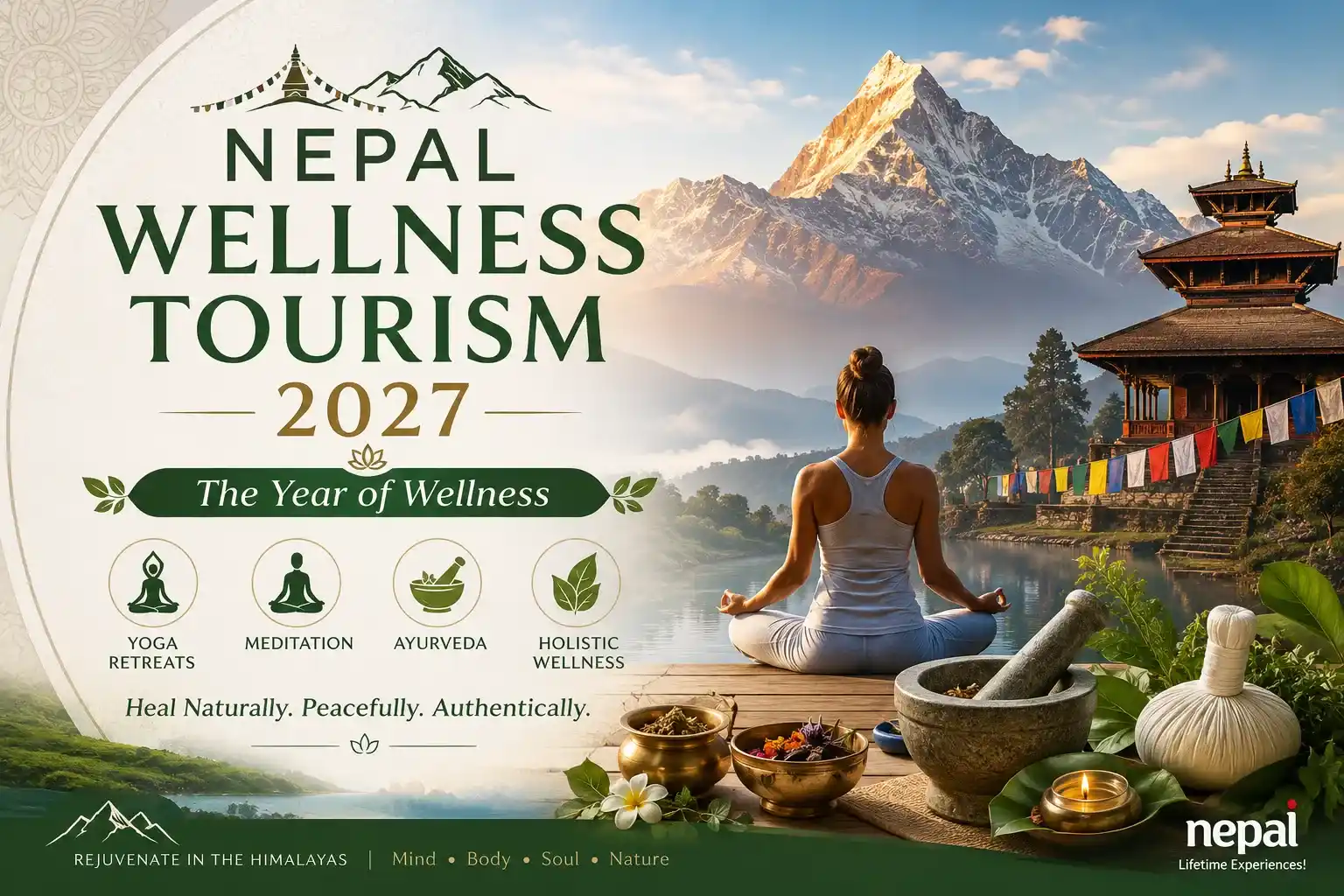
With that, Nepal officially launched the Nepal Wellness Year 2027 a government-backed, year-long national campaign to position Nepal as the world’s premier destination for yoga, meditation, Ayurveda, and spiritual healing, backed by a 10-year National Wellness Tourism Strategy running to 2035 and a five-year action plan with specific targets, dedicated infrastructure investment, and a national brand identity campaign called Arogya Nepal (Healthy Nepal).
This is not a soft launch or a promotional slogan. The strategy encompasses four sectors: spa and massage services, Ayurveda clinics, yoga and meditation, and natural healing and spirituality. Nepal aims to establish integrated wellness centres in at least five key areas and raise tourist satisfaction levels, with the plan targeting over 10,000 wellness tourists annually after 2030, generating USD 20–30 million in annual revenue.
For the traveler reading this now and planning a 2027 Nepal trip, the campaign’s ambition is less interesting than its practical implications. This guide addresses what actually matters: what Nepal’s wellness offering genuinely is, where the best retreats and meditation centres are, what the Lumbini spiritual circuit involves, and what the Year of Wellness campaign will concretely mean for pricing, crowds, and the quality of what you find when you arrive.
Why Nepal’s Wellness Claim Is Legitimate And Not Manufactured
No destination in the world holds the combination of assets that Nepal does. Nepal is the birthplace of the Buddha. The country carries centuries of living practice in yoga, meditation, Ayurveda, Tibetan medicine, and shamanic healing traditions that exist nowhere else on earth in this concentration.
This matters because wellness tourism has a credibility problem globally. Bali has branded itself a wellness destination. Tulum has branded itself a wellness destination. Both have placed wellness labels over what are, at their core, beach resort economies with yoga classes attached. The legitimacy of the practice its roots, its transmission, its daily living reality in the community is largely absent.
Nepal’s claim is different in kind, not just degree.
Kathmandu Valley has housed functioning Hindu and Buddhist tantric traditions for over a millennium. Lumbini is the authenticated birthplace of the historical Buddha not a designated spiritual zone built for tourism, but a site where the Ashoka Pillar confirms the connection in third-century stone. The Tibetan Buddhist monasteries of Mustang, Solukhumbu, and the Manang valley operate on centuries-old schedules of practice that no Year of Tourism designation created and none can end. And the Himalayan environment itself clean air above 1,500m, spring water from snowmelt, the particular quality of silence on a high ridge produces physiological conditions for contemplative practice that no urban wellness centre anywhere can replicate.
The wellness offer here is authentic. What the 2027 campaign is doing is making it visible, standardised, and internationally bookable in a way it previously was not.
The Best Yoga Retreat Centres in Nepal
Nepal’s yoga retreat landscape ranges from world-class residential programmes in heritage properties to small family-run ashrams where the instruction is genuine but the accommodation is basic. Here is where to look, by city and style.
Kathmandu
Dwarika’s Sanctuary is the benchmark for luxury wellness in Kathmandu an 18-room boutique property within the Dwarika’s Heritage Hotel complex that integrates Ayurvedic treatments, yoga, and meditation with the extraordinary cultural surroundings of one of Nepal’s finest heritage hotels. Premium wellness properties like Shinta Mani Mustang and Dwarika’s Sanctuary have already set the bar for premium wellness hospitality in Nepal, attracting guests from all corners of the globe seeking a once-in-a-lifetime experience. Programmes range from single-treatment appointments to multi-day retreat packages. Not budget but not priced above comparable properties in Bali or Thailand.
Nagarjun Forest Retreat operates at the northern edge of Kathmandu, adjacent to Shivapuri Nagarjun National Park, offering forest-immersed yoga and meditation programming at the accessible mid-range. The combination of walking in forest that edges the city and structured yoga practice makes this particularly well-suited to first-time yoga retreatants who want gradual immersion rather than total withdrawal from the world.
Pokhara
Pokhara is arguably Nepal’s finest yoga city the combination of Phewa Lake, Annapurna panoramas, and a laid-back Lakeside culture has attracted yoga teachers and practitioners since the 1970s. The infrastructure is dense and competitive, which keeps quality relatively high and prices honest.
Pokhara is the perfect destination for combining yoga retreat Nepal with trekking, making it ideal for active wellness tourism lakeside yoga studios backed by Himalayan panoramas, paired with trekking routes that weave mindfulness into physical adventure.
Yoga Centre Nepal in Lakeside is one of Pokhara’s longest-running operations, with both daily drop-in classes (NPR 500–800 per class) and structured multi-day programmes. The Sarangkot sunrise yoga conducted at the hilltop viewpoint above Pokhara as dawn light touches the Annapurna range is a specific offering that, even at its most commercial, delivers something genuinely extraordinary.
Fishtail Lodge on a private island in Phewa Lake offers the most atmospheric yoga setting in Nepal below altitude views of Machhapuchhre (Fishtail) framed by the lake, complete privacy, and a programme depth that more than compensates for the premium price.
Mustang
For experienced practitioners seeking monastery-based immersion, Mustang’s ancient walled city of Lo Manthang and its surrounding gompas represent Nepal’s deepest available contemplative environment. Several operators now offer programme-based stays combining meditation instruction from resident lamas, access to ancient Buddhist manuscripts, and the austere Tibetan-plateau landscape that strips away every urban distraction simultaneously. Monastery-based silent meditation and Buddhist philosophy immersion across multi-week programs in Lumbini and Mustang Lumbini is where spiritual seekers go when they want to go deep, not a weekend retreat but a genuine recalibration of inner life.
Vipassana Meditation in Nepal: What to Know
Vipassana the wordless, technique-based meditation practice rooted in the original Theravada Buddhist tradition is available in Nepal through two main channels.
The Dhamma Shringa Vipassana Centre in Budhanilkantha, on the northern edge of Kathmandu at the base of the Shivapuri hills, operates 10-day residential Vipassana courses on the standard Goenka tradition format: complete silence, 10 hours of meditation per day, no phones or reading, no cost (the centres operate entirely on donations from previous participants). Courses begin several times monthly and fill weeks in advance during the October–November and March–May peak seasons. Register at dhamma.org. Free does not mean easy the 10-day Vipassana course has a completion rate well below 100%.
Shorter programmes 1-day, 3-day, and weekend introductory meditation retreats are available at multiple locations in Kathmandu and Pokhara, primarily through Buddhist centres affiliated with the Kopan Monastery tradition (Tibetan Mahayana) and the Insight Meditation tradition from Southeast Asia.
Kopan Monastery on a hill above Kathmandu’s Boudhanath district offers monthly residential meditation courses (7–10 days, approximately USD 50–80 per day all-inclusive) that combine Tibetan Buddhist philosophy instruction with structured meditation practice. The monastery is fully functioning not a retreat centre with monastery aesthetics, but an active monastery that accepts guest practitioners. The distinction in atmosphere is significant.
Ayurvedic Treatments: What Nepal Offers
Nepal’s Ayurvedic tradition is less developed than India’s Kerala-centred Ayurveda industry in terms of formal infrastructure there are no dedicated multi-week Panchakarma hospitals of the scale found in Kovalam or Thrissur. What Nepal has instead is genuine integration of Ayurvedic practice within broader healthcare and wellness contexts, plus the distinctive advantage of Himalayan herbs not available in India’s treatment pharmacopoeia.
Nepal’s Wellness Year strategy includes Himalayan Ayurveda as a pillar, with the government planning international-standard wellness retreats in Kathmandu or Pokhara, a Himalayan wellness retreat hub, and a wellness village in Lumbini as pilot projects.
SOALTEE Hotel Kathmandu and Dwarika’s Sanctuary both offer Ayurvedic treatment menus Abhyanga (full-body warm oil massage), Shirodhara (continuous oil stream to the forehead for nervous system regulation), and abbreviated Panchakarma detox programmes ranging from 3 to 14 days. Prices at these properties are in line with comparable Indian resort Ayurveda at USD 80–200 per treatment or USD 200–500 per day for multi-day programmes.
The authenticity advantage that Nepal specifically offers is access to high-altitude Himalayan medicinal herbs yarsa gumba (cordyceps mushroom from Dolpo), Himalayan ashwagandha, chiuri butter, and the extraordinary pharmacopoeia of plants that Tibetan medicine has documented for centuries and that no Keralan resort can source or prepare. As the wellness certification programme develops through 2027, expect more practitioners offering Himalayan-specific herbal treatments rather than standard South Indian Ayurvedic menus.
The Spiritual Circuit: Lumbini to Kathmandu
The most coherent way to experience Nepal as a spiritual destination rather than as a collection of individual retreat experiences is through what the 2027 campaign is packaging as the Lumbini–Pokhara–Kathmandu wellness circuit. The journey moves from birthplace to mountain to ancient civilisation, with each stage offering a distinct contemplative register.
Lumbini (3–5 days): The starting point for any Buddhist spiritual itinerary. The Maya Devi Temple complex marks the authenticated birthplace of the historical Buddha. The surrounding Sacred Garden stupas, monasteries from 21 different countries, the Ashoka Pillar creates a landscape of accumulated devotion spanning 2,300 years. The atmosphere at Lumbini is unlike any other UNESCO site in Nepal: genuinely quiet, genuinely pilgrimage-focused, largely free from the souvenir-market noise of more commercially developed sacred sites. The Lumbini Vipassana Meditation Centre at the site itself offers retreat stays for practitioners wanting immersive time here.
Pokhara (3–7 days): The transition point where contemplative practice meets natural beauty and active engagement. Yoga retreats with Annapurna backdrop, lakeside walking meditation, forest bathing on the trails above Phewa Lake. If Lumbini is for going inward, Pokhara is for beginning to integrate what inwardness reveals.
Kathmandu (3–5 days): The civilisational layer Pashupatinath, Boudhanath, Swayambhunath, the ancient Newar temples whose spiritual depth has been active for centuries. Ayurvedic treatments at a Kathmandu heritage property. A morning Kopan monastery meditation session overlooking the city. The Kathmandu Valley as a sacred geography rather than a tourist infrastructure hub. The circuit ends where Nepal’s contemplative history is most densely concentrated.
This three-city circuit, packaged as 10–17 days, is exactly what the NTB is preparing to market internationally as the signature 2027 wellness itinerary. Expect it to appear on international booking platforms and in UK, US, and Indian wellness travel media in the second half of 2026.
What the 2027 Campaign Will Mean for Pricing and Crowds: The Honest Assessment
Every government-declared tourism year in Nepal has produced the same pattern: advance enthusiasm, a year of genuine increase in targeted visitor numbers, followed by normalisation. The Visit Nepal Year 2020 cancelled by COVID was the most recent example of ambition meeting reality.
For 2027 specifically, here is what the evidence suggests will happen:
During 2026–27, facilities will be tested by attracting 500–1,000 foreign wellness tourists. In the second phase (2028–29), facilities will be expanded and 3,000–5,000 foreign tourists will be targeted a phased approach that reflects realistic capacity rather than aspirational marketing numbers.
What this means for pricing: Expect premium wellness properties (Dwarika’s Sanctuary, Fishtail Lodge, Shinta Mani Mustang) to increase rates by 15–25% in 2027 as global visibility drives demand. Mid-range yoga centres in Pokhara Lakeside are likely to see more modest increases of 10–15%. Budget ashrams and community-based retreat programmes are unlikely to change significantly their pricing is governed more by local economics than international marketing campaigns.
What this means for crowds: Wellness tourism by its nature self-selects for smaller, more committed groups rather than the mass arrivals that trekking season brings to EBC and the Annapurna circuit. A yoga retreat has fixed capacity you cannot pack 200 people into a 20-person programme. The crowd risk from the 2027 campaign is concentrated at high-profile pilgrimage sites, particularly Lumbini, which is likely to see significantly increased Buddhist pilgrim traffic from India, China, and Southeast Asia. Book Lumbini accommodation 3–4 months in advance for any 2027 visit.
Wellness tourism can attract visitors year-round and help balance the traditional spring and autumn trekking peaks this is one of the government’s explicit goals, targeting travelers who come in the June–August and December–February windows that trekking season misses. This is the genuine structural opportunity: a wellness retreat in Nepal in February or July operates in completely different conditions from an October trek no crowds, lower prices, and the natural environment at its most atmospheric for contemplative purposes.
The honest caveat: A national brand identity needs to reach key international markets well before the year opens. A certification framework needs to be rolled out so that when travelers arrive expecting quality, quality is reliably what they find. A single wave of disappointed travelers sharing their experiences on the platforms that now shape destination reputation can undo years of brand building in weeks. The Nepal Economic Forum has stated this concern plainly the infrastructure ambition and the 2027 marketing timeline are tight. Early-moving travelers in 2027 will encounter both the best of a genuinely extraordinary wellness destination and the inevitable roughness of a system still building toward its stated standard.
The safest approach for a 2027 wellness visit: book established, long-running centres (Kopan Monastery, Dhamma Shringa, Dwarika’s Sanctuary, Yoga Centre Nepal) whose quality is proven before the campaign began, rather than newly certified operations whose standards are being tested for the first time.
Practical Planning for a Nepal Wellness Trip 2027
Best seasons: February–March and October–November for yoga and meditation in Kathmandu and Pokhara. June–August for Lumbini (hot but significantly quieter than the rest of Nepal in monsoon). December–January for Mustang monastery retreats cold but extraordinary winter silence.
Duration: Wellness travelers come for longer by the very nature of what they seek a yoga retreat, an Ayurvedic detox, a silent meditation program, a monastery immersion: none of these are weekend experiences. They are week-long, two-week, sometimes month-long commitments. Plan a minimum of 10 days for any meaningful wellness itinerary. The Lumbini–Pokhara–Kathmandu circuit works best at 14–17 days.
Budget: Wellness tourism in Nepal spans an extraordinary range. A Dhamma Shringa Vipassana course costs nothing (donation-based). A 7-day yoga retreat at a Pokhara Lakeside centre costs USD 400–800 all-inclusive. A 10-day Ayurvedic programme at Dwarika’s Sanctuary costs USD 2,000–4,000. The 2027 campaign is deliberately targeting high-value travelers at the upper end of this range but the mid-range and budget options remain genuinely excellent.
The Explore All About Nepal team is based in Kathmandu and will track the Nepal Wellness Year 2027 programme developments as they are announced. For the latest retreat listings, certification updates, and Lumbini circuit packages, check back regularly or leave a question in the comments.
