⚠️ Editorial Transparency Notice This article is based on publicly reported court allegations, official statements, and investigative journalism published through May 2026. All allegations described herein are unproven in final court adjudication at the time of writing unless explicitly stated otherwise. Organisations and individuals named reflect those cited in official court documents and verified news reporting not editorial accusation. Explore All About Nepal presents this information in the public interest of traveler safety and industry accountability.
📋 Quick Reference
- Alleged Fraud Amount: USD $19.69 million (approximately NPR 2.6 billion)
- Case Filed By: Nepal’s Commission for the Investigation of Abuse of Authority (CIAA)
- Primary Jurisdiction: Special Court, Kathmandu
- Number of Accused: 37+ individuals and entities named across court filings
- Scheme Duration Alleged: Approximately 2014–2023
- Insurance Companies Defrauded: Primarily international travel insurers via reimbursement claims
- Key Method: Staged medical emergencies, fraudulent helicopter evacuations, inflated hospital billing
- Case Status (May 2026): Trial proceedings ongoing at Special Court, Kathmandu; multiple accused in custody, several cases pending
The Rescue That Never Needed to Happen
Somewhere on a Nepal trekking trail the precise location varying across hundreds of alleged incidents spanning nearly a decade a trekker began feeling unwell.
The symptoms were real enough: nausea, dizziness, a racing heart, the unmistakable physical distress of a body in rebellion. The trekker’s guide expressed concern. Perhaps another member of the team did too. Within hours, sometimes within minutes, the assessment arrived: this trekker needed emergency evacuation. A helicopter was called. The trekker was airlifted, often to a private hospital in Kathmandu, where they were admitted, assessed, treated, and discharged with a medical bill that their travel insurance company would ultimately pay.
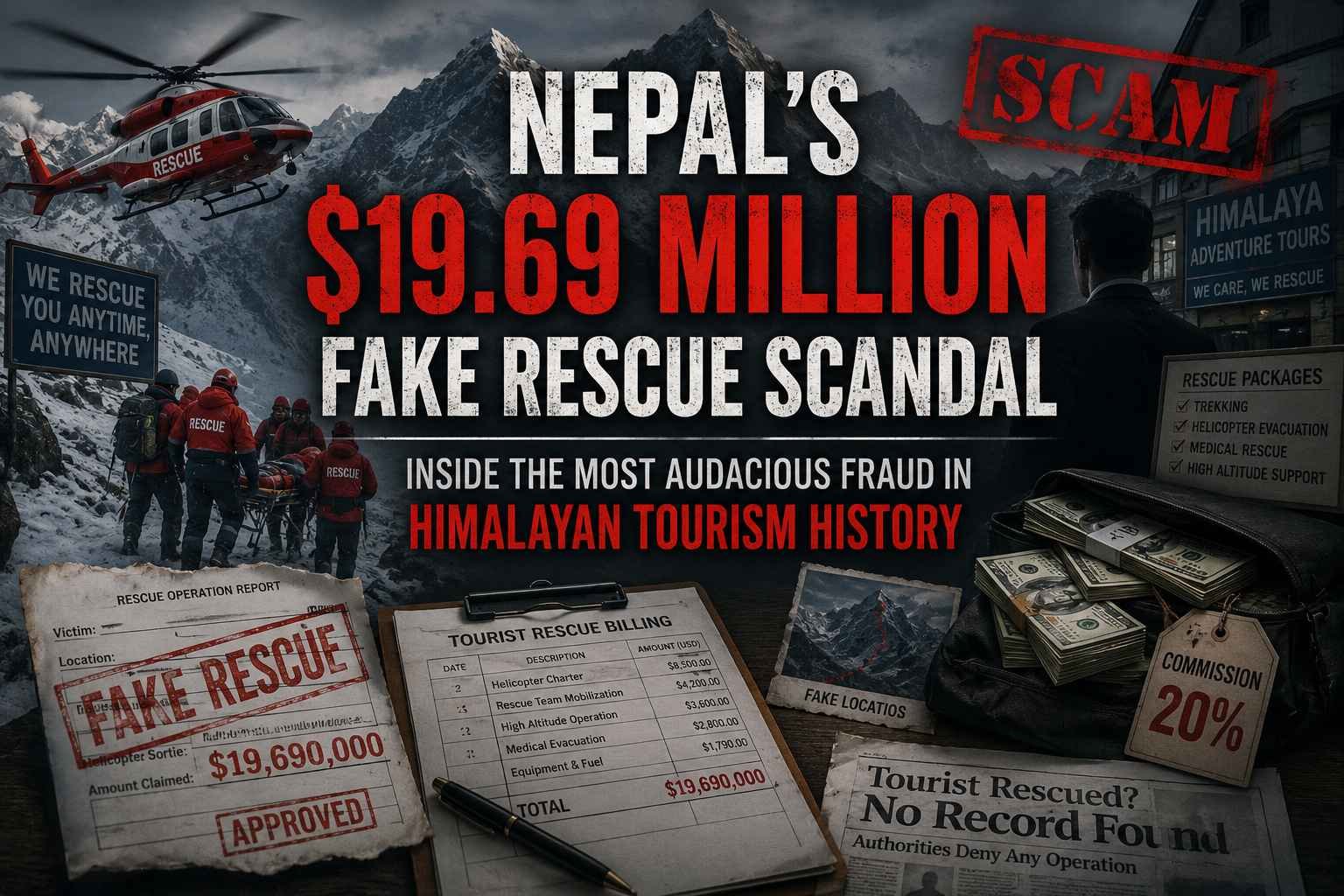
Nepal’s $19.69 Million Fake Rescue Scandal: Inside the Most Audacious Fraud in Himalayan Tourism History
What the trekker did not know what the insurance company did not know, what the international travel insurance industry took years to fully recognise was that in a significant number of these cases, the illness had been deliberately induced. The emergency had been staged. The helicopter had been pre-arranged before the symptoms appeared. And the hospital billing had been systematically inflated to extract maximum reimbursement from insurers who had no practical means to verify the claims being submitted from a remote Himalayan country.
This, according to Nepal’s anti-corruption authority, is how a fraud totalling nearly USD $19.69 million was allegedly operated across nearly a decade making it, by the scale of its financial damage, the most consequential organised crime case in Nepal’s trekking industry history.
The Investigation How the CIAA Built Its Case
The Commission for the Investigation of Abuse of Authority
Nepal’s Commission for the Investigation of Abuse of Authority (CIAA) the constitutional anti-corruption body with prosecutorial authority filed the primary case that triggered what has become the most significant criminal investigation in Nepal’s tourism sector history.
The investigation was not triggered by a single whistleblower or a single suspicious claim. It emerged from a pattern that international insurers had begun documenting with increasing alarm from approximately 2018 onward: a statistically anomalous concentration of helicopter rescue claims originating from Nepal’s trekking trails, filed through a small cluster of trekking agencies, directed to a small number of private hospitals, exhibiting billing patterns that departure significantly from genuine emergency medical costs.
International insurance investigators particularly from European insurers who collectively represent the majority of Nepal-bound trekking travelers’ policies began sharing data, identifying the pattern, and communicating their concerns to Nepal’s authorities. The volume and consistency of the anomalies eventually triggered a formal CIAA investigation that took several years to build into prosecutable cases.
When the CIAA filed its case at the Special Court in Kathmandu, the scale of the alleged fraud was staggering: 37+ individuals and entities named, across a scheme allegedly generating nearly $20 million in fraudulent insurance claims.
How the Scheme Allegedly Worked The Mechanics of Manufactured Emergency
Court filings and investigative reporting have outlined an alleged operational structure of considerable sophistication. Understanding it requires examining each component separately.
Stage One The Trekker Selection
Not every trekker was allegedly targeted. The scheme allegedly worked most effectively with trekkers who:
- Were solo travelers or part of small groups without companions who might question the medical assessment
- Were on their first Nepal trek and had limited experience of altitude symptoms to compare against
- Had purchased comprehensive travel insurance with high evacuation coverage limits guides allegedly had access to information about trekker insurance arrangements, in some cases through documentation provided at agency booking
- Were at altitude where genuine AMS symptoms are common and any physical distress is plausibly attributable to elevation
Stage Two The Induction of Symptoms
The most disturbing element of the alleged scheme and the detail that has received the most international attention is the allegation that baking soda (sodium bicarbonate) was dissolved in beverages and administered to trekkers without their knowledge.
The physiological mechanism alleged is medically coherent: ingesting significant quantities of sodium bicarbonate disrupts the body’s acid-base balance, producing a condition called metabolic alkalosis symptoms of which include nausea, muscle weakness, irregular heart rhythm, dizziness, and general malaise. These symptoms are, critically, largely indistinguishable from moderate-to-severe Acute Mountain Sickness without specific blood chemistry testing testing that is not available on Nepal’s trekking trails and not routinely ordered in the emergency triage context of a helicopter evacuation.
Court documents allege that baking soda was the primary adulterant used, though investigators have referenced other potential agents capable of producing similar symptom profiles. The alleged delivery mechanism was most commonly tea, soup, or other beverages provided by the guide or teahouse at a moment when the trekker’s consumption could be controlled.
⚠️ Medical Note: Metabolic alkalosis induced by sodium bicarbonate ingestion is genuinely unpleasant, potentially dangerous in large doses, and in the context of pre-existing altitude stress on the body potentially more serious than it would be at sea level. The alleged scheme was not medically trivial in its physical impact on victims.
Stage Three The Staged Assessment and Helicopter Call
Once symptoms appeared, the guide’s response allegedly followed a practiced script. Concern was expressed. Pulse oximetry readings which can be manipulated by user technique or environmental interference were cited. The assessment: this trekker cannot continue safely; evacuation is required.
The helicopter call allegedly came not as a response to a genuine emergency but as the execution of a pre-arranged operational sequence. Court filings allege that in many cases, the helicopter company, the receiving hospital, and the guide were coordinating in advance the helicopter was not being dispatched in response to a distress call but as part of a pre-planned commercial transaction in which the “emergency” was a stage direction rather than a medical reality.
Helicopter operators named in the investigation which includes some of Nepal’s private helicopter companies allegedly received a percentage of the fraudulent billing as their participation fee. The quid pro quo alleged: guaranteed call volume in exchange for participation in the billing inflation scheme.
Stage Four Hospital Admission and Billing Inflation
The trekker, genuinely unwell from whatever combination of altitude stress and alleged adulteration they had experienced, arrived at a private Kathmandu hospital. The hospital admission was real. The clinical assessment was real. The treatment was real.
What was allegedly not real or not proportionate to clinical reality was the billing.
Court documents allege that participating private hospitals systematically inflated invoices submitted to international insurers, billing for:
- Treatments and procedures that were not performed
- Days of hospitalisation that did not occur or were unnecessarily extended
- Diagnostic tests conducted without clinical indication
- Pharmaceutical costs inflated far beyond actual administration
- Specialist consultations that were either not conducted or not at the specialist level billed
The invoices were then submitted to international travel insurance companies primarily European and North American insurers whose claims assessment processes were designed for their home markets and had limited capacity to audit medical billing from Nepal’s private hospital sector.
International insurers, operating under the standard presumption that a helicopter evacuation from a Nepal trekking trail followed by hospital admission represents a genuine emergency, paid the claims. For nearly a decade, they kept paying.
Organisations Named Who the Court Documents Identify
Court filings and verified investigative reporting have named entities across three primary sectors of the Nepal tourism and healthcare industries:
Trekking Agencies
Multiple trekking agencies are named as alleged primary operators of the scheme the entities that recruited guides, selected targets, coordinated the alleged adulteration, and arranged helicopter calls. Several of these agencies operated in Kathmandu’s Thamel district and had established online presences and booking infrastructure targeting international travelers.
The agencies named span a range of sizes some were small operations apparently existing primarily to facilitate the fraud, others were more established businesses where the alleged scheme operated as a parallel revenue stream alongside legitimate trekking operations.
Helicopter Companies
Several private helicopter operators are named as alleged participants specifically in the pre-arrangement of evacuations and the inflation of evacuation billing submitted to insurers. Helicopter evacuation costs in Nepal are genuinely high legitimate emergency evacuations from high altitude can cost $3,000–$8,000 USD providing significant billing headroom within which inflation could be concealed within plausible ranges.
Private Hospitals
The hospital complicity allegations are perhaps the most institutionally significant element of the case because hospitals carry a public trust obligation that extends beyond commercial entities.
Multiple private hospitals in Kathmandu are named in court documents as alleged participants in the billing inflation scheme. The allegations suggest that participating hospitals had internal processes involving billing departments, admission coordinators, and in some cases clinical staff for generating inflated invoices aligned with the scheme’s requirements.
The named hospitals have, through legal representatives, denied the allegations. These denials are noted; the allegations remain unproven at final adjudication.
Individual Guides and Medical Professionals
Individual licensed trekking guides, medical personnel, and hospital administrative staff are named as individual accused across the court filings making this a case that reaches into Nepal’s professional licensing structures for both tourism and healthcare.
What the Evidence Shows
The prosecution’s evidentiary case, as reported from court proceedings and CIAA statements through May 2026, rests on several categories of evidence:
Financial forensics form the spine of the case the CIAA’s financial investigation traced money flows from insurance reimbursements through hospital accounts, helicopter company accounts, and agency accounts, allegedly identifying systematic fee-splitting arrangements that demonstrate coordinated rather than coincidental participation.
Claim pattern analysis provided by international insurers statistical modelling showing that claim frequency, claim value, and claim characteristics from specific Nepal agencies and hospitals were multiple standard deviations outside the profile of legitimate emergency medical claims from comparable trekking populations.
Witness testimony from former guides and agency staff who have cooperated with investigators providing inside accounts of how the scheme operated, how trekkers were selected, and how the coordination between guides, helicopter operators, and hospitals was managed.
Physical evidence including communication records messaging applications, email chains, and phone records allegedly showing pre-evacuation coordination between guides, helicopter dispatchers, and hospital admission staff in cases where clinical emergency would not have been known in advance.
Trekker victim testimony international trekkers who, having been contacted by investigators or having independently reported suspicious circumstances around their Nepal medical emergencies, provided statements describing the sequence of events preceding their evacuations.
Where the Case Stands May 2026
As of May 2026, the Mera Peak fake rescue case and related CIAA prosecutions are in active trial proceedings at the Special Court in Kathmandu. Key status points:
- Multiple accused individuals remain in custody pending trial conclusion; others are on bail with travel restrictions
- The Special Court has admitted the CIAA’s primary evidentiary submissions; defence teams have filed multiple procedural challenges that have extended the timeline
- Several accused individuals have entered partial cooperation agreements with prosecutors, providing testimony in exchange for sentencing consideration a development that significantly strengthens the prosecution’s case
- Nepal’s government has announced a comprehensive review of the helicopter evacuation billing system and is working with international insurers to implement pre-authorisation requirements and independent medical assessment protocols for evacuation claims
- The Nepal Medical Council has separately opened disciplinary proceedings against named medical professionals; the Nepal Tourism Board has suspended the licenses of several named trekking agencies
- International insurers coordinated through the International Union of Marine Insurance and bilateral insurer communications have implemented enhanced Nepal claim scrutiny protocols that have reportedly reduced fraudulent claim approvals dramatically since 2023
A final verdict is not anticipated before late 2026 at earliest, given the complexity of the multi-defendant case and the volume of evidence under examination.
How to Protect Yourself What Every Nepal Traveler Must Know
The fake rescue scandal does not make Nepal unsafe to visit. The vast majority of Nepal’s trekking agencies, guides, helicopter operators, and hospitals operate with complete integrity and have been as damaged by this scandal reputationally and commercially as any international traveler.
What it does require is informed, deliberate selection of every service provider in your Nepal travel chain. Here is the protection framework:
Agency Verification Non-Negotiable Steps:
- ✅ Verify TAAN (Trekking Agencies’ Association of Nepal) membership at taan.org.np
- ✅ Verify Nepal Tourism Board registration
- ✅ Confirm guide holds NTB-issued guide license request the license number and verify independently
- ✅ Ask for client references from the previous 12 months specifically contact them directly
- ✅ Cross-reference the agency name against NTB’s published list of suspended operators (updated periodically on ntb.gov.np)
Insurance Critical Clauses:
- ✅ Purchase travel insurance from a major international insurer with Nepal-specific experience not the cheapest comparison site option
- ✅ Ensure your policy requires insurer pre-authorisation for helicopter evacuation this single clause dramatically reduces your exposure to fraudulent evacuation schemes because a pre-authorisation call to your insurer creates an independent record of the emergency assessment
- ✅ Confirm your policy covers evacuation to 6,000m+ if trekking to EBC or high trekking peaks
- ✅ Keep your insurance documentation private do not share your insurer name, policy number, or coverage limits with guides, agencies, or teahouse staff
On the Trail Behavioral Protection:
- ✅ Never accept drinks or food from guides when you cannot observe preparation carry your own water purification and prepare your own hot beverages when possible in high-risk contexts
- ✅ If you feel unwell, seek a second opinion before agreeing to evacuation contact your insurer’s emergency line directly, describe your symptoms yourself, and request independent medical assessment if possible
- ✅ Document your own health throughout the trek daily pulse oximeter readings create a personal baseline that makes unusual deterioration more identifiable
- ✅ If evacuation is recommended, call your insurer directly yourself do not rely solely on the guide or agency to make the evacuation call on your behalf
- ✅ Travel with a trekking companion wherever possible isolated solo travelers were disproportionately represented in alleged victim profiles
Post-Trek Reporting:
If you experienced a Nepal medical evacuation and have retrospective concerns about its circumstances unusual symptom onset, pre-arranged feeling of the evacuation, or billing that seemed disproportionate to your clinical experience report to:
- Nepal Tourism Board: ntb.gov.np
- CIAA Nepal: ciaa.gov.np
- Your travel insurer’s fraud investigation unit
Your report may form part of a pattern that protects future travelers. 🙏
The Broader Lesson Trust Is the Product Nepal Sells
Nepal’s trekking industry sells something more fragile than scenery, more valuable than summit views, and more essential than any logistical service: it sells trust. The trust that the guide leading you through remote mountain terrain has your safety as their primary commitment. The trust that the helicopter responding to a distress call represents genuine rescue. The trust that the medical team treating you in a Kathmandu hospital is motivated by clinical care rather than billing optimisation.
The $19.69 million fake rescue scheme allegedly attacked that trust at its foundation — and the damage extends far beyond the insurance companies who paid the fraudulent claims. It reaches every legitimate guide who now works under a cloud of industry-wide suspicion. Every honest helicopter operator whose billing is now subjected to enhanced scrutiny. Every reputable hospital whose invoices are now viewed through a lens of institutional scepticism.
The court proceedings unfolding at the Special Court in Kathmandu are not merely a criminal prosecution. They are Nepal’s tourism industry’s reckoning with the consequences of inadequate regulation, insufficient oversight, and the exploitation of a system of trust that the country’s entire mountain economy depends upon.
The mountains remain extraordinary. The guides who serve with integrity — the overwhelming majority — remain among the most skilled and dedicated professionals in adventure travel. Nepal remains one of the world’s essential journey destinations.
But the era of unconditional trust of booking any agency, accepting any guide, consuming any beverage, and assuming all emergencies are genuine is over. Informed travel is the new baseline.
Explore All About Nepal maintains a verified agency database and provides pre-trek operator vetting consultation. We do not accept advertising from trekking agencies and maintain full editorial independence in all operator recommendations.
