📋 Need to Know at a Glance
- Best For: Conscious travelers, cultural explorers, volunteer tourists, slow travelers
- Best Time to Visit: October–November & March–May (ideal weather + festival seasons)
- Budget Range: $40–$200/day depending on experience type
- Ideal Trip Length: 14–21 days for a truly meaningful experience
- Difficulty: No trekking fitness required meaningful tourism in Nepal is for everyone
The Mountain Is Not the Whole Story
Close your eyes and picture Nepal.
You probably see it the jagged white spine of the Himalayas cutting across a cobalt sky, a lone trekker on a ridge above the clouds, a prayer flag snapping in thin air above Everest Base Camp. It’s a powerful image. It’s also, if we’re honest, only a tiny fragment of what this country truly is.
Nepal is the grandmother pressing her palms together in a doorway smelling of incense and woodsmoke in Bhaktapur. It’s the 12-year-old apprentice learning to paint golden Thangkas in a Kathmandu monastery courtyard. It’s a farmer in the Terai lowlands coaxing life from flooded rice paddies with techniques unchanged for a thousand years. It’s a Sherpa woman running a teahouse on the Khumbu trail her hospitality quieter and warmer than any five-star hotel you’ve ever checked into.
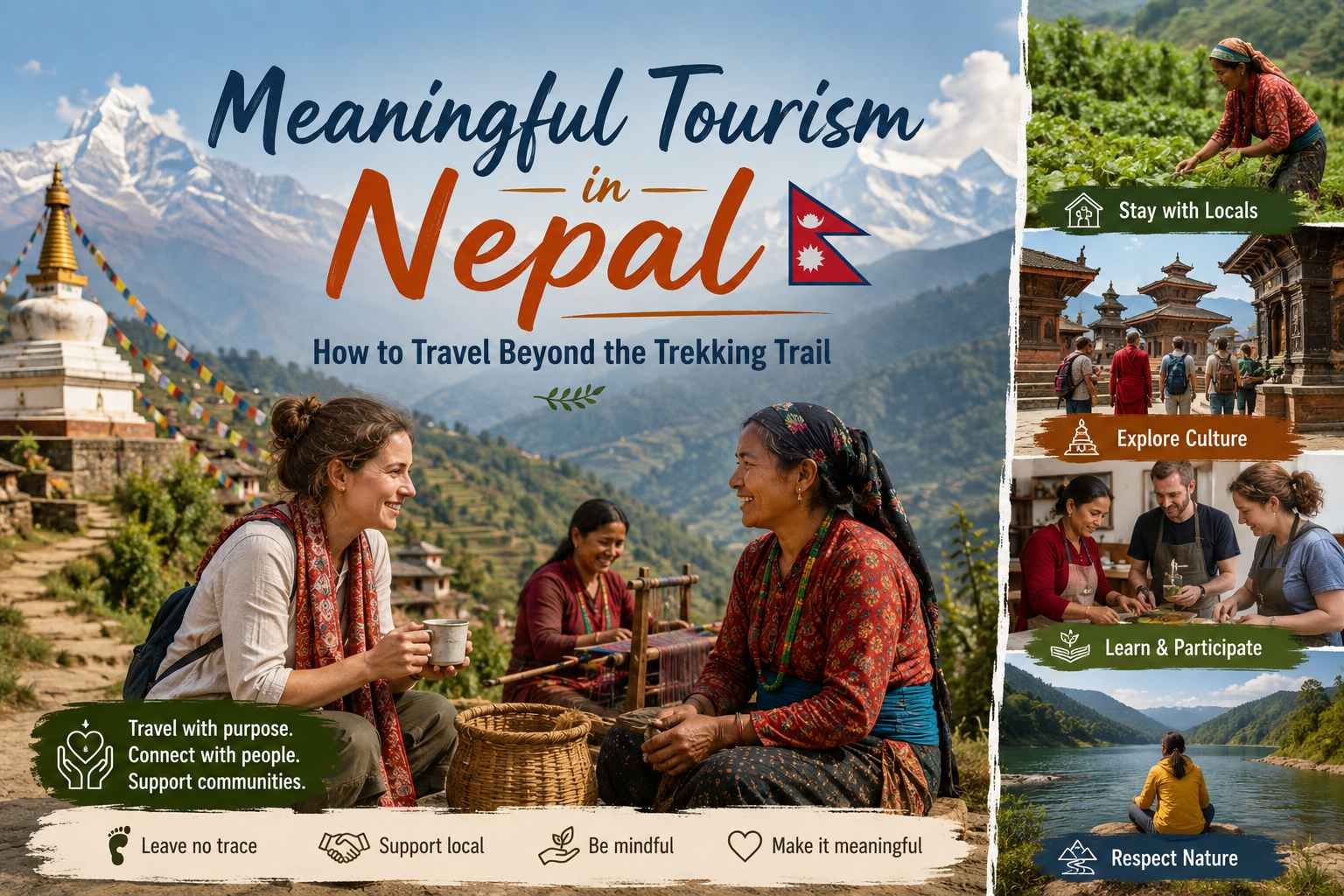
Meaningful Tourism in Nepal
For too long, the global travel narrative around Nepal has been almost entirely about altitude about getting higher, going further, reaching the base of the world’s tallest mountain. And while those trails are genuinely magnificent, reducing Nepal to its trekking routes is like visiting Italy and only ever eating at airport restaurants.
Meaningful tourism in Nepal is the antidote to that reductive view. It is a growing, globally recognized movement that invites travelers to slow down, go deeper, and leave something behind beyond boot prints and empty energy bar wrappers.
This is your complete guide to practicing meaningful tourism in Nepal what it means, where to go, what to do, and how to make sure your visit genuinely benefits the communities and landscapes that make this country one of the most extraordinary places on Earth.
What Is Meaningful Tourism in Nepal?
Before you pack your bags, it helps to understand what sets meaningful tourism in Nepal apart from conventional travel and even from the broader term “sustainable tourism.”
Meaningful tourism in Nepal is travel designed around genuine human connection, cultural exchange, environmental responsibility, and economic benefit to local communities. It’s not about ticking off a bucket list. It’s about arriving as a guest and leaving as someone who has genuinely contributed even in a small way to the wellbeing of the people and places you visited.
Think of it this way:
| Conventional Tourism | Meaningful Tourism in Nepal |
|---|---|
| Stay in internationally-owned hotels | Sleep in community-run homestays |
| Hire the cheapest guide available online | Hire certified, locally-trained guides |
| Buy mass-produced souvenirs at airport shops | Purchase directly from village artisans |
| Trek the most popular routes | Explore lesser-known trails that support remote economies |
| Take photos of people without asking | Build real conversations with communities |
| Donate to large international NGOs | Support verified local grassroots organizations |
| Eat at tourist-facing restaurants | Dine in community kitchens and family homes |
The distinction matters deeply because Nepal’s tourism economy, while vital, has a well-documented problem with tourism leakage: the phenomenon where the majority of money spent by visitors flows out of the country through foreign-owned hotel chains, international booking platforms, and imported goods. Studies suggest that in some Nepali tourist hubs, up to 70% of tourism revenue leaks out of the local economy before it ever reaches the communities being “visited.”
Meaningful tourism in Nepal actively works against that leakage. Every choice you make where you sleep, what you eat, who you hire, what you buy either reinforces or disrupts that extractive pattern.
Why Nepal Needs Meaningful Tourism Now More Than Ever
Nepal is a country of staggering beauty and equally staggering complexity. It is one of the world’s poorest nations by GDP per capita, yet it sits at the center of a global travel industry worth billions. The disconnect between those two facts is exactly where meaningful tourism in Nepal becomes not just a nice idea, but a moral imperative.
🌍 The Overtourism Problem
The trails to Everest Base Camp and the Annapurna Circuit have, in recent years, become genuinely overwhelmed. In peak seasons, the route to EBC resembles a slow-moving queue rather than a wilderness adventure. The environmental impact waste accumulation, trail erosion, pressure on teahouse resources has been widely documented and is worsening.
Meanwhile, Nepal’s remote western regions Humla, Jumla, Mugu, Dolpa receive a fraction of 1% of the country’s international visitors, despite containing some of the most extraordinary landscapes and ancient cultures on the planet.
Meaningful tourism in Nepal redistributes that footprint. It channels curious, conscious travelers toward communities and corridors that genuinely need and welcome the economic benefits of tourism while giving overvisited trails a chance to recover.
🌱 Post-Earthquake Community Resilience
The 2015 Gorkha earthquake and its aftershocks killed nearly 9,000 people and destroyed or damaged over 800,000 homes and countless heritage structures. While Kathmandu’s famous durbar squares and Bhaktapur’s medieval streets have seen impressive rebuilding, many rural villages particularly in Sindhupalchok, Gorkha, and Rasuwa districts are still in various stages of recovery.
Visiting these communities through responsible, locally-organized tourism experiences provides direct economic injection to households that have rebuilt from almost nothing. Meaningful tourism in Nepal in these contexts is, quite literally, part of the healing process.
🏔️ Climate Vulnerability
Nepal’s glaciers are melting at an accelerating pace. The Imja Glacial Lake near Island Peak, for example, has grown from 0.1 km² in 1960 to over 1.3 km² today a direct consequence of Himalayan warming driven by global carbon emissions. Yet Nepal contributes less than 0.1% of global greenhouse gas emissions.
Choosing meaningful tourism in Nepal means choosing travel partners who offset carbon, support reforestation projects, use local transport, and operate with minimal environmental footprint a small but symbolically important act of solidarity with a country bearing a disproportionate share of the climate crisis.
7 Ways to Practice Meaningful Tourism in Nepal
Here is the practical heart of this guide seven concrete, accessible ways that any traveler can embrace meaningful tourism in Nepal, regardless of budget, fitness level, or travel experience.
1. 🏡 Stay in a Community Homestay
This is the single highest-impact change you can make as a traveler in Nepal.
Community homestays where visitors stay with local families in traditional homes, eat family-prepared meals, and participate in daily life are the backbone of meaningful tourism in Nepal. Every rupee you spend on a homestay goes directly to a family’s income. There are no middlemen, no booking platform commissions, no foreign investors taking a cut.
Some of Nepal’s finest homestay experiences include:
- Sirubari Village, Syangja District — Often cited as Nepal’s pioneering community tourism village; traditional Gurung culture, terraced hillside farms, and extraordinary mountain views
- Ghale Gaun, Lamjung — A Gurung village perched above the Marsyangdi Valley; women-led tourism cooperative; traditional crafts and festivals
- Bandipur Homestays — A beautifully preserved Newari hilltop town; excellent for families; easy access from Kathmandu-Pokhara highway
- Jugal Village Circuit, Sindhupalchok — Community homestay network rebuilt after 2015 earthquake; direct benefit to recovering households
- Tamang Heritage Trail Villages — A string of Tamang communities north of Kathmandu offering cultural immersion, monastery visits, and honest mountain landscapes without EBC-level crowds
Pro Tip: Always book through verified community cooperatives or the Nepal Tourism Board’s registered homestay program this ensures families are properly compensated and standards are maintained.
2. 🎨 Engage With Living Cultural Traditions
Nepal’s intangible cultural heritage its festivals, art forms, ritual practices, music, and craft traditions is as endangered as its glaciers. Many ancient skills are dying with the elders who hold them, as younger generations migrate to Kathmandu or abroad for economic opportunities.
Meaningful tourism in Nepal includes deliberately seeking out and financially supporting these living traditions:
- Thangka Painting Workshops in Kathmandu — Sit with a master Thangka painter in Boudhanath or Patan and learn the meditative art form that has mapped Buddhist cosmology for centuries. Many studios offer half-day and multi-day workshops; proceeds fund apprenticeship programs for young artists
- Newari Pottery in Bhaktapur’s Pottery Square — Watch and participate in wheel-thrown pottery using methods unchanged since the medieval Malla kingdom era; purchase directly from the potter’s family
- Dhime Drummaking in Bhaktapur — The Dhime drum is central to Newari festival culture; a handful of master craftsmen still make them by hand
- Pashmina Weaving Cooperatives in Kathmandu Valley — Visit fair-trade certified cooperatives where you can watch the process from raw cashmere to finished shawl — and buy knowing your money goes to the weaver, not a middleman
- Nepali Paper (Lokta) Making, Janakpur — Lokta paper, made from Himalayan shrub bark, is used in religious texts and art; small cooperatives in Janakpur teach the process and sell handmade products
These experiences don’t just give you a richer travel story they provide crucial economic incentives for communities to continue preserving traditions that might otherwise be abandoned.
3. 🌿 Choose Ethical Wildlife & Nature Experiences
Nepal’s biodiversity is extraordinary it’s one of only a handful of countries where you can see Bengal tigers, one-horned rhinoceroses, snow leopards, red pandas, and Gangetic river dolphins, sometimes in the same week.
But not all wildlife tourism is created equal. Meaningful tourism in Nepal‘s approach to wildlife means:
- Choosing mahout-free and riding-free elephant experiences Several operators in Chitwan still offer elephant-back safari rides; ethical operators have moved to walking safaris alongside semi-wild elephants instead. Always verify before booking
- Supporting community buffer zone lodges around Chitwan and Bardia These lodges are partly owned by local communities and fund anti-poaching patrols and wildlife corridor maintenance
- Visiting Bardia National Park over Chitwan for a less impacted wilderness experience; Bardia has seen remarkable tiger population recovery in recent years, driven partly by community-based conservation tourism
- Koshi Tappu Wildlife Reserve for birdwatching 485+ species; birding guides here are local Tharu community members trained through conservation tourism programs
- Supporting snow leopard conservation programs in Mustang and Manang Organizations like Snow Leopard Trust work with herder communities to reduce human-wildlife conflict; some offer volunteer and observer opportunities for visitors
4. 🍽️ Eat Nepali, Pay Nepali
Food is one of the most overlooked dimensions of meaningful tourism in Nepal and one of the easiest places to make a direct positive impact.
Nepal’s culinary landscape is far richer and more diverse than the dal bhat + momos combination that most tourist restaurants serve on repeat. Each ethnic community Newari, Tharu, Gurung, Sherpa, Limbu, Madhesi has its own distinct food culture, and most of it is almost entirely invisible to mainstream tourism.
Seek out:
- Newari feasts (Samay Baji) in Bhaktapur and Kirtipur fermented rice beer, buffalo meat dishes, spiced beaten rice, black soybean preparations; unlike anything else in South Asian cuisine
- Tharu kitchens in Chitwan buffer zone villages smoked fish curry, wild mushroom dishes, rice-based fermented drinks; eat with a Tharu family and the meal becomes a cultural event
- Tibetan-influenced Sherpa cuisine in Namche Bazaar beyond the yak cheese pizza catering to trekkers, local restaurants serve Tibetan butter tea, tsampa (roasted barley), and genuine Sherpa staples
- Madhesi sweets in Janakpur the Terai’s culinary traditions are deeply distinct from hill Nepal; Janakpur’s sweets markets are extraordinary
- Street food in Asan Tol, Kathmandu the city’s oldest market neighborhood; eat pani puri, chatamari (Newari rice crepes), and juju dhau (Bhaktapur’s famous king curd) where locals actually eat them
Rule of thumb: If the restaurant has a laminated multi-page menu with photos and lists 14 different “international breakfast options” walk past it. If a grandmother is running a 6-item chalk board menu out of her front room sit down immediately.
5. 🎒 Hire Local, Certify Right
Every guide and porter you hire on a Nepal trek or tour is a family’s primary income source. The quality and ethics of that hiring decision matters enormously.
Meaningful tourism in Nepal hiring principles:
- Always hire through Nepal Tourism Board registered agencies this ensures guides have completed mandatory training in first aid, mountain safety, and cultural sensitivity
- Verify porter welfare standards porters should never carry more than 30kg; they must be provided appropriate clothing for altitude (many agencies still fail this); their accommodation and food must be covered. The International Porter Protection Group (IPPG) publishes verified agency lists
- Choose female guides when possible Female trekking guides in Nepal earn significantly less than male counterparts and work in a male-dominated industry; several agencies specialize in women-led guiding teams (Three Sisters Adventure Trekking in Pokhara is the pioneering example)
- Tip generously and in cash directly Tips should go directly to your guide and porter in person on the final day, not through the agency
Never book through platforms that race to the bottom on price. The cheapest trek operator is cheap for a reason and the people paying the real cost are the guides and porters.
6. 🏛️ Support Heritage Reconstruction
Wandering through the courtyards of Bhaktapur, the tiered pagodas of Patan Durbar Square, or the intricate woodcarvings of Kathmandu’s hidden monasteries, it’s easy to feel that Nepal’s heritage is eternal and indestructible.
It isn’t. And meaningful tourism in Nepal includes actively supporting its preservation:
- Pay Bhaktapur’s entry fee without complaint — The NPR 1,500 entry fee funds ongoing restoration and is one of the most direct tourist-to-heritage contributions in South Asia
- Donate to verified restoration projects — UNESCO, Kathmandu Valley Preservation Trust, and the National Trust for Nature Conservation all run verifiable, accountable programs
- Buy original crafts over replicas — A hand-carved wooden deity bought directly from a Bhaktapur craftsman keeps a family in business AND contributes to keeping the craft alive
- Visit during shoulder season — Over-concentrated visits during October–November peak season strain conservation infrastructure; March–May visits spread economic and physical impact more sustainably
7. 🤲 Volunteer Thoughtfully (Or Don’t Volunteer at All)
Voluntourism in Nepal is a genuinely complex issue. The country has, in the past, been a destination for well-meaning but poorly-designed volunteering programs particularly “orphanage volunteering” schemes that have been widely exposed as exploitative.
Meaningful tourism in Nepal approaches volunteering with rigorous honesty:
✅ Ethical volunteering exists — it looks like this:
- Minimum 4-week commitments (anything shorter rarely produces real benefit)
- Skills-matched placements (teaching English if you’re a qualified teacher; not because you’re a native speaker)
- Programs run by Nepali-led organizations, not foreign companies charging large “volunteer fees”
- Clear accountability for how funds are used
- No direct child contact in the first placement weeks
❌ Avoid these red flags:
- Orphanages accepting short-term volunteers (studies show rotating volunteers are psychologically harmful to children)
- Programs charging $2,000+ in “program fees” with minimal transparency
- “Building schools” programs that employ unskilled visitors instead of local construction workers
- Any program that promises a feel-good experience over a genuinely useful one
Organizations that meet ethical standards for meaningful tourism in Nepal include: Rural Community Development Programme (RCDP Nepal), Volunteer Nepal National Group, and Teach for Nepal (for qualified educators).
Where to Go: Regions Built for Meaningful Tourism in Nepal
The map of meaningful tourism in Nepal doesn’t look like a conventional trekking map. Here’s where to focus your attention:
🏘️ Kathmandu Valley (Beyond the Durbar Squares)
Most visitors do a circuit of Kathmandu’s UNESCO sites and leave. But the valley rewards slower exploration:
- Kirtipur — Ancient hilltop Newari town; almost no tourists; extraordinary architecture and craft workshops
- Khokana — Village famous for mustard oil production using centuries-old stone presses; a living museum of Newari agricultural culture
- Sankhu — Northeastern valley town with a 17th-century Vajrayogini temple complex and traditional Newari street life
- Lubhu — Weaving cooperative center; where traditional Nepali fabric is still made on handlooms
🌾 The Terai Lowlands (Nepal’s Most Overlooked Region)
The Terai Nepal’s southern plains bordering India is almost entirely absent from mainstream travel writing. Yet it contains:
- Janakpur Sacred Hindu city; birthplace of Sita from the Ramayana; extraordinary Maithili art tradition and the stunning Janaki Mandir temple
- Lumbini Birthplace of Siddhartha Gautama (the Buddha); a UNESCO site of global spiritual significance; home to monasteries built by Buddhist nations from Japan to Germany
- Tharu Cultural Villages around Sauraha The Tharu people have inhabited the Terai for millennia; their culture, cuisine, and architecture are utterly distinct from hill Nepal
🏔️ Mid-Hills (Nepal’s Cultural Heartland)
The rolling hills between the Terai and the high Himalayas are where Nepal’s extraordinary ethnic diversity is most accessible:
- Palpa (Tansen) A beautifully preserved hilltop trading town; Dhaka fabric weaving; tin metalwork; extraordinary valley views; almost no foreign tourists
- Gorkha Birthplace of the unified Nepal nation; Gorkha Palace; community tourism programs directly connected to earthquake recovery
- Manaslu Conservation Area Buffer Zone Villages Traditional Gurung and Tibetan Buddhist communities; growing community tourism infrastructure
🌄 A Sample 14-Day Meaningful Tourism in Nepal Itinerary
This itinerary combines cultural depth, community benefit, wildlife ethics, and genuine off-the-beaten-path exploration:
| Day | Location | Activity |
|---|---|---|
| Day 1–2 | Kathmandu | Arrive; explore Kirtipur and Khokana; Thangka painting workshop |
| Day 3 | Bhaktapur | Full day; pay heritage entry fee; pottery square; Newari feast |
| Day 4 | Bandipur | Overnight homestay; traditional Newari hilltop town |
| Day 5–6 | Ghale Gaun | Women-led cultural homestay; Gurung village life; Lamjung himal views |
| Day 7 | Pokhara | Rest day; hire Three Sisters female trek guide for city orientation |
| Day 8 | Palpa (Tansen) | Dhaka fabric cooperative; Newari-Thakali architecture; local markets |
| Day 9–10 | Lumbini | Buddhist pilgrimage circuit; monastery visits; contemplative gardens |
| Day 11–12 | Tharu Village, Sauraha | Community homestay; Tharu cultural evening; ethical walking safari |
| Day 13 | Janakpur | Maithili art cooperative; Janaki Mandir; Mithila painting workshop |
| Day 14 | Kathmandu | Return; farewell Newari meal; purchase directly from artisan cooperative |
Practical Tips for Every Meaningful Traveler in Nepal
A few final, concrete pieces of guidance to help you travel better from day one:
- Carry small denomination Nepali rupees — Many community cooperatives and family homestays cannot process cards; cash paid directly to families has zero processing fee loss
- Learn 10 words of Nepali — Namaste, Dhanyabad (thank you), Mitho chha (it’s delicious), Ramro chha (it’s beautiful) even minimal effort is received with extraordinary warmth
- Ask before photographing — Always. A smiled “photo linu hunchha?” (May I take a photo?) completely transforms the interaction
- Budget for quality, not just price — The traveler who spends $80/day mindfully and locally does far more good than one who spends $200 in foreign-owned resorts
- Read before you go — “Little Princes” by Conor Grennan, “In the Kingdom of Ice” by Hampton Sides, and Manjushree Thapa’s “Forget Kathmandu” will deepen every experience you have
- Travel slowly — Two weeks in three regions beats two weeks in twelve; depth of experience always outweighs breadth of geography
- Offset your carbon — Nepal is disproportionately impacted by climate change; use Gold Standard certified offsets for your flights; it’s a small cost with genuine impact
Why Meaningful Tourism in Nepal Is the Future of Travel Here
There is a version of Nepal’s tourism future that looks troubling more crowded trails, more plastic-wrapped summits, more tourism income flowing offshore, more ancient villages emptied of young people who’ve given up on a future at home.
And there is another version one where meaningful tourism in Nepal becomes the dominant model. Where travelers arrive with curiosity instead of just ambition. Where a grandmother in Ghale Gaun earns enough from her homestay to keep her granddaughter in school. Where a Thangka painter in Boudhanath has enough workshop students to justify training the next generation of apprentices. Where the trail to Rara Lake is as well-maintained as the trail to Everest Base Camp, because both bring sustainable, equitable income to the communities along them.
Meaningful tourism in Nepal is not a sacrifice of experience. It is, in almost every dimension, a richer, deeper, more memorable, and more human form of travel than the conventional alternative.
The mountains will take your breath away regardless of which path you choose. But meaningful tourism in Nepal gives you something more than altitude it gives you a genuine, earned connection to one of the most extraordinary civilizations on this planet.
That connection is what you’ll carry home. That is what will bring you back.
Frequently Asked Questions About Meaningful Tourism in Nepal
Is meaningful tourism in Nepal only for budget travelers?
Absolutely not. Meaningful tourism in Nepal spans every budget level from $40/day community homestays to $500/night luxury eco-lodges that fund conservation programs. The distinction is not how much you spend, but where your money goes and how you engage with communities.
Can I practice meaningful tourism in Nepal if I only have 7 days?
Yes though 14–21 days allows deeper immersion. Even a 7-day visit can prioritize homestays over hotels, local restaurants over tourist cafes, certified guides over discount operators, and direct artisan purchases over airport shops.
Is it safe to travel to remote regions for meaningful tourism in Nepal?
Nepal’s remote regions are generally very safe for travelers. The primary considerations are altitude (acclimatize properly), trail conditions (always hire a local guide for remote routes), and communication (carry a satellite communicator for truly isolated areas). Register your trekking plans with the Tourism Board before departing.
How do I verify that a homestay or operator is genuinely community-benefit?
Look for: Nepal Tourism Board registration, membership in the Tourism for Rural Poverty Alleviation Programme (TRPAP), affiliation with Trekking Agencies’ Association of Nepal (TAAN), and transparent financial reporting showing what percentage of fees reach host families. When in doubt, ask directly how much of my fee goes to the family hosting me?
What is the best season for meaningful tourism in Nepal?
October–November is peak season best weather, most festivals, vibrant atmosphere. March–May is equally beautiful and slightly less crowded. December–February offers winter landscapes and minimal crowds in lower regions. Monsoon (June–September) is challenging for trekking but extraordinary for lush valley landscapes and authentic local life with very few other tourists around.
Can meaningful tourism in Nepal include a trek?
Absolutely yes. Meaningful tourism in Nepal and trekking are not mutually exclusive it’s about how you trek. Hire certified local guides and porters, use teahouses owned by local families, carry out your waste, choose less-crowded trails, and spend your rest days in village cultural activities rather than just recovering in your sleeping bag.
Planning your Nepal journey? Explore All About Nepal is your expert guide to discovering the country beyond the trekking trails from living cultural traditions to community homestays, ethical wildlife experiences, and hidden regional gems. Start exploring below. 🇳🇵
