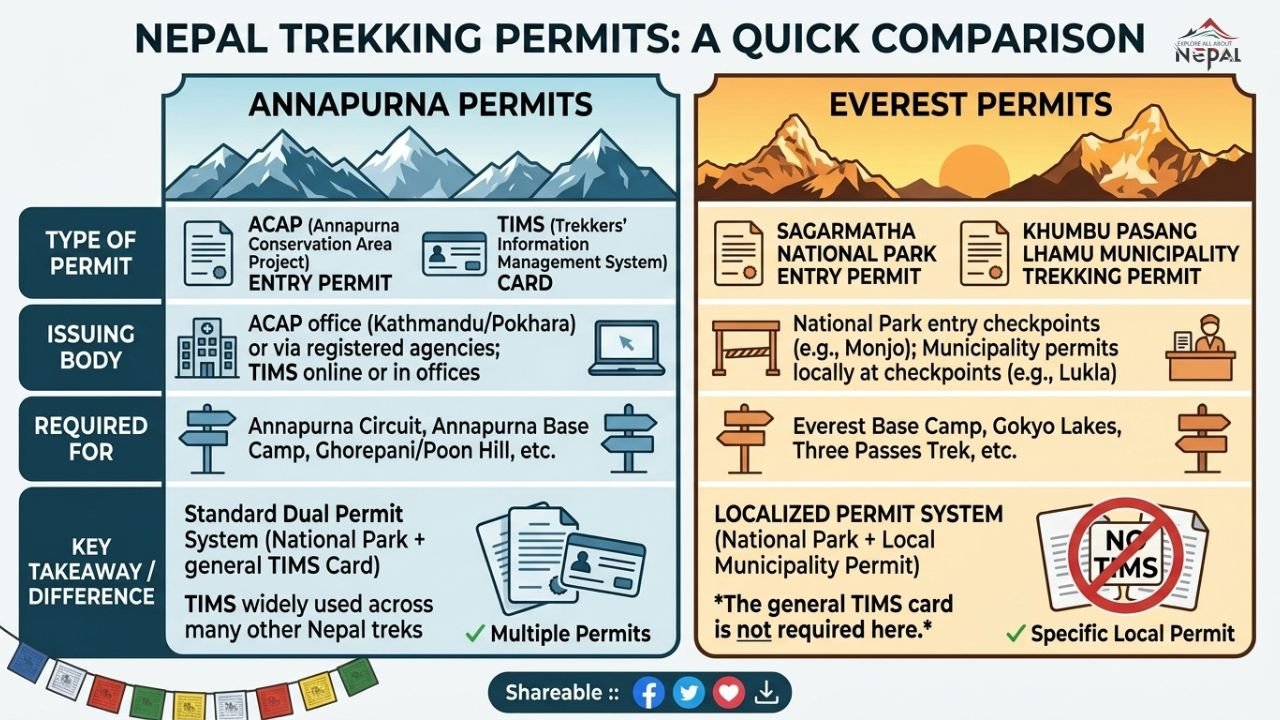
Here’s what you need before you start stressing: which permits you need depends entirely on where you trek, but for the two most popular regions the answer is simple. For Annapurna (including Annapurna Base Camp and Poon Hill), you need the ACAP permit (NPR 3,000 / ~$22) plus a TIMS card (~NPR 2,000 / ~$15 via an agency, ~NPR 1,000 for SAARC nationals). For Everest (Base Camp), you skip TIMS and instead need the Khumbu Pasang Lhamu Rural Municipality permit (NPR 2,000 / ~$15–20) plus the Sagarmatha National Park permit (NPR 3,000 / ~$22). The big catch most people miss: solo trekking is now restricted in many areas, and a licensed guide is often required. Details below.
The rule that changed everything: solo trekking restrictions
Start here, because it affects your whole plan. In recent years Nepal moved to restrict solo (fully independent) trekking in national parks and conservation areas, with rules requiring trekkers in many regions to hire a licensed guide and trek through a registered agency. Enforcement and the exact list of affected areas have shifted since, and some regions are stricter than others.
Here’s what most people get wrong: they plan a money-saving solo trek based on an old blog post, fly in, and discover at the permit counter that they need a guide they didn’t budget for. If your plan depends on trekking alone, confirm the current rule for your specific route before you book your flights not after.
This single rule change is the biggest permit-related surprise hitting first-timers right now, and it’s exactly why many people now just book a tour that bundles the guide and the paperwork together.
TIMS card: what it is and who needs it
The TIMS card (Trekkers’ Information Management System) is a trekker registration system run by Nepal’s tourism authorities and the trekking agencies’ association (TAAN). Its purpose is safety logging who’s on the trails so you can be traced in an emergency.
Cost: roughly NPR 2,000 (~$15) for foreign nationals trekking through an agency, with a lower rate (around NPR 1,000) for SAARC-country nationals. Independent rates have differed historically.
Where TIMS applies: it’s required for many trekking regions Annapurna being the key one but, importantly, not everywhere. The Everest region uses a local municipality permit instead of TIMS. This trips people up constantly.
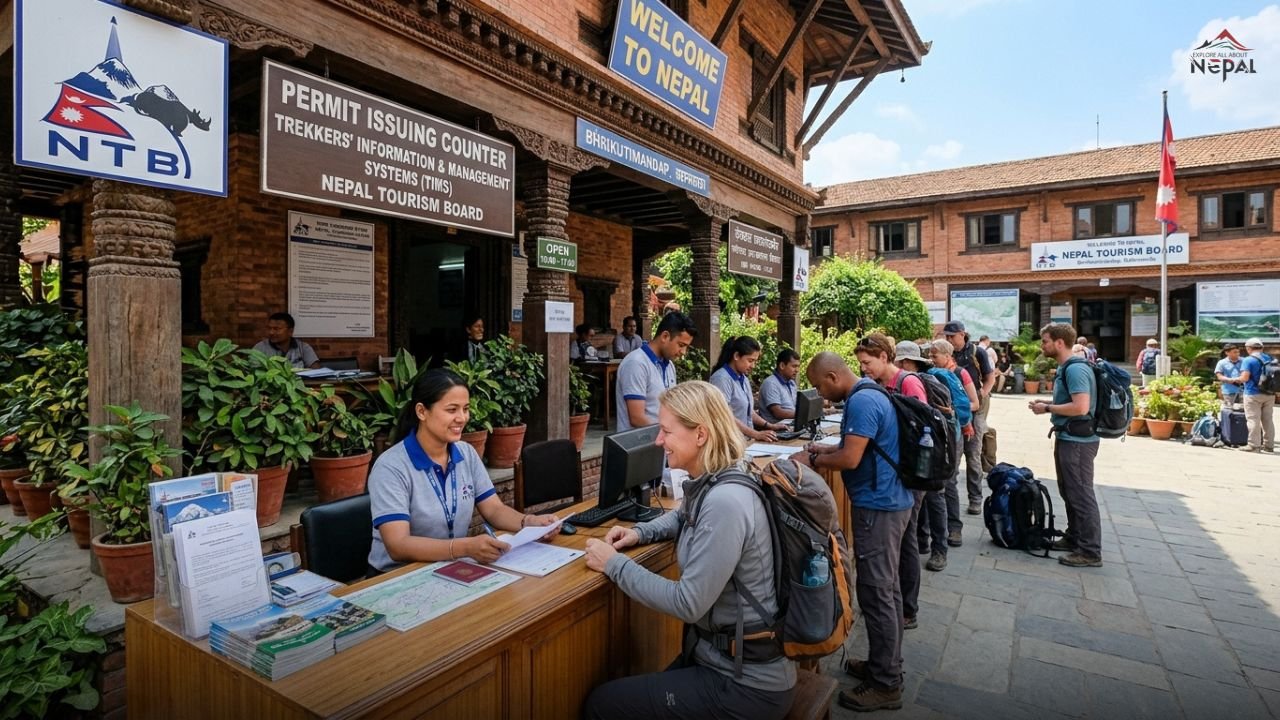
Where to get it: the Nepal Tourism Board offices in Kathmandu and Pokhara, or through your trekking agency (who’ll usually sort it as part of a package). Bring your passport and two passport-sized photos.
ACAP: the Annapurna Conservation Area Permit
If you’re trekking anywhere in the Annapurna region Annapurna Base Camp, Poon Hill, Mardi Himal, the Annapurna Circuit you need the ACAP (Annapurna Conservation Area Permit).
Cost: NPR 3,000 (~$22) for foreign nationals; NPR 1,000 for SAARC nationals. The fee supports conservation and local communities in the region.
Where to get it: Nepal Tourism Board offices in Kathmandu or Pokhara, or via your agency. Same requirements passport and photos. Get it before you start trekking; buying permits at checkpoints on the trail is not the system, and trying to skip ahead and pay later typically means a penalty (often double the fee).
So for a standard Annapurna trek, your permit stack is ACAP + TIMS, totalling roughly $35–$40 in fees.
Everest (Khumbu) permits: different system, no TIMS
This is where people who only researched Annapurna get caught out. The Everest Base Camp trek does not use TIMS. Instead you need two different permits:
- Khumbu Pasang Lhamu Rural Municipality permit: around NPR 2,000 (~$15–20), a local-government permit collected for the Khumbu region (often paid at Lukla or Monjo).
- Sagarmatha National Park permit: NPR 3,000 (~$22) for foreign nationals, for entry into the national park.
Where to get them: the national park permit is available in Kathmandu or at the Monjo park entrance; the municipality permit is typically collected within the Khumbu. Your agency handles all of this on a packaged trek.
So an Everest permit stack runs roughly $35–$45 in fees, plus the larger reality that Everest also means the Lukla flight famously weather-delayed, which is its own planning headache worth budgeting buffer days for.
nepal trekking permit
Restricted-area permits: the expensive tier
Some of Nepal’s most remote and beautiful regions Upper Mustang, Manaslu, Upper Dolpo, Tsum Valley, Nar Phu are restricted areas with a completely different, pricier permit regime, and these require a registered agency and (usually a minimum of two) trekkers plus a licensed guide. No solo trekking, no exceptions.
These Restricted Area Permits (RAP) are charged in US dollars and are far more expensive for example, Upper Mustang runs into the hundreds of dollars per person (historically around $500 for the first 10 days), and Manaslu is priced by season.
If you’re eyeing one of these, the permit cost alone reshapes your budget, and you must go through an operator. This is a place where a guided package isn’t just convenient it’s mandatory.
What permits cost: the quick reference
Approximate foreign-national fees, to sanity-check any quote:
- ACAP (Annapurna): NPR 3,000 / ~$22
- TIMS card: ~NPR 2,000 / ~$15
- Sagarmatha National Park (Everest): NPR 3,000 / ~$22
- Khumbu Pasang Lhamu Rural Municipality: ~NPR 2,000 / ~$15–20
- Langtang National Park: NPR 3,000 / ~$22 (Langtang also needs TIMS)
- Restricted areas (Mustang, Manaslu, etc.): much higher, charged in USD, agency required
For the two most popular treks, you’re looking at roughly $35–$45 in permit fees total genuinely a small line item against flights and tours, which is worth remembering before you stress over it.
How to actually get your permits (two routes)
Route 1: Do it yourself
Go to the Nepal Tourism Board office in Kathmandu (Bhrikutimandap) or Pokhara. Bring your passport, two or more passport photos, and cash in Nepali rupees. Fill the forms, pay, walk out with your cards. It’s straightforward for Annapurna and Langtang. Bring more passport photos than you think you need they’re used for permits, and running out means a detour to a photo shop.
Route 2: Let an agency or tour handle it
On any guided trek or package tour, permits are bundled in the operator handles the forms, the photos, the queuing, and the rules. Given the solo-trekking restrictions now in force for many regions, this is increasingly the default path anyway.
The honest tradeoff: doing it yourself saves a small amount and gives you a half-day errand; a package saves you the hassle and, crucially, the guide requirement is handled for you. For restricted areas, you have no choice it’s agency-only.
Mistakes that cost trekkers time and money
A few I see repeatedly:
Assuming one permit covers everything. It doesn’t permits are region-specific, and the Annapurna and Everest systems are entirely different. Research your route.
Planning a solo trek on outdated information. The guide requirement is the big one. Check the current rule before committing.
Not carrying enough cash. Permit offices want Nepali rupees (restricted-area permits in USD). Sort cash before you go to the office.
Trying to dodge a checkpoint. Trails have permit checkpoints with rangers. Trekking without the right permit means being turned back or fined a miserable way to lose a trekking day.
Forgetting permits aren’t insurance. A permit logs you for safety; it does not cover an evacuation. You still need travel insurance covering high-altitude trekking and helicopter rescue a Himalayan evacuation runs $3,000–$5,000+, and your $22 permit does nothing toward it.
FAQ About Nepal Trekking Permits
What permits do I need to trek to Everest Base Camp?
Two: the Sagarmatha National Park permit (NPR 3,000 / ~$22) and the Khumbu Pasang Lhamu Rural Municipality permit (~NPR 2,000 / ~$15–20). The Everest region does not use the TIMS card a common point of confusion for trekkers who researched Annapurna first.
Do I need a TIMS card for the Annapurna Base Camp trek?
Yes. Annapurna treks require both the ACAP permit (NPR 3,000 / ~$22) and a TIMS card (~NPR 2,000 / ~$15 for foreign nationals via an agency). You can get both at Nepal Tourism Board offices in Kathmandu or Pokhara, or through your trekking agency.
Can I trek in Nepal without a guide?
In many regions, no longer. Nepal has restricted solo trekking in national parks and conservation areas, with many areas now requiring a licensed guide through a registered agency. Restricted areas like Mustang and Manaslu have always required one. Confirm the current rule for your specific route before booking.
How much do Nepal trekking permits cost in total?
For the most popular treks, roughly $35–$45 in permit fees total about $22 for the area/park permit plus $15 for TIMS or the local municipality permit. Restricted areas like Upper Mustang cost far more, running into the hundreds of dollars per person and charged in US dollars.
Where do I get trekking permits in Nepal?
At the Nepal Tourism Board offices in Kathmandu (Bhrikutimandap) or Pokhara, or through a trekking agency that bundles them with your trek. Bring your passport, at least two passport photos, and cash. Restricted-area permits can only be arranged through a registered agency.
