Here’s the number you came for. A typical two-week Nepal trip costs most travelers $1,500–$3,500 per person all-in, including international flights. Backpacking lean, you can do it for around $1,200–$1,800. Mid-range with a guided trek and decent hotels lands at $2,000–$3,000. Comfort-level with private guides and good lodges runs $3,500–$6,000+. International airfare is usually your single biggest line item ($900–$1,500 from the US), followed by your trek. Below I break down every category flights, permits, trekking, food, insurance so you can build your number, not a generic one.
The three budgets at a glance
Per person, two weeks, everything in:
- Backpacker: $1,200–$1,800. Cheap guesthouses, local buses, independent or minimally-supported trekking where permitted, eating dal bhat. Possible, but tighter now that solo trekking is restricted in many areas.
- Mid-range: $2,000–$3,000. A guided trek, comfortable hotels in cities, a mix of flights and tourist buses, eating well. This is where most Western travelers land, and what I’d recommend for a first trip.
- Comfort: $3,500–$6,000+. Private guides, premium lodges, domestic flights over long drives, five-star city stays. Goes higher fast if you add helicopter-assisted trekking.
The rest of this post is how those totals are built so let’s go line by line.
International flights: your biggest single cost
For most travelers this is the largest line item, and there’s no nonstop to Kathmandu from the US, UK, or Australia you’ll connect through the Gulf, Delhi, or a Southeast Asian hub.
Typical return economy fares:
- US: $900–$1,500 (peak October can top $1,600; rare deals under $800)
- UK: £550–£900
- Australia: AUD $1,100–$1,800
Here’s what most people get wrong: they book late and fly in October–November, the trekking peak, paying top dollar. Booking 2–4 months out (4–6 for autumn) is the single biggest saving on the whole trip. Flying in the December–February low season cuts fares further if your plans suit it.
Visa and entry costs
Budget this small but unavoidable line. Most Western nationalities get a visa on arrival at Tribhuvan International (KTM): roughly $30 for 15 days, $50 for 30 days, $125 for 90 days, paid in US dollars bring clean cash and a passport photo. For a two-week trip, the 15-day visa at $30 usually covers you (count your days carefully if you’re close to the limit). Fees change, so verify before flying.
Nepal Trip Cost
Trekking: the cost that varies most
This is where budgets diverge wildly, because how you trek matters more than where.
Permits
Small but mandatory. For Annapurna: the ACAP permit (NPR 3,000 / ~$22) plus a TIMS card (~NPR 2,000 / ~$15). For Everest Base Camp: the Sagarmatha National Park permit (NPR 3,000 / ~$22) plus the Khumbu Pasang Lhamu Rural Municipality permit (~NPR 2,000 / ~$15–20). So ~$35–$45 in permit fees for the popular treks. Restricted areas like Upper Mustang cost far more hundreds of dollars, charged in USD.
Guide and porter
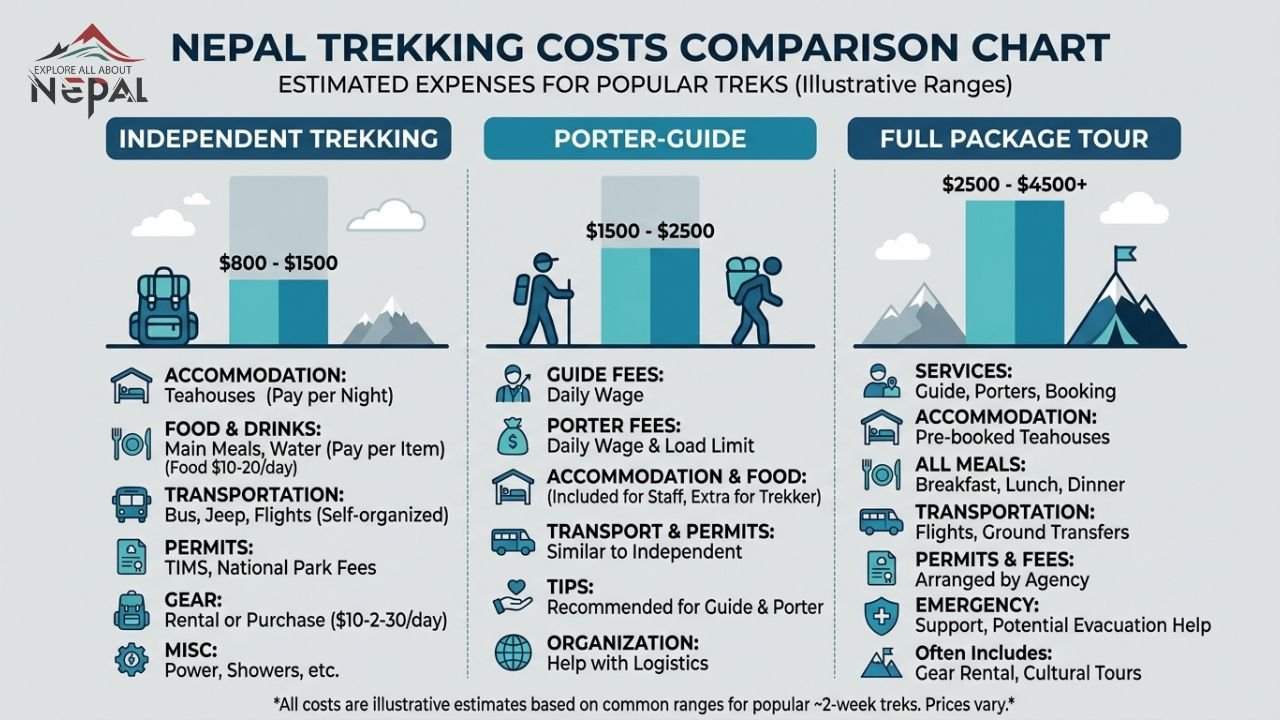
Remember that solo trekking is now restricted in many regions, so a guide is often required, not optional. Reckon on:
- Porter-guide: ~$25–$35 per day
- Licensed guide: ~$30–$40 per day, porter extra
- Full guided trek package (Annapurna Base Camp, ~7 days): $700–$1,400, bundling guide, permits, teahouses, and transport
On-the-trail living
Teahouse trekking costs roughly $25–$40 a day for a bed, three meals, and tea rising the higher you go, because everything up there is carried in on someone’s back. There are no ATMs on the trail, so carry all your trekking cash.
So a 7-day ABC trek ranges from roughly $400 independent (where permitted) to $700–$1,400 fully guided—a big swing that largely sets which budget tier you land in.
Accommodation in the cities
Your nights in Kathmandu and Pokhara, roughly per night:
- Budget guesthouse: $12–$20
- Comfortable mid-range hotel: $25–$50
- Boutique / heritage: $60–$120
- Luxury / five-star: $200–$500+
Nepal’s genuine luxury hotels are in the cities (not on the trail), so if you want a splurge, this is where it makes sense bookending a trek with real comfort. Over a two-week trip with ~5–6 city nights, city accommodation typically runs $70–$300 budget-to-mid, more for luxury.
Food and drink
Eating is cheap if you eat local, pricier if you want Western comfort food.
- Dal bhat (the unlimited-refill local staple) at a local spot: NPR 200–500 / ~$2–4
- Tourist-restaurant meal in Thamel or Lakeside: NPR 600–1,200 / ~$5–10
- A beer: NPR 400–600 / ~$3–5 (more at altitude)
Reckon $10–$25 a day for food off the trail depending on your style. The mistake here: assuming everything in Nepal is dirt cheap. Tourist-area restaurants, imported goods, and anything at altitude cost far more than the local rate.
Transport within Nepal
- Tourist bus (Kathmandu–Pokhara, 6–8 hrs): $10–$30
- Domestic flight (Kathmandu–Pokhara, 25 min): $100–$130
- The Lukla flight for Everest: pricier and famously weather-delayed—budget buffer days
- Airport taxis / local rides: a few dollars to ~$10
My honest advice: on a tight two-week schedule, pay for the key domestic flight to save most of a day. Time is the scarce resource on a short trip.
Travel insurance: small cost, non-negotiable
I won’t soften this. Standard travel insurance often excludes trekking above 3,000 m, and Nepal’s popular treks go well above that. A Himalayan helicopter evacuation runs $3,000–$5,000+, billed before anyone asks how you’ll pay.
Buy a policy that explicitly covers high-altitude trekking and helicopter evacuation expect $80–$200 for a two-week trip, more for older travelers or higher-altitude cover. It’s the cheapest insurance against the most expensive disaster on the whole trip. Read the altitude limit in the policy document, not the marketing page.
Gear: buy-at-home vs buy-in-Thamel
Two ways to handle gear, with very different costs.
Buy quality at home: boots, a down jacket, and a sleeping bag are the three worth getting right reckon $400–$800+ if you’re starting from nothing. These you don’t gamble on for a high trek.
Buy or rent in Thamel: Kathmandu’s gear district sells genuine and knockoff kit cheaply, and you can rent down jackets and sleeping bags for a few dollars a day. A budget trekker can kit out for $50–$150. The sweet spot for most: bring trusted boots from home (broken in first), top up cheaper items in Thamel.
Tipping: a real line item, not an afterthought
Tipping is expected in Nepal’s trekking industry and adds up. On a guided trek, budget roughly $10–$15 per day for your guide and a bit less per porter, paid at the end. For a 10-day trek with a guide and porter, that’s a meaningful $100–$180. Hotels and restaurants: round up or leave 10%. Factor this in it surprises people at checkout.
Putting it together: a real mid-range example
A realistic two-week mid-range trip, per person:
- International flight (US): $1,100
- Visa (15-day): $30
- Guided ABC trek package (permits included): $1,000
- 6 city nights, mid-range hotels: $200
- Food and drink off-trail: $150
- Domestic flight + transport: $160
- Travel insurance with altitude cover: $130
- Gear top-ups in Thamel: $100
- Tips: $150
- Personal spending / souvenirs: $150
Total: roughly $3,170 comfortably inside the $2,000–$3,000+ mid-range band once you trim or pad a category or two. Backpackers cut the trek, hotels, and flights to land near $1,500; comfort travelers add private guides and luxury lodges to climb past $4,000.
How to spend less without ruining the trip
A few honest levers:
Fly in low season (Dec–Feb) for cheaper flights and hotels just expect cold at altitude. Book flights early for the autumn peak. Eat dal bhat, not imported steak. Take the tourist bus where time allows. Rent gear in Thamel instead of buying. What I would not cut: travel insurance, a properly warm jacket and sleeping bag for high treks, or the guide where it’s now required. Those aren’t where the savings should come from.
FAQ
How much does a two-week trip to Nepal cost?
Most travelers spend $1,500–$3,500 per person all-in, including international flights. Backpackers can manage around $1,200–$1,800; mid-range trips with a guided trek and good hotels run $2,000–$3,000; comfort-level trips with private guides and premium lodges reach $3,500–$6,000+.
What is the biggest expense on a Nepal trip?
For most travelers, international airfare $900–$1,500 return from the US, with no nonstop available. Your trek is usually the second-biggest cost, ranging from around $400 independent to $700–$1,400 for a fully guided package. Booking flights 2–4 months ahead is the single biggest saving.
Is Nepal expensive for tourists?
On the ground, Nepal is inexpensive local meals cost $2–$4 and budget rooms $12–$20. The costs that add up are international flights, guided treks, travel insurance, and tipping. Tourist-area restaurants and anything at altitude cost far more than local rates, which surprises first-timers.
How much money should I bring for trekking in Nepal?
Carry all your trekking cash in Nepali rupees there are no ATMs on the trail. Budget $25–$40 per day for teahouse food and lodging, plus tips (around $10–$15 per day for a guide), and extra for emergencies. For a week-long trek, many trekkers carry several hundred dollars’ worth of rupees.
How much does travel insurance for Nepal cost?
Expect $80–$200 for a two-week trip with high-altitude trekking and helicopter-evacuation cover, more for older travelers or higher-altitude policies. It’s essential standard policies often exclude trekking above 3,000 m, and a Himalayan helicopter rescue can cost $3,000–$5,000+.
