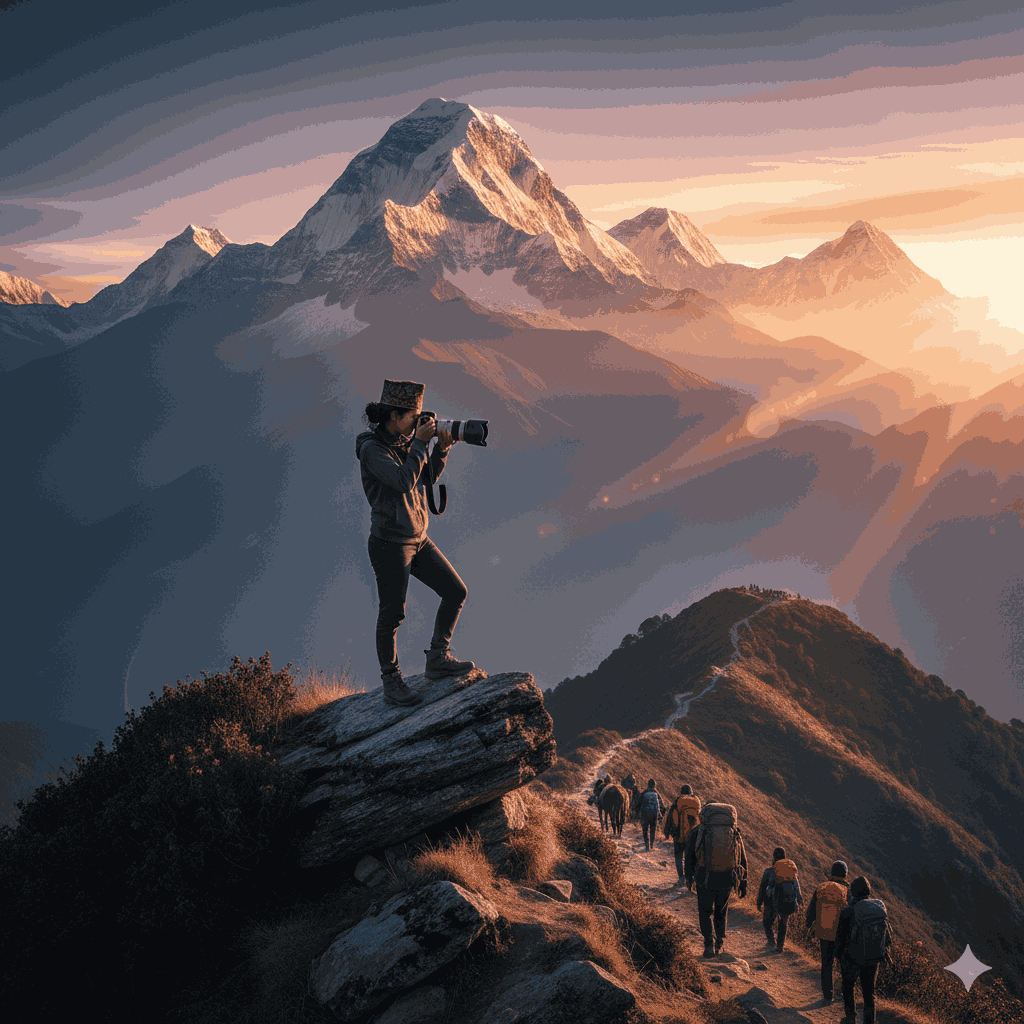
“Nepal travel photography showcasing a modern photographer capturing Himalayan landscapes at sunrise, blending tradition and modernity in 2026
To step into the world of nepal travel photography in 2026 is to witness a profound cultural shift. While the jagged peaks of the Everest and Annapurna ranges remain the star attractions, the modern photographer is now equally drawn to the “in-between” moments. In 2026, the global audience is no longer satisfied with just “pretty” mountain photos; they want to see the friction. They want to see the Buddhist monk using a high-end tablet at Boudhanath Stupa, or the young Sherpa climber who is as comfortable with a GoPro as they are with an ice axe. This guide will teach you how to document this unique transition while maintaining the technical excellence required for world-class nepal travel photography.
I. Technical Gear: Equipping for the 2026 Terrain
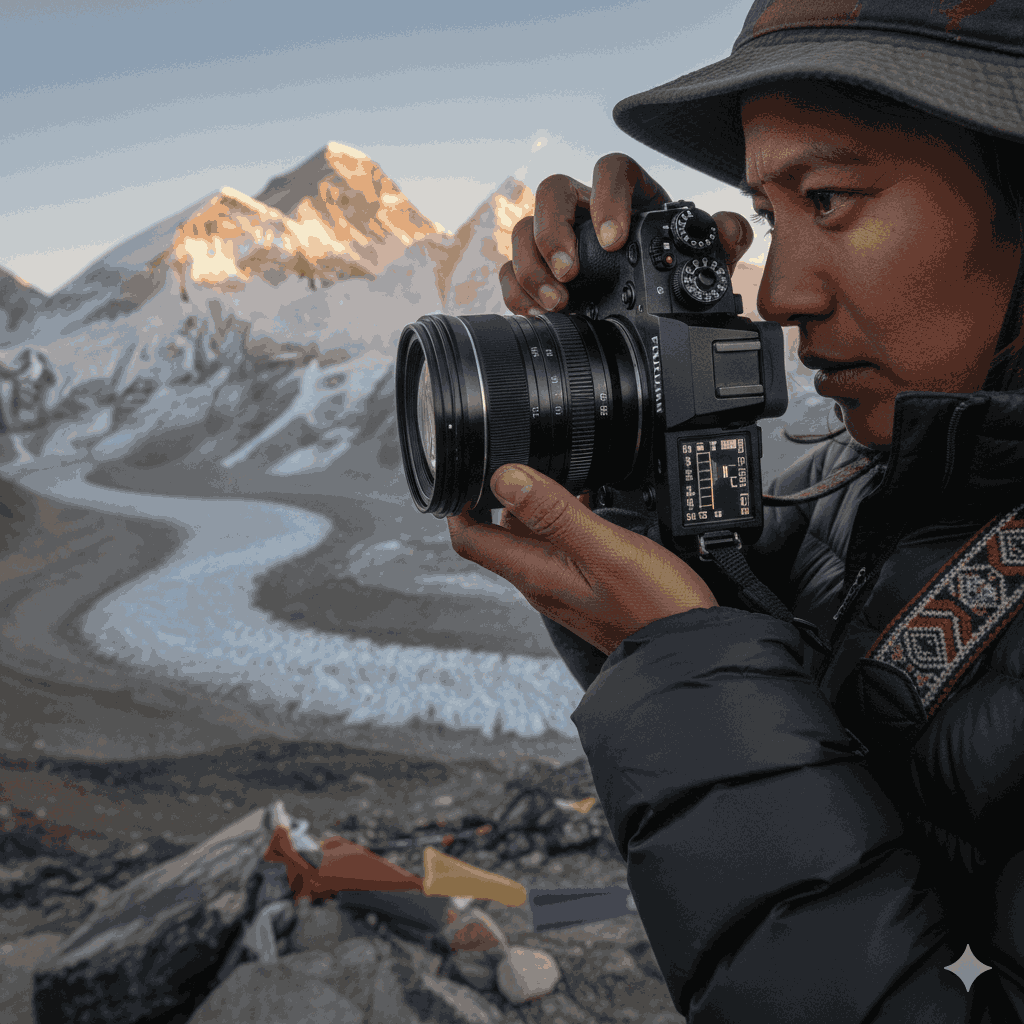
Nepali photographer adjusting mirrorless camera with wide-angle lens overlooking Everest at dawn, exemplifying Nepal travel photography techniques.
The physical demands of nepal travel photography are legendary. In 2026, the trend has shifted toward “Minimalist High-Performance.” Carrying 20kg of gear is no longer necessary; instead, creators are opting for smart, versatile kits that can withstand the dust of the Terai and the sub-zero thins of the high Himalayas.
1. The Mirrorless Revolution
In 2026, mirrorless systems have completely overtaken DSLRs for nepal travel photography. The ability to see your exposure in real-time is vital when the sun is reflecting off blinding white glaciers.
Recommendation: A body with at least 45MP is ideal for nepal travel photography because it allows you to crop into distant peaks without losing the fine detail of the prayer flags or the texture of the rock.
2. The “Trinity” Lens Kit
For a truly comprehensive nepal travel photography portfolio, your bag should contain:
The 14-24mm f/2.8: Essential for the wide-angle “theatre” of the Annapurna Base Camp.
The 24-105mm f/4: Your primary street lens. In 2026, this lens is the “Goldilocks” of nepal travel photography because it covers everything from environmental portraits to mid-range landscapes.
The 100-400mm: Necessary for “compressing” the mountains. This lens makes the peaks look like they are towering directly over the village houses—a classic nepal travel photography technique.
3. Power & Storage Management
In the high-altitude world of nepal travel photography, your batteries are your lifeline. Cold air drains lithium-ion cells 30-50% faster.
Pro Tip: Always keep your spare batteries in an inner pocket of your down jacket, close to your body heat. In 2026, many photographers also carry lightweight, foldable solar panels that can be strapped to the top of a backpack during a trek.
II. Mastering the Light: The Himalayan Timeframe
The “Golden Hour” in Nepal is unlike anywhere else on Earth. Due to the extreme elevation, the light doesn’t just change color; it changes the very feeling of the landscape.
1. The Dawn Alpenglow
The most coveted shot in nepal travel photography is the “First Light” on an 8,000-meter peak. When the rest of the world is still in blue-hour shadow, the summits of Everest or Machhapuchhre catch the sun and glow a vibrant, fiery orange. To capture this, you must be in position at least 45 minutes before sunrise.
2. Dealing with Midday Haze
The Kathmandu Valley and the lower hills often suffer from atmospheric haze. For successful nepal travel photography during the day, use a Circular Polarizer (CPL) filter. This will help cut through the glare, saturate the blues of the sky, and reveal the hidden details of the distant mountains. In 2026, AI-integrated post-processing can help with “Dehazing,” but nothing beats getting the raw data right in-camera.
III. The Rurban Aesthetic: Capturing the 2026 Culture
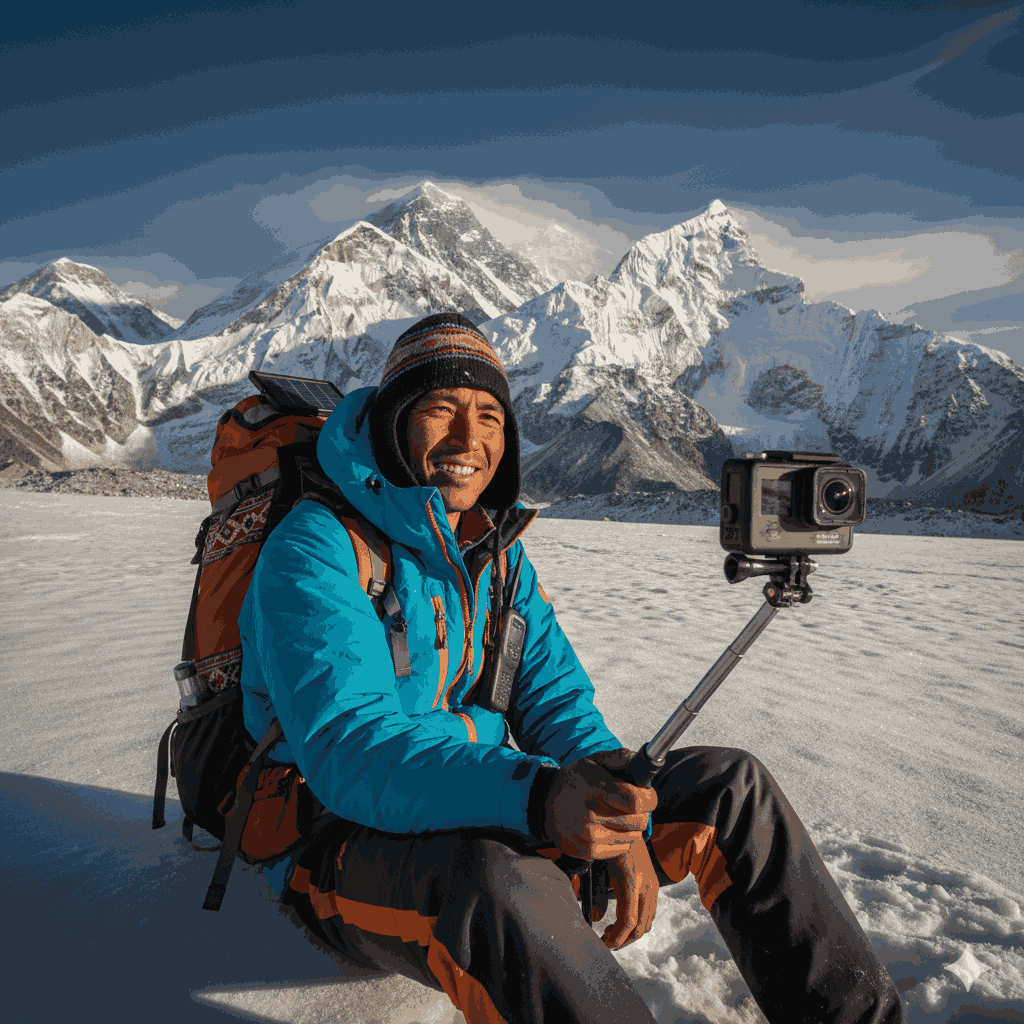
Sherpa climber using a GoPro on snow, highlighting in-between moments in Nepal travel photography and the rurban culture
One of the most exciting developments in nepal travel photography is the “Rurban” movement,the intersection of rural traditions and urban modernity.
1. Kathmandu’s Nightlife and Live Scenes
Beyond the temples, the 2026 photographer should explore the bustling jazz clubs and rooftop lounges. These venues provide a fantastic opportunity for low-light nepal travel photography. You can find the best spots for these candid, high-energy shots at jazz festivals and live music in Kathmandu. The contrast of a modern saxophone player framed against a backdrop of ancient carved wood is the definition of “2026 Nepal.”
2. The Human Element: Portraits with Purpose
Portraiture in nepal travel photography requires a “permission-first” mindset. In 2026, there is a global push toward ethical travel content.
The Connection: Spend five minutes talking to your subject before lifting the lens. Showing interest in their life,give whether they are a thangka painter in Bhaktapur or a teahouse owner in Manang,leads to more soulful, relaxed portraits.
The Environment: Always include the surroundings. A portrait of a Sherpa isn’t just a face; it’s the yak-wool sweater, the steam from the salt-butter tea, and the misty window looking out over the Khumbu.
IV. Top 5 Photography Destinations for 2026
For those planning their nepal travel photography itinerary, these locations provide the most diverse and high-impact shots:
Upper Mustang: Known as the “Forbidden Kingdom,” its red-walled canyons and cave dwellings provide a stark, “Mars-like” aesthetic that is a favorite for 2026 editorial nepal travel photography.
Patan Durbar Square: For architectural enthusiasts, Patan offers the most intricate “leading lines” and geometric patterns. Visit during the evening when the golden light hits the bronze statues.
Shey Phoksundo Lake: Located in the remote Dolpo region, this lake is the purest turquoise blue imaginable. It is the pinnacle of remote nepal travel photography.
Bandipur: This hilltop town is a “living museum” of Newari culture. The mist that rolls through the main street in the morning is a dream for “Atmospheric” style nepal travel photography.
Bardia National Park: For wildlife lovers, Bardia offers a better chance of spotting the Bengal Tiger than the more crowded Chitwan. Use a long telephoto lens and a fast shutter speed to capture the “King of the Jungle” in the morning mist.
V. Ethics, Sustainability, and the “Leave No Trace” Lens
As nepal travel photography continues to grow in popularity, so does the responsibility of the photographer.
1. Cultural Sensitivity
In 2026, many religious sites have introduced “No Photography” zones in their inner sanctums. Respect these rules. Your role in nepal travel photography is to be an ambassador, not an intruder. For a deeper understanding of what to capture (and what to avoid), explore our guides on indigenous culture Nepal and village life Nepal.
2. Protecting the Environment
Climate change is visibly altering the Himalayas. In 2026, photographers are using their platforms to highlight “Regenerative Tourism.” Use your nepal travel photography to tell the story of the melting glaciers or the community-led reforestation projects. This “Advocacy Photography” is a major trend for 2026 and adds a layer of depth and meaning to your work.
VI. Post-Processing: The 2026 Himalayan Look
The final step in nepal travel photography happens at the computer. In 2026, the “over-HDR” look is out. The trend is toward “True-to-Life Cinematic.”
Dynamic Range: Use the high dynamic range of your mirrorless camera to recover details in the snow without blowing out the highlights.
Color Grading: Keep the “Himalayan Gold” in your highlights but maintain the natural “Deep Teal” of the high-altitude sky. This color palette is a hallmark of professional nepal travel photography.
Frequently Asked Questions (FAQs)
Q1: What is the best month for nepal travel photography? A: October and November provide the clearest skies and most stable weather. However, for “moody” landscapes with green hills, the tail end of the monsoon (September) is increasingly popular for nepal travel photography.
Q2: Do I need a tripod for nepal travel photography? A: For sunrise, sunset, and astrophotography (which is world-class in the Himalayas), a lightweight carbon-fiber tripod is essential. For daytime street shots, modern in-body image stabilization (IBIS) is usually enough.
Q3: Can I fly a drone for my nepal travel photography? A: In 2026, you must have a permit from the CAAN. Drones are strictly prohibited in many national parks and religious areas without special permission.
Q4: How do I handle the dust in Kathmandu for my gear? A: Use a high-quality UV filter to protect your front element and carry a rocket blower. Never change lenses in the open air of a busy street.
Q5: What is the “rurban” trend in nepal travel photography? A: It is the documentation of the blend between traditional rural lifestyle and modern urban development. It is the “new” face of Nepal.
The journey of nepal travel photography is never truly finished. Every trek, every street corner, and every conversation offers a new frame. In 2026, as you build your portfolio, remember that the most successful nepal travel photography doesn’t just show what a place looks like—it shows how it feels.
Whether you are capturing the roar of a festival crowd, the silence of a high-altitude pass, or the improvisational brilliance found at jazz festivals and live music in Kathmandu, let your lens be a bridge between cultures. Focus on the ethics of your story, the technical precision of your craft, and the genuine warmth of the Nepali people.
