

Traditional weaving in Nepal showing women artisans working on wooden looms in the Himalayan hills
In the mist-covered hills of Tehrathum and the bustling ancient courtyards of Patan, a singular sound echoes through the centuries: the rhythmic clack-clack of the wooden loom. Traditional weaving in Nepal is not merely an industry; it is a spiritual lineage, a communal bond, and a testament to human resilience against the rugged backdrop of the Himalayas.
As you begin to explore all about Nepal’s rich cultural tapestry, you realize that the country is not just defined by its peaks, but by the intricate threads that bind its people together. From the waterproof woolen blankets of the high-altitude nomads to the gossamer-thin Pashmina shawls sought by global royalty, Nepal’s textile history is a 5,000-year-old masterpiece in progress. In 2026, as Nepal prepares for its graduation from the Least Developed Country (LDC) status, this heritage stands at a critical crossroads of preservation and modernization.
Chapter 1: The Genesis (3,000 BCE to 1800 CE)
The history of weaving in the Himalayas predates the Silk Road. Archaeological findings suggest that spinning and weaving were established practices by 3,000 BCE. While the rest of the world was just beginning to organize into early civilizations, the artisans of the Nepal hills were already masters of natural fibers.
The Vedic and Licchavi Eras
Ancient Sanskrit texts and the Arthashastra (2nd century BCE) by Kautilya contain the first written evidence of Nepal’s textile prowess. Kautilya specifically praised Bhingisi, a black, waterproof woolen blanket made of eight strips sewn together. This early export to the Mauryan Empire established Nepal’s trade and economy as a powerhouse of craftsmanship long before modern industrialization. During the Licchavi period (400–750 CE), the Kathmandu Valley became a hub for fine cotton and silk weaving, fueled by the demand of royalty and the thriving trans-Himalayan trade with Tibet.
The Malla Dynasty and the Golden Age
During the Malla era (12th–18th century), weaving became a regulated and celebrated art. The kings of the Kathmandu Valley encouraged specific dress codes to signify caste and social standing. It was during this time that the Haku Patasi (black sari) was refined. The colors were not chosen at random; they represent the fertile black soil of the valley and the red blood of life-giving Shakti.
Chapter 2: The Materials – Nature’s Alchemy
Traditional weaving in Nepal using natural fibers like allo nettle and Himalayan pashmina
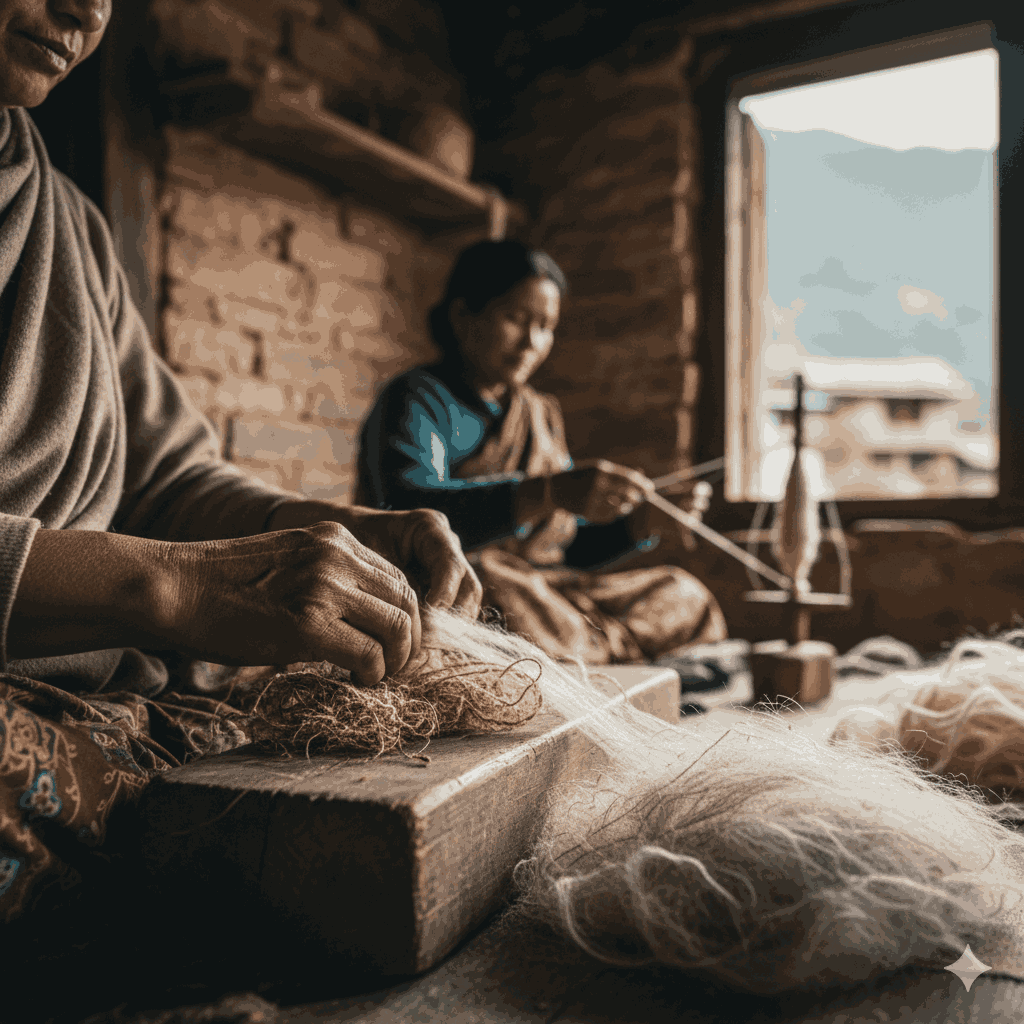
Traditional weaving in Nepal using natural fibers like allo nettle and Himalayan pashmina
What sets traditional weaving in Nepal apart is its reliance on “wild” and high-altitude fibers that cannot be replicated by machines.
Allo: The Giant Nettle (Himalayan Silk)
Allo (Girardinia diversifolia) is a stinging nettle that grows wild in the temperate forests of Nepal between 1,500 and 3,000 meters.
The Harvesting Ritual: Harvesters must wear thick gloves to protect themselves from the stinging hairs. The inner bark is stripped, boiled with wood ash for hours to soften the fibers, and then beaten to release the pulp.
The Result: A strong, lustrous fiber often called “Himalayan Silk.” It is naturally anti-bacterial and incredibly durable. According to research on Himalayan Nettle, this fiber is one of the strongest natural threads available globally, used for everything from luxury coats to survival gear.
Chyangra Pashmina: The Diamond Fiber
Harvested from the soft undercoat of goats living in the sub-zero temperatures of Mustang and Dolpa, Pashmina is the most luxurious fiber in the Nepalese repertoire.
The Fineness: A single Pashmina fiber is about 12–15 microns thick,roughly six times thinner than a human hair.
The Process: Weaving Pashmina requires a specialized frame loom and a delicate touch that takes years to master. To learn more about the landscapes where these goats roam, see our guide on trekking in Mustang.
Chapter 3: Regional Masterpieces – A Geographic Tapestry
Nepal is a geographic tapestry where every district and ethnic group maintains its own signature weave, pattern, and spiritual meaning.
The Eastern Hills: The Soul of Dhaka
Dhaka is the undisputed king of Nepali textiles. Originating in Tehrathum, it was traditionally a domestic art practiced by Limbu and Rai women.
The Technique: Dhaka is woven using a “supplementary weft” technique. This means the weaver manually inserts the colored patterns into the base fabric as they go, essentially “painting” with thread.
Symbolism: The patterns are not just decorations; they are codes. A diamond shape might represent a protective mountain peak, while a zigzag line symbolizes a river. You can learn more about these symbols in our guide to traditional Nepali symbols.
The Kathmandu Valley: Haku Patasi and Newari Identity
The Newar community refined weaving into a status symbol. The Haku Patasi is a black cotton sari with deep red borders.
Function and Faith: Traditionally worn by the Jyapu (farmer) community, the black dye (traditionally made from mineral extracts) is believed to absorb heat, while the red border represents the goddess Kali.
Modern Revival: Today, Haku Patasi patterns are a staple of Newari festivals and are being used by modern fashion houses in Kathmandu to create high-end fusion wear that has graced runways in London and New York.
The technology behind traditional weaving in Nepal is a marvel of indigenous engineering, focusing on portability and body-tension.
The Backstrap Loom (Tan):
Traditional Weaving in Nepal
This is the most portable and ancient loom. The weaver sits on the floor with a strap around their lower back to provide tension.
The “Body-Machine” Connection: The weaver’s own body weight determines the tightness of the weave, making the resulting fabric incredibly personal. Technical details on this mechanical process can be found at the Asia InCH Encyclopedia of Crafts.
Limitations: The width of the fabric is limited by the width of the weaver’s reach, usually resulting in strips about 18–24 inches wide, which are then sewn together to make larger garments.
The Pit Loom and Frame Loom:
Traditional Weaving in Nepal
Common in the Terai and the valley, the pit loom allows for wider fabrics and a faster weaving pace. The Nepal Tourism Board often showcases these looms in heritage sites like the Patan Museum to educate visitors on the labor-intensive nature of handloom production.
Chapter 5: Weaving and Women’s Empowerment
In 2026, weaving has transitioned from a domestic craft to a tool for radical social change. In many rural districts, the loom is the primary vehicle for female financial autonomy.
Economic Independence:
Traditional Weaving in Nepal
According to Label STEP, a global fair-trade organization, the handloom industry provides employment to thousands of women who would otherwise be limited to unpaid agricultural labor. In fact, over 91% of weavers in the artisan carpet sector are women. Groups like Manushi ensure that these weavers receive a fair wage, health benefits, and education for their children.
The “Slow Fashion” Narrative: Traditional Weaving in Nepal
In a world dominated by fast fashion and environmental degradation, Nepal’s weaving industry is a beacon of sustainability.
Carbon Neutral: Most traditional looms require zero electricity.
Zero Waste: Natural fibers like Allo and Wool are biodegradable.
Community Fixed: The profit stays within the village, preventing urban migration and preserving the local family structure.
Chapter 6: The Modern Fusion – From Looms to Jazzmandu
Nepal’s weaving tradition is not a museum piece; it is a living, breathing part of the modern cultural scene. In the vibrant nightlife of Kathmandu, you see the influence of these ancient patterns everywhere.
As someone interested in jazz festivals and live music in Kathmandu, you might notice that the aesthetic of events like Jazzmandu often incorporates traditional textiles. Musicians perform in “Dhaka fusion” waistcoats, blending the rhythmic complexity of jazz with the geometric complexity of the Limbu loom. This intersection of the ancient and the modern is what makes Kathmandu’s music scene so vibrant and authentic.
Chapter 7: Challenges & The Road to 2026
As Nepal graduates from its LDC status in late 2026, the textile sector faces several critical hurdles:
Machine Imitations: Cheap, printed “Dhaka-style” prints are often sold to tourists, undercutting the genuine artisans.
Technological Obsolescence: While the tradition is beautiful, small-scale producers often lack access to digital marketing and modern trade intelligence.
The Generation Gap: As youth migrate for work, the “sacred knowledge” of the elders is being lost. Experts at the Kathmandu Post suggest that the only way forward is through high-end branding and direct-to-consumer digital platforms.Frequently Asked Questions
1. What makes Traditional Weaving in Nepal unique compared to other textile cultures?
The uniqueness of Traditional Weaving in Nepal lies in the combination of extreme topography and indigenous fibers. Unlike industrial textiles, Nepali weavers use wild-harvested Allo (giant nettle) and high-altitude Chyangra Pashmina. These materials are processed using ancestral techniques that have remained unchanged for centuries, making every piece a direct link to the country’s ancient heritage.
2. Which regions are most famous for Traditional Weaving in Nepal?
If you are looking for the heart of Traditional Weaving in Nepal, you must look toward Tehrathum and Palpa for Dhaka fabric, and the Kathmandu Valley for Newari Haku Patasi. Additionally, the northern Himalayan regions like Mustang and Solu-Khumbu are world-renowned for their heavy woolen Radhi rugs and hand-knotted carpets, which are essential for survival in the cold mountain climates.
3. How is Traditional Weaving in Nepal empowering rural women?
Traditional Weaving in Nepal serves as a primary pillar for women’s economic independence. In many rural villages, women organize into cooperatives to produce handloom fabrics. By turning ancestral skills into a business, these artisans can earn a fair wage, support their children’s education, and lead their communities without having to migrate to urban centers for work.
4. What are the main types of looms used in Traditional Weaving in Nepal?
In the practice of Traditional Weaving in Nepal, three main looms are used: the portable Backstrap Loom (Tan), the stationary Pit Loom, and the more modern Frame Loom. The backstrap loom is particularly iconic to the hills, as it allows weavers to work in small spaces or even outdoors, using their own body weight to provide the necessary tension for the warp.
5. Is Traditional Weaving in Nepal still relevant in the modern fashion industry?
Absolutely. In 2026, Traditional Weaving in Nepal has seen a massive resurgence through “fusion fashion.” Modern designers are incorporating Dhaka and Allo fabrics into contemporary streetwear and high-end evening gowns. This trend not only keeps the ancient art alive but also introduces the sustainable, “slow-fashion” ethos of Nepal to the global stage
To support traditional weaving in Nepal is to support a 5,000-year-old lineage of human creativity. It is an industry that is naturally carbon-neutral, socially empowering, and aesthetically unmatched. Whether you are draped in a warm Radhi blanket on a trek to Everest Base Camp or wearing a fine Dhaka scarf at a jazz club in Thamel, you are carrying a piece of Nepal’s soul.
When you visit Nepal, don’t just buy a souvenir; buy a story. Look for the “Handmade in Nepal” certification and support the artisans who keep the heartbeat of the loom alive. To learn more about how to visit these artisans, see our guide on living heritage in Kathmandu.
| Region | Primary Fiber | Key Product | Cultural Group | Symbolism |
| Eastern Hills | Cotton | Dhaka Shawls/Topi | Limbu / Rai | Mountains & Rivers |
| Kathmandu Valley | Cotton / Silk | Haku Patasi | Newar | Fertility & Protection |
| High Himalayas | Yak/Sheep Wool | Radhi Rugs | Sherpa / Bhotia | Survival & Warmth |
| Western Hills | Allo (Nettle) | Bags / Coats | Magar / Gurung | Strength & Durability |
