
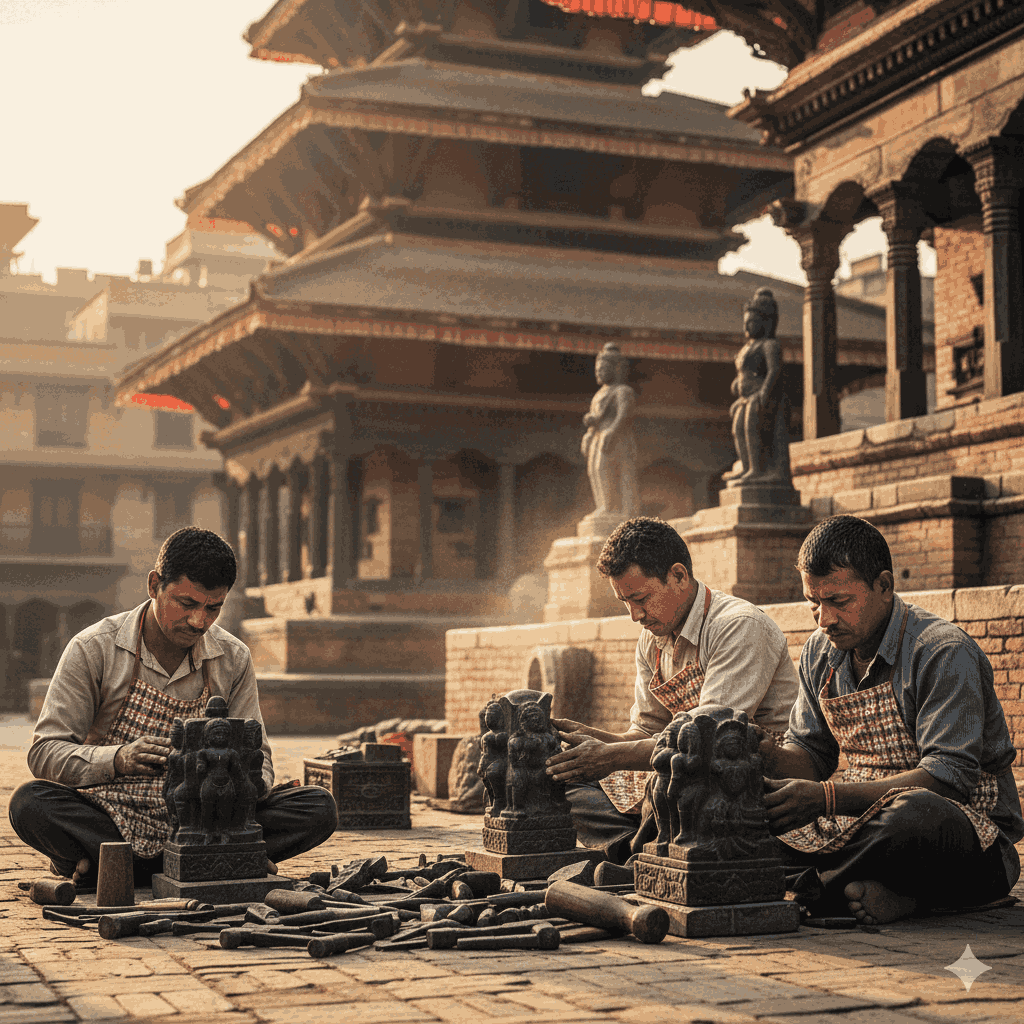
Stone carving culture Nepal showcased through Newari artisans carving stone sculptures in Patan Durbar Square
To craft a comprehensive, authority guide on stone carving culture Nepal, we must delve into the geological, spiritual, and artistic veins of the Himalayas. This guide explores two millennia of history, the secrets of the Newari masters, and the status of the craft in 2026.
In the quiet side-streets of Patan and the ancient, sun-drenched squares of Bhaktapur, there is a sound more permanent than the mountain wind: the steady, rhythmic tink-tink-tink of steel hitting cold stone. Stone carving culture Nepal is not merely an artistic tradition; it is the physical manifestation of the country’s soul. For over two thousand years, Nepali artisans,predominantly from the Newar community,have turned limestone and schist into living deities that breathe life into the city’s architecture.
As you explore all about Nepal’s rich cultural tapestry, you realize that these sculptures are more than museum pieces. They are the guardians of temples, the storytellers of myths, and the focal points of daily worship. In 2026, stone carving culture Nepal remains a vibrant industry that defines the visual identity of the Kathmandu Valley, standing as a testament to the endurance of human creativity.
Chapter 1: The Historical Genesis of Stone Carving
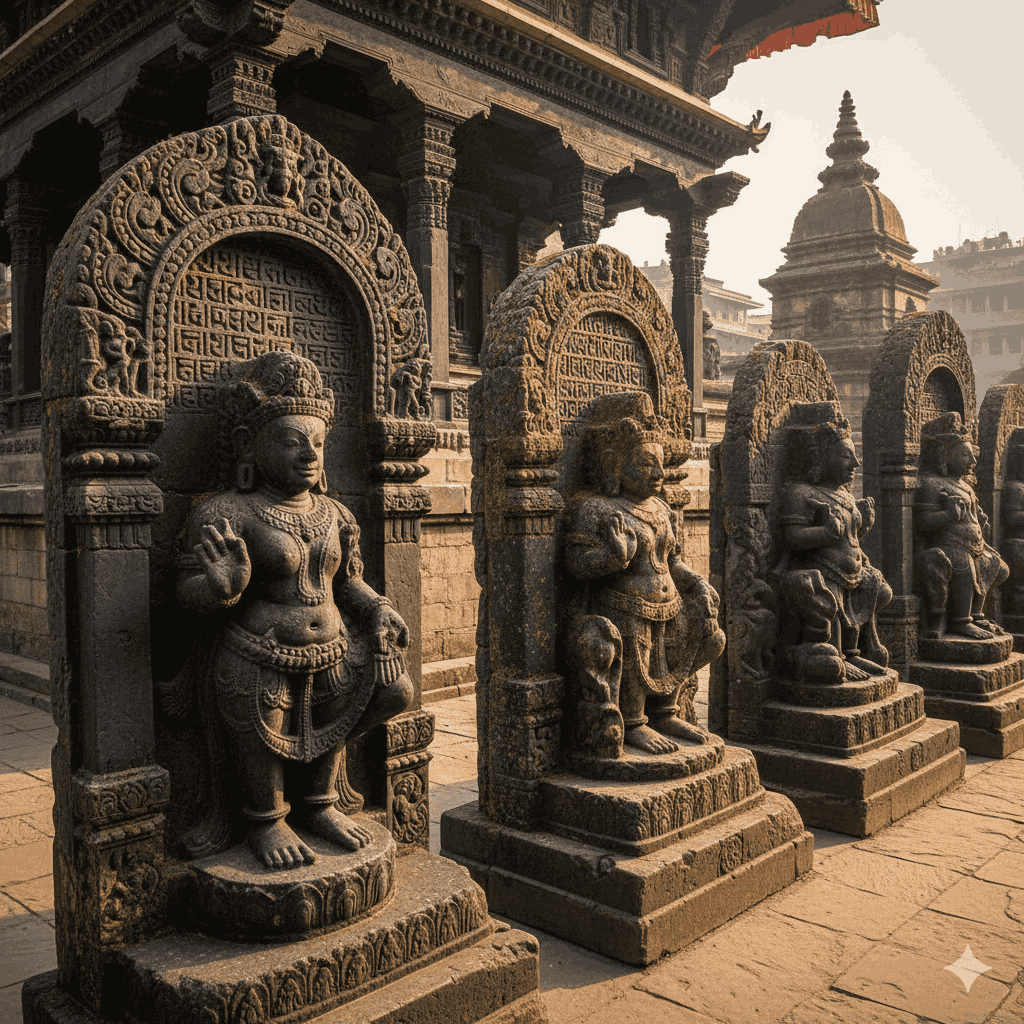
Ancient stone carving culture Nepal visible in Licchavi-era sculptures at Changu Narayan Temple
The history of stone carving culture Nepal is divided into distinct eras, each marked by shifting styles and increasing complexity. To understand the present, we must look at the first strikes of the chisel.
The Early Roots (1st Century AD)
The earliest significant piece in the history of stone carving culture Nepal is the 2,000-year-old Yaksha Bodhisattva statue. Currently housed in the National Museum, this torso exhibits a rugged, powerful style influenced by the Mathura school of India. It proves that even two millennia ago, the inhabitants of the valley were already masters of lithic art.
The Licchavi Golden Age (4th – 9th Century)
This era is widely considered the “Golden Age” of stone carving culture Nepal. The Licchavi kings were great patrons of the arts. Sculptures from this period are characterized by their “wet-cloth” drapery, serene facial expressions, and perfect anatomical proportions.
Masterpiece: The Vishnu Vikrant and the Varaha incarnations are prime examples.
The Changu Narayan Legacy: If you visit Changu Narayan Temple, you will see stone inscriptions from 464 AD, the oldest in Nepal. These inscriptions are vital to the stone carving culture Nepal as they record the political and social life of the era.
The Malla Flourishing and Tantric Influence
Under the Malla kings (12th–18th century), stone carving culture Nepal moved toward intense ornamentation and Tantric symbolism. This period gave us the iconic “Sunken watering spots” or Hitis, and the monumental stone monoliths of kings found in Patan Durbar Square. The craftsmanship was so guarded that legends say kings would cut off the hands of master carvers to ensure their skills weren’t shared with rival city-states.
Chapter 2: The Alchemy of Tools and Materials
The perfection of stone carving culture Nepal relies on a deep, almost spiritual understanding of geology. Artisans do not see stone as a dead object, but as a vessel waiting to be opened.
The Sacred Stone: Black Limestone & Schist
Artisans primarily use a specific black limestone traditionally mined from the Hattiban and Chandragiri Hills. This stone is soft enough to carve into intricate jewelry on a goddess, yet durable enough to withstand the monsoon rains for centuries. According to Department of Archaeology records, this local stone is key to the longevity of the valley’s monuments.
The Tools of the Master
Despite the availability of power tools in 2026, true masters of stone carving culture Nepal still favor hand tools:
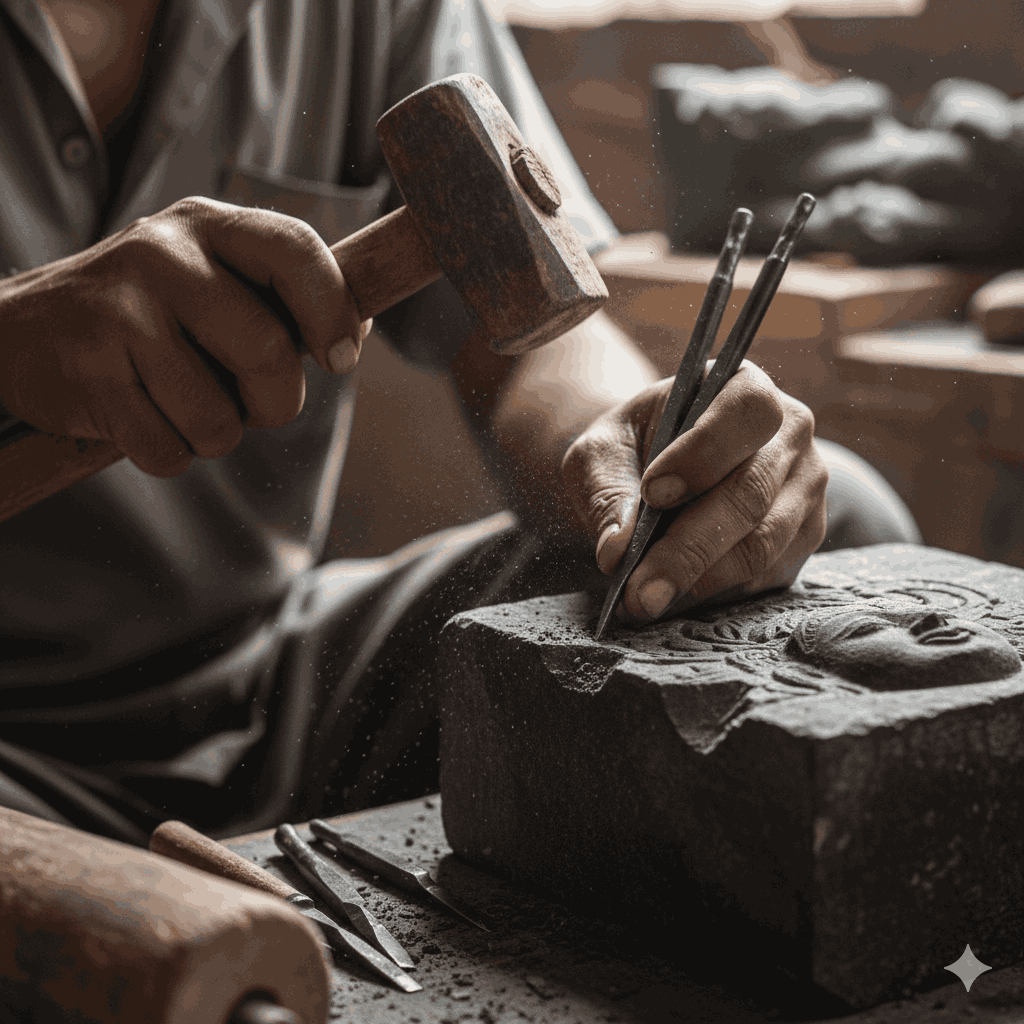
Mugari (Wooden Hammer): Used for the initial heavy strikes to block out the form.
Chheno (Chisels): These come in dozens of sizes, from broad-tipped ones for shaping to needle-fine points used for carving the pupils of a deity’s eyes.
Abrasives: Traditionally, artisans used sand and water to polish the stone, a technique that remains a staple of stone carving culture Nepal.
Chapter 3: The Symbolic Language of the Chisel
In stone carving culture Nepal, no curve is accidental. Every gesture and every mount carries a theological weight that transcends simple decoration.
Mudras (Hand Gestures): The positioning of the hands in a stone statue communicates a state of being,such as the Abhaya Mudra (fearlessness).
The Naga (Serpents): Water spouts are almost always guarded by stone serpents. In stone carving culture Nepal, Nagas are the controllers of rain, a vital aspect of Nepal’s agricultural economy.
Mandala Geometry: Many stone slabs in Kathmandu’s hidden courtyards are carved as Mandalas, representing the universe and the path to enlightenment.
Chapter 4: Stone Carving and Modern Life in 2026
As Nepal navigates the mid-2020s, stone carving culture Nepal has adapted to a globalized world through “Regenerative Heritage.”
Youth and the Guthi System
In 2026, the preservation of stone carving culture Nepal is driven by youth-led heritage cooperatives. These groups use the ancient Guthi system (community-based organizations) to manage restoration projects. This ensures that the skills of stone carving culture Nepal are passed down through apprenticeships rather than just academic study.
Stone Carving and the Music Scene
Interestingly, the spiritual calm required for stone carving culture Nepal is often found in other Nepali art forms. As someone interested in jazz festivals and live music in Kathmandu, you might notice that many heritage venues, like the Patan Museum courtyard, feature stone-carved backdrops for modern jazz performances. This juxtaposition of the “immortal stone” and the “fleeting note” is a hallmark of Kathmandu’s nightlife.
Chapter 5: Challenges to the Heritage
The survival of stone carving culture Nepal faces significant hurdles in 2026:
Environmental Decay: Pollutants and acid rain are slowly eroding outdoor sculptures in UNESCO World Heritage Site

Traditional tools used in stone carving culture Nepal including chisels and wooden hammers shaping black ston
FAQs: Understanding Stone Carving Culture Nepal
1. Why is the Kathmandu Valley the center of stone carving culture Nepal?
The valley has been the seat of power and religion for millennia. The concentration of wealth and devotion in the city-states of Patan, Kathmandu, and Bhaktapur allowed stone carving culture Nepal to flourish as a full-time profession for specialized artisan castes.
2. What kind of stone is used in traditional stone carving culture Nepal?
The most common material is black limestone and schist, often referred to as “Nepali Black Stone.” It is prized in stone carving culture Nepal for its fine grain and ability to hold extremely intricate detail.
3. How long does it take to learn the art of stone carving culture Nepal?
A master artisan usually begins as an apprentice at a young age. It can take 10 to 15 years to fully master the iconography and technical skills required to be considered a leader in stone carving culture Nepal.
4. Can tourists buy authentic work from the stone carving culture Nepal?
Yes, many workshops in “Stone Cutters’ Row” in Lalitpur sell modern creations. However, it is strictly illegal to export any antique piece (over 100 years old) from the stone carving culture Nepal.
5. Is stone carving culture Nepal only focused on Hindu deities?
No, stone carving culture Nepal is a perfect blend of Hindu and Buddhist traditions. You will find stone Buddhas, Bodhisattvas, and Chaityas coexisting seamlessly with images of Shiva and Vishnu.
Stone carving culture Nepal is the heavy, silent foundation upon which the country’s artistic reputation rests. It is a craft that requires the patience of a monk and the precision of a surgeon. As long as the tink-tink of the chisel echoes through the valley, the gods of Nepal will continue to have a home in the rock.
To support this heritage, consider visiting the workshops directly or attending cultural events where these crafts are celebrated. To see how these traditions blend with modern life, check out our guide on festivals in the Kathmandu Valley.
