
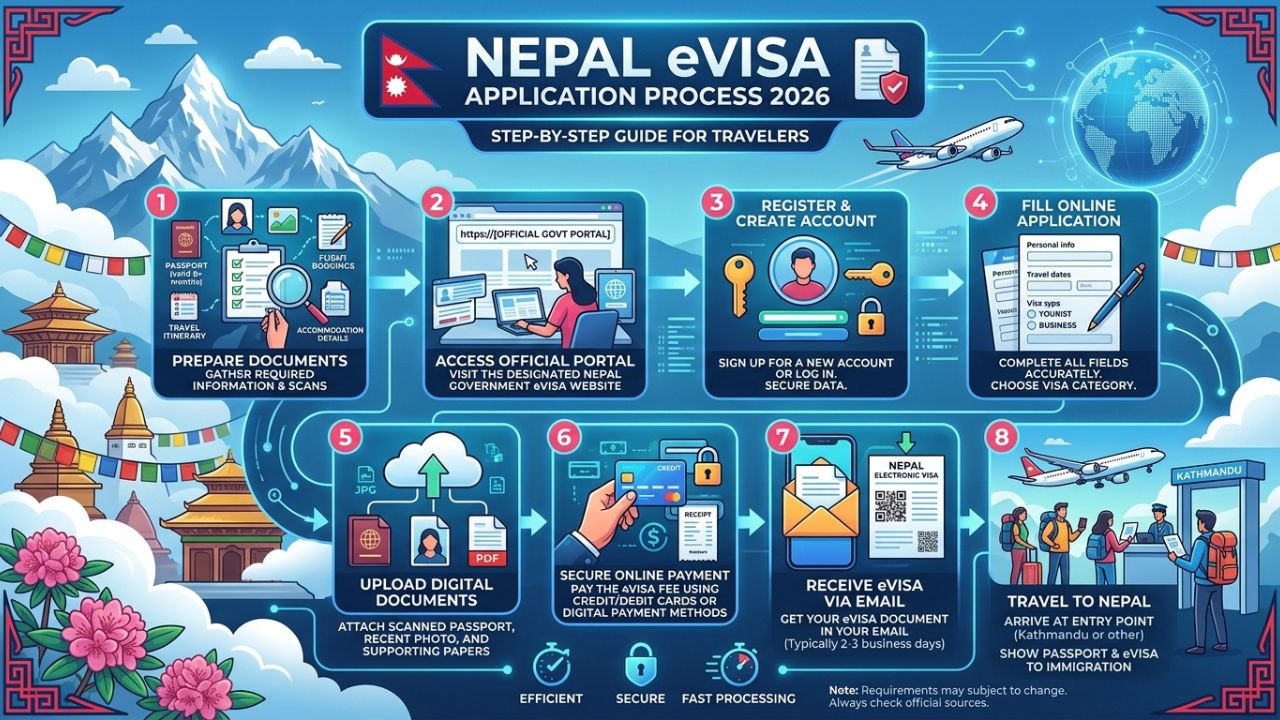
Planning a trip to the land of the Himalayas? Understanding the Nepal eVisa application process is the first and most important step toward a seamless journey. Whether you are heading to Kathmandu to explore ancient temples, trekking toward Everest Base Camp, or visiting the wildlife-rich plains of Chitwan, securing your Nepal visa correctly ensures you arrive without complications.
This comprehensive guide covers everything you need to know about the Nepal eVisa application process in 2026, including eligibility, required documents, step-by-step instructions, fees, processing times, entry points, extensions, trekking permits, and expert tips all updated with the latest information from Nepal’s Department of Immigration.
What Is the Nepal eVisa? Understanding the Electronic Travel Authorization (ETA)
Nepal introduced its Electronic Travel Authorization (ETA) system in February 2024, marking a major digital overhaul of the country’s immigration services. Deputy Prime Minister and Home Minister Narayan Kaji Shrestha officially launched the service, and the portal uses secure servers and digital signatures to protect personal data.
The Nepal eVisa, often called the Nepal ETA, is not technically a visa stamp itself it is a pre-approval system. An eVisa or Electronic Travel Authorization is a digital permission that allows travelers to apply for a Nepali visa online before their trip. It confirms that the applicant has been approved to receive a visa stamp upon arrival in Nepal.
In simple terms, completing the Nepal eVisa application process online means that when you land at Tribhuvan International Airport (or Pokhara International Airport), you bypass the long general queues and proceed directly to a dedicated counter to collect your visa stamp quickly and efficiently.
The Nepal eVisa application process enables travelers to apply for tourist visas online before arriving in Nepal. This Electronic Travel Authorization (ETA) system, managed by the Nepal Department of Immigration, streamlines entry procedures and reduces airport waiting times.
Nepal eVisa Application Process
Who Needs a Nepal eVisa? Eligibility in 2026
As of 2026, Nepal offers flexible visa options for citizens of over 150 countries, including Visa on Arrival, online eVisas, and pre-arranged visas through consulates or embassies.
Countries Eligible for Nepal eVisa
Most foreign nationals are eligible to apply for an eVisa for tourism, business, or transit purposes. The eVisa is open to citizens of the United States, Canada, European Union countries, Australia, New Zealand, Japan, South Korea, China, India (for business and transit), and many others. Travelers should verify their eligibility on the official nepaliport.immigration.gov.np website prior to applying.
Countries NOT Eligible for eVisa or Visa on Arrival
Some nationalities must obtain visas in advance through a Nepalese embassy or consulate and are not eligible for visa on arrival or the eVisa. Countries currently ineligible include Afghanistan, Nigeria, Ghana, Zimbabwe, Swaziland, Cameroon, Somalia, Liberia, Ethiopia, Syria, Iraq, and Palestine. Citizens from these nations must secure a visa prior to traveling to Nepal.
Special Exemptions
Indian citizens are visa-free no visa required for any duration of stay. SAARC nationals (Bangladesh, Bhutan, Maldives, Pakistan, Sri Lanka) receive a free 30-day visa. Chinese citizens may enter visa-free for 15 days pursuant to a bilateral agreement.
Under the 1950 Indo-Nepal Treaty, Indian visitors are allowed to enter Nepal visa-free; however, they have to show an Indian passport or voter ID with a photo.
Types of Nepal Visas Available in 2026
Before beginning the Nepal eVisa application process, it is important to choose the correct visa category for your purpose of travel.
1. Tourist eVisa (Most Common)
The tourist visa is by far the most popular category. It is suitable for trekking, sightseeing, or casual visits.
Available durations:
- 15 days — USD 25
- 30 days — USD 40
- 90 days — USD 100
The Nepal Government allows tourist visas for 15, 30, or 90-day stays up to a cumulative 150 days per calendar year.
2. Business eVisa
The business visa is ideal for foreign professionals visiting for meetings, investment, or trade. It requires an invitation letter from a registered Nepali company and proof of business activity (such as a business license or meeting schedule). Business visas are usually issued for 30 days but can be extended for up to 1 year based on need.
3. Student Visa
For international students enrolled in Nepali universities or training institutes, a student visa requires an acceptance or admission letter from a Nepali institution. The visa is valid for the duration of the academic program and can be extended yearly.
4. Transit Visa
For travelers passing through Nepal en route to another destination. This is typically short-duration and requires proof of onward travel.
Nepal eVisa Fees 2026: Updated Cost Breakdown
Understanding the fee structure before starting the Nepal eVisa application process helps you avoid surprises. Here is the current fee schedule:
| Visa Duration | Fee (USD) | Best For |
|---|---|---|
| 15 Days | USD 25 | Short trips, transit |
| 30 Days | USD 40 | Standard tourism, trekking |
| 90 Days | USD 100 | Long-term travel, multi-region trekking |
| Children under 10 | Free | — |
Kids under 10 years old get their visas free of charge. Extending your visa costs $45 for every extra 15 days. After the extension, each additional day costs $3. Make sure not to overstay penalties and fines apply.
Whether you apply for a visa online or after your arrival, all applicants must meet Nepal tourist visa requirements, which include a passport photo and a passport valid for 6 or more months.
Payment Methods: Fees can be paid via credit/debit card on the official portal, or in USD, EUR, or GBP cash at the airport counter. It is still advisable to carry cash as a backup in case of online payment issues.
Documents Required for Nepal eVisa Application Process
Before you open the official portal to begin the Nepal eVisa application process, gather all necessary documents. Preparing everything in advance allows you to complete the application in a single sitting.
Mandatory Documents
To apply, you need a passport valid for at least six months (with a blank page for the visa), a recent passport-sized photo on a plain background, and proof of your onward journey (such as a return ticket).
Full document checklist:
- Valid passport — minimum 6 months validity beyond your travel dates, with at least one blank page for the visa stamp
- Passport-sized photograph — recent, clear, on a plain/white background (JPEG or PNG format)
- Scanned bio page of passport — clear scan showing all personal details (JPEG or PNG)
- Return or onward flight ticket — proof of your departure from Nepal
- Travel itinerary or hotel booking — confirmation of accommodation
- Valid email address — to receive your eVisa confirmation
- Proof of sufficient funds — bank statements or similar evidence
It is also wise to show where you will stay hotel confirmation or a trekking itinerary and to have evidence of sufficient funds. For business visas, additional requirements include an invitation letter from a Nepali-registered company and business registration documents.
Step-by-Step Nepal eVisa Application Process 2026
Now let’s walk through the complete Nepal eVisa application process from start to finish. The Nepal eVisa application process takes 10 to 15 minutes to complete online. Email confirmation arrives immediately to 30 minutes after submission.
Step 1: Access the Official Portal
Navigate to the official Nepal Department of Immigration eVisa portal:
Official URL: https://nepaliport.immigration.gov.np
⚠️ Critical Warning: Only use the official government portal. There are numerous fraudulent websites that mimic the Nepal immigration portal and charge extra fees while providing fake approvals. Always verify you are on the .gov.np domain.
Step 2: Select Your Visa Type
On the homepage, you will see several visa options:
- eVisa (Online Pre-Application) — recommended for advance planning
- Visa on Arrival — available at the airport
- Visa Extension — for those already in Nepal
Select “eVisa” or “Online Tourist Visa” to begin the Nepal eVisa application process.
Step 3: Create an Account or Register
Enter your valid email address to create an applicant account. You will receive a verification email check your inbox and spam folder. This account allows you to save your application progress and track your application status later.
Step 4: Fill Out the Online Application Form
Complete the application form carefully with accurate information:
- Personal information: Full name (exactly as on passport), date of birth, nationality, gender
- Passport details: Passport number, issue date, expiry date, issuing country
- Travel details: Intended entry date, entry point, intended duration of stay
- Accommodation information: Hotel name, address, or trekking itinerary
- Emergency contact details
Complete the online form with your personal information, passport details, travel dates, intended entry point, and accommodation. Double-check every field before proceeding. Errors in name spelling or passport number can cause serious delays or rejection at immigration.
Step 5: Upload Required Documents
Upload a recent passport photograph and a clear scan of your passport’s bio page in JPEG or PNG format. Photo specifications:
- Recent (within 6 months), clear, and well-lit
- Plain white or light-colored background
- Full face visible, no hats or glasses
- File size typically under 500KB
Passport scan specifications:
- All text and photo on the bio page must be clearly legible
- JPEG or PNG format preferred
- Avoid scanning at an angle
Step 6: Review and Submit Your Application
Before hitting submit, review every detail of your application. Once submitted: Submit the application and note the submission ID; print or save the confirmation slip to present at immigration and to track your application status online.
📌 Important Timing Note: The application remains valid for only 15 days. Do not apply more than 15 days before your travel date or it expires.
Step 7: Pay the eVisa Fee
After submission, you will be directed to the payment gateway. Pay using:
- International credit or debit card (Visa, MasterCard)
- Some payment gateways accept PayPal or other digital wallets
Keep a record of your transaction ID and payment receipt.
Note: Some travelers have reported occasional payment gateway failures on the official portal. If this occurs, try a different browser or card. You can also complete the form online for the barcode/receipt and pay in person at the airport.
Step 8: Receive Your eVisa Confirmation
Email confirmation arrives immediately to 30 minutes after submission. You will receive an authorization email containing your eVisa approval number. Print your eVisa confirmation slip. A physical printed copy is mandatory a digital copy is not enough; always carry a print.
Step 9: Arrive in Nepal and Collect Your Visa Stamp
At the airport or border crossing:
At the airport, eVisa holders bypass the on-arrival kiosks, present the slip, pay any remaining fees if required, and get the visa stamped quickly. The entire immigration process for eVisa holders typically takes 5 to 15 minutes, compared to 1 to 3 hours without pre-registration during peak seasons.
Nepal eVisa Processing Time 2026
One of the most common questions about the Nepal eVisa application process is how long it takes.
- Online form completion: 10–15 minutes
- Email confirmation: Immediate to 30 minutes after submission
- Full processing (in some cases): 2–5 working days if manual verification is required
Typically 2–5 working days for online applications.
For most travelers, the eVisa approval arrives almost instantly via email. However, during peak seasons (October–November and March–May), processing may take slightly longer due to high volume.
Recommendation: Apply at least 3–5 days before your travel date to allow time for any issues or re-applications.
Nepal eVisa vs. Visa on Arrival: Which Is Better in 2026?
Both the Nepal eVisa and Visa on Arrival grant you the same type of tourist visa upon entering Nepal. The key differences come down to convenience, especially during busy travel seasons.
Visa on Arrival
With Visa on Arrival, visitors fill out a form at kiosks in the arrival lounge, pay the visa fee in cash, and obtain a visa on the spot. The process can involve long queues and delays.
Visa on Arrival is available at Tribhuvan International Airport (KTM), Pokhara International Airport, and several land border crossings. Payment is accepted in USD, EUR, or GBP (or by card).
Nepal eVisa (Online Pre-Application)
Applicants who complete the online eVisa application form, upload documents, and pay fees through the Nepali payment gateway before traveling receive an authorization email or receipt. At the airport they bypass the on-arrival kiosks and get the visa stamped quickly.
Expert Tip: Use the eVisa during peak seasons (October–November, March–May) to avoid long airport queues.
| Feature | eVisa | Visa on Arrival |
|---|---|---|
| Application | Online (before travel) | At airport/border |
| Queue time | 5–15 minutes | 1–3 hours (peak season) |
| Fee | Same (USD 25/40/100) | Same |
| Documents uploaded in advance | Yes | No |
| Validity window | 15 days from application | Immediate upon arrival |
| Recommended for peak season? | ✅ Yes | ❌ Long queues |
Entry Points for Nepal eVisa Holders in 2026
Your eVisa or ETA approval is valid at the following major entry points:
Airports
- Tribhuvan International Airport (TIA), Kathmandu — the primary international entry point
- Pokhara International Airport — now operational for select international flights
Land Border Crossings
Major land borders where Nepal visa (including eVisa holders) can enter:
- Birgunj / Raxaul (India–Nepal border, central)
- Bhairahawa / Sunauli (India–Nepal border, western)
- Kakarbhitta / Panitanki (India–Nepal border, eastern)
- Kodari / Tatopani (China–Nepal border — verify status before travel as this crossing has had periodic closures)
- Gyirong / Rasuwa (China–Nepal border)
Note: Always verify that your intended border crossing is operational before travel, especially land borders from China, which may close due to weather or policy changes.
Nepal eVisa Extension Process 2026
If you are already in Nepal and wish to stay longer, extending your tourist visa is straightforward. Extensions are processed at immigration offices in Kathmandu, Pokhara, and Chitwan. The maximum stay in Nepal is 150 days per calendar year.
Extension Fees
Extending your visa costs $45 for every extra 15 days. After the extension, each additional day costs $3.
Documents Required for Visa Extension
Required documents include: a valid passport with minimum 6 months remaining validity, your current visa, a printed online application receipt with barcode from nepaliport.immigration.gov.np, 2–3 recent passport photos (standard size, light background), the extension fee in USD cash (pristine bills), and Nepal address proof (hotel booking or registration).
Immigration Office Locations
Nepal visa extensions are processed at two primary immigration offices. The main office is located at Kalikasthan, Dillibazar, Kathmandu, and handles all visa types. The Pokhara immigration office is at Damside, inside the Nepal Tourism Board office, and is ideal for trekkers extending stays in the Pokhara region.
Timing Tip: Complete the online application 7–10 days early and visit the immigration office on Tuesday to Thursday mornings at 10:00 AM sharp. Avoid Monday mornings (weekend backlog) and Friday afternoons (weekend rush).
Nepal Trekking Permits 2026: What eVisa Holders Also Need
A Nepal eVisa grants you entry into the country, but if you plan to trek in Nepal’s famous Himalayan regions, you will need additional permits. This is a critical part of trip planning that many travelers overlook.
An eVisa grants permission to enter Nepal, but trekkers heading into controlled or conservation areas such as Everest, Annapurna, Manaslu, or Mustang must obtain trekking permits. These include the Trekkers’ Information Management System (TIMS) card, conservation area permits (such as Sagarmatha National Park or Annapurna Conservation Area), and restricted-area permits for regions like Upper Mustang or Manaslu.
TIMS Card (Trekkers’ Information Management System)
Since 2023, Nepal has been transitioning to an electronic version called e-TIMS. The concept is the same; the paper has been replaced by a QR code. The fee for group trekkers through a registered company is two thousand Nepali rupees (roughly fifteen US dollars). Individual trekkers pay three thousand rupees (about twenty-three dollars).
Conservation Area and National Park Permits
Trekkers need a TIMS card (NPR 2,000 for SAARC nationals, NPR 4,000 for others) and special area permits. For example: Annapurna Conservation Area Permit costs NPR 3,000, and Everest Sagarmatha National Park costs NPR 3,000.
Restricted Area Permits 2026 Update
Nepal’s trekking permit online application system, launched in March 2026, represents a major convenience upgrade for international travelers. Foreign nationals can now apply for restricted area trekking permits from their home countries before arriving in Nepal, eliminating Kathmandu permit office queues and rushed pre-trek preparations.
The Department of Immigration’s digital platform requires applicants to provide their approved Nepal tourist visa number during the permit application. This visa-linking system verifies legal entry authorization before processing trekking permits.
This means completing the Nepal eVisa application process before applying for trekking permits is now more important than ever your eVisa approval number is required.
Common Mistakes to Avoid in the Nepal eVisa Application Process
Understanding what NOT to do is just as important as following the correct steps. Here are the most frequent errors travelers make during the Nepal eVisa application process:
1. Applying Too Early
The application remains valid for only 15 days. Do not apply more than 15 days before your travel date or it expires.
2. Using Third-Party Websites
Many unofficial websites charge inflated fees for Nepal eVisa processing. Always use nepaliport.immigration.gov.np — the official government portal.
3. Passport Name Mismatch
A mismatch can delay or cause rejection at immigration. Ensure every name, passport number, and date exactly matches your travel document.
4. Not Printing the Confirmation
A digital copy is not enough. Always carry a print. Immigration officers require a physical printed copy of your eVisa confirmation slip.
5. Poor Quality Photo or Passport Scan
Blurry or poorly lit photographs are a leading cause of application delays. Ensure your photo is crisp, on a plain background, and within the specified file size.
6. Overstaying Your Visa
Overstaying carries daily fines and can affect future visa applications to Nepal and other countries. After the extension, each additional day costs $3, and penalties and fines apply if you overstay.
7. Forgetting Trekking Permits
Your eVisa alone does not authorize you to trek in protected areas. Arrange all required permits separately.
Nepal eVisa for Specific Nationalities: 2026 Notes
US Citizens
US citizens can apply online or get a visa on arrival. No prior embassy visit is required in most cases.
UK Citizens
UK nationals are eligible for both the eVisa and Visa on Arrival. The process is identical to other eligible nationalities.
SAARC Citizens (Bangladesh, Pakistan, Sri Lanka, Bhutan, Maldives)
SAARC nationals receive a free 30-day visa. The eVisa application process is the same, but the fee is waived for the initial 30-day period.
Chinese Citizens
Chinese citizens may enter visa-free for 15 days pursuant to a bilateral agreement. For longer stays, the standard eVisa process applies.
Indian Citizens
Indian visitors are allowed to enter Nepal visa-free; they only need to show an Indian passport or voter ID with a photo.
Tips for a Smooth Nepal eVisa Application Process
Here are expert-backed tips to make your Nepal eVisa application process quick and hassle-free:
- Apply 5–10 days before travel — gives buffer time for any technical issues or re-applications, while staying within the 15-day validity window.
- Use Google Chrome or Mozilla Firefox — the official portal works best with these browsers.
- Save your application ID — this allows you to track your application and re-access your form if the session times out.
- Carry both digital and printed copies — while a physical print is mandatory, having a digital backup on your phone is useful.
- Prepare USD cash — even with online payment options, carrying clean, crisp USD bills is advisable for any additional fees at the airport.
- Book your hotel in advance — the eVisa form asks for accommodation details. Even a one-night booking confirmation will suffice.
- Check seasonal queues — use the eVisa during peak seasons (October–November, March–May) to avoid long airport queues.
- Verify your entry point — ensure your chosen entry point (airport or land border) accepts eVisa holders.
- Link your trekking permits — since March 2026, restricted area permit applications now require your Nepal eVisa number. Complete the Nepal eVisa application process first before applying for trekking permits.
- Beware of scam websites — legitimate Nepal eVisa processing is only done at nepaliport.immigration.gov.np. Any website charging a “service fee” on top of the official visa fee is a third-party service, not the government.
Frequently Asked Questions (FAQs)
How long does the Nepal eVisa application process take?
The Nepal eVisa application process takes 10–15 minutes to complete online. Email confirmation arrives immediately to 30 minutes after submission.
Is the Nepal eVisa a single-entry or multiple-entry visa?
The Nepal eVisa is a single-entry visa.
How long can I stay in Nepal on a tourist eVisa?
The Nepal Government allows tourist visas for 15, 30, or 90-day stays (multi-entry) up to a cumulative 150 days per calendar year. While the individual eVisa is single-entry, extensions can be obtained inside Nepal up to the 150-day annual maximum.
Can I extend my Nepal eVisa while in Nepal?
Yes. Extensions are processed at immigration offices in Kathmandu (Dillibazar), Pokhara (Damside), and Chitwan. Extending your visa costs $45 for every extra 15 days.
What is the official Nepal eVisa portal URL?
The official portal is https://nepaliport.immigration.gov.np
Do I need a Nepal eVisa if I already have a Visa on Arrival?
No both the eVisa and Visa on Arrival give you the same tourist visa. The eVisa is simply the advance online application that saves time at the airport.
What happens if my eVisa application is rejected?
You can reapply or go through embassy processing. Ensure all your documents are accurate and try again, or contact the nearest Nepal embassy for assistance.
Is there a Nepal eVisa mobile app?
As of 2024, the app is no longer available. Use the official web portal nepaliport.immigration.gov.np for all applications.
Can children apply for a Nepal eVisa?
Kids under 10 years old get their visas free of charge. The application process is the same, and the fee is waived automatically.
Do trekkers need anything beyond the Nepal eVisa?
Yes. Trekkers heading into controlled or conservation areas must obtain trekking permits, including the TIMS card, conservation area permits, and restricted-area permits for regions like Upper Mustang or Manaslu. These permits are separate from the visa and are issued by the Department of Immigration or the Tourism Board.
Summary: Nepal eVisa Application Process 2026 at a Glance
| Step | Action | Time Required |
|---|---|---|
| 1 | Visit nepaliport.immigration.gov.np | 1 minute |
| 2 | Register with email and select visa type | 2 minutes |
| 3 | Fill personal and travel details | 5–8 minutes |
| 4 | Upload photo and passport scan | 2 minutes |
| 5 | Review, submit, and pay | 3–5 minutes |
| 6 | Receive email confirmation | Instant – 30 min |
| 7 | Print eVisa confirmation slip | Before travel |
| 8 | Arrive in Nepal, present slip at counter | 5–15 min |
Total online time: Approximately 15–20 minutes Processing to confirmation: Instant to 2–5 working days
Final Thoughts on the Nepal eVisa Application Process
The Nepal eVisa application process in 2026 is one of the most straightforward visa procedures in Asia. With a user-friendly online portal, competitive fees, and near-instant approval for most nationalities, Nepal has made it easier than ever to plan your Himalayan adventure.
Whether you are a first-time visitor heading to Kathmandu’s Durbar Square, a seasoned trekker bound for the Annapurna Circuit, or a photographer dreaming of sunrise over Everest your journey begins with these simple steps on the official Nepal immigration portal.
Start your Nepal eVisa application process at nepaliport.immigration.gov.np, apply no more than 15 days before your departure, print your confirmation, and prepare to be welcomed into one of the world’s most extraordinary destinations.