
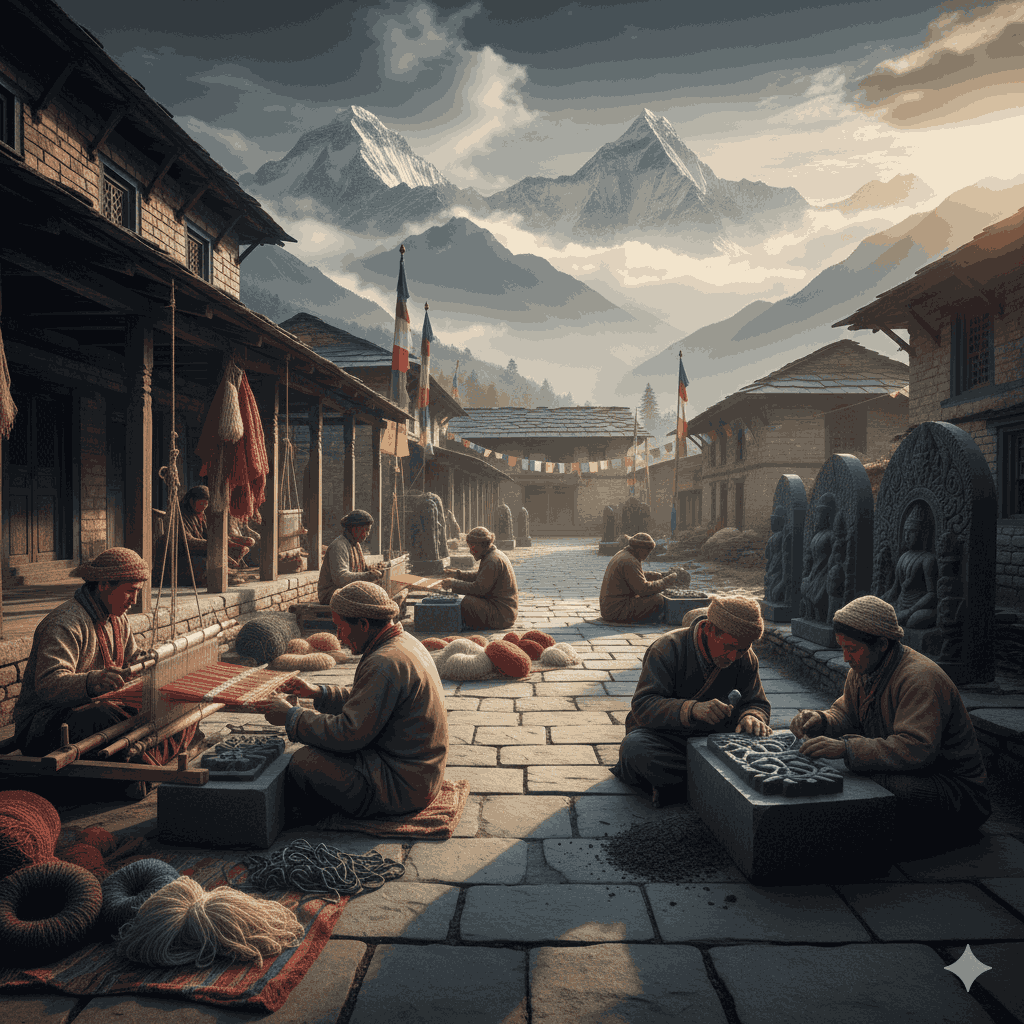
indigenous village industries nepal showcasing traditional handloom weaving and stone craft in Himalayan village
In 2026, the global shift toward conscious consumerism has turned its eyes toward the high-altitude workshops and valley-floor looms of the Himalayas. The rise of indigenous village industries nepal represents a powerful transition from mass-produced goods to soulful, slow-crafted heritage. These industries are not merely economic engines; they are the custodians of centuries-old wisdom, transforming local resources into global icons of sustainability.
As travelers and investors prioritize best sustainable travel in Nepal 2026, the role of these village-based enterprises has become paramount. They bridge the gap between ancient craftsmanship and modern market demands, ensuring that the “Made in Nepal” label is synonymous with ethical production and cultural integrity. This extensive guide dives into the heart of indigenous village industries nepal, exploring the people, the processes, and the future of Himalayan heritage.
Indigenous Village Industries Nepal: The Future of Heritage Craft
To understand the economic soul of the country in 2026, one must look at the indigenous village industries nepal fosters. These are micro-enterprises rooted in specific ethnic identities—the Newars of the valley, the Sherpas of the mountains, the Rais of the eastern hills, and the Tharus of the plains. By utilizing hyper-local materials like Himalayan nettle, volcanic clay, and Daphne bark, these industries define carbon neutral travel Nepal 2026 at its source.
1. The Textile Revolution: Handlooms and Natural Fibers

indigenous village industries nepal highlighting traditional Dhaka weaving and allo fiber production
Textiles are the most visible success story of indigenous village industries nepal. In 2026, the demand for natural, biodegradable fabrics has skyrocketed, putting Nepali weavers in the international spotlight. Unlike factory-made cloth, these textiles carry the DNA of the landscape.
Allo (Himalayan Giant Nettle): Harvested primarily in the eastern hills, Allo is the “silk of the mountains.” Indigenous Rai and Limbu communities have mastered the art of extracting fibers from this stinging plant to create durable, lustrous cloth. In 2026, Allo is used in everything from luxury fashion to eco-friendly home decor.
Dhaka Weaving: The intricate geometric patterns of Dhaka fabric are the pride of indigenous village industries nepal. Traditionally woven in Terathum and Palpa, these hand-loomed textiles are central to cultural preservation Nepal.
Pashmina and Cashmere: In the high-altitude regions, indigenous village industries nepal revolve around the soft undercoat of the Chyangra goat. By 2026, community-owned cooperatives ensure that the wealth generated from this “diamond fiber” stays within the mountain villages. The National Pashmina Sector Export Strategy aims for $75 million in exports by 2026, supporting over 300,000 livelihoods.
Sheep Wool and Felt: From the rugged jackets of the mountain herders to the vibrant felt products exported to Europe, the processing of sheep wool remains a staple of indigenous village industries nepal.
2. Lokta Paper: The Living Bark of the Himalayas
The production of Lokta paper is one of the oldest indigenous village industries nepal preserves. Made from the bark of the Daphne shrub, which grows between 6,000 and 9,000 feet, this paper is naturally resistant to insects and decay.
In 2026, Lokta has evolved beyond traditional manuscripts. Modern indigenous village industries nepal now produce Lokta-based lampshades, stationery, and even wallpaper for high-end eco-hotels. The process remains entirely organic: the bark is harvested sustainably, boiled into a pulp, and sun-dried on wooden frames in mountain clearings. This “forest-to-frame” journey is a highlight for those seeking authentic cultural experiences nepal.
3. Metal and Stone: The Sacred Crafts of the Newars
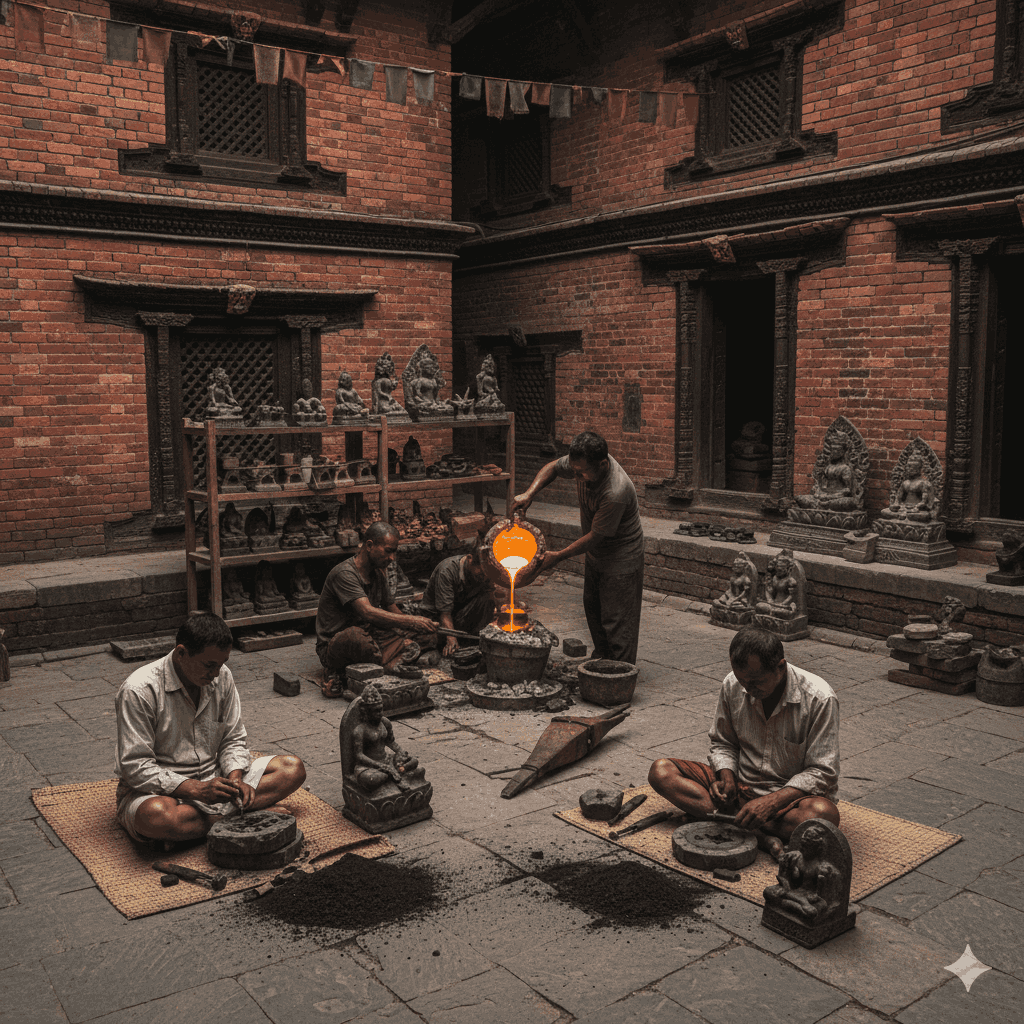
The Kathmandu Valley is a powerhouse for indigenous village industries nepal focused on metalwork and stone carving. In towns like Patan and Bhaktapur, craftsmanship is considered a form of meditation.
Lost-Wax Casting: This ancient technique produces the world-renowned bronze and copper statues of Nepal. Artisans in Patan are the global leaders in this field, proving that indigenous village industries nepal can maintain 5th-century standards in a 21st-century world.
Stone Carving: The meticulous stone carving culture Nepal is still practiced in the same family courtyards. In 2026, these artisans are utilizing 3D scanning to document ancient motifs, ensuring that indigenous village industries nepal survive digitisation.
Filigree and Jewelry: Delicate wirework in silver and brass, often studded with turquoise and coral, defines the jewelry wing of indigenous village industries nepal.
4. Agri-Industries: Traditional Flavors as Global Exports
Indigenous knowledge extends to the food we eat. In 2026, indigenous village industries nepal has scaled up the production of traditional superfoods and organic preserves.
Himalayan Honey: The “Mad Honey” harvested by the Gurung honey hunters and the organic floral honey from the mid-hills are vital indigenous village industries nepal.
Orthodox Tea: Small-holder tea gardens in Ilam and Dhankuta operate as indigenous village industries nepal, focusing on high-quality, hand-rolled leaves that outperform industrial plantations.
Traditional Cheese (Chhurpi): Once just a local snack for herders, the production of hard yak cheese has become a booming export industry, particularly as a healthy pet treat in the West. This is a prime example of how indigenous village industries nepal can innovate for the global market.
5. Challenges and “Rurbanomics” in 2026
While indigenous village industries nepal thrives, it faces the challenge of youth migration. The “Rurbanomics” model,integrating rural production with urban market access,is the 2026 solution.
Digital Integration: Young indigenous entrepreneurs are now using e-commerce platforms to sell their village-made crafts directly to international buyers, bypassing exploitative middlemen.
Infrastructure: By improving nepal local transport, the government has made it easier for village industries to reach the Kathmandu export hubs.
Education: Vocational training that respects indigenous knowledge is being integrated into local schools, ensuring the next generation sees a future in indigenous village industries nepal.
6. Sustainable Logistics and the Green Economy
The sustainability of indigenous village industries nepal is closely tied to how goods are moved. In 2026, the use of electric cargo vans and gravity-powered ropeways in the mountains has significantly lowered the carbon footprint of these products. This alignment with carbon neutral travel Nepal 2026 goals makes Nepali indigenous products even more attractive to the global “Green” market.
7. The Role of Community and “Guthi”
At the heart of indigenous village industries nepal is the community structure. For the Newars, the Guthi system ensures that skills and resources are shared among members, providing a social safety net that factory workers rarely enjoy.
Aama Samuha (Mothers’ Groups): In rural hills, women’s groups manage micro-finance for spinning and weaving, ensuring that the profits from indigenous village industries nepal directly fund local education and health.
Parma System: The tradition of labor exchange ensures that during peak harvest or production times, the entire village works together. This collective consciousness is what makes indigenous village industries nepal so resilient.
8. Impact of Village Tourism
In 2026, community tourism Nepal 2026 has become a primary driver for these industries.
Direct Sales: Tourists staying in homestays buy crafts directly from the source, providing immediate cash flow.
Workshops: Many indigenous village industries nepal now offer 3-day workshops, where travelers can learn to weave, carve, or make paper.
Cultural Pride: The interest of international visitors validates the work of local artisans, encouraging them to keep their traditions alive.

indigenous village industries nepal featuring traditional metal casting and stone carving craftsmanship
Frequently Asked Questions (FAQs)
1. What defines an industry as an “indigenous village industry” in Nepal? These are enterprises that use traditional knowledge, local raw materials, and are owned and operated by indigenous community members. Indigenous village industries nepal are characterized by their small scale and cultural significance.
2. How does buying from indigenous village industries nepal support the economy? Unlike large corporations, these industries keep the majority of the revenue within the community. In 2026, it is estimated that 80% of the cost of a village-made product goes directly toward local salaries and community development.
3. Are products from indigenous village industries nepal eco-friendly? Generally, yes. Most indigenous village industries nepal rely on natural fibers, organic dyes, and manual labor. In 2026, they are leaders in the carbon neutral travel Nepal movement.
4. Where can I see indigenous village industries nepal in action? The best places include the Pottery Square in Bhaktapur, the metalwork districts of Patan, the weaving centers of Palpa, and the high-altitude herding communities of the Solu-Khumbu.
5. Is the Pashmina industry part of indigenous village industries nepal? Yes, it is one of the most significant sectors. In 2026, the industry supports over 300,000 people, with a focus on empowering women in rural areas.
6. How do indigenous village industries nepal handle the challenge of modernization? Through “Rurbanomics”,using digital tools for marketing and sales while maintaining traditional, manual production methods that ensure high quality and authenticity.
7. Can I learn these crafts myself? Many villages now offer intensive workshops. Learning from a master artisan is one of the most authentic cultural experiences nepal offers.
The growth of indigenous village industries nepal in 2026 is a testament to the fact that heritage is not a relic of the past, but a tool for the future. By supporting these industries, we are not just buying a product; we are investing in the survival of a culture and the health of our planet. As you explore the jazz festivals and live music in Kathmandu or trek the high passes, take a moment to look at the fabric on your back or the paper in your journal,it is likely the work of a master from the indigenous village industries nepal.
