
Drone laws in Nepal 2026 — infographic explaining permit categories, restrictions, and regulations
As we move through 2026, the sky over Nepal is no longer a wild frontier for tech-savvy travelers. It has transitioned into a highly regulated airspace. The drone laws in Nepal 2026 are designed with a very specific set of priorities: preventing interference with high-altitude rescue helicopters,especially in the “Khumbu Icefall”,and safeguarding the deep-rooted privacy of local communities and sensitive military sites.
If you are caught flying without a permit, the “fine and move on” days are over. The consequences are now immediate and often quite expensive. Your drone will likely be seized on the spot by the Nepal Police or the Army. Monetary penalties range from NPR 2,000 to NPR 50,000, and in sensitive border areas near China or India, unauthorized flight can even lead to detention under the Civil Aviation Act.
For a deeper dive into why these rules exist and how they have evolved, you can explore the drone permit process in Nepal on Explore All About Nepal, which breaks down the safety rationale for international travelers in much finer detail.
Breaking Down the Weight Classes: Do You Actually Need a Permit?
In 2026, Nepal uses a weight-based classification system. Every category has different requirements under the drone laws in Nepal 2026. You need to know exactly where your device sits before you even pack your bags.
Category A (Nano): Under 250g These are the small hobbyist drones like the DJI Mini series. While they have the fewest restrictions, don’t be fooled. For private use on your own property or indoors, you are generally safe under 50 feet. However, the moment you step into a public area or a heritage site, the rules change. Even these small devices require registration to be strictly legal in tourist hubs.
Category B (Micro): 250g to 2kg This is the sweet spot for most travel vloggers and photographers. If you own a DJI Air or a standard Mavic, you are in Category B. For these, CAAN UIN registration is mandatory, and you will need a series of clearances from the Ministry of Home Affairs.
Category C (Small): 2kg to 25kg These are professional-grade machines. If you are here for a documentary or a high-end commercial, you will need third-party liability insurance and a much more detailed flight plan.
Category D (Large): Above 25kg These are almost exclusively for industrial use, research, or major film productions. They require a professional flight crew license and a government-appointed liaison officer.
The Step-by-Step Roadmap: Drone laws in Nepal 2026
The permit process in Nepal is not a “one-stop shop.” It is a “chain-link” system where each approval unlocks the next office door. Here is exactly how to get a permit and drone laws in Nepal 2026 in 2026 without losing your mind.
First Contact: The Customs Declaration

Drone laws in Nepal 2026 — traveler declaring drone at Tribhuvan International Airport Customs
Your journey begins before you even leave the airport. When you arrive at Tribhuvan International Airport (TIA), do not walk through the “Green Channel” with a drone in your luggage. You must declare the drone at the Customs Red Channel. You will receive a Customs Clearance Certificate. Without this certificate, CAAN will refuse to register your device, and you will be stuck in a loop of bureaucratic limbo.
The Paperwork Peak: Registration with CAAN
Once you have your customs slip, you must visit the Flight Safety Standards Department (FSSD) in Sinamangal, Kathmandu. While some pre-filing can happen online, a physical visit is often required for foreigners to finalize the identification.
Fill out Form RPA/Form/001: This is the basic registration form.
Submit your Dossier: You will need a passport copy, your visa, clear photos of the drone (including the serial number), and the manufacturer’s manual.
The Fee: The registration fee has stabilized at USD 50 plus 13% VAT for foreigners.
The UIN: If everything checks out, you will receive your Unique Identification Number (UIN). You are legally required to stick this number onto your drone.
The Ministry Gauntlet
The UIN is just your “license plate.” To actually “drive” in the sky, you need flight permission. This requires “No Objection” letters from:
Ministry of Home Affairs: To ensure you aren’t filming security installations.
Department of Tourism: Because as a foreigner, your activities are overseen by this body.
Ministry of Communication: They check that your drone’s radio frequency doesn’t mess with local emergency bands.
Flying in Restricted Zones: The High-Altitude Challenge

Drone laws in Nepal 2026 — flying over Everest with permit requirements and protected areas
The most beautiful spots in Nepal,Everest, Annapurna, and the ancient squares of Kathmandu,are the most heavily protected. Under the drone laws in Nepal 2026, flying in National Parks is a “Special Case” that requires a separate budget and timeline.
If you are heading to Sagarmatha National Park (Everest Region), you need an additional permit from the Department of National Parks and Wildlife Conservation (DNPWC). For foreign professionals, this permit can cost as much as $1,500 USD. Furthermore, you might be assigned a Liaison Officer whose food, lodging, and daily allowance you are responsible for covering.
Similarly, UNESCO World Heritage Sites like Patan Durbar Square or Boudhanath require an extra layer of permission from the Department of Archaeology. The monks and residents in these areas are very sensitive to the “buzz” of drones, so always ask for local verbal consent even after you have your papers.
Professional Tips for a Smooth Application
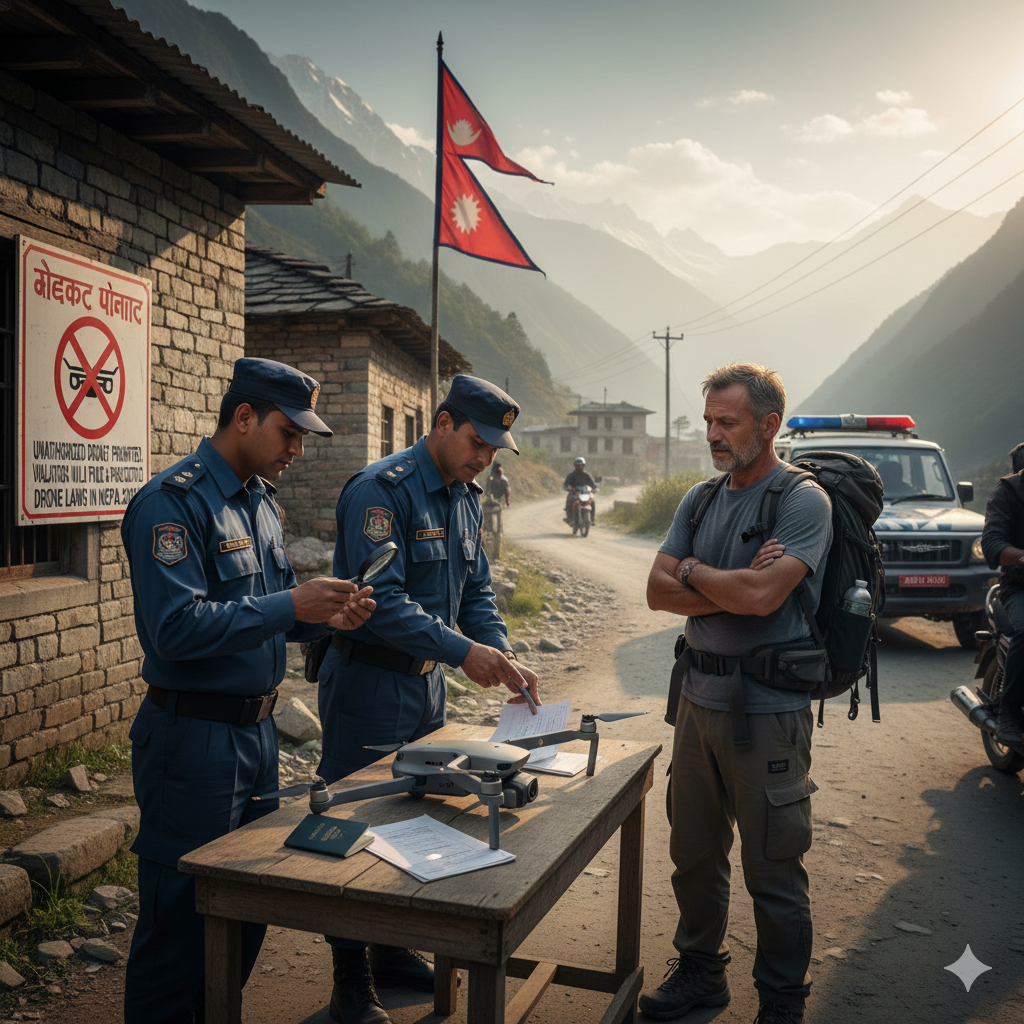
Drone laws in Nepal 2026 — enforcement checkpoint with seized drone and penalty signs
If you want to ensure you get your permit on time, follow these tips from people who do this every day. First, be incredibly specific about your locations. Don’t just say “Kathmandu Valley.” Provide GPS coordinates or specific names of the “gallis” or temples you plan to shoot. This transparency builds trust with the CAAN officers.
Second, use a local contact. Whether it is your trekking agency or a local fixer in Kathmandu, having a Nepali speaker follow up at the Ministry of Home Affairs can shave a week off your waiting time. The system still relies heavily on physical signatures, and a “friendly reminder” at the office goes a long way.
Third, always carry your physical documents. Digital copies on your phone are rarely enough when you are stopped at a remote checkpoint in the mountains. Keep a waterproof folder with your CAAN registration, your Ministry letters, and your passport.
Frequently Asked Questions (FAQs) on Drone laws in Nepal 2026
Is a drone permit in Nepal mandatory for a DJI Mini 4 Pro?
Yes. While it is a “Nano” drone, the drone laws in Nepal 2026 state that any flight in public, near heritage sites, or in national parks requires registration (UIN) and local police notification at the very minimum.
How much does a drone permit cost in Nepal for a tourist?
The initial CAAN registration is $50 + VAT. However, if you add in the ministry clearances and park fees, a recreational pilot should budget between $100 and $300 USD. For professional filming in places like Everest, that number can jump to $1,800 USD or more.
How long does it take to get a drone permit?
The “standard” time is 7 to 15 working days. If you are on a tight schedule, it is highly recommended to hire a local agency in Kathmandu to handle the legwork before you even land.
What happens if I fly without a permit?
The police have become very efficient at spotting drones in 2026. You face immediate confiscation of your gear, a fine up to NPR 50,000, and potential blacklisting from future mountain permits.
Can I fly my drone at night in Kathmandu?
No. Night flying is strictly prohibited for foreigners under the current drone laws in Nepal 2026, primarily for security and aviation safety reasons.
Navigating the drone laws in Nepal 2026 is admittedly a marathon of paperwork. It requires patience, a bit of money, and a lot of respect for the local system. But when you finally see that 4K footage of a prayer flag fluttering against the backdrop of Ama Dablam, every form you filled out will feel worth it.
By taking the time to learn how to get a permit properly, you aren’t just protecting your equipment from being seized,you are respecting the quiet dignity of the Himalayas and the safety of the pilots who fly those thin mountain air currents every day. Nepal is a land of ancient traditions and modern technology; finding the balance between the two is what makes an ethical traveler.
For the most current forms and technical updates, always double-check the Civil Aviation Authority of Nepal (CAAN) official portal. Safe flying, and may your batteries stay warm and your horizons stay clear!
