
You will know Bhaktapur’s food before you know the city.
The smell of bara frying in black mustard oil reaches you somewhere in the medieval lanes before you have found the right square. The clay pots of Juju Dhau sit in rows outside small shops like glossy, cream-coloured certainties. A woman in a red tika bends over a griddle just inside a doorway, pouring rice flour batter in careful circles that expand as they hit the hot iron. Everything edible in Bhaktapur is made in front of you, in small quantities, by people who have been making the same things for their entire working lives.
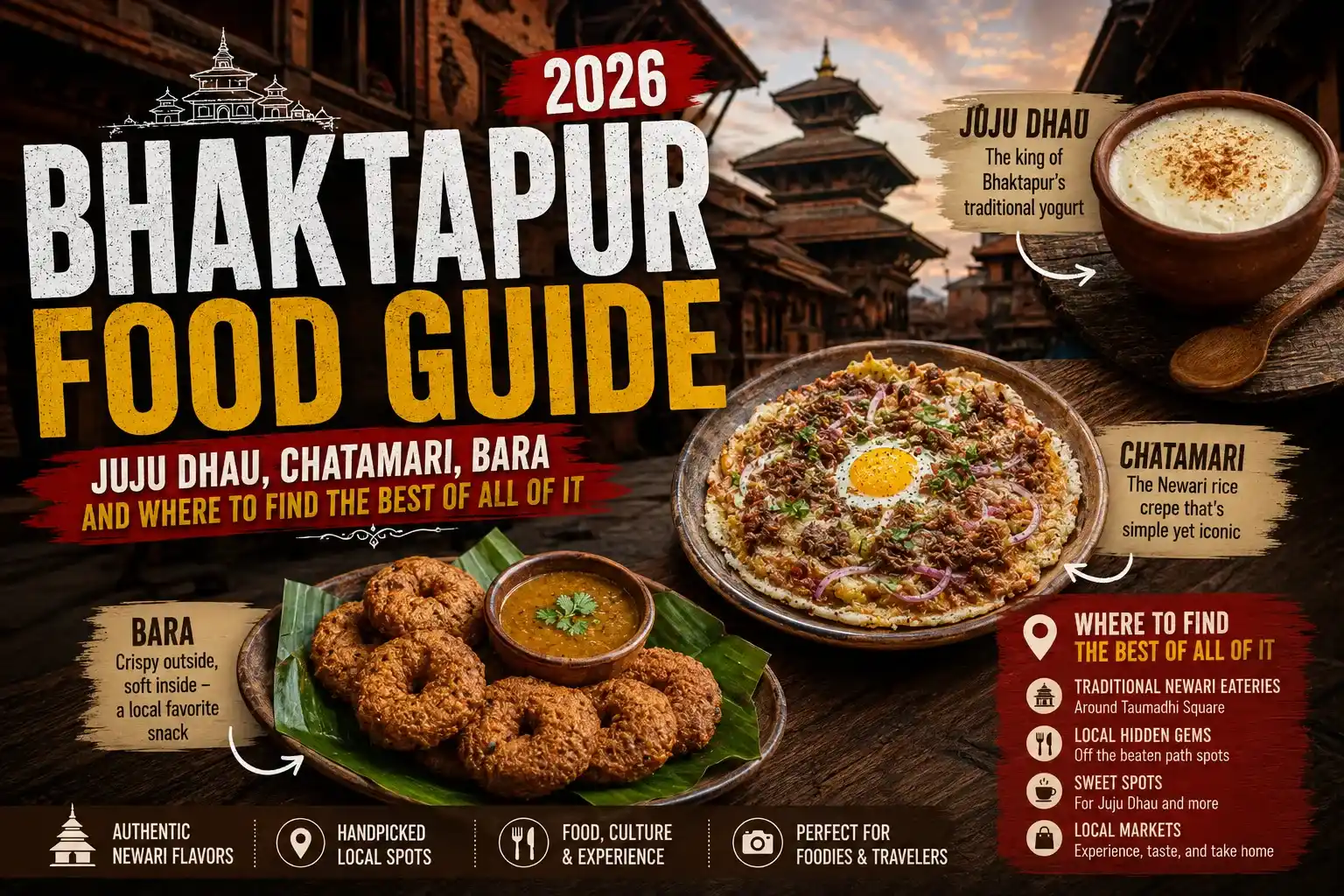
Bhaktapur Food Guide 2026: Juju Dhau, Chatamari, Bara and Where to Find the Best of All of It
This is not Thamel. There is no laminated menu in twelve languages. There is food, and there are prices, and there is the steady confidence of cooks who need no approval from someone with a travel blog.
What follows is the guide to navigating it what to eat, where specifically to find it, what it costs in NPR, and the sequence of meals that turns a Bhaktapur day trip into a genuinely edible one.
Juju Dhau: The King of Curd and Why Bhaktapur’s Version Is Different
There is yoghurt. And then there is Juju Dhau.
The name translates directly: juju means king, dhau means curd. The title is not modesty. Juju Dhau is the thick, slightly sweet, extraordinarily creamy set yoghurt made exclusively in Bhaktapur from local buffalo milk, and the reason it tastes fundamentally different from any other yoghurt on earth comes down to three specific factors that cannot be replicated elsewhere.
Factor 1: The milk. Juju Dhau is always produced with buffalo milk not cow’s milk. Buffalo milk has a naturally higher fat content (6–8% versus cow’s 3–4%), which gives the set curd a richness and body that is viscerally different from ordinary yoghurt on first contact with the tongue.
Factor 2: The clay pot. The clay draws moisture from the curd as it sets, resulting in a texture that is creamier and denser than anything sold in a plastic tub. This is not aesthetic. The clay pots the small, unglazed terracotta cups made in Bhaktapur’s own Pottery Square are porous, and that porosity allows the whey to slowly seep out during setting. What remains is curd so concentrated that a spoon inserted into a good Juju Dhau meets genuine resistance before yielding. The pot is not a serving container. It is part of the production process.
Factor 3: The fermentation culture. The specific bacterial cultures used in Bhaktapur’s Juju Dhau production have been transmitted from batch to batch for generations. These cultures are not available commercially. They live in the particular dairy practices of particular families in Bhaktapur, and they produce a flavour profile gentle natural sweetness, a clean acidity underneath, an earthy undertone from the clay that cannot be reproduced in a factory.
The first spoonful melts smoothly on your tongue and leaves a sweet, gentle taste. The comparison to ordinary yoghurt becomes almost embarrassing.
Where to Buy Juju Dhau in Bhaktapur
As you walk around in Bhaktapur, you will see that many little shops are selling King Curd. Juju Dhau is a sweet yogurt and is like a dessert in Nepal. Look for small cafes or shops with the sign “King Curd” or “Juju Dhau” to try some.
The specific locations that produce the most consistent Juju Dhau:
Near Bhaktapur Durbar Square: The shops immediately inside and around the Durbar Square entrance particularly the lane running south from the square toward the Peacock Window have the densest concentration of Juju Dhau sellers. These shops refrigerate the pots and sell directly to passing visitors. The clay pots are small enough to hold easily in one hand and the yoghurt inside is eaten with a small wooden or plastic spoon provided by the vendor.
Siddha Pokhari area: The shops near the large sacred pond at Siddha Pokhari, at Bhaktapur’s western entrance, are where local residents often buy Juju Dhau slightly less tourist-facing than the Durbar Square sellers and priced accordingly.
Taumadhi Square vendors: The lanes surrounding Taumadhi Square, where the Nyatapola Temple stands, have several small dairy shops with Juju Dhau alongside other Newari sweets.
Juju Dhau Prices 2026
| Location | Price |
|---|---|
| Local shops and street stalls in Bhaktapur | NPR 80–150 per clay pot |
| Tourist-facing shops near Durbar Square | NPR 100–200 per clay pot |
| Restaurants (tourist area) | NPR 150–300 depending on size |
Juju Dhau is a local speciality that you’ll find in nearly all stores in Bhaktapur for around NPR 50–100 from the most local sellers. The smaller, local-facing shops consistently offer better prices than the tourist-adjacent sellers the quality is identical.
Eat it at the end of your visit, not the beginning. Juju Dhau is the natural conclusion of a Bhaktapur food day the cool, sweet, dairy counterpoint to everything spicy that came before it. Many experienced Bhaktapur visitors eat it standing outside the shop, pot in hand, in the last 20 minutes before their taxi back to Kathmandu.
Chatamari: The Ancient Rice Crepe
Chatamari is a traditional specialty of the Newar community. It is more like a French crepe: made from a batter of rice flour, poured thinly on a flat iron griddle. But the French crepe comparison undersells it chatamari predates French cuisine by a significant margin and occupies an entirely different cultural position. It is ritual food, festival food, the everyday breakfast of the Newari household.
In Bhaktapur specifically, chatamari is made differently from the tourist-oriented versions you might find in Thamel restaurants. The batter is thinner. The cooking surface a flat cast iron tawa produces edges that are genuinely crisp where they have caught the heat, while the centre remains soft and yielding. The topping is spread directly onto the raw batter while the crepe is still cooking, so the egg and minced buff (water buffalo) or vegetable cook into the surface rather than sitting on top of it.
The result is a unified disc not a base with toppings but a single thing. This is what most “Newari pizza” descriptions get wrong about chatamari. It is not a flatbread with things placed on it. It is one coherent preparation whose components have fused during cooking.
Where to Find Chatamari in Bhaktapur
Around Pottery Square (Talako Tole): The small stalls and tea houses around Bhaktapur’s Pottery Square are the best places to find chatamari cooked and eaten in the most ordinary, everyday context vendors with single griddles, a few ingredients, and a steady rhythm of production. Look for small shops with locals gathered outside that’s usually a sign of good food.
Near Taumadhi Square: Taumadhi Square is great for yomari, bara, and chatamari at small tea houses and local stalls. The Nyatapola Temple’s base offers one of Bhaktapur’s most atmospheric eating spots a plate of chatamari with the five-tiered pagoda visible above you is an experience that compensates for any number of mediocre tourist restaurant meals.
Newa Lahana restaurant (small side street near Taumadhi Square): Down a small side street near Taumadhi Square, you’ll find this little gem. They serve typical Newari food with a vast menu, including chatamari, samay baji, bara, and choila. It is a little difficult to find, but worth the search.
Chatamari prices: NPR 80–200 per crepe depending on toppings plain egg the cheapest, buff and egg the most expensive. At street stalls, NPR 80–120 is standard. At sit-down restaurants like Newa Lahana, NPR 150–250.
Bara: The Fried Lentil Pancake That Bhaktapur Does Best
Bara is black lentil batter soaked, ground with garlic, ginger, cumin, and turmeric into a thick paste, then shallow-fried until the exterior is crisp and the interior remains dense and yielding. The classic version has a cracked egg broken directly onto the raw batter while it fries. The meat version has minced buff or duck laid into the batter. Both versions arrive with a small side of aloo achar (spicy potato pickle) and sometimes a pour of tama (fermented bamboo shoot soup) over the top.
Aamako Bara Pasal The Best Bara in Bhaktapur
Aamako Bara Pasal is famous among locals in Bhaktapur. This tiny shop has been operating for 53 years. The woman who runs it cooks all the food herself. She specialises in bara with tama soup poured on top. There is no menu you simply get whatever she makes that day. You can get a filling meal for under NPR 300.
This is the benchmark against which every other bara in Bhaktapur is measured. The shop is small four people standing makes it full and the Aama runs it with the quiet authority of someone who has made this specific thing better than almost anyone else for more than five decades. Go before noon. She sells out.
Bara prices: NPR 60–150 per piece depending on topping (plain NPR 60–80; egg NPR 100–120; buff NPR 120–150). A full bara and tama soup meal at Aamako Bara Pasal: under NPR 300.
Newari Sweets and the Rest of the Sugar Portfolio
Yomari: The steamed rice-flour dumpling filled with chaku (molasses) or sweet khuwa (milk solids), shaped into a pointed form that represents the deity Kumari. Available year-round at dedicated Newari restaurants in Bhaktapur. Yomari Ghar Restro & Café in Gatthaghar Bhaktapur focuses only on yomari khuwa, chaku, and chocolate versions priced at NPR 70–100.
Lakhamari: A hard, crunchy sweet bread made from flour, sugar, and ghee significant in Newari wedding ceremonies and religious rituals. Available from sweet shops near Bhaktapur Durbar Square. More durable than most Bhaktapur sweets and excellent for carrying home.
Sel roti: The crispy rice-flour ring that is Bhaktapur’s morning staple available from street vendors near Pottery Square and Taumadhi from approximately 7am onward. NPR 20–40 per piece, eaten with chiya.
Gwaramari: A simpler, rounder deep-fried bread made from rice flour softer than sel roti, slightly sweet, eaten for breakfast with tea or with aloo tarkari. Available from street-side vendors in the old city’s residential alleys in the early morning.
Breakfast vs Lunch in Bhaktapur: The Sequence That Works
Breakfast (7:00–10:00am):
Arrive in Bhaktapur early the temples are less crowded, the light on the brickwork is golden, and the morning food is at its freshest.
Walk to Pottery Square immediately. The vendors setting up their griddles produce the day’s best sel roti and gwaramari in the first two hours after sunrise. A sel roti with a small cup of chiya costs NPR 40–60. This is the correct Bhaktapur breakfast.
From Pottery Square, walk toward Aamako Bara Pasal. If you arrive before 10am you will find fresh bara. Order one with egg and tama soup. Budget NPR 200–250.
Lunch (11:30am–2:00pm):
Build your visit around a samay baji lunch at a local bhatti and finish with Juju Dhau from the clay pot sellers near the Durbar Square. The combination costs less than NPR 500 and represents some of the best eating in all of Nepal.
The samay baji the Newari meal set arrives as a round tray with beaten rice (chiura) at the centre, surrounded by buff chhoila, bara, boiled egg, aloo tarkari, gundruk pickle, and sometimes a small cup of aila (rice spirit) or tama soup. This is the definitive Bhaktapur lunch.
At Newa Lahana: Samay baji approximately NPR 400–600. Newari food is so spicy that we had some curd after every meal to cool our mouths. The Juju Dhau is not optional.
At Hotel Garuda (near Nayatapola Temple): Newari set approximately NPR 700. They made the food less spicy when requested and the mushroom choila is especially good. Rooftop views of the Nayatapola Temple from the upper terrace.
At Aamako Bara Pasal: Under NPR 300 for bara and soup the most local option and the hardest to find.
Dessert (anytime from 2:00pm onward):
Juju Dhau. One pot from a Durbar Square or Taumadhi area vendor. NPR 100–150. Stand outside in the afternoon light and eat the king curd from its clay pot while Bhaktapur does the same thing it has been doing since before anyone thought to write about it.
What a Full Bhaktapur Food Day Costs
| Meal | What | Cost |
|---|---|---|
| Breakfast | Sel roti + chiya | NPR 50–60 |
| Mid-morning | Bara with egg + tama soup | NPR 200–250 |
| Lunch | Samay baji set (full Newari) | NPR 400–600 |
| Afternoon sweet | Juju Dhau | NPR 100–150 |
| Optional chai throughout | Chiya at local stalls | NPR 20–25 each |
| Total | NPR 750–1,100 (~USD 6–8) |
The Explore All About Nepal team eats in Bhaktapur regularly and considers it among the finest single-city food days available anywhere in Asia at this price point. For questions about specific dishes or combining Bhaktapur food with a Kathmandu day trip, leave a comment below.
