
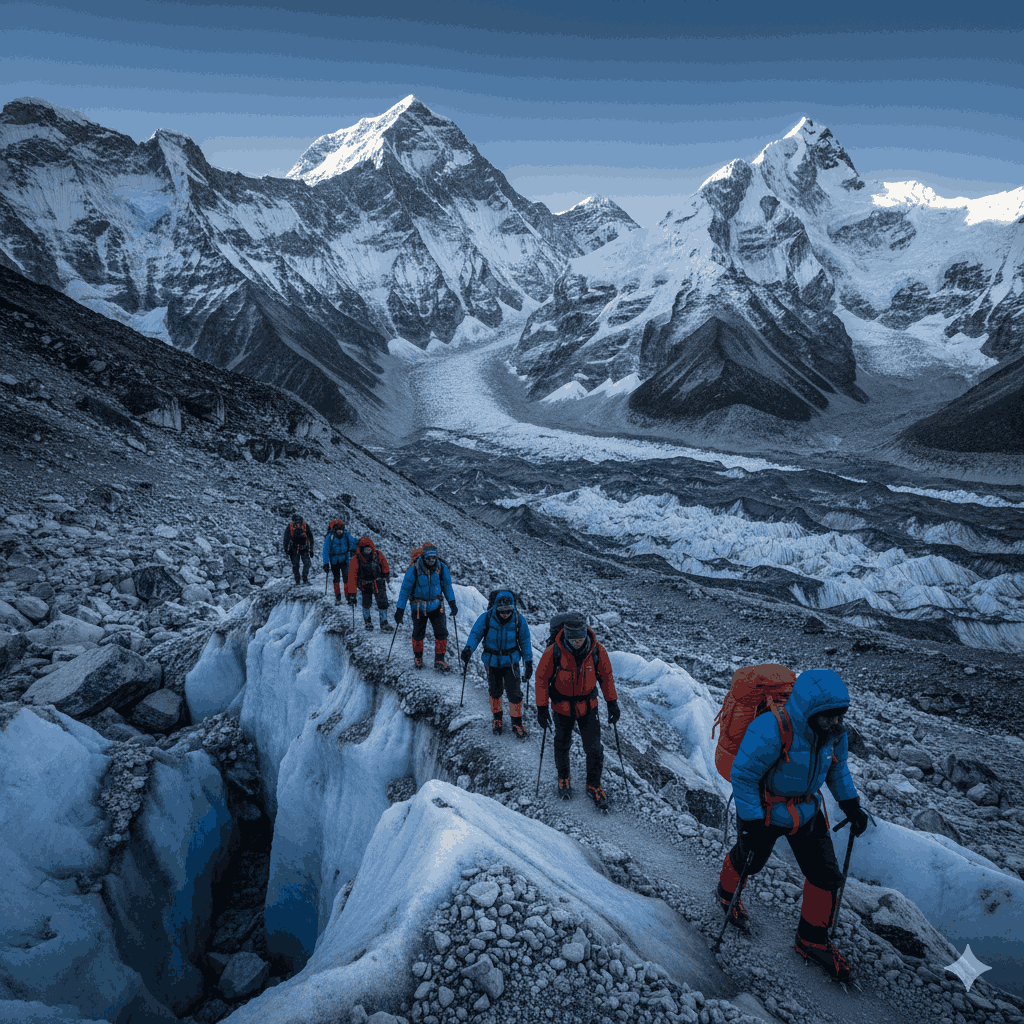
The Annapurna Base Camp trek (ABC trek) is a 7–11 day teahouse trek that ends inside a ring of 7,000 and 8,000-meter peaks. You sleep at 4,130 m, surrounded on all sides by Annapurna I, Annapurna South, and Machhapuchhre.
It is Nepal’s best mid-length trek: higher and wilder than Poon Hill, shorter and cheaper than Everest Base Camp. This guide covers every itinerary option, real costs, honest difficulty, and the one safety issue most trek operators bury the avalanche section.
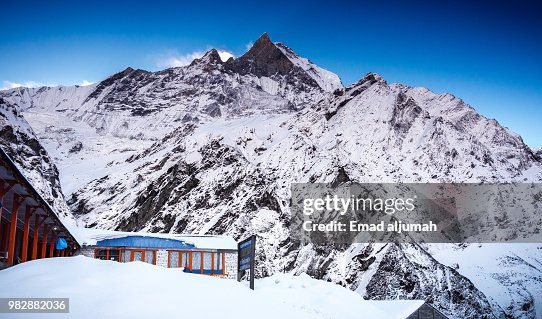
ABC Trek in Nepal
Quick answers:
| Question | Answer |
|---|---|
| Duration | 7 days (fast) to 11 days (classic) |
| Max altitude | 4,130 m at base camp you sleep there |
| Difficulty | Moderate. Endless stone stairs, one high day. |
| Best seasons | October–November and March–April |
| Permits | ACAP (NPR 3,000) + TIMS (NPR 2,000) |
| Guide | Officially required since 2023 |
| Cost | $600–$900 guided, all-inclusive |
What Makes ABC Different
Most base camp treks end at a viewpoint looking at mountains. ABC puts you inside them. The trail enters the Annapurna Sanctuary a natural amphitheater reached through a single narrow gorge and the peaks rise on every side of your lodge.
Sunrise at base camp is the payoff. Annapurna I (8,091 m) turns gold about 200 meters from your breakfast table. No other teahouse trek in Nepal delivers mountains this close for this little effort.
Itinerary Options: 7, 9, or 11 Days
All routes follow the same core trail from Chhomrong upward. The difference is where you start and what you add.
7-Day ABC Trek (fastest sensible option)
Drive from Pokhara to Siwai or Jhinu cuts two walking days.
| Day | Route | Sleep at |
|---|---|---|
| 1 | Pokhara → Siwai (drive), trek to Chhomrong | 2,170 m |
| 2 | Chhomrong → Bamboo | 2,310 m |
| 3 | Bamboo → Deurali | 3,230 m |
| 4 | Deurali → ABC via MBC | 4,130 m |
| 5 | ABC → Bamboo | 2,310 m |
| 6 | Bamboo → Jhinu Danda (hot springs) | 1,780 m |
| 7 | Jhinu → drive to Pokhara | — |
This is the itinerary our old 7-day guide covered. It works, but day 4 gains 900 m the maximum safe daily gain at this altitude. If you feel a headache at Deurali, add a night at MBC (3,700 m).
9-Day Classic (recommended)
Adds Ghandruk village at the start and splits the high climb: Deurali → MBC (sleep) → ABC. Safer acclimatization, better villages, one extra sunrise.
11-Day with Poon Hill
Combines the Ghorepani–Poon Hill loop before joining the ABC trail at Tadapani. Best option if this is your one trip to Nepal. See our Poon Hill Mardi Himal guide for how these trails connect.
How Difficult Is the ABC Trek?
Moderate, with two specific challenges people underestimate.
The stairs. The Annapurna foothills are farmed on terraces, and the trails are stone staircases thousands of steps up and down, especially around Chhomrong. Your knees suffer more than your lungs. Trekking poles are not optional here.
The altitude day. Sleeping at 4,130 m is high enough for real altitude sickness. Around one in four trekkers feels symptoms at ABC headache, nausea, poor sleep. The fix is simple: sleep at MBC first if you have any symptoms at Deurali, and descend immediately if symptoms worsen at base camp. Descent is fast on this route, which makes ABC far safer than EBC.
Daily walking is 4–7 hours. Anyone who can hike uphill for a full day with a light pack can do this trek.
The Avalanche Section: What Operators Don’t Tell You
The trail between Deurali and Machhapuchhre Base Camp crosses several avalanche chutes below the Hiunchuli slopes. This is a real, documented hazard trekkers have died here, most recently in heavy snow years.
The honest risk picture:
- October–November and dry spring: risk is minimal. Thousands cross safely.
- January–February and after heavy snowfall: the section can be genuinely dangerous. Lodges at Deurali hold trekkers back when conditions are bad.
- Rule: cross this section early in the morning, never after fresh snowfall, and follow lodge and guide advice without argument. If locals say wait, wait.
This is the main reason a guide earns their fee on this trek. They know the crossing timing and current conditions.
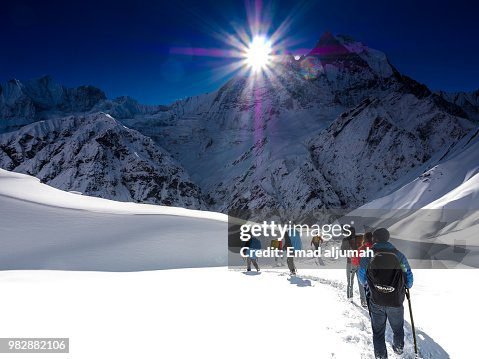
Group of people walking on snow in the way to Annapurna Base Camp Trek sounded by Annapurna mountains range, March 5, 2017
ABC Trek Cost Breakdown
| Item | Cost |
|---|---|
| Guided package (9 days, all-inclusive) | $600–$900 |
| Guide only | $25–$35/day |
| Porter (optional) | $20–$25/day |
| ACAP + TIMS permits | ~$38 |
| Food and lodging, pay-as-you-go | $30–$45/day (higher up = pricier) |
| Pokhara–Siwai jeep | $15–$25 shared |
| Hot shower / device charging up high | NPR 300–600 each |
Realistic totals: $600–$750 budget guided, $850–$1,000 with porter and private guide. Cash only on the trail withdraw everything in Pokhara.
Dal bhat at base camp costs $8–$9. That is not a scam; every ingredient walked there on someone’s back.
Best Time for the ABC Trek
| Season | Verdict |
|---|---|
| October–November | Best. Clear skies, stable trail, biggest crowds. Book lodges ahead. |
| March–April | Second best. Rhododendron bloom below, some avalanche caution above. |
| December–February | Possible in dry spells. Cold (−15°C at ABC), avalanche risk after snow. |
| June–September | Avoid. Monsoon rain, leeches, blocked views. |
Do You Need a Guide?
Officially yes. Nepal has required a licensed guide for Annapurna region treks since 2023. Checkpoint enforcement varies, but beyond the rule, the avalanche section and the altitude day are exactly where a guide matters on this route. A guide shared between 3–4 trekkers costs under $10 per person per day.
Verify the current rule before your trip enforcement and policy keep shifting.
ABC vs Everest Base Camp: Which Should You Do?
| ABC | EBC | |
|---|---|---|
| Days | 7–11 | 12–14 |
| Max altitude | 4,130 m | 5,364 m |
| Cost | $600–$900 | $1,300–$1,800 |
| Getting there | 2 hr drive from Pokhara | Lukla flight (weather delays common) |
| Altitude sickness risk | Moderate | High |
| Views | Inside a peak amphitheater | Distant Everest, dramatic Khumbu |
| Crowds | High in season | Very high in season |
Choose ABC if you have under two weeks, a mid-range budget, or any doubt about altitude. Choose EBC if standing below Everest is the specific dream and you have the time and money. ABC delivers 80% of the experience for half the cost and none of the flight-delay risk.
Teahouses and the Trail Experience
Lodges from Chhomrong to Bamboo are comfortable: private rooms, decent menus, hot showers. From Deurali up, everything is basic shared rooms in peak season, frozen pipes, and dining halls heated by one stove everyone huddles around.
Base camp lodging is the most basic on the route and books out in October–November. Your guide reserves ahead by phone; independent trekkers sometimes sleep in dining halls.
The reward on the way down is Jhinu Danda’s hot springs natural pools by the river, NPR 200 entry, and the best possible end to a week of stairs.
Packing Notes
The essentials beyond standard trekking gear: poles (the stairs), a −10°C-rated sleeping bag or liner (lodge blankets thin out at MBC/ABC), headlamp for the pre-dawn sunrise at base camp, water purification, and sunscreen the Sanctuary bounces UV off snow from every direction.
FAQ
How long is the Annapurna Base Camp trek?
The ABC trek takes 7 to 11 days. The 7-day version uses a jeep to Siwai and moves fast. The 9-day classic adds safer acclimatization. The 11-day version includes Poon Hill.
How hard is the ABC trek?
It is a moderate trek. The main challenges are thousands of stone stairs in the lower sections and one high day sleeping at 4,130 m. No technical climbing is involved. Reasonable fitness is enough.
How much does the ABC trek cost?
A guided ABC trek costs $600–$900 per person all-inclusive. Permits cost about $38, guides $25–$35 per day, and food and lodging $30–$45 per day if paying as you go.
Can you do the ABC trek without a guide?
Officially no. Nepal has required licensed guides on Annapurna treks since 2023. The avalanche section between Deurali and MBC is also where local knowledge genuinely matters.
Is there altitude sickness on the ABC trek?
Yes, it is possible. Base camp sits at 4,130 m and roughly a quarter of trekkers feel mild symptoms. Sleeping at MBC (3,700 m) before base camp cuts the risk sharply.
Which is better, ABC or EBC?
ABC is shorter, cheaper, lower, and easier to reach the better choice for most first-time trekkers. EBC is higher, more expensive, and iconic. ABC delivers comparable scenery in half the time.
Why 2026 is Your Year to Go:
The Amphitheater Effect: Unlike other base camps, the Annapurna Sanctuary is a high-altitude basin that puts you in a 360-degree amphitheater of 7,000m and 8,000m peaks.
A Journey of Resilience: Standing at 4,130m, surrounded by the Annapurna Massif and the sacred, unclimbed Machhapuchhre (Fishtail), you gain a perspective on life that only the mountains can provide.
The Ultimate Transition: After you’ve tested your limits on the trail, the transition back to civilization is just as rewarding. Most trekkers time their return to enjoy the jazz festivals and live music in Kathmandu, where the soulful melodies of the city provide a perfect counterbalance to the raw silence of the peaks.
There has never been a safer, more organized, or more rewarding time to step into the Sanctuary. The mountains have a way of clearing the mind, and in 2026, the Annapurna Base Camp is ready to tell you its story.
