
Did you knoiw Nepal has dolphins.
This is not a widely known fact. The Himalayas dominate the country’s international image so completely mountains, trekking, monasteries, base camps that the wildlife of Nepal’s southern lowlands remains one of the best-kept secrets in Asian nature travel. But in the Sapta Koshi River, threading through the far eastern corner of Nepal’s Terai floodplain, Ganges river dolphins surface and dive in water that is cold, brown, and extraordinary.
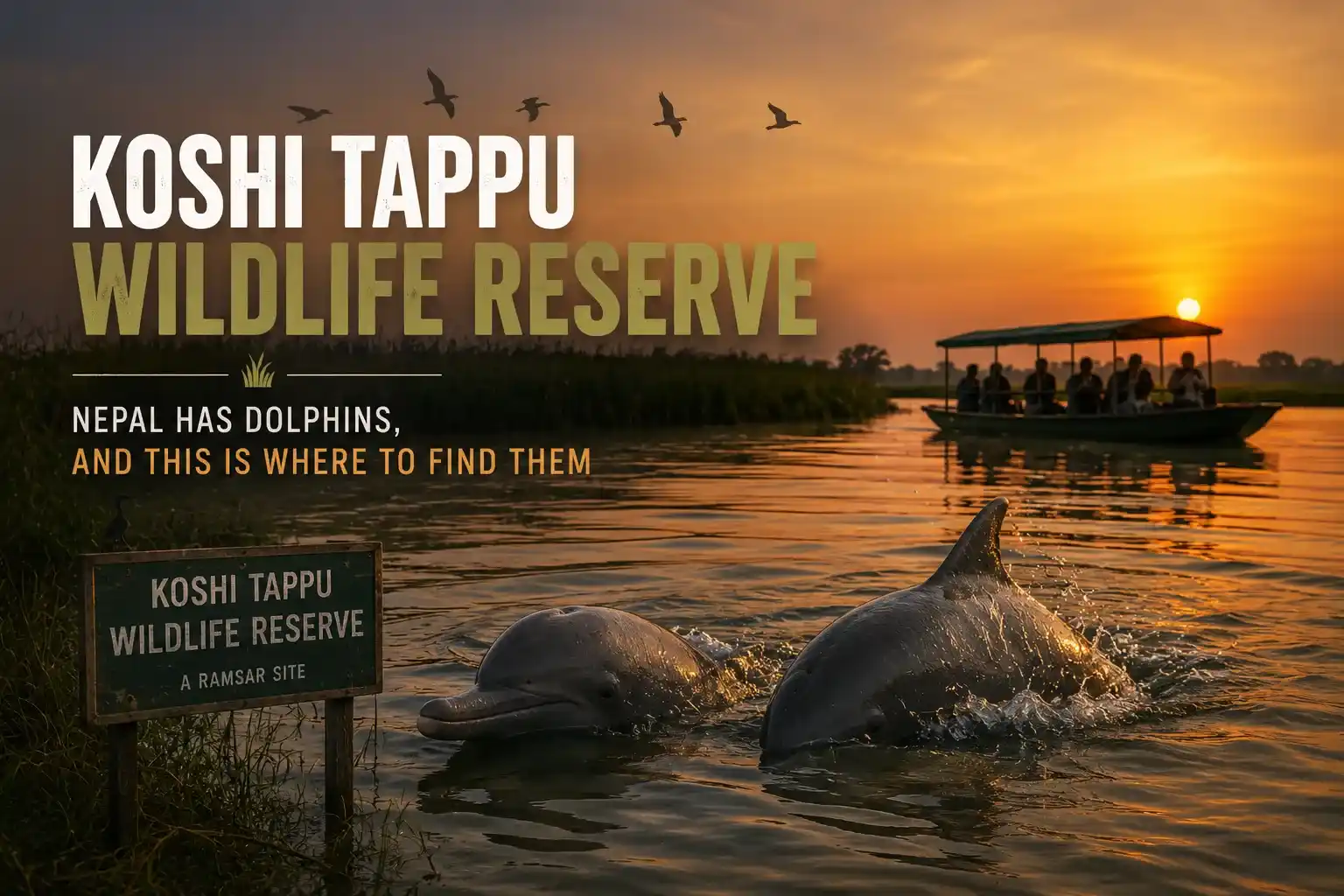
Koshi Tappu Wildlife Reserve: Nepal Has Dolphins, and This Is Where to Find Them
They share the river with gharial crocodiles, smooth-coated otters, and over 485 species of birds more than half of Nepal’s total bird count, in a reserve that covers just 176 square kilometres. On a clear morning from the upper part of the Sapta Koshi, with Makalu (8,463m the world’s fifth highest mountain) visible above the treeline to the north, you can watch Gangetic dolphins surface thirty metres from your boat while a flock of bar-headed geese crosses overhead en route from the Tibetan plateau.
This is Koshi Tappu Wildlife Reserve. It is Nepal’s most important wetland, its finest birdwatching destination, and one of the least visited wildlife reserves in South Asia for its size and ecological significance.
That last point is your advantage. Go now, before it is discovered.
What Koshi Tappu Actually Is
Koshi Tappu Wildlife Reserve lies on the floodplain of the Sapta Koshi River in the south-eastern Terai, in the Sunsari, Saptari and Udayapur districts of eastern Nepal. It covers 176 square kilometres small by national park standards, but ecologically dense in a way that larger parks rarely match.
The word Koshi derives from the name of the great river system. Tappu means island and the reserve is literally an island formation, defined to the east and west by the afflux embankments of the Koshi Barrage, the massive dam and river control structure built across the Sapta Koshi with Indian technical assistance in the 1960s. The barrage creates the wetland conditions shallow backwaters, reed beds, extensive riverine grassland that make the reserve the habitat it is.
The reserve was established in 1976 with a single primary mission: to protect the last remaining population of wild water buffalo in Nepal. Everything else the birds, the dolphins, the crocodiles, the elephants came with the habitat protection that the buffalo required.
In 1987, Koshi Tappu was designated Nepal’s first Ramsar site a Wetland of International Importance under the international Ramsar Convention, one of the world’s most significant wetland conservation treaties. This designation confirmed what wildlife scientists already knew: the reserve’s wetland ecosystem is globally significant, not just nationally important.
The buffer zone, declared in 2004, covers an additional 173 square kilometres across five municipal units surrounding the core reserve a community management zone where local Tharu communities have formal roles in conservation governance.
The Wild Water Buffalo: What the Reserve Was Built For
The greater one-horned rhinoceros is Nepal’s most famous conservation success story. The wild water buffalo of Koshi Tappu is equally dramatic and almost entirely unknown outside specialist conservation circles.
Nepal’s last remaining herd of wild water buffalo, locally called Arna, inhabit the area. The wild water buffalo Bubalus arnee, the ancestor of all domesticated buffalo was once common across the Indian subcontinent. It is now globally endangered, its pure wild population reduced to a few fragmented herds across South and Southeast Asia.
The Koshi Tappu population is the last in Nepal. And it has recovered from a population of 63 animals at the reserve’s founding in 1976 to 441 individuals recorded in the 2018 census a growth rate of 7.27% annually, making it one of the fastest-recovering large mammal populations in Asia.
Wild water buffalo are distinct from the domestic buffalo that Nepali farmers keep in every village across the Terai. They are larger bulls can exceed 900kg darker, more heavily built, with a wild intensity that domestic animals have lost through thousands of years of selection. Seeing a herd of Arna in the Koshi Tappu grasslands, moving through tall elephant grass at the river’s edge, is a wildlife encounter that has no equivalent anywhere else in Nepal.
The conservation success has become so substantial that authorities are planning a possible transfer of some wild water buffaloes to the floodplains of Chitwan National Park, where they were extirpated in the 1950s. Koshi Tappu’s Arna population may soon become the genetic source for restoring the species to a park that lost it generations ago.
The Gangetic Dolphin: Nepal’s Most Surprising Wildlife Encounter
The Ganges river dolphin Platanista gangetica is one of the world’s most ancient and most endangered cetaceans. Functionally blind (its eyes have no lens, giving it only the ability to detect light intensity rather than form), it navigates by echolocation in the turbid, fast-moving water of the Ganges-Brahmaputra-Meghna river system. It surfaces in a distinctive rolling arc back first, then dorsal fin, then flukes that experienced guides can distinguish from fifty metres.
The Ganges river dolphin has been sighted in the Koshi River. “Sighted” understates the regularity resident dolphins inhabit the stretch of Sapta Koshi between the Koshi Barrage and the reserve’s upper boundary, and boat safaris on the river produce sightings with sufficient frequency that naturalist guides list it as a reliable encounter rather than a lucky bonus.
This is not a fact that most Nepal wildlife articles have caught up with. The country’s Gangetic dolphin population is small the Koshi system is one of only a handful of rivers in Nepal with confirmed resident populations but stable, and the Koshi Barrage’s water management has inadvertently created conditions that support the dolphins’ preferred deep-channel habitat.
A raft boat safari on the upper Sapta Koshi is the primary dolphin-watching activity at Koshi Tappu. Naturalist guides position the boat in mid-channel and allow it to drift, watching the surface for the distinctive rolling surfacing pattern. Early morning (6–8am) and late afternoon (4–6pm) are the most reliable windows.
The Birds: Why Ornithologists Come from Around the World
Over 500 birds found out of Nepal’s total 900+ species can be spotted in Koshi Tappu. This is the statistic that lands hardest when you first encounter it: more than half of Nepal’s entire avifauna is concentrated in a reserve smaller than the city of Kathmandu.
The reason is ecological position. Koshi Tappu sits at the junction of three distinct habitat types open water, reed beds and freshwater marshes, and scrub and deciduous riverine forest and at the confluence of two major migratory flyways. The Central Asian Flyway brings birds from Siberia, Central Asia, and the Tibetan Plateau south through Nepal each winter. The East Asian-Australasian Flyway brings additional species from northeast Asia. Koshi Tappu’s wetlands sit directly beneath both routes, and the reserve’s diverse habitats allow different species to find exactly what they need some as winter residents, some as breeding populations, some as passage migrants passing through on their way to the Indian subcontinent.
Species to Look For
Bengal florican one of the world’s most endangered bustards, with fewer than 1,000 individuals remaining globally. Koshi Tappu’s tall grasslands are among the most important remaining Bengal florican habitat in the world. In spring 2011, 17 individuals were recorded from nine different sites along a 39km stretch of the Koshi River. Male floricans perform their extraordinary jumping display flights leaping vertically from grassland with wings flapping from April through June.
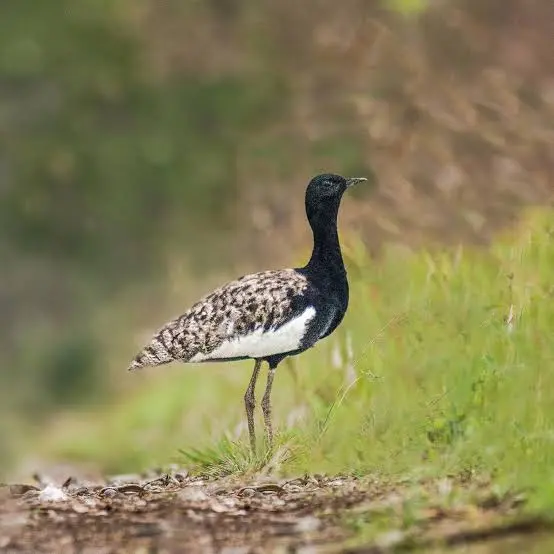
image credit: mongabayindia
Sarus crane the world’s tallest flying bird, standing at up to 1.8 metres, with a distinctive crimson head. Nepal’s Terai holds one of South Asia’s largest breeding populations. Koshi Tappu’s wetlands are a reliable sighting location, particularly in winter when resident pairs are joined by migrants.
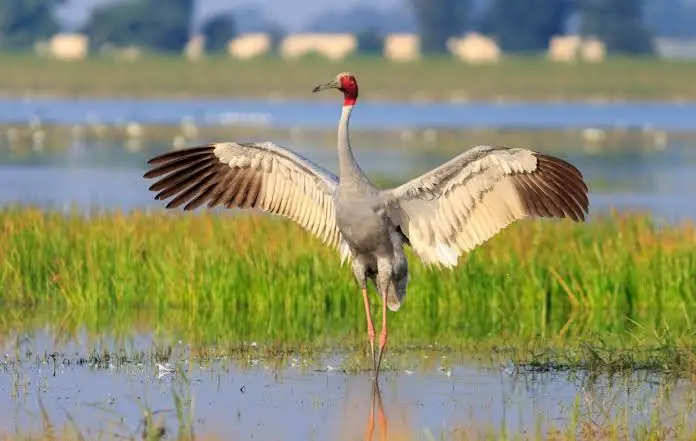
image credit: Wildlife Conservation Trust
Bar-headed geese among the world’s highest-flying birds, documented crossing the Himalayas at altitudes above 7,000 metres during migration from their breeding grounds on the Tibetan plateau. Koshi Tappu is a major wintering location, with flocks of hundreds or thousands arriving in October and departing in March.
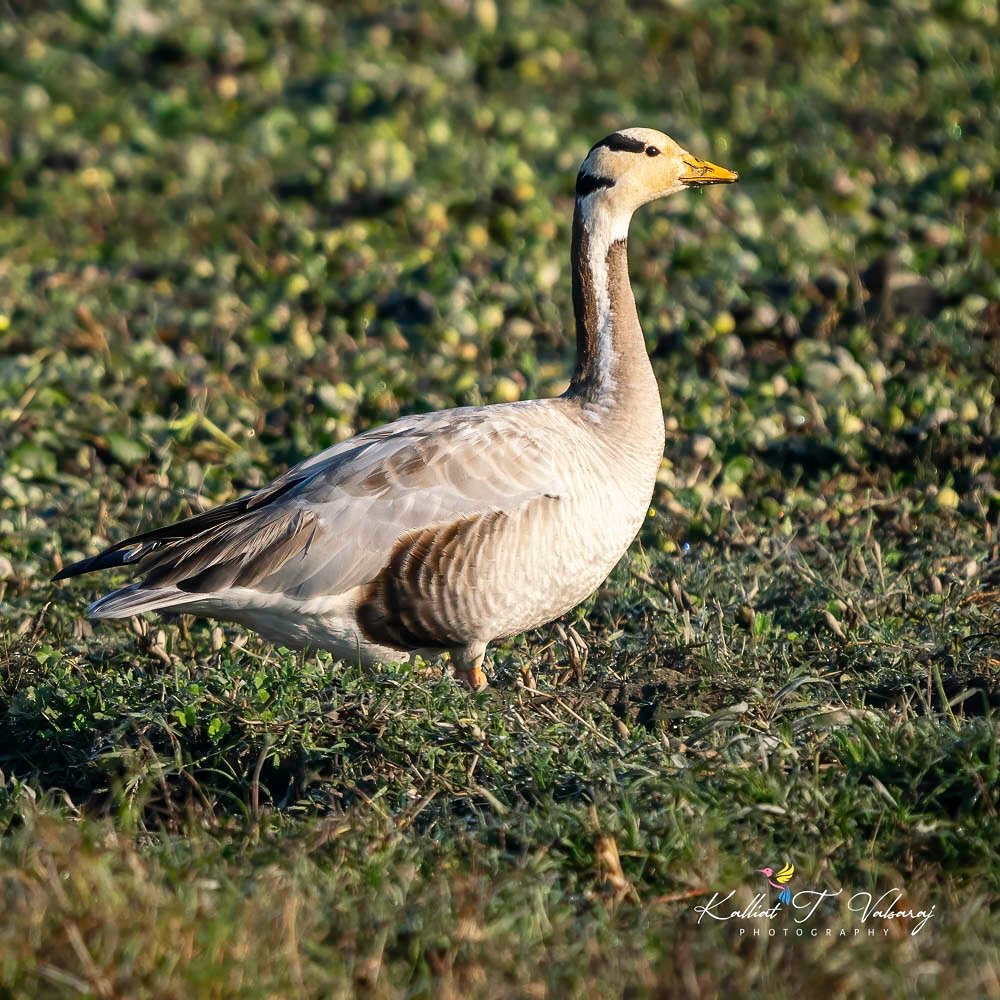
Image by: valsaraj.kt
Large adjutant stork globally endangered, with one of Nepal’s most significant populations at Koshi Tappu. A massive bird of striking ugliness, standing over 1.5 metres with a bare, wrinkled head. The large adjutant’s conservation status makes every sighting meaningful this is a bird that may not survive the century in many of its remaining strongholds.
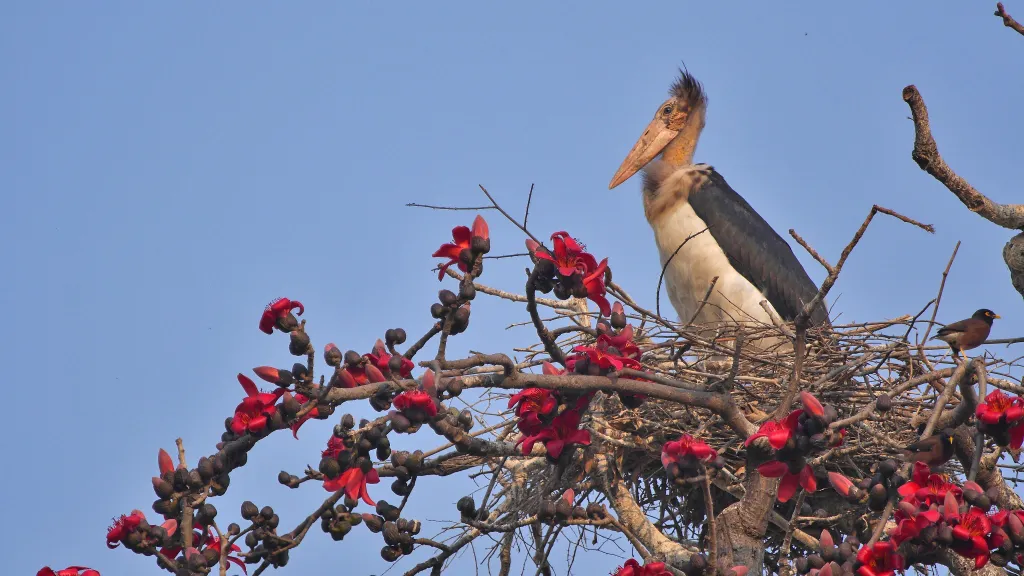
image by Mongabay
Duck diversity the reserve is home to more than 20 species of ducks, making it Nepal’s most important waterfowl site. Ferruginous duck, common goldeneye, Baer’s pochard, and the globally vulnerable lesser white-fronted goose all occur here in numbers unavailable anywhere else in Nepal.
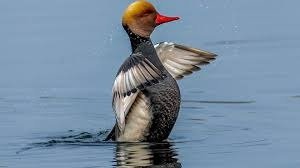
image credit kathamnadu post
Other notable species: Swamp partridge, black-necked stork, Pallas’s fish eagle, dusky eagle-owl, striated grassbird, watercock, Himalayan swiftlet, and numerous species of warblers, buntings, and raptors.
For dedicated birders: The reserve is best covered in combination boat safari on the Sapta Koshi for waterbirds and river species, jeep safari into the grassland interior for bustards, cranes, and terrestrial species, and a dawn walk along the river embankment for passerines and raptors.
The Other Mammals: What Else Shares the Reserve
Beyond the Arna and the dolphins, Koshi Tappu holds 31 recorded mammal species. Asian elephants visit the reserve a wild herd that ranges through the eastern Terai between Nepal and India, crossing the Koshi system at traditional ford points. Elephant sightings are possible but unpredictable, and the thrill of encountering a wild elephant on foot or from a jeep not a domesticated working elephant of the kind used for elephant-back safaris is different in kind from any managed wildlife experience.
Smooth-coated otters inhabit the river margins and are frequently seen in early morning from boats. Mugger crocodiles bask on sandbanks throughout the reserve more approachable and visible than the gharial, which is more reclusive. Spotted deer and hog deer move through the grassland and forest margins at dawn and dusk. Wild boar, blue bull (nilgai), and golden jackal complete the larger mammal list. Rock pythons inhabit the denser riverside vegetation.
The reserve also hosts one of Nepal’s last gaur populations the massive forest bison that is Asia’s largest bovid though numbers are extremely low and sightings rare.
Best Time to Visit: Season by Season
October–November (peak): Post-monsoon clarity, cool temperatures, resident wildlife active, first winter migrants arriving. The most comfortable months for extended activity. Bar-headed geese arrive in large flocks. Resident wildlife well-distributed through the grasslands. Best overall window.
December–February (winter): Coldest months night temperatures drop to 4°C with frost possible in January. Day temperatures pleasant at 15–23°C. Maximum bird diversity: Siberian migrants at their peak, resident species concentrated near water. The finest birdwatching months for sheer species count, but cold mornings and evenings require warm layers. This is when serious ornithologists come.
March–May (spring): Bengal florican display season. Temperatures rising to 25–35°C by May. Resident birds breeding, providing nesting behaviour observations. Still excellent birdwatching, though increasingly hot by late April. A good month for combining with springtime treks in the Khumbu or Annapurna region.
June–September (monsoon): The reserve floods significantly. Main access roads become difficult. Wildlife concentrated in higher ground areas. Not recommended for general wildlife tourism some specialist bird tours target monsoon breeders, but logistics are challenging. The Koshi Barrage’s flood management makes the reserve less prone to total inundation than other Terai wetlands, but expect limited access.
Getting There: Transport from Kathmandu
By Air (Recommended)
Kathmandu → Biratnagar: Domestic flight, approximately 45 minutes. Buddha Air and Yeti Airlines both operate daily services. Cost: NPR 8,000–12,000 one way (~USD 60–90). Book 2–3 weeks ahead in peak birdwatching season (October–February).
Biratnagar → Koshi Tappu: Private jeep transfer, approximately 1.5–2 hours. Your accommodation can arrange this in advance (USD 40–60 one way, shared between the vehicle). The road runs east from Biratnagar on the East-West Highway, then turns north toward the reserve. No public transport serves the reserve directly from Biratnagar arrange your transfer before you land.
By Road (Budget Option)
Kathmandu → Koshi Tappu: 7–9 hours by private vehicle or overnight bus to Itahari, then local transport to the reserve entrance. Cost: NPR 1,200–2,000 by overnight bus. Considerably less comfortable than flying but viable for budget travelers and those who want to see the Terai landscape in transition.
Journey note: The drive from Kathmandu east along the Araniko Highway and then onto the East-West Highway passes through the eastern hills and gradually descends into the Terai a landscape transition that is fascinating in its own right. The approach to Koshi Tappu from the west gives you your first view of the great river system long before you reach the reserve boundary.
Accommodation in and Around Koshi Tappu
Accommodation options are genuinely limited — which is both the honest warning and part of what makes Koshi Tappu special.
Koshi Tappu Wildlife Camp (the reserve’s primary upmarket option) operates tented safari accommodation on the reserve boundary AC safari tents with attached bathrooms, full board including all meals and guided activities. This is the camp that organises the standard 2-night/3-day wildlife programme including boat safari, jeep safari, birdwatching walks, and village visits. Cost: approximately USD 80–150 per person per night all-inclusive. Book well ahead for October–February.
Accommodations at Koshi Tappu are basic and mostly seasonal. There are only a couple of AC tented camps accommodating foreigners the limited infrastructure is intentional: the reserve’s buffer zone communities manage access and visitor numbers to prevent the over-tourism that has affected Chitwan.
A small number of guesthouses exist in the nearby market towns of Laukahi and Kusaha basic rooms, local food, and no wildlife programme organisation. These suit independent birders who want to arrange their own activities.
Practical note: Bring cash in NPR there are no functioning ATMs at the reserve. Withdraw in Biratnagar before your transfer.
Entry fee: NPR 1,000 per day for foreign nationals. NPR 500 for SAARC nationals. NPR 50 for Nepali citizens.
The Honest Case for Going
Koshi Tappu is not Chitwan. There are no guaranteed rhino sightings, no established jeep safari circuit with frequent wildlife encounters, no Lakeside restaurant for dinner. The accommodation is limited and basic. Getting here takes effort.
What Koshi Tappu offers instead is a wildlife experience that Chitwan precisely because it has been developed for tourism can no longer provide: genuine wildness in a landscape that is ecologically extraordinary and undervisited.
Over 500 of Nepal’s birds in 176 square kilometres. Dolphins in the river. The last wild water buffalo in Nepal. Bar-headed geese that have just crossed the Himalayas. A Bengal florican displaying in grassland where you may be the only observer.
For anyone who has exhausted what Chitwan offers and wants the next layer of Nepal’s extraordinary wildlife story come east. The dolphins are waiting.
The Explore All About Nepal team is based in Kathmandu. For specific birdwatching planning at Koshi Tappu, including which months target specific species, leave a question in the comments.
