
At 11:53am Nepal Standard Time on Wednesday, October 21, 2026, something extraordinary will happen in every corner of the country simultaneously.
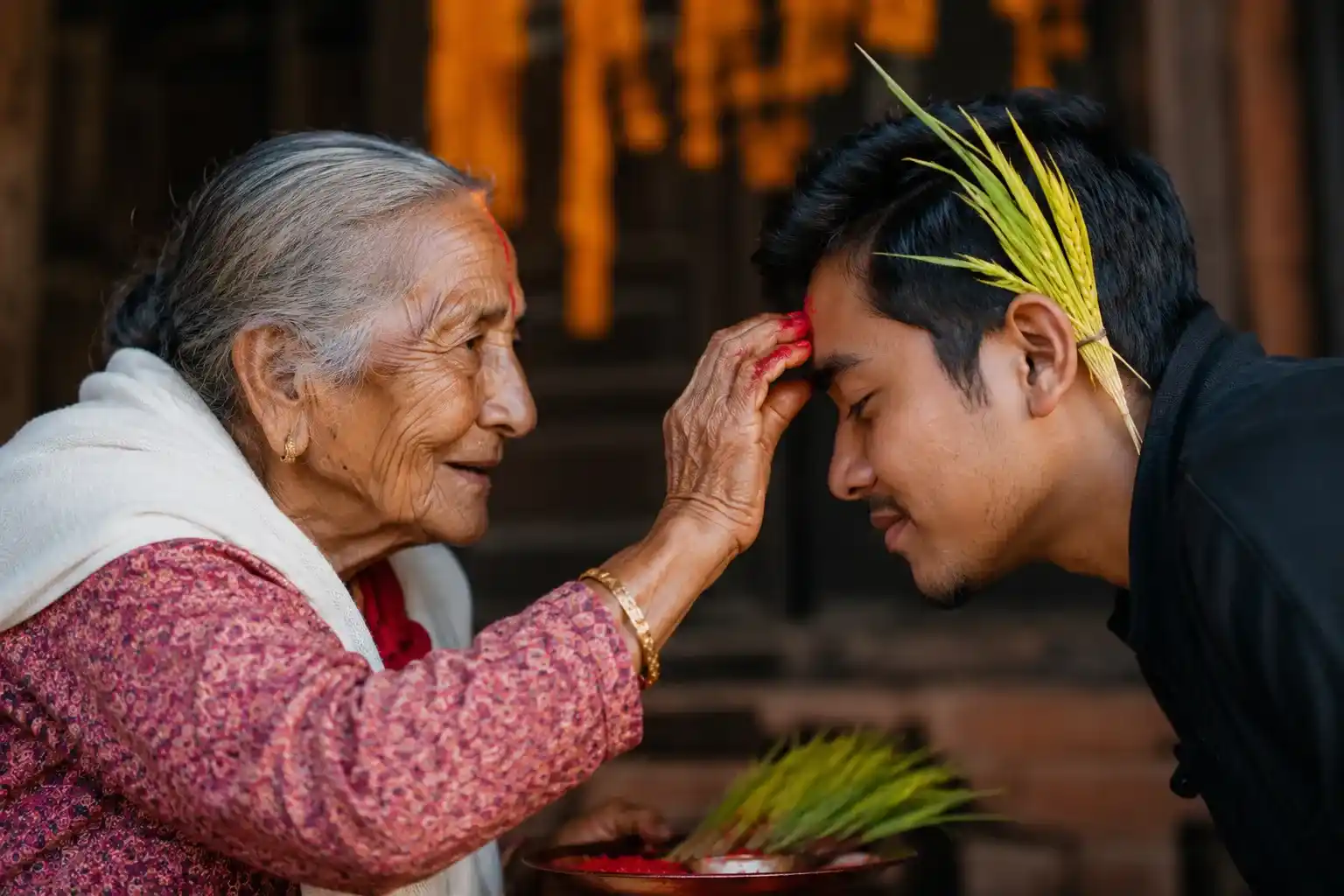
In a village in Solukhumbu, an 82-year-old grandmother will press her thumb into a mixture of red vermilion, rice, and yoghurt and mark the foreheads of her grandchildren one by one. In a courtyard in Patan, a family dressed in new clothes will move through four generations great-grandparents to toddlers in a ceremony that links every living person to the family’s dead. In Kathmandu’s Hanuman Dhoka, a river of people will queue for hours for the same blessing from the same kind of elder, wearing the same kind of new clothes, carrying the same pale yellow jamara seedlings behind their ears.
Dashain 2026
This is Vijaya Dashami. This is the day Nepal stops, turns inward, and does the most fundamentally Nepali thing it knows how to do: asks its elders for their blessing.
For foreign visitors, Dashain is simultaneously the most rewarding and the most logistically complex festival to visit Nepal during. This guide covers everything you need: all 15 days explained clearly, what to witness and where, the animal sacrifice context handled honestly, how to receive tika if a family offers it, what closes (a lot) and what that means for your itinerary, and the specific trekking logistics that catch unprepared visitors every year.
Dashain 2026: The Complete Date Calendar
Dashain 2026 runs from October 11 to October 25, with the most auspicious tika muhurat on Vijaya Dashami confirmed at 11:53 AM Nepal Standard Time on October 21, 2026, as determined by the Nepal Panchanga Nirnayak Samiti.
| Day | Name | 2026 Date | Key ritual |
|---|---|---|---|
| Day 1 | Ghatasthapana | Sunday, October 11 | Sacred pot installed, jamara seeds planted |
| Day 2 | Dwitiya / Fagupat | Monday, October 12 | First puja of Durga |
| Day 3 | Tritiya / Maha Panchami | Tuesday, October 13 | Second puja |
| Day 4 | Chaturthi / Maha Shashti | Wednesday, October 14 | Third puja |
| Day 5 | Panchami / Maha Saptami | Thursday, October 15 | Fourth puja Taleju Temple opens to Newar community |
| Day 6 | Shashthi / Maha Ashtami (first) | Friday, October 16 | Fifth puja evening processions begin |
| Day 7 | Fulpati | Saturday, October 17 | Royal flower procession, Hanuman Dhoka, Kathmandu |
| Day 8 | Maha Ashtami | Sunday, October 18 | Major animal sacrifice day Kal Ratri (dark night) |
| Day 9 | Maha Nawami | Monday, October 19 | Ayudha Puja vehicles blessed, Taleju opens to public |
| Day 10 | Vijaya Dashami (Tika Day) | Wednesday, October 21 | Main day tika ceremony, family reunions, 11:53am auspicious hour |
| Day 11 | Ekadashi | Thursday, October 22 | Tika continues visiting extended family |
| Day 12 | Dwadashi | Friday, October 23 | Tika continues |
| Day 13 | Trayodashi | Saturday, October 24 | Tika continues |
| Day 14 | Chaturdashi | Sunday, October 25 | Final tika day |
| Day 15 | Kojagrat Purnima | Sunday, October 25 | Full moon jamara released into rivers, festival ends |
Note: Days 11–15 overlap in the Nepali lunar calendar for 2026 the final Tika days and Kojagrat Purnima fall close together. Exact sub-dates should be confirmed locally.
Understanding Dashain: What It Actually Is
Before the days and rituals make sense, the story behind them needs telling.
Dashain celebrates the goddess Durga’s victory over the buffalo demon Mahishasura a demon so powerful that no individual god could defeat him, so all the deities pooled their strength into a single supreme force: Durga, riding a lion, ten-armed, carrying weapons lent by every god. The battle lasted nine days. On the tenth, Durga destroyed Mahishasura. Dashain’s 15 days re-enact this cosmic struggle, building from quiet preparation through nine days of worship toward the triumphant tenth day Vijaya Dashami, Victory Tenth when good has decisively won.
The festival also celebrates Lord Ram’s victory over the demon king Ravana, timed to the same lunar period making Dashain simultaneously a Shakti (goddess power) festival and a Rama-worship festival, layered meanings that reflect how Nepal’s Hinduism operates: capaciously, with room for multiple mythological truths simultaneously.
What this mythology produces, at the family and community level, is a festival centred on reunion, blessing, and renewal. Adult children travel home. Elders bless the young. New clothes are worn. Feasts are shared. The barley seedlings grown in darkness for nine days the jamara are placed behind ears as physical proof that the family’s prayers took root and grew. The red tika on the forehead marks a person as someone whose elder loves them enough to pray for them.
For foreign visitors, this is the most important thing to understand: Dashain is not a performance for external audiences. It is the most intimate ritual in Nepali life. You are witnessing something real.
The 15 Days: What Happens When
Days 1–6: The Quiet Preparation (October 11–16)
The first six days of Dashain are simultaneously the most overlooked and, in some ways, the most interesting for foreign visitors.
On Ghatasthapana (October 11), the puja room of every observing household is cleaned, a sacred Kalash (clay or metal pot filled with holy water and covered with cow dung) is installed at the centre of a sand altar, and barley, wheat, or corn seeds are sown around it. These seeds are watered daily for the nine days of Navaratri and kept in darkness the deliberate absence of sunlight turns the sprouting seedlings pale yellow. The pale yellow colour of jamara results from germination in the absence of sunlight, a deliberate cultivation process mirroring the spiritual incubation of divine energy during Navaratri.
During days two through six, a different aspect of Durga is worshipped daily. Schools close from day one. Families begin buying new clothes Dashain is Nepal’s single largest retail spending period of the year, and the markets in Kathmandu’s New Road and Asan Bazaar are extraordinary scenes of consumer intensity in the ten days before Vijaya Dashami. Goats and ducks appear in increasing numbers tethered outside households across the city.
What foreign visitors see: Kathmandu quieter than usual but with markets in full festive mode. Thamel relatively empty of tourists. Families shopping. Kites the great Dashain kite tradition beginning to appear above the rooflines. The sky above Kathmandu in the first week of Dashain is a different sky: dozens, then hundreds, then thousands of kites in every colour, string-fought between neighbouring households and neighbourhood gangs of children. This is your first unmistakable signal that Dashain has begun.
Day 7: Fulpati The Procession Day (October 17)
Fulpati is celebrated on October 17, 2026. Fulpati an assortment of flowers, leaves, banana stalks, sugarcane, and jamara are carried in a royal tradition from Gorkha and Nuwakot to Hanuman Dhoka Durbar in Kathmandu in a grand procession.
The word Fulpati means “sacred flower leaves.” The procession to Hanuman Dhoka is one of Dashain’s most visually spectacular moments a column of bearers in traditional dress carrying the sacred plants through the city streets to the old royal palace, accompanied by music and marking the moment the festival shifts from household to public scale.
Where to witness it: Arrive at Hanuman Dhoka, Kathmandu Durbar Square by mid-morning. The procession arrives in the late morning or early afternoon exact timing varies. Stand on the elevated viewing areas around the square for the best vantage point. The square fills quickly; arrive early.
From Fulpati, all government offices close and do not reopen until after Vijaya Dashami. This is the moment when Nepal administratively stops.
Day 8: Maha Ashtami The Night of Sacrifice (October 18)
This is the day that requires the most honest, contextual preparation for foreign visitors.
This day is devoted to Goddess Kali, the most fearful incarnation of Durga. The sacrifice of 54 buffalo and 54 goats is performed on this day in the yard of Kathmandu Durbar Square. The blood is offered to the gods, and the meat is taken home to be cooked for the feast. The blood of the sacrificed animals is considered pure and is believed to please the goddess, ensuring her protection for the year ahead.
Animal sacrifice during Dashain is not incidental. It is theologically central. The sacrifice is an offering the animal’s life given to sustain the goddess’s power and by extension the community’s wellbeing. It has been performed on this same day, in the same courtyards, for centuries. The meat is shared and eaten, never wasted.
The scale varies by location. At Kathmandu’s Hanuman Dhoka and Dashinkali Temple (12km south of Kathmandu), the sacrifices are large and public. At household level, a family may sacrifice a single goat or duck. The practice is declining somewhat in urban households but remains widespread and central to Dashain observance.
For foreign visitors: Attend or avoid according to your own values both are legitimate choices. If you attend, do so with genuine respect rather than the detached curiosity of a wildlife documentary viewer. This is not a spectacle arranged for observers. It is a religious ceremony that has been performed by the same families in the same temple courtyards for generations.
If you are not comfortable with this context, Maha Ashtami is a good day to be at Boudhanath Stupa or exploring a quieter neighbourhood. The city is electric but not tourist-oriented on this day.
The night of Maha Ashtami is called Kal Ratri the dark night. Temples are lit. Rituals continue. The atmosphere in the old city after midnight is unlike anything in Nepal’s ordinary calendar.
Day 9: Maha Nawami Vehicles, Tools and the Open Temple (October 19)
On Maha Navami, people worship their tools, vehicles, and machines. This is called Bishowkarma Puja. Cars, motorbikes, and even pens and books are decorated and blessed. In Kathmandu, the Taleju Temple opens only on this day, and many people go to visit it.
Maha Nawami is the day Nepal blesses everything that moves or cuts or writes or functions. Taxis, buses, construction machinery, military vehicles, army weaponry all decorated with marigolds and tikad, all offered puja for protection and safe operation in the coming year. The roads on Nawami morning are extraordinary: every parked vehicle in the country wearing flowers.
The Taleju Temple opening: The Taleju Bhawani temple inside Hanuman Dhoka normally closed to the public year-round opens on Maha Nawami for a single day of public access. The queue forms before dawn and extends for hours. If you want to enter, arrive at Kathmandu Durbar Square by 5:00–5:30am. The temple interior is small; you will spend the time inside briefly. The experience of standing in a space that is open to the public one day a year is something no other Nepal experience replicates.
Day 10: Vijaya Dashami The Heart of Everything (October 21)
The most auspicious Tika time for 2026: 11:53am Nepal Standard Time.
By dawn on Vijaya Dashami, the streets of Kathmandu are already busy. By 9:00am they are rivers of families dressed in new clothes, moving between houses, carrying plates of tika ingredients vermilion, rice, yoghurt and the pale yellow jamara that has been growing in darkness for nine days.
When an elder places tika on a younger family member’s forehead, they transmit a specific blessing long life, victory over obstacles, and continued prosperity. Every participant in the ceremony, both giver and receiver, re-enacts the mythological moment when the gods transferred their power to Durga to overcome what they could not defeat alone.
The tika itself is a physical object: red vermilion mixed with rice and yoghurt, applied to the centre of the forehead in a generous mark that can extend from the hairline toward the bridge of the nose. The jamara is tucked behind the ear. The blessing is spoken. The meal that follows is the year’s best.
For foreign visitors in Kathmandu on Vijaya Dashami: Walk the old city Asan Tole, Indra Chowk, Patan’s Durbar Square in the morning and watch families moving between houses. The city has a feeling on Tika Day that cannot be described adequately in words: collective joy made intimate, at scale. It is one of the finest days to be in Kathmandu that the calendar offers.
Days 11–14: The Tika Continues (October 22–25)
The tika ceremony does not end on Vijaya Dashami. For the following four days, extended family visiting continues — cousins, uncles, teachers, employers, community elders. Nepal is a country where social hierarchy is taken seriously, and Dashain provides the annual occasion to traverse that hierarchy in person. Government offices remain closed. The country is still festive, still in new clothes, still making these journeys.
Day 15: Kojagrat Purnima The Full Moon Ending (October 25)
Dashain ends on Kojagrat Purnima, a full moon day. On this final day, people stay awake and light oil lamps because they believe Goddess Laxmi visits those who are awake. The jamara that was planted on Ghatasthapana is released into rivers, officially marking the festival’s end.
The pale yellow seedlings that were the festival’s first ritual object become its last carried to a river, released into the water, their nine days of darkness ending in flow. Practical Nepal begins to resume: offices announce reopening dates, transport returns to normal schedules, Thamel fills again with trekkers.
Receiving Dashain Tika: A Practical Etiquette Guide
If you are in Nepal during Vijaya Dashami and a Nepali family, your hotel host, your guide, or a local acquaintance offers you Dashain Tika accept.
This is not always guaranteed. Some families reserve tika for blood relatives only. Others welcome foreign friends warmly. Your guide or hotel host is the most likely person to extend this invitation. If they do:
Before the tika:
- Wash your face and hands beforehand presenting yourself clean is respectful
- Wear clean, modest clothing this is a formal family occasion, not a casual moment
- If you are eating beforehand, keep it light the Dashain feast follows tika, and eating beforehand signals you don’t intend to join the meal
Receiving the tika:
- Stand or sit with your head slightly bowed do not hold your face stiffly upright
- Cup your hands together in front of you (anjali mudra) as the elder applies the tika
- Remain still and composed while the tika is applied and the blessing is spoken
- When complete, say “Dhanyabad” (thank you) with a slight bow
- Accept the jamara placed behind your ear do not remove it immediately
After the tika:
- Keep the tika on your forehead for the rest of the day removing it quickly communicates you found the ceremony inconvenient or unimportant
- Join the meal if invited refusing a Dashain feast is one of the most genuine forms of social rejection in Nepal
- Bring a small gift if you know the family sweets, fruit, or a modest cash gift in an envelope (NPR 500–1,000) is appropriate
Kathmandu vs Villages: Where to Be
In Kathmandu: The city offers the festival at its most spectacular and accessible scale. The Fulpati procession, the Maha Ashtami temple ceremonies, the Nawami vehicle puja, the Tika Day family movement all available within walking distance of most accommodation. The kite flying is spectacular from any rooftop. The markets before Dashain are extraordinary. The Taleju Temple opening on Nawami is unique.
The Kathmandu downside: The city empties significantly after Fulpati as residents travel home. Restaurants in local neighbourhoods close; only tourist-facing establishments stay open. Thamel becomes very quiet. If you are based in Kathmandu for the whole festival, you will have a quieter, less communal experience from Fulpati onward than in a village.
In a village: Dashain in a village a hill settlement, a Sherpa community in Solukhumbu, a Gurung or Tamang village in the Annapurna foothills is a different and arguably more profound experience. The scale is human rather than civic. The ceremonies are family rather than public. The meals are extended and multi-generational. The kite flying happens above terraced fields rather than rooftops. If your guide or trek operator has family in their home village and you are with them during Dashain, and if they invite you, go.
The Kite Flying Tradition: What It Means and When It Peaks
Dashain kite flying is not decoration. It is tradition with deep significance and precise timing.
The kites appear from Day 1 and peak around Day 8–10. By Tika Day, the sky above Kathmandu has hundreds of kites simultaneously string-fighting, diving, cutting each other’s lines in aerial battles between houses, neighbourhoods, and rooftops. Children and adults both participate. The kite string is often coated with ground glass (manja) to cut opposing strings a practice that has caused injuries serious enough to trigger annual safety warnings.
The significance: kites are flown to signal to the gods that Dashain prayers are ascending. The kite string is the visible line between earth and heaven during the festival period. The act of flying connects the person on the ground to the divine realm above.
For visitors: Ask your hotel host if you can access the roof on any clear afternoon from Day 6 onward. Watching kite battles from a Kathmandu rooftop during Dashain is one of the finest low-cost, low-effort festival experiences Nepal provides.
What Closes During Dashain: The Practical Reality
This is what catches most foreign visitors by surprise the sheer scale of what stops.
From Fulpati (October 17) through Vijaya Dashami (October 21) and beyond:
- All government offices: closed
- Banks: closed
- Most local shops, markets, and restaurants in non-tourist areas: closed
- Domestic bus services: severely reduced
- Domestic flights: still operating but fully booked months in advance
- Permit offices (Nepal Tourism Board, NTNC, Department of Immigration): closed
What stays open:
- Tourist restaurants and hotels in Thamel, Lakeside Pokhara, and tourist hubs
- Most trekking route teahouses (with reduced staff)
- Supermarkets and pharmacies in tourist areas (reduced hours)
- Emergency services
- Domestic airlines (fully booked do not try to book last minute)
Cash: ATMs can run short of cash in the days before Tika as people withdraw heavily. Withdraw a significant amount of NPR by October 15 at the latest. Carry more than you think you need. Government employees receive a Dashain bonus equivalent to one month’s salary the entire country is spending simultaneously.
Trekking During Dashain 2026: Everything You Need to Know
Autumn trekking season and Dashain overlap every year autumn is Nepal’s finest trekking weather, and Dashain falls squarely within it. Here is how to navigate both simultaneously.
Teahouses stay open. Major trekking routes including EBC, Annapurna Circuit, Annapurna Base Camp, Langtang, and Poon Hill maintain teahouse operations throughout Dashain. Some teahouses may have reduced staff as workers travel home, but food and accommodation remain available.
Guides and porters will request Tika Day off. This is entirely reasonable Vijaya Dashami is the most important day in the Nepali calendar, and a guide or porter who cannot be with their family for Tika Day has made a significant personal sacrifice. Build October 21 as a rest day into your trekking itinerary if you are on the trail during this period. Most good agencies factor this into Dashain-period bookings automatically. If yours has not, ask.
Permits before Fulpati. Government permit offices close from approximately October 17 and do not reopen until October 22 or 23 at the earliest. Obtain all permits Sagarmatha NP, ACAP, MCAP, restricted area permits before October 15. Do not arrive in Kathmandu on October 17 expecting to obtain permits that day.
Domestic flights: book 3–4 months ahead. The Lukla flight situation during Dashain is acute both before the festival (trekkers trying to start before the closures) and after (everyone restarting simultaneously). If your trek includes a Lukla flight in the October 17–25 window, you should have booked it in July at the latest. If you have not, check availability immediately and consider alternative trailheads.
The post-Dashain trekking rush. Every year, in the five to seven days after Dashain ends, trekking routes experience their single busiest week. EBC and Annapurna teahouses fill to capacity as everyone who delayed their trek until after the festival begins simultaneously. If your flexibility allows, start your trek on or around October 11–15 (before closures) or wait until October 28+ (after the rush clears). The period October 22–27 is beautiful weather but extremely crowded on popular routes.
The Greeting: What to Say
If you are in Nepal during Dashain and want to greet locals appropriately, two phrases cover everything you need:
“Shubh Dashain!” Happy/Auspicious Dashain (appropriate from Day 1 through Tika Day) “Dashainko Shubhakamana!” Dashain blessings/greetings (slightly more formal, used throughout)
Either phrase, offered with a slight bow and a smile, will be received warmly by any Nepali you meet during the festival. The response is almost always genuine delight that a foreign visitor knows the greeting.
The Explore All About Nepal team is in Kathmandu for Dashain every year. For specific questions about visiting Nepal during Dashain 2026 accommodation that stays open, trekking logistics, or how to find a family experience leave a question in the comments or contact us directly.
