
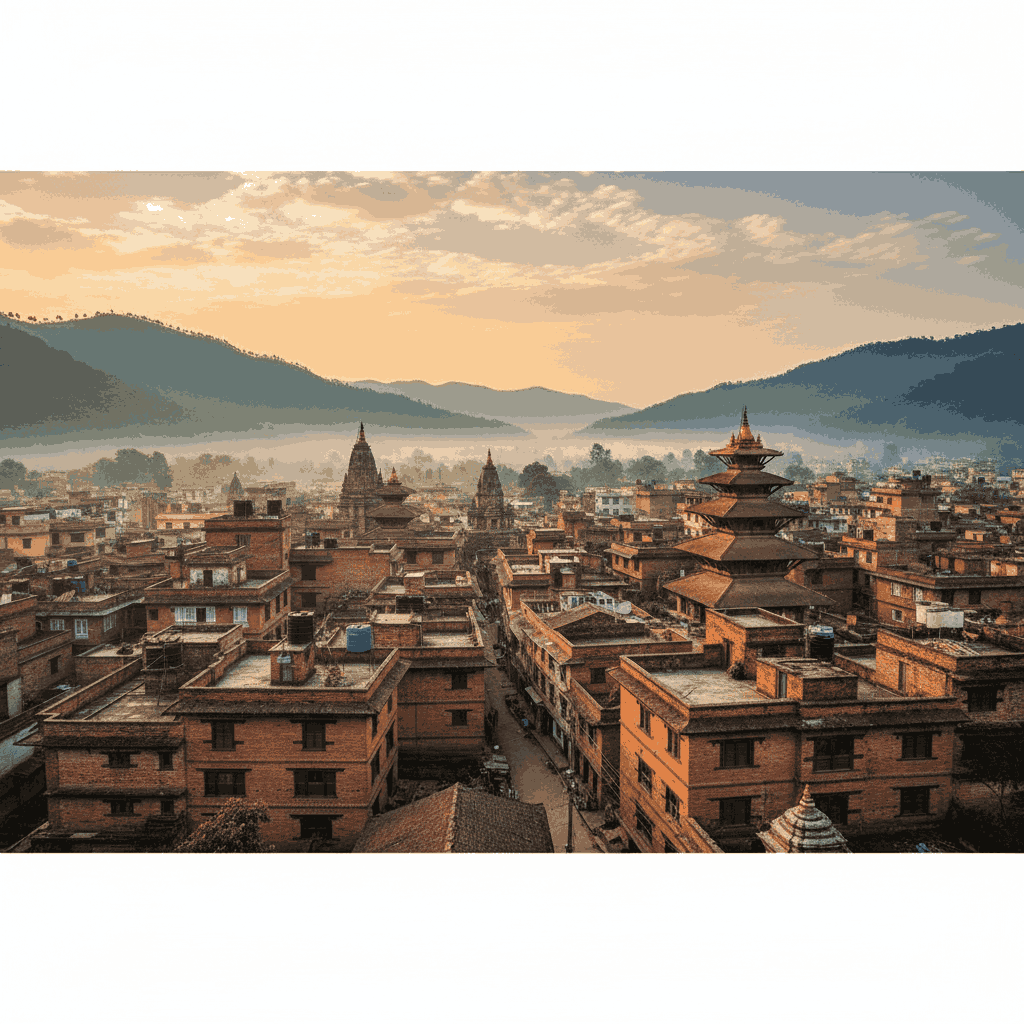
Sankhu heritage town showcasing medieval Newari architecture and ancient streets near Kathmandu
Located approximately $17$ kilometers northeast of Kathmandu, Sankhu heritage town stands as a testament to the endurance of Newari culture. In 2026, as the world moves toward sustainable and culturally immersive travel, Sankhu heritage town serves as a “living museum” that offers a raw, unfiltered look at medieval urban planning. Known historically as “Sankharapur” (The City of Shankha), the town’s layout was mythologically designed in the shape of a ritual conch shell, a sacred geometry that still dictates the flow of life today.
A visit to Sankhu heritage town is a journey into the ancient trade routes that once connected the Kathmandu Valley to the high plateaus of Tibet. While many tourists remain within the city limits to explore the jazz festivals and live music in Kathmandu, the seasoned traveler knows that the true soul of the valley lies in the red-brick alleys and tantric temples of Sankhu heritage town. Here, the rhythmic chants of the Swasthani and the aroma of authentic Khuwa provide a sensory experience that is both ancient and deeply moving.
Chapter 1: The Mythological Genesis of the Conch City
The history of Sankhu heritage town is inextricably linked to the goddess Bajrayogini. To understand the town’s identity in 2026, one must delve into the legends that predate the Licchavi dynasty.
The Legend of Shankharapur
According to the Swayambhu Purana, the valley where Sankhu heritage town sits was once a vast lake. It was the goddess Bajrayogini who cleaving the mountains with her divine sword, drained the waters and instructed King Sankhadev to build a city. She commanded that the city be built in the shape of a Shankha (Conch), symbolizing purity and the call to prayer. Today, the curving streets and narrow pathways of Sankhu heritage town still follow this spiral logic, making it one of the most unique urban designs in the UNESCO World Heritage Tentative List.
The Tibet Trade Route Legacy
During the Malla period, Sankhu heritage town became a flourishing commercial hub. It was the last major settlement before merchants crossed the rugged Himalayan passes toward Lhasa. This strategic position allowed the residents of Sankhu heritage town to accumulate immense wealth, which they poured into the construction of elaborate temples, rest houses (Sattals), and private residences featuring the iconic Ankhi-Jhyal (carved wooden windows). This historical prosperity is still visible in the intricate woodcarvings that adorn the buildings of Sankhu heritage town in 2026.
Chapter 2: The Five Sacred Gates: Ritual Boundaries
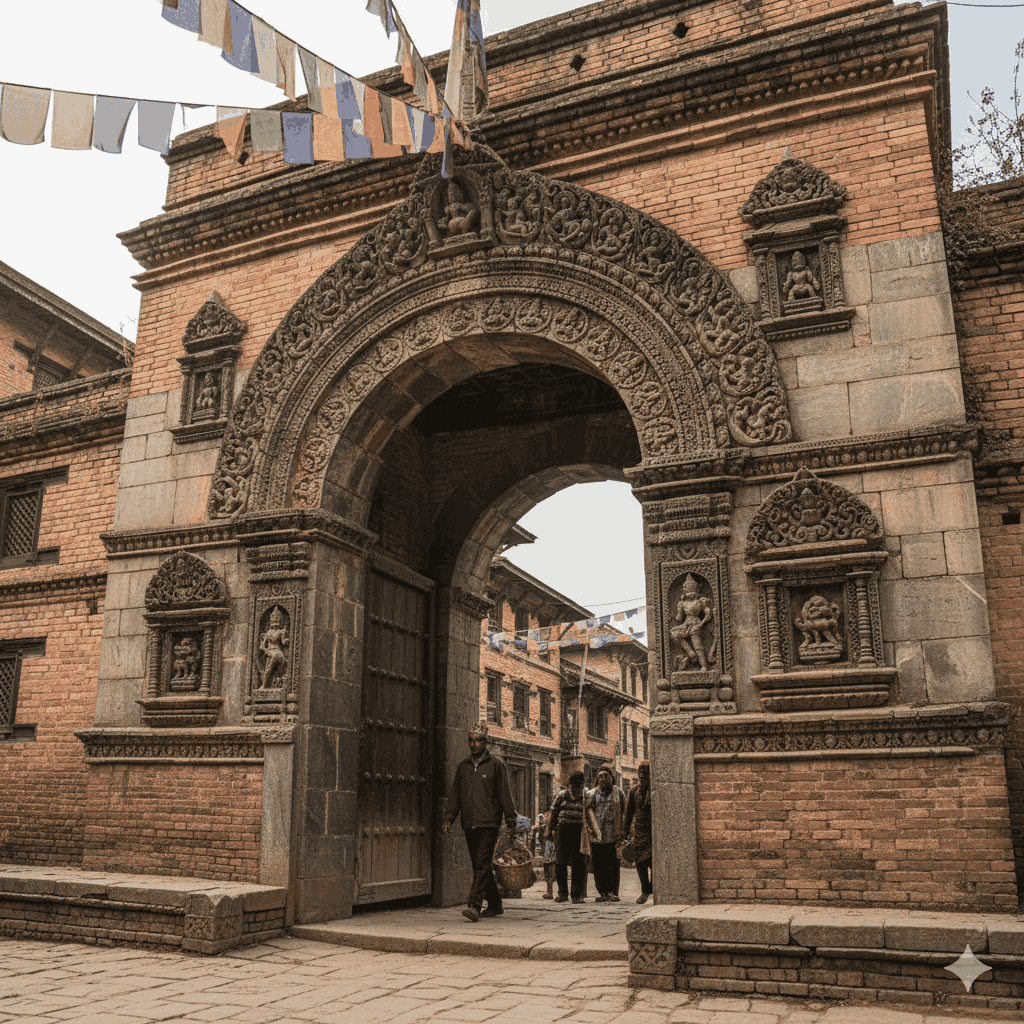
One of the sacred gates of Sankhu heritage town representing traditional Newari ritual boundaries
Sankhu heritage town is defined by its five historic gates. These are not merely physical entrances but ritual portals that govern the life cycle of the Newar community. In 2026, these gates have been meticulously restored to their former glory, standing as sentinels of the town’s heritage.
Bhau Dhwakha (The Bride Gate): This is the main ceremonial entrance for new brides entering Sankhu heritage town. It represents the welcoming of new life and the expansion of the community.
Mhyamachaa Dhwakha (The Daughter Gate): Located on the opposite side, this gate is used when a daughter is married off. It is a place of bittersweet farewells, marking her transition to a new family outside Sankhu heritage town.
Dya Dhwakha (The God Gate): This gate is reserved for the gods. During the annual Jatra (festival), the chariot of the goddess passes through this portal, blessing the entire settlement.
Si Dhwakha (The Death Gate): A somber but essential part of the town’s layout, this gate is used exclusively for funeral processions. It leads directly to the cremation grounds by the river, symbolizing the final journey out of Sankhu heritage town.
Naari Dhwakha: Historically used for agricultural and daily movement, this gate connects the residents of Sankhu heritage town to the fertile fields that have sustained them for generations.
Chapter 3: Architectural Marvels: The Bajrayogini Temple Complex

Bajrayogini Temple overlooking Sankhu heritage town, a sacred spiritual site in Kathmandu Valley
No visit to Sankhu heritage town is complete without ascending the stone steps to the Bajrayogini temple. Located about $1.5$ km north of the town center, this complex is the spiritual heart of the region.
The Tantric Heart of the Valley
The main temple is a three-story pagoda, rebuilt in its current form in the 17th century by King Pratap Malla. It is a rare site where both Hindus and Buddhists worship the same deity. For Buddhists, she is one of the four key Yoginis of the Kathmandu Valley; for Hindus, she is a powerful manifestation of Parvati. In 2026, the temple continues to be a center for tantric practice, where secret rituals are performed to maintain the balance of the universe.
The Eternal Flame and the Caves
Inside the complex of Sankhu heritage town, visitors can witness the “eternal flame,” which has supposedly burned since the time of the world’s creation. Surrounding the temple are nine meditation caves. These caves were used by great masters, including the Tibetan yogi Marpa Lotsawa, who is said to have gained significant insights while meditating in the hills overlooking Sankhu heritage town. The silence of these caves provides a stark contrast to the bustling energy of the bazaar below.
Chapter 4: The Salinadi Rituals and the Swasthani Mela
Every year during the month of Magh (January/February), Sankhu heritage town becomes the most important pilgrimage site in Nepal.
The Month-Long Fasting
Thousands of devotees gather at the banks of the Salinadi River in Sankhu heritage town to observe the Swasthani Vrata. For $31$ days, pilgrims read the stories of Goddess Swasthani and Lord Madhav Narayan. The river itself is considered holy, and a dip in its waters is believed to wash away the sins of a lifetime. In 2026, the infrastructure around the river has been improved to accommodate the growing number of international spiritual seekers who come to witness this display of faith in Sankhu heritage town.
The Madhav Narayan Procession
During the festival, a group of dedicated fasters travels from Sankhu heritage town to other holy sites like Pashupatinath and Changunarayan, walking barefoot as an act of penance. Their return to Sankhu heritage town is marked by a massive celebration, where the entire community comes together to offer food and prayers. This ritual highlights the communal spirit that has kept Sankhu heritage town alive for centuries.
Chapter 5: 2026 Travel Logistics and Sustainability
Reaching Sankhu heritage town is easier than ever in 2026, but it requires mindful planning to ensure the preservation of its delicate heritage.
Transportation: Regular buses depart from the Ratna Park bus station in Kathmandu. The journey takes about an hour, passing through scenic outskirts and traditional farming villages.
Heritage Homestays: In 2026, many families in Sankhu heritage town have opened their traditional homes as boutique guesthouses. This allows travelers to experience authentic Newari life while directly contributing to the local economy.
Financial Planning: While the town is becoming more modern, it is always wise to carry local currency. For tips on managing finances in more remote areas, see our guide on ATMs in the mountains of Nepal.
Frequently Asked Questions (FAQs)
Q1: What is the best time of year to visit Sankhu heritage town?
A: The best time is during the Swasthani Mela (Jan/Feb) for spiritual energy or during the Bajrayogini Jatra (April) for colorful local festivities.
Q2: Is there an entrance fee for the town?
A: Currently, there is no formal entrance fee for Sankhu heritage town, though individual temples may request a small donation for maintenance and local cleaning initiatives.
Q3: Can I hike from Sankhu heritage town to other places?
A: Yes! Sankhu heritage town is a prime starting point for the “Heritage Trail” that leads to Nagarkot or the ancient Changu Narayan temple.
Q4: Is the food safe for international travelers?
A: Most heritage kitchens in Sankhu heritage town adhere to high standards of hygiene. Be sure to try the local Khuwa (thickened milk), which is the town’s most famous culinary export.
Q5: How has the town changed since the 2015 earthquake?
A: Sankhu heritage town was heavily impacted, but by 2026, the reconstruction is nearly complete. The town has used this opportunity to reinforce traditional building techniques with modern safety standards.
Sankhu heritage town is more than just a cluster of old buildings; it is a living, breathing organism of faith and history. It is a place where the goddess still walks the streets, where the five gates still protect the souls of the residents, and where the ancient trade routes still whisper stories of gold and salt. In 2026, as Nepal continues to modernize, Sankhu heritage town remains a vital anchor to the past,a reminder that some things, like the sound of a conch shell at dawn, are truly eternal.
