

Role of Monasteries and Lamas During Losar Celebrations in Nepal,Monks perform Cham dances outside a Himalayan monastery during Losar, with prayer flags and snow-covered peaks in the background.
The jagged peaks of the Himalayas don’t just host snow; they are the spiritual guardians of a culture that thrives on ancient wisdom. As the Tibetan New Year approaches, the Role of Monasteries and Lamas During Losar Celebrations in Nepal becomes the central pillar of the festivities. While families are busy with the physical act of house cleaning, the spiritual heavy lifting happens within the crimson walls of the Gompas (monasteries) scattered across the Solukhumbu, Mustang, and the Kathmandu Valley.
From the resonant blast of the long horns (dungchen) to the intricate rituals performed by high-ranking monks, the transition from domestic preparation to collective monastery prayers marks a profound shift in the Himalayan consciousness. In this comprehensive guide, we dive deep into how these sacred institutions and their guides steer the community toward a virtuous and auspicious new year.
The Gompa as the Spiritual Compass
In high-altitude regions and the bustling outskirts of Boudhanath, the monastery is more than a building,it is the heartbeat of the community. The Role of Monasteries and Lamas During Losar Celebrations in Nepal begins weeks before the actual New Year. Lamas act as cosmic navigators, consulting the Tibetan lunar calendar and astrological charts to determine the exact auspicious moments for each ritual.
While the community focuses on the outer house cleaning, the Lamas perform an “inner cleaning” of the spiritual environment. They chant specific protective sutras designed to pacify local spirits and ensure that the transition into the new year is free from obstacles. This spiritual gatekeeping is perhaps the most vital Role of Monasteries and Lamas During Losar Celebrations in Nepal.
Gutor: The Ritual of Banishing Negativity
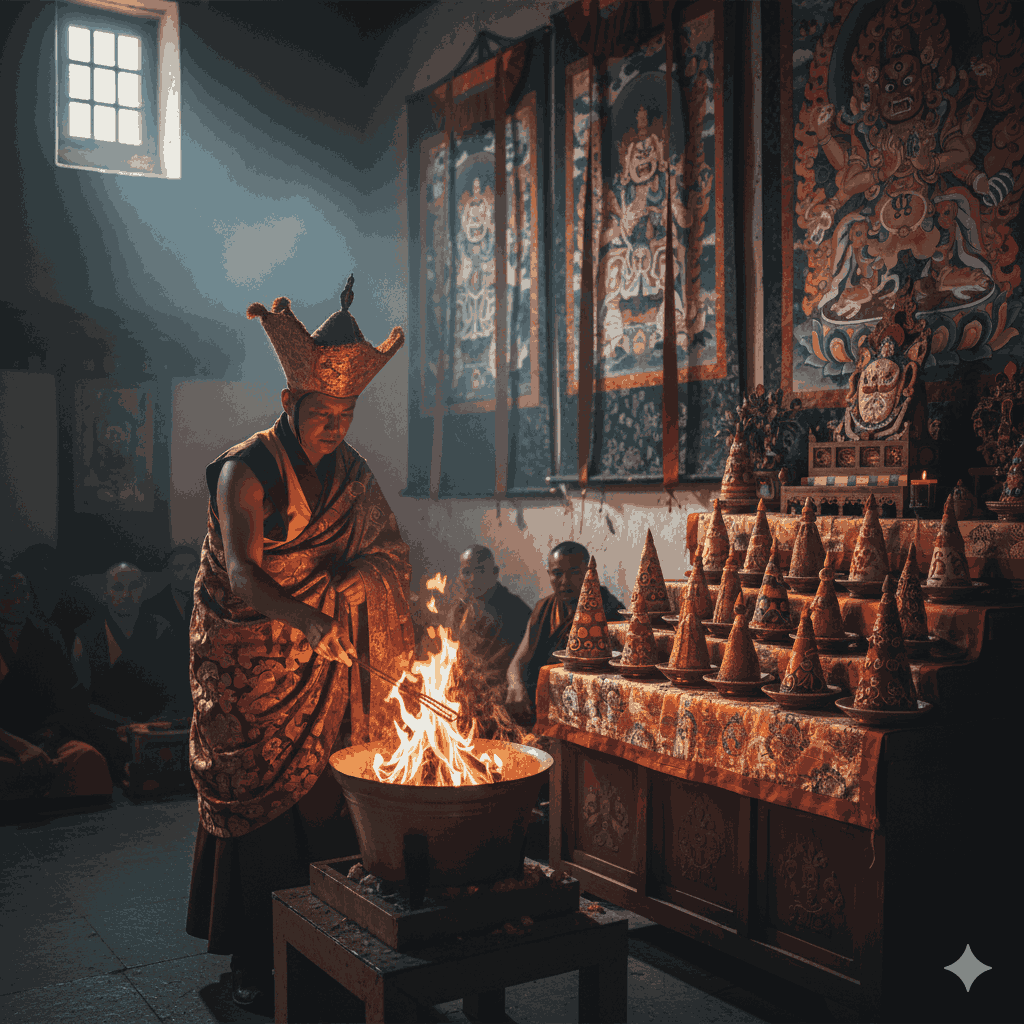
Role of Monasteries and Lamas During Losar Celebrations in Nepal ,Lama performing Gutor ritual to banish negativity, surrounded by offerings and sacred art inside a monastery.
During Gutor, Lamas perform elaborate “wrathful” rituals to expel the negativity of the past year. They construct a Torma,a ritual cake made of flour and butter,which acts as a “scapegoat” for the community’s collective bad karma. At the climax of the ritual, the Torma is carried out of the monastery and burned at a crossroads, symbolizing the total destruction of evil forces. This ritual highlights the indispensable Role of Monasteries and Lamas During Losar Celebrations in Nepal in purging the old to make way for the new.
The Power of Lama Losar (Day One)
The very first day of the festival is not dedicated to the self or the family, but to the teacher. Known as Lama Losar, this day underscores the hierarchy of spiritual life and the essential
Devotees flock to the Gompas to participate in the first monastery prayers of the year. Here, the Role of Monasteries and Lamas During Losar Celebrations in Nepal is to provide a “transmission of blessings.” By offering a Khata (ceremonial white scarf) to a Lama, a practitioner acknowledges the importance of the lineage and receives a blessing string (sung-wa) that is believed to protect them throughout the coming twelve months.
Sacred Cham Dances: Moving Meditations
Perhaps the most visually stunning Role of Monasteries and Lamas During Losar Celebrations in Nepal is the performance of the Cham dances. These are not merely folk dances; they are profound religious rites performed by monks who have undergone weeks of intensive meditation and rehearsal.
Masked Deities: Monks wear fearsome masks representing wrathful protectors like Mahakala or the legendary Padmasambhava (Guru Rinpoche).
Symbolic Victory: The rhythmic, hypnotic movements are designed to “trample” on the human ego and the “demons” of ignorance, attachment, and aversion.
Community Merit: By simply watching these dances, laypeople are said to receive spiritual merit. This bridges the gap between the high philosophy of the Lamas and the everyday lives of the villagers.
For those interested in the cultural nuances of these mountain regions, understanding the traditional attire of the Sherpa and Gurung people provides context to the diverse crowds that gather for these monastery events.
Leading the Chotrul Duchen (The Festival of Miracles)
The Role of Monasteries and Lamas During Losar Celebrations in Nepal extends well past the first few days of the New Year. it culminates on the 15th day, known as Chotrul Duchen.
During this time, monasteries display massive, intricate sculptures made entirely of colored yak butter. These “Butter Lamps” are carved with painstaking detail by monks. The Lamas lead the community in extensive monastery prayers to commemorate the miracles performed by the Buddha. The melting of these butter sculptures under the moonlight serves as a powerful lesson on impermanence,a core teaching of the very Lamas who created them.
The Monastery as a Social Safety Net
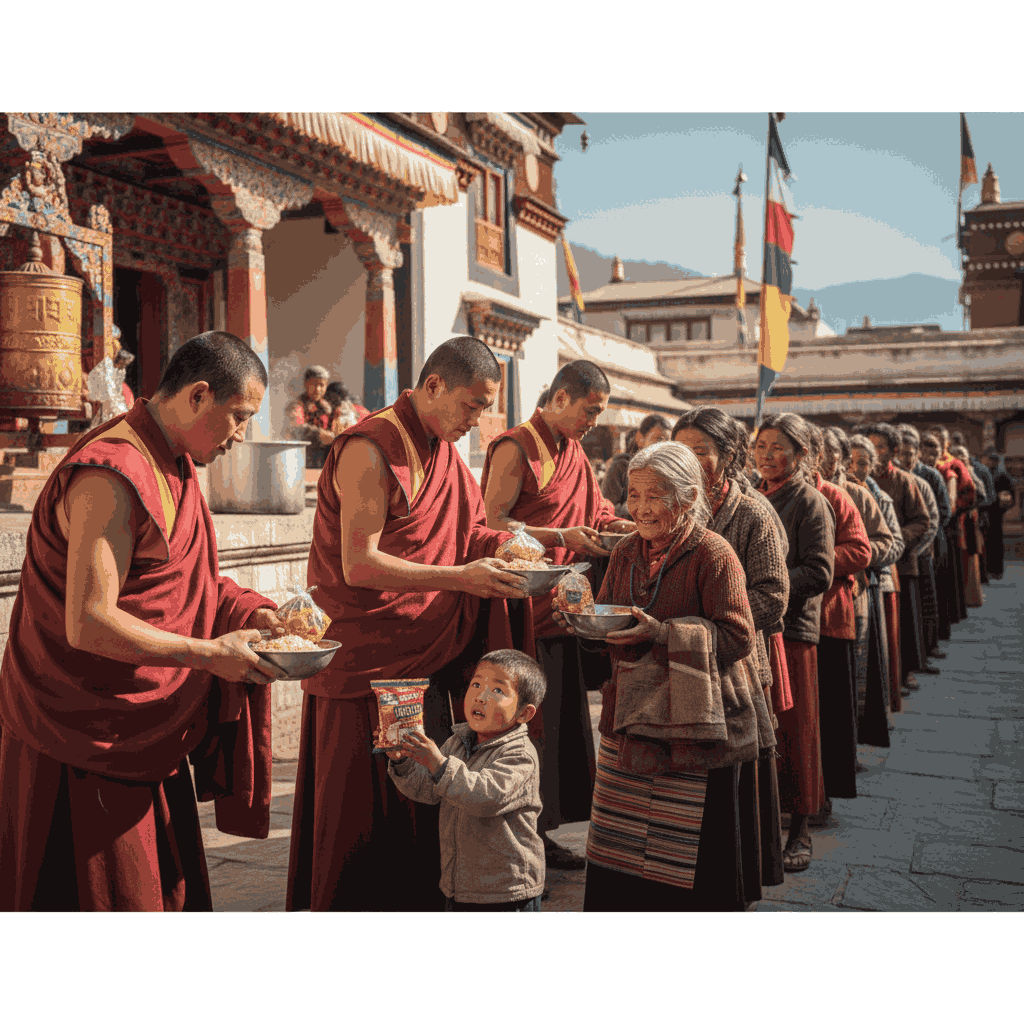
Role of Monasteries and Lamas During Losar Celebrations in Nepal — Monks giving charity and food to community members, embodying spiritual compassion during Losar.
Beyond the metaphysical, the Role of Monasteries and Lamas During Losar Celebrations in Nepal has a very practical side. During Losar, the monastery often serves as a communal kitchen and a place of refuge.
Lamas organize the distribution of food and charity (Dana) to the less fortunate members of the community. This ensures that the “abundance” celebrated during Losar isn’t just for the wealthy but is shared by all. In this way, the monastery prayers are backed by direct, compassionate action, embodying the true spiri
t of the Dharma. This is particularly evident during festivals like Mani Rimdu in the Everest region.
Spiritual Guidance for the Domestic Rituals
Interestingly, the Role of Monasteries and Lamas During Losar Celebrations in Nepal even touches the domestic sphere. Many families will visit their local Lama to ask for specific instructions on how to set up their home altar or which auspicious symbols to paint during their house cleaning.
The Lamas might suggest specific deities to focus on or provide “blessed pills” and incense to be used during the home purification rites. This synergy between the monastery and the home is what makes the Role of Monasteries and Lamas During Losar Celebrations in Nepal so deeply integrated into the local way of life.
Raising the Wind Horse: Lung-Ta Flags

Role of Monasteries and Lamas During Losar Celebrations in Nepal — Monks raising prayer flags to invoke blessings and prosperity during Losar in Nepal
A major Role of Monasteries and Lamas During Losar Celebrations in Nepal involves the consecration of new prayer flags. Known as Lung-Ta or Wind Horse, these flags are hung on the third day of Losar.
The Lamas lead ceremonies to “raise the wind horse,” a ritual intended to boost the vitality and good fortune of the community. As the monks recite the monastery prayers, the flags are unfurled, sending prayers for peace and prosperity out into the world on the wings of the wind. This is a quintessential part of the Role of Monasteries and Lamas During Losar Celebrations in Nepal.
Preservation of Himalayan Identity
Finally, the most enduring Role of Monasteries and Lamas During Losar Celebrations in Nepal is the preservation of ethnic identity. In a rapidly modernizing world, the monasteries serve as repositories of language, art, and history.
By hosting the Losar festivities, the Lamas ensure that the younger generation learns the traditional chants, the significance of the 12-year animal cycle, and the importance of communal harmony. Without the active Role of Monasteries and Lamas During Losar Celebrations in Nepal, the rich tapestry of Himalayan culture might fray over time.
Frequently Asked Questions (FAQs)
1. Why is the role of the Lama so important during Losar?
In Tibetan Buddhism, the Lama is the bridge between the practitioner and the Buddha. During Losar, they are responsible for ensuring the community starts the year with a clean spiritual slate through rituals and monastery prayers.
2. Can foreigners witness these monastery rituals in Nepal?
Yes! Most monasteries in areas like Boudha, Swayambhu, and Kopan welcome visitors. However, it is essential to respect the silence during monastery prayers and follow local etiquette, such as walking clockwise around stupas.
3. What is the difference between house cleaning and monastery purification?
House cleaning is the physical removal of dirt from the home. Monastery purification, a key Role of Monasteries and Lamas During Losar Celebrations in Nepal, is a metaphysical process using chants and fire rituals to remove spiritual obstacles for the entire community.
4. What are ‘Tormas’ and why do monks make them?
Tormas are ritual offerings made of barley flour and butter. The Role of Monasteries and Lamas During Losar Celebrations in Nepal involves creating these as offerings to deities or as “scapegoats” to carry away the year’s misfortunes.
5. How long do the monastery prayers last?
While public ceremonies may last a few hours, the monks often perform monastery prayers and chants in shifts that can last from pre-dawn until late at night for several days during the 15-day Losar period.
The Role of Monasteries and Lamas During Losar Celebrations in Nepal is what transforms a simple New Year party into a profound spiritual experience. By guiding the community from the initial house cleaning to the final, transcendent monastery prayers, the Lamas ensure that the tradition remains vibrant and meaningful.
The monastery stands as a lighthouse of wisdom, reminding us that while we must clean our homes, we must also clean our hearts. As the prayer flags snap in the cold Himalayan wind, we are reminded of the resilience and depth of a culture that honors its spiritual guides as much as its ancient peaks. The Role of Monasteries and Lamas During Losar Celebrations in Nepal remains the invisible thread that binds the past to the future.
