Nepal is famous around the world for Mount Everest, the Himalayas, ancient temples, and breathtaking trekking routes. However, there is another side of Nepal that many travelers are only beginning to discover its extraordinary night skies. From remote mountain valleys and alpine lakes to high-altitude deserts and protected national parks, Nepal offers some of the most spectacular stargazing opportunities in Asia. For travelers searching for the best Places to See the Milky Way in Nepal, the country provides a remarkable combination of dark skies, high elevations, and stunning natural landscapes.
The Milky Way is visible from many parts of Nepal during the right seasons, particularly in areas with minimal light pollution. Unlike heavily urbanized destinations where artificial lights can obscure the stars, many regions of Nepal remain naturally dark after sunset. This creates ideal conditions for observing the Milky Way, constellations, meteor showers, and countless stars stretching across the Himalayan sky.
In recent years, astrophotography and dark-sky tourism have become increasingly popular. Travelers are now planning trekking adventures specifically to photograph the Milky Way above iconic landscapes such as Everest, Annapurna, Rara Lake, and Upper Mustang. Professional photographers and amateur stargazers alike are drawn to Nepal because few countries combine dramatic mountain scenery with such accessible dark-sky locations.
Weather also plays a major role in visibility. During clear nights in spring, autumn, and parts of winter, the skies above Nepal can be exceptionally transparent. High-altitude locations often sit above clouds and atmospheric pollution, creating conditions that are ideal for observing celestial objects.
Beyond photography, stargazing offers a unique way to experience Nepal’s natural beauty. Sitting beneath a sky filled with thousands of stars while surrounded by the Himalayas can be one of the most memorable travel experiences imaginable. Whether you are an experienced astrophotographer or simply someone who enjoys looking at the night sky, Nepal has destinations suitable for every level of interest.
This guide explores the best Places to See the Milky Way in Nepal, the ideal seasons for viewing, photography tips, and the most impressive dark-sky destinations across the country.
Why Nepal Is Perfect for Milky Way Viewing
Nepal has become one of South Asia’s most underrated destinations for stargazing and astrophotography. Several natural advantages make the country exceptionally well-suited for observing the Milky Way and other celestial phenomena.
One of the biggest advantages is altitude. Much of Nepal’s most spectacular scenery lies at elevations above 2,000 meters, with many trekking destinations reaching 3,000 to 5,000 meters or more. At higher elevations, the atmosphere is thinner and often clearer, reducing haze and improving visibility. This allows stargazers to see more detail in the night sky than would be possible in many lowland locations.
Another major factor is low light pollution. While Kathmandu and a few major cities generate artificial light, vast areas of Nepal remain remarkably dark after sunset. Remote mountain regions, national parks, and isolated villages experience minimal light interference, making them ideal for Milky Way observation.
Places to See the Milky Way in Nepal
The Himalayan landscape also creates extraordinary foregrounds for photography. Snow-covered peaks, alpine lakes, monasteries, forests, and rugged mountain ridges add dramatic visual elements that make Nepal particularly attractive to astrophotographers. Images of the Milky Way rising above the Himalayas are among the most sought-after travel photographs in the world.
Climate conditions also contribute to excellent viewing opportunities. Nepal experiences distinct seasons, and during clear periods in spring and autumn, visibility can be outstanding. After the monsoon season, dust and pollution levels often decrease, resulting in exceptionally transparent skies.
Accessibility is another advantage. Unlike some remote dark-sky destinations elsewhere in the world, many of Nepal’s best stargazing locations are accessible through established trekking routes and tourism infrastructure. Travelers can combine hiking, cultural experiences, and astronomy within a single journey.
The growing interest in astrophotography has also encouraged local tourism operators to promote dark-sky experiences. Some trekking agencies now offer specialized photography trips focused on capturing the Milky Way and Himalayan landscapes.
These factors collectively make Nepal one of Asia’s premier destinations for night-sky enthusiasts. Whether viewing from a remote national park or a famous trekking route, visitors can experience some of the clearest and most inspiring night skies on Earth.
Best Time to See the Milky Way in Nepal
Timing is one of the most important factors when planning a stargazing adventure. Even the best Places to See the Milky Way in Nepal require favorable weather, dark skies, and the right seasonal conditions to provide optimal viewing experiences.
In Nepal, the Milky Way is generally visible between March and October, although visibility varies depending on location, weather patterns, and moon phases. During these months, the galactic core becomes visible in the night sky and can often be observed with the naked eye from dark locations.
Spring, particularly March through May, is one of the best seasons for Milky Way photography. Temperatures are relatively comfortable, skies are often stable, and many trekking routes remain accessible. Higher-altitude destinations also offer excellent atmospheric clarity during this period.
Autumn, from late September through November, is widely considered the prime season for both trekking and stargazing. Following the monsoon rains, dust particles are washed from the atmosphere, resulting in exceptionally clear skies. Mountain views are often at their best, and visibility of celestial objects can be outstanding.
Moon phases play a crucial role in Milky Way observation. New moon periods provide the darkest skies and the best conditions for seeing faint celestial features. Full moon nights, while beautiful for mountain scenery, can significantly reduce Milky Way visibility.
Weather forecasting is another important consideration. Cloud cover can obscure the night sky regardless of season. Checking local forecasts before traveling improves the chances of successful stargazing sessions.
Winter also offers opportunities in some regions, particularly in western Nepal where skies can remain clear for extended periods. However, colder temperatures and snow conditions may limit access to certain locations.
The ideal viewing window generally occurs between midnight and early morning hours, when the Milky Way core appears highest in the sky. Photographers often plan their sessions carefully around moonrise, moonset, and astronomical twilight.
Understanding seasonal patterns and lunar cycles can significantly enhance the experience. By choosing the right time of year and visiting during dark-sky conditions, travelers can maximize their chances of witnessing the spectacular beauty of the Milky Way above Nepal’s extraordinary landscapes.
Sagarmatha National Park – Everest Region Night Skies
One of the most iconic Places to See the Milky Way in Nepal is the Everest region, officially protected under Sagarmatha National Park. Known globally for Mount Everest, this region is equally impressive after sunset, when the skies transform into one of the clearest natural observatories in the world.
The combination of extreme altitude, minimal light pollution, and vast open landscapes makes the Everest region ideal for Milky Way viewing. Villages such as Namche Bazaar, Tengboche, Dingboche, and Lobuche sit at elevations where atmospheric clarity is significantly higher than in lowland areas. This allows stargazers to see dense star fields, bright constellations, and the Milky Way stretching across the Himalayan sky.
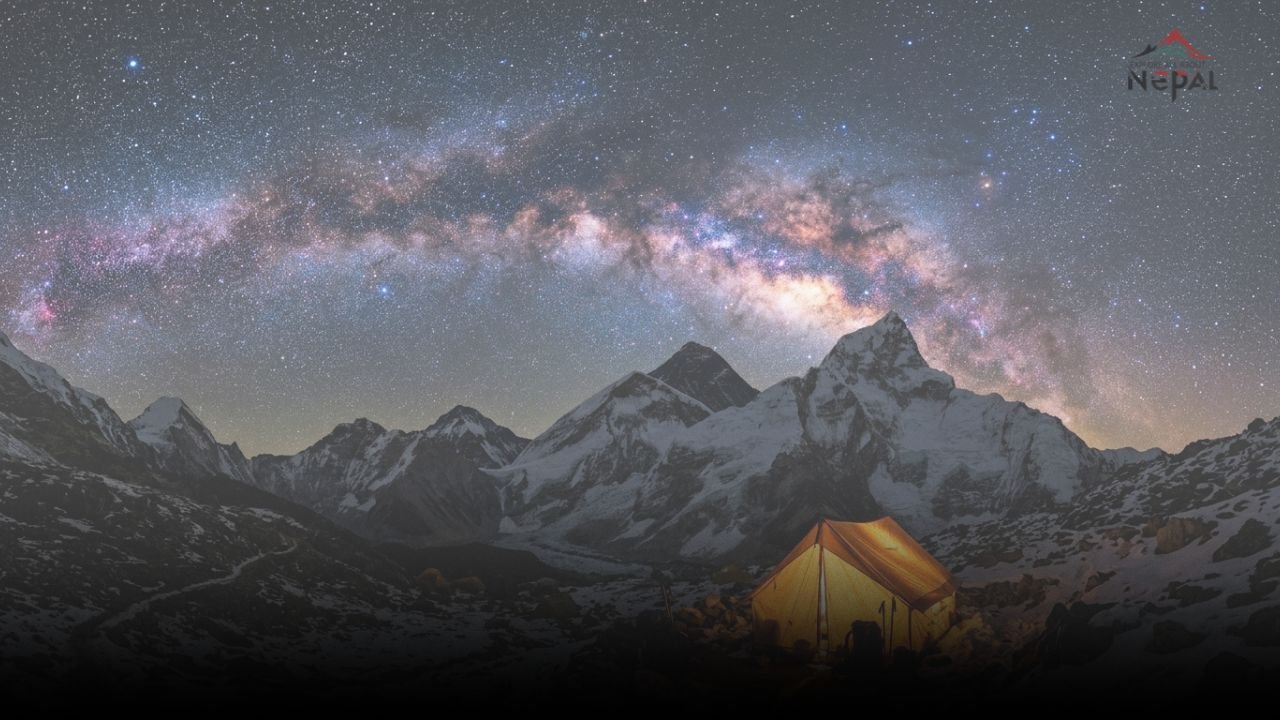
During clear nights in spring and autumn, the Milky Way appears vividly above the snow-covered peaks of the Khumbu region. The contrast between rugged mountain silhouettes and the glowing galactic core creates some of the most dramatic astrophotography scenes in the world. Many professional photographers consider this region one of the top global destinations for night landscape photography.
Another advantage of the Everest region is its well-established trekking infrastructure. While it is a remote mountain environment, trekkers can still find tea houses and guided support along major routes like the Everest Base Camp trail. This makes it possible for travelers to combine trekking adventure with stargazing experiences.
However, conditions can be cold and challenging at night, especially at higher elevations. Proper preparation, warm clothing, and acclimatization are essential. Despite these challenges, the reward is unmatched: a clear, unpolluted sky filled with millions of stars and the Milky Way arching over the highest mountains on Earth.
For travelers searching for unforgettable astrophotography locations, the Everest region remains one of the most powerful and visually stunning Places to See the Milky Way in Nepal.
Upper Mustang – Nepal’s Dark Sky Desert
Another extraordinary destination among the best Places to See the Milky Way in Nepal is Upper Mustang, often described as Nepal’s “hidden desert in the Himalayas.” Located in the rain-shadow region north of the Annapurna range, Upper Mustang offers some of the clearest and driest skies in the country.
Unlike lush green trekking regions, Upper Mustang features a dramatic, arid landscape with rocky cliffs, deep canyons, and ancient cave dwellings. This desert-like environment receives very little rainfall throughout the year, resulting in consistently clear skies an essential condition for Milky Way visibility.
The region is also extremely remote and sparsely populated, meaning there is almost no artificial light pollution. Once the sun sets, the night sky becomes incredibly dark, revealing thousands of stars with exceptional clarity. This makes Upper Mustang one of the most reliable stargazing destinations in Nepal.
The historical capital, Lo Manthang, provides a unique cultural backdrop for astrophotography. Ancient monasteries, traditional mud-brick houses, and medieval architecture create fascinating foregrounds for night sky photography. Capturing the Milky Way above these centuries-old settlements offers a rare blend of astronomy and cultural heritage.
Because Upper Mustang lies in a restricted area, visitors require special permits, and trekking is regulated. This limited access helps preserve its natural environment and ensures that visitor numbers remain low, further protecting its dark-sky conditions.
The best time to visit is during late spring and autumn, when weather conditions are stable and skies remain clear. Cold desert nights can be extreme, so proper gear is essential for comfort and safety.
For travelers seeking solitude, extreme landscapes, and some of the darkest skies in Asia, Upper Mustang stands out as one of the most remarkable Places to See the Milky Way in Nepal.
Rara Lake – Nepal’s Most Beautiful Night Reflection
Among the most visually stunning Places to See the Milky Way in Nepal is Rara Lake, the largest lake in Nepal and one of the most peaceful stargazing destinations in the country.
Located in the remote northwestern region, Rara Lake sits within Rara National Park and is surrounded by dense pine forests, rolling hills, and snow-capped peaks. Its isolation from major cities means that light pollution is virtually nonexistent, making it an excellent location for observing the night sky.
What makes Rara Lake especially unique for Milky Way viewing is its reflective surface. On calm nights, the lake acts like a mirror, reflecting the stars and the Milky Way across its surface. This creates symmetrical astrophotography compositions that are rarely found elsewhere in Nepal.
The journey to Rara is long and requires multiple transportation stages, but this remoteness is part of its appeal. Fewer tourists visit the region compared to popular trekking routes, allowing for a quiet and immersive natural experience.
During clear nights, especially in autumn, the Milky Way can be seen stretching across the sky above the lake’s tranquil waters. Combined with the surrounding forests and mountain silhouettes, the scene becomes one of the most peaceful and photogenic night landscapes in Nepal.
Rara Lake is also known for its biodiversity, including unique bird species and wildlife, which adds another dimension to daytime exploration before nightfall begins.
Camping near the lake offers one of the best stargazing experiences in the country. Without artificial lighting and with minimal human activity, the night sky feels vast and untouched.
For travelers looking for serenity and reflection-based astrophotography, Rara Lake is one of the most magical Places to See the Milky Way in Nepal.
Annapurna Base Camp – Himalayan Amphitheatre Under the Stars
One of the most breathtaking Places to See the Milky Way in Nepal is Annapurna Base Camp, located deep within the Annapurna Sanctuary at an altitude of around 4,130 meters. This natural mountain amphitheatre is surrounded by towering peaks such as Annapurna I, Machhapuchhre (Fishtail), Hiunchuli, and Annapurna South, creating one of the most dramatic night landscapes in the Himalayas.
What makes Annapurna Base Camp exceptional for Milky Way viewing is its 360-degree mountain enclosure. On clear nights, the Milky Way rises above the surrounding peaks like a glowing arc of light, while the glaciers and snowfields reflect faint starlight below. The combination of altitude, isolation, and minimal light pollution makes it one of the most reliable high-altitude stargazing locations in Nepal.
During trekking seasons—especially spring and autumn—trekkers often experience crystal-clear night skies. After sunset, temperatures drop significantly, and the sky becomes densely filled with stars. For photographers, this location provides one of the most iconic compositions in Nepal: the Milky Way framed by the sharp pyramid of Machhapuchhre.
Because ABC is a popular trekking destination, there are basic tea houses available, allowing trekkers to stay overnight and wait for optimal night-sky conditions. However, weather conditions can change quickly, and cloud cover may sometimes obstruct visibility.
Despite these challenges, Annapurna Base Camp remains one of the most accessible high-altitude Places to See the Milky Way in Nepal, offering a rare combination of trekking infrastructure and world-class astrophotography opportunities.
Poon Hill – Gateway Stargazing Above the Annapurnas
Another popular destination among the Places to See the Milky Way in Nepal is Poon Hill, a famous viewpoint in the lower Annapurna region. Known primarily for its sunrise views, Poon Hill also offers excellent opportunities for night sky observation and Milky Way photography.
Located at an altitude of 3,210 meters, Poon Hill is accessible through a relatively short trekking route, making it one of the most beginner-friendly stargazing destinations in Nepal. The trail passes through charming villages like Ghorepani and Ulleri, where trekkers can experience local culture before reaching the viewpoint.
At night, Poon Hill becomes a quiet and dark environment ideal for observing the stars. While it is more accessible than remote Himalayan regions, light pollution remains relatively low compared to urban areas, allowing the Milky Way to be visible on clear nights.
The panoramic viewpoint offers sweeping views of the Annapurna and Dhaulagiri ranges. When the Milky Way rises above these massive peaks, the result is a stunning combination of mountains and night sky that is highly attractive for photography enthusiasts.
Because of its accessibility, Poon Hill is often recommended for travelers who are new to astrophotography or short on time. It provides a balanced experience of trekking, cultural exposure, and night sky viewing without requiring extreme altitude exposure.
For those searching for easy yet rewarding Places to See the Milky Way in Nepal, Poon Hill remains one of the most practical and visually impressive options.
Langtang Valley – Dark Skies Close to Kathmandu
The Langtang region is one of the most convenient yet underrated Places to See the Milky Way in Nepal, located just north of Kathmandu within Langtang National Park. Despite its proximity to the capital, the valley offers surprisingly dark skies, making it a great destination for astrophotography and stargazing.
The Langtang Valley trek passes through forests, alpine meadows, and traditional Tamang villages before reaching higher elevations such as Kyanjin Gompa. At night, the lack of major urban lighting allows the Milky Way to be clearly visible in many sections of the valley.
One of the key advantages of Langtang is accessibility. Unlike remote trekking regions that require long travel times, Langtang can be reached within a day’s drive from Kathmandu followed by several days of trekking. This makes it ideal for travelers who want a stargazing experience without committing to longer expeditions.
The valley also offers diverse foregrounds for astrophotography. Snow-covered peaks, glacial rivers, prayer flags, and monasteries create visually rich compositions under the night sky. Kyanjin Gompa, in particular, is a popular location for capturing Milky Way images framed by surrounding mountains.
Because Langtang is less crowded than Everest or Annapurna, it provides a quieter and more peaceful environment for night sky observation. However, weather conditions can vary, and trekkers should be prepared for sudden changes in temperature and visibility.
For travelers seeking accessible yet authentic Himalayan stargazing, Langtang Valley is one of the most balanced Places to See the Milky Way in Nepal.
Khaptad National Park – Nepal’s Hidden Dark Sky Sanctuary
One of the least explored yet scientifically valuable Places to See the Milky Way in Nepal is Khaptad National Park, located in the far-western region of the country. This protected area is known for its open grasslands, forested hills, and extremely low levels of human settlement.
Unlike popular trekking regions, Khaptad remains largely untouched by tourism. This isolation creates near-perfect dark-sky conditions, making it one of Nepal’s best natural observatories for stargazing and Milky Way photography.
The park’s landscape is relatively flat compared to the Himalayas, featuring rolling meadows and dense forests. This open terrain allows for wide-angle views of the night sky without obstruction from tall peaks, making it especially suitable for capturing long-exposure Milky Way images.
Light pollution in this region is almost nonexistent. Once the sun sets, the sky becomes extremely dark, revealing dense star fields and clear visibility of the Milky Way during appropriate seasons.
Khaptad also holds cultural and spiritual significance. The area is associated with meditation practices and was once inhabited by the famous sage Khaptad Baba. This spiritual connection adds depth to the experience of stargazing in the region.
Because it is less developed for tourism, visitors should be prepared for basic facilities and limited infrastructure. However, this remoteness is also what preserves its exceptional night sky quality.
For travelers seeking solitude and some of the darkest skies in Nepal, Khaptad National Park stands out as one of the most unique Places to See the Milky Way in Nepal.
Shey Phoksundo Lake – Turquoise Waters Under the Galactic Sky
One of the most visually dramatic Places to See the Milky Way in Nepal is Shey Phoksundo Lake, located in the remote Dolpo region of northwestern Nepal. Known for its deep turquoise waters and rugged Himalayan surroundings, this alpine lake offers one of the most surreal nightscape experiences in the country.
Shey Phoksundo sits at an altitude of about 3,600 meters and lies within Shey Phoksundo National Park. The region is extremely isolated, with limited road access and a strong preservation of traditional Tibetan-influenced culture. This remoteness results in almost zero light pollution, making it one of Nepal’s darkest skies.
At night, the lake becomes a natural mirror. When the Milky Way rises above the surrounding cliffs and mountains, its reflection often appears on the lake’s surface, creating a double-layered astrophotography composition. This makes it one of the most sought-after locations for photographers looking for rare and cinematic night landscapes.
The Dolpo region is also known for its dry climate, especially in comparison to other parts of Nepal. This means clearer skies during many months of the year, particularly in autumn. Combined with high altitude and minimal human interference, conditions for stargazing are often excellent.
However, reaching Shey Phoksundo requires significant effort. Trekkers must travel through remote trails, often requiring multiple days of hiking. This difficulty is precisely what keeps visitor numbers low, preserving its untouched night sky quality.
The surrounding landscape—steep cliffs, ancient villages, and vast wilderness—adds to the sense of isolation and wonder. For those willing to undertake the journey, Shey Phoksundo offers one of the most rewarding stargazing experiences in Nepal.
For astrophotographers and adventure travelers, this remains one of the most extraordinary Places to See the Milky Way in Nepal.
Gosaikunda – Sacred Lake Beneath the Stars
Another powerful destination among the Places to See the Milky Way in Nepal is Gosaikunda, a sacred alpine lake located in Langtang National Park. At an altitude of around 4,380 meters, Gosaikunda is both a spiritual pilgrimage site and a stunning high-altitude stargazing location.
According to Hindu mythology, the lake was created by Lord Shiva, and it attracts thousands of pilgrims during the Janai Purnima festival. Outside of pilgrimage season, however, Gosaikunda becomes a quiet and peaceful destination ideal for night sky observation.
The lake is surrounded by rugged mountain terrain, rocky slopes, and snow-capped peaks. At night, the combination of high altitude and minimal light pollution allows for excellent visibility of stars and the Milky Way.
One of the most striking features of Gosaikunda is its reflective surface. On calm nights, the lake mirrors the night sky, doubling the visual impact of the Milky Way. This creates a powerful composition for photographers and a deeply atmospheric experience for trekkers.
Because of its elevation, temperatures at night can drop significantly, even during trekking seasons. Proper gear is essential for comfort and safety. Weather conditions can also change quickly, with clouds sometimes blocking visibility.
The trek to Gosaikunda itself passes through forests, ridges, and alpine terrain, making the journey as rewarding as the destination. Once at the lake, trekkers often experience one of the clearest and most spiritually charged night skies in Nepal.
For those seeking a combination of cultural significance and astronomical beauty, Gosaikunda is one of the most unique Places to See the Milky Way in Nepal.
Why Nepal Is a Top Milky Way Destination
Nepal stands out globally as one of the most extraordinary countries for astrophotography and stargazing. From remote Himalayan deserts to sacred alpine lakes and high-altitude trekking routes, the country offers a wide variety of landscapes that make it one of the best Places to See the Milky Way in Nepal.
What makes Nepal truly special is its combination of altitude, darkness, and natural scenery. Many of its best stargazing locations sit far above urban light pollution, where the night sky becomes incredibly clear. The Himalayas provide dramatic foregrounds that elevate Milky Way photography into something truly artistic and unforgettable.
Another key advantage is diversity. Unlike many countries where stargazing is limited to deserts or observatories, Nepal offers mountains, lakes, valleys, forests, and cultural villages—all under the same night sky. This allows travelers to experience astrophotography in completely different environments within a single journey.
Accessibility also plays a role. While some destinations require long trekking expeditions, others like Langtang or Poon Hill offer relatively easier access. This makes Milky Way viewing possible for both beginner travelers and experienced adventurers.
However, preserving these dark skies is becoming increasingly important. As tourism grows, responsible travel practices are essential to maintain Nepal’s natural night environment. Avoiding unnecessary artificial lighting, respecting local communities, and practicing eco-friendly trekking all help protect these fragile ecosystems.
In recent years, Nepal has also seen growing interest in astro-tourism. Photographers and travel enthusiasts are increasingly visiting the country specifically to capture night sky landscapes. This trend is helping promote lesser-known destinations and encouraging sustainable tourism development in remote regions.
Ultimately, Nepal offers something rare: the ability to stand beneath one of the brightest night skies on Earth while surrounded by some of the world’s highest mountains. For anyone searching for unforgettable natural experiences, the country’s best Places to See the Milky Way in Nepal deliver both visual beauty and emotional impact.
