
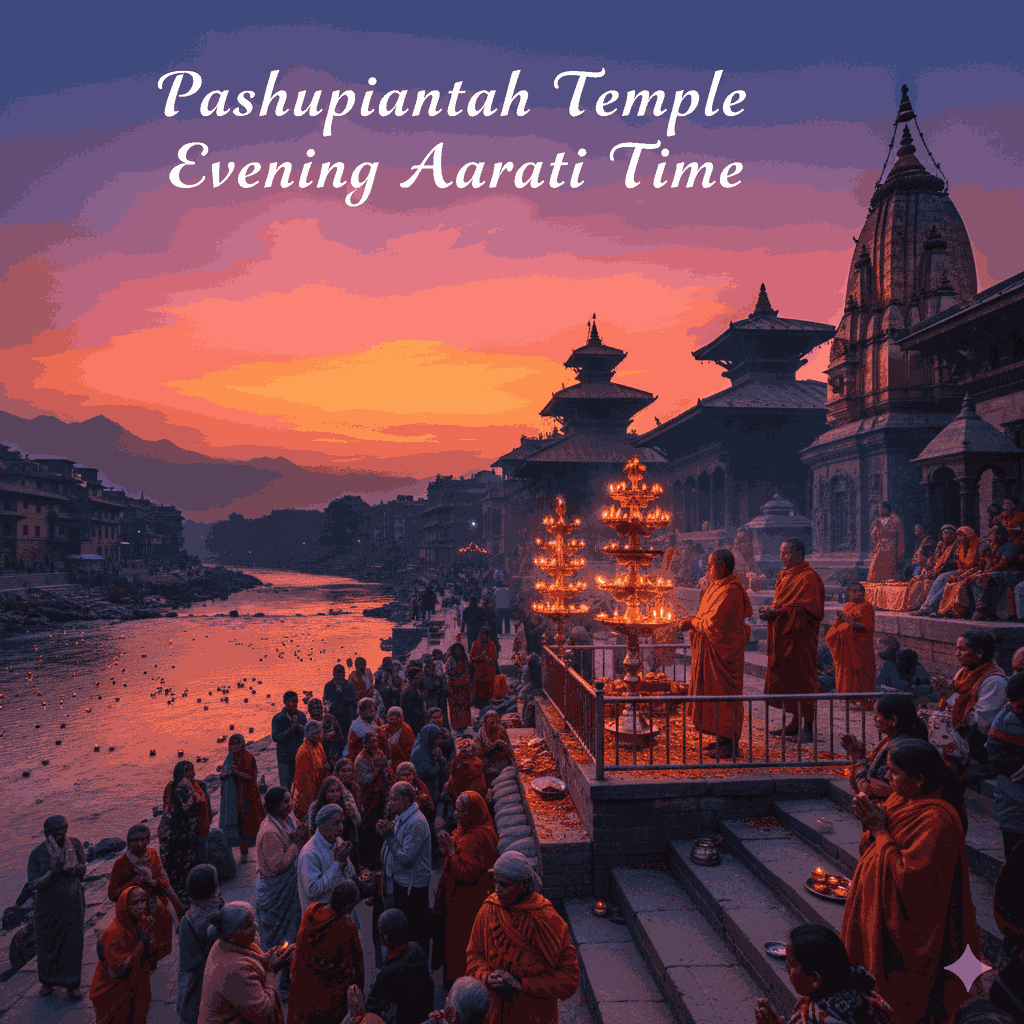
Spectacular view of Pashupatinath Temple during the evening Aarati, showcasing the spiritual atmosphere of the ceremony in Kathmandu
This guide is designed as the definitive guide for pilgrims, photographers, and travelers. We cover every intricate detail of the Pashupatinath Temple evening Aarati time, the historical evolution of the ritual, and the spiritual philosophy that makes this site the beating heart of Nepal.
In the ancient city of Kathmandu, where history is etched into every brick and spirituality is breathed in with the morning mist, there is one event that stands above all others in its emotional and visual power. As the sun begins its descent behind the jagged peaks of the Himalayas, the air around the sacred Bagmati River starts to hum. This is the moment thousands of seekers from around the world look for the Pashupatinath Temple evening Aarati time.
The Bagmati Sandhya Aarati is not merely a tourist attraction; it is a profound declaration of faith. Set against the backdrop of the UNESCO World Heritage site of Pashupatinath, the ceremony is a choreographed masterpiece of light, sound, and movement. For the Newar artisans of the valley and the Hindu devotees from the plains of India, this ritual is the culmination of a day spent in prayer. In this exhaustive guide, we will explore why this ceremony is essential to your journey and how to experience it like a local in 2026.
Part 1: Understanding the Pashupatinath Temple Evening Aarati Time
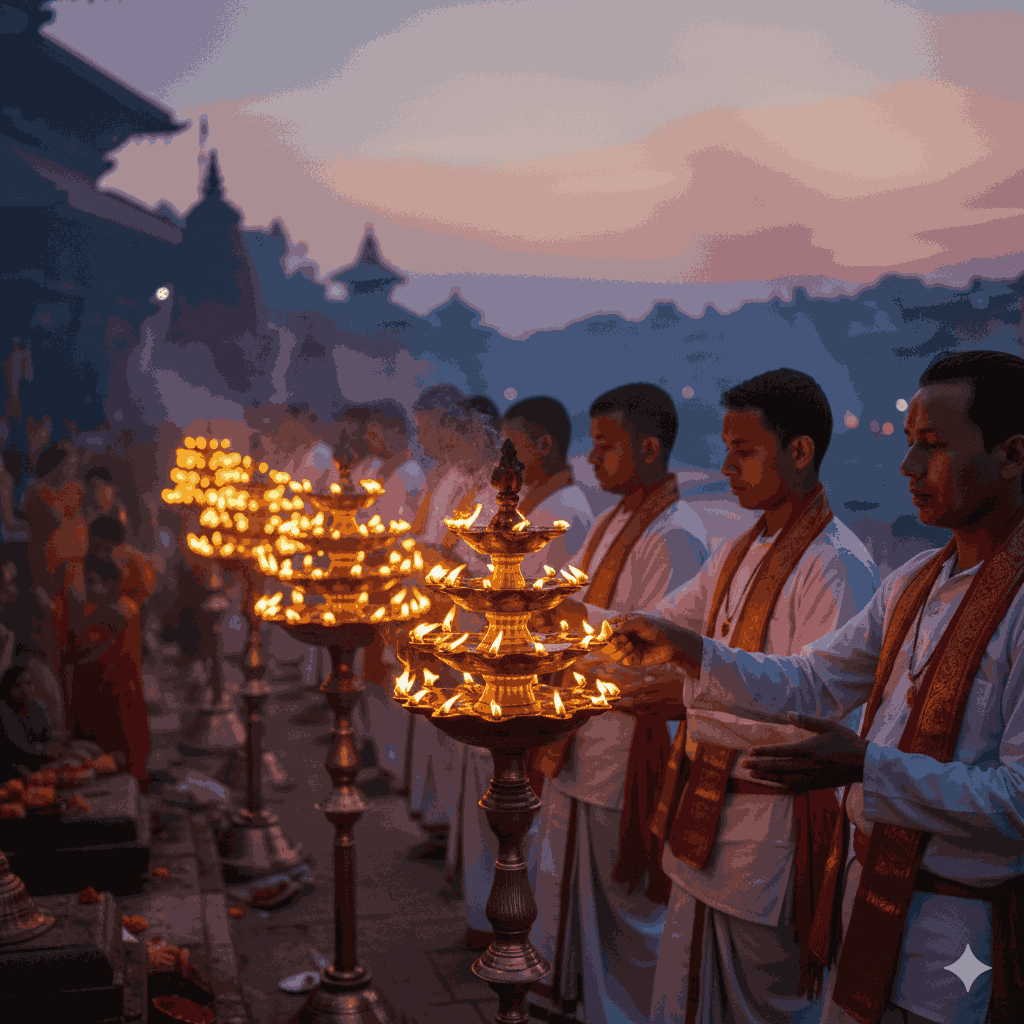
Priests lighting lamps during Pashupatinath Temple evening Aarati in Kathmandu, a key moment of the ritual
One of the most common mistakes travelers make is arriving too late or on the wrong side of the river. Because the ritual is tied to the lunar and solar cycles of the Hindu calendar, the exact Pashupatinath Temple evening Aarati time shifts slightly throughout the year.
The 2026 Seasonal Schedule
Winter (November – February): During the shorter days, the Aarati begins earlier, typically around 5:30 PM. The crisp, cold air makes the glow of the butter lamps appear even more brilliant.
Spring (March – May): This is peak tourist season. The ceremony usually starts at 6:00 PM.
Summer/Monsoon (June – August): Despite the rains, the devotion never stops. The Pashupatinath Temple evening Aarati time shifts to 6:30 PM.
Autumn (September – October): As the festivals of Dashain and Tihar approach, the Aarati starts at 6:00 PM and takes on a particularly festive atmosphere.
When Should You Actually Arrive?
While the lamps may not be lit until 6:00 PM, the “experience” begins much earlier. To secure a seat on the stone steps directly opposite the priests, you should aim to be inside the complex by 4:45 PM. This allows you time to pay your entrance fee, navigate the monkeys, and observe the afternoon rituals before the main event begins.
Part 2: The Spiritual Significance of the Ritual
To truly appreciate the Pashupatinath Temple evening Aarati time, one must understand the philosophy behind the fire. In Hinduism, Aarati is an act of “offering.” It is the removal of darkness (Andhaka) by the light of wisdom (Jyoti).
The Five Elements (Pancha Tattva)
The ceremony is designed to honor the five elements that make up the universe according to Vedic science:
Earth (Bhumi): Represented by the flowers and the incense.
Water (Jala): Represented by the sacred Bagmati River flowing beside the altar.
Fire (Agni): The centerpiece of the ritual—the massive ghee lamps.
Air (Vayu): The movement of the fans and the breath of the chanting devotees.
Space (Akasha): The sound of the bells and conch shells filling the sky.
When you attend at the Pashupatinath Temple evening Aarati time, you are witnessing a symbolic return of these elements to the Creator. It is a moment of profound gratitude. For more on the deep spiritual roots of these ceremonies, visit Explore All About Nepal for their deep dive into Hindu Traditions in the Valley.
Part 3: A Step-by-Step Breakdown of the Ceremony
What exactly happens during that hour of the Pashupatinath Temple evening Aarati time? The ritual is structured into several distinct phases, each with its own rhythm.
The Invocation (Sankha Dhwani)
The ceremony begins with the haunting, deep sound of the Sankha (conch shell). In Hindu mythology, the sound of the conch is the sound of “Om,” the primordial vibration of the universe. It clears the air of negative energy and alerts the deities that the offering is about to begin.
The Lighting of the Lamps
Three priests, dressed in traditional saffron and gold robes, stand on individual wooden platforms. They light the multi-tiered brass lamps, each holding dozens of wicks soaked in pure ghee. The synchronization of these three priests is a testament to years of practice. As they lift the heavy lamps, the Pashupatinath Temple evening Aarati time reaches its visual peak.
The Bhajan and Kirtan
The music is provided by a live band of traditional musicians playing the Tablas, Harmonium, and Manjira (cymbals). The crowd joins in, singing praises to Shiva, Parvati, and the Ganges. In 2026, many visitors find this the most moving part,hundreds of voices rising in a single, unified chorus.
The Tandava Dance
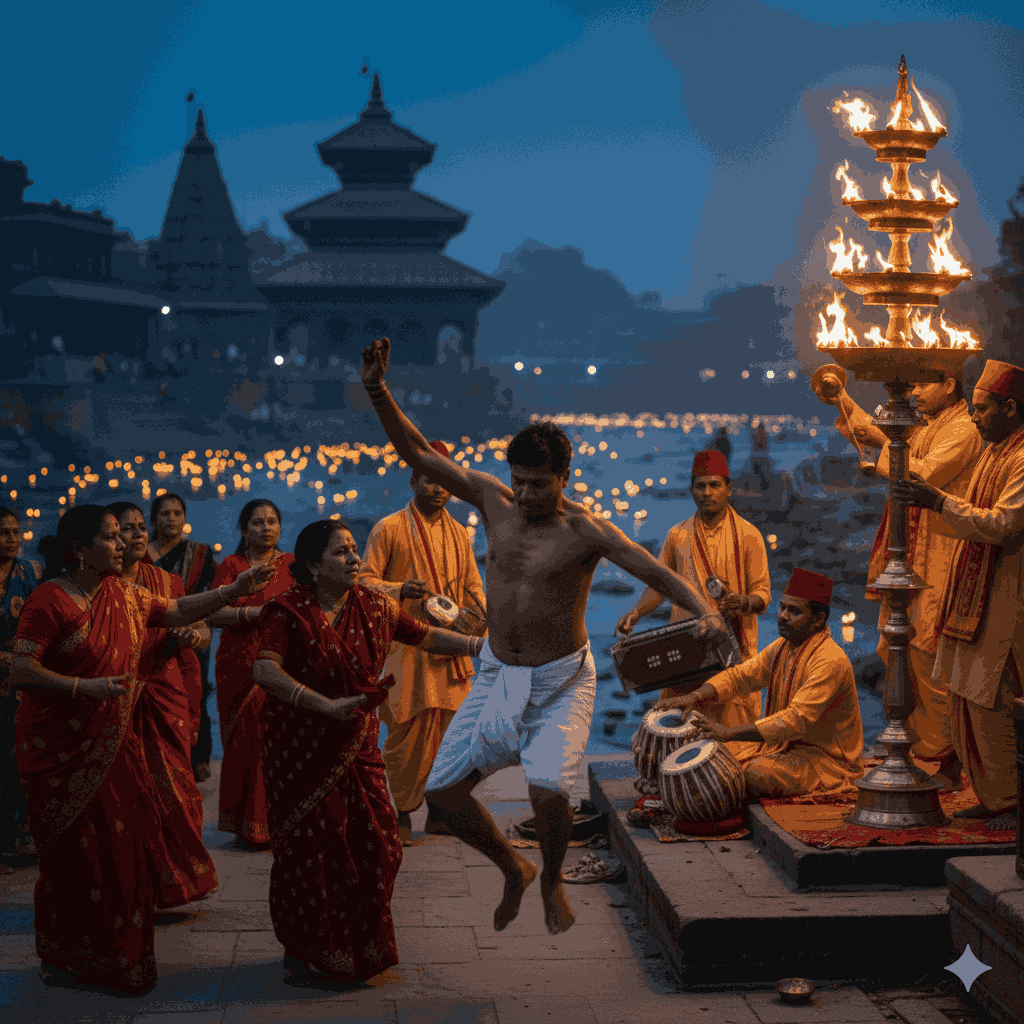
Devotees performing Tandava dance during Pashupatinath Temple evening Aarati, illustrating the spiritual dance of Lord Shiva
You will notice some devotees, and sometimes the priests themselves, performing a rhythmic dance. This is the Tandava, the dance of Lord Shiva. It represents the energy of creation and destruction. Witnessing this at the Pashupatinath Temple evening Aarati time is a visceral experience of raw human emotion.
Part 4: Logistics and Insider Tips for 2026
Navigating a site as large and crowded as Pashupatinath can be overwhelming. Here is how to handle the logistics of the Pashupatinath Temple evening Aarati time.
Entrance Fees and Access
Foreigners: 1,000 NPR (approx. $7.50 USD).
SAARC Citizens: 500 NPR.
Indian Nationals: Free (though certain areas of the temple may have specific requirements).
Note: Your ticket is valid for the whole day. If you visited in the morning, keep your ticket to re-enter for the Pashupatinath Temple evening Aarati time.
Where to Sit for the Best View
The Eastern Ghats (The Steps): This is the “front row.” You sit on the ancient stone steps facing the priests. It is crowded but offers the most immersive energy.
The Bridge: If you are a photographer, standing on the footbridge gives you a great elevated angle of the priests with the river in the foreground.
The Upper Terraces: For a quieter experience, head to the small shrines located on the hill behind the seating area. You can look down on the entire scene from a distance.
Photography and Etiquette
In 2026, photography rules have become stricter to preserve the sanctity of the site.
No Drones: Drones are strictly banned and will be confiscated by police.
Flash: Please turn off your flash. It is highly distracting to the priests and the people in meditation.
Cremations: Do not turn your back on the Aarati to take photos of the cremations at the Arya Ghat. It is considered disrespectful to the grieving families.
For external travel advice on cultural sensitivity, we recommend checking the U.S. State Department’s Nepal Travel Advisory or Lonely Planet’s Cultural Guide to Nepal.
Part 5: Beyond the Aarati, What Else to Do at Pashupatinath?
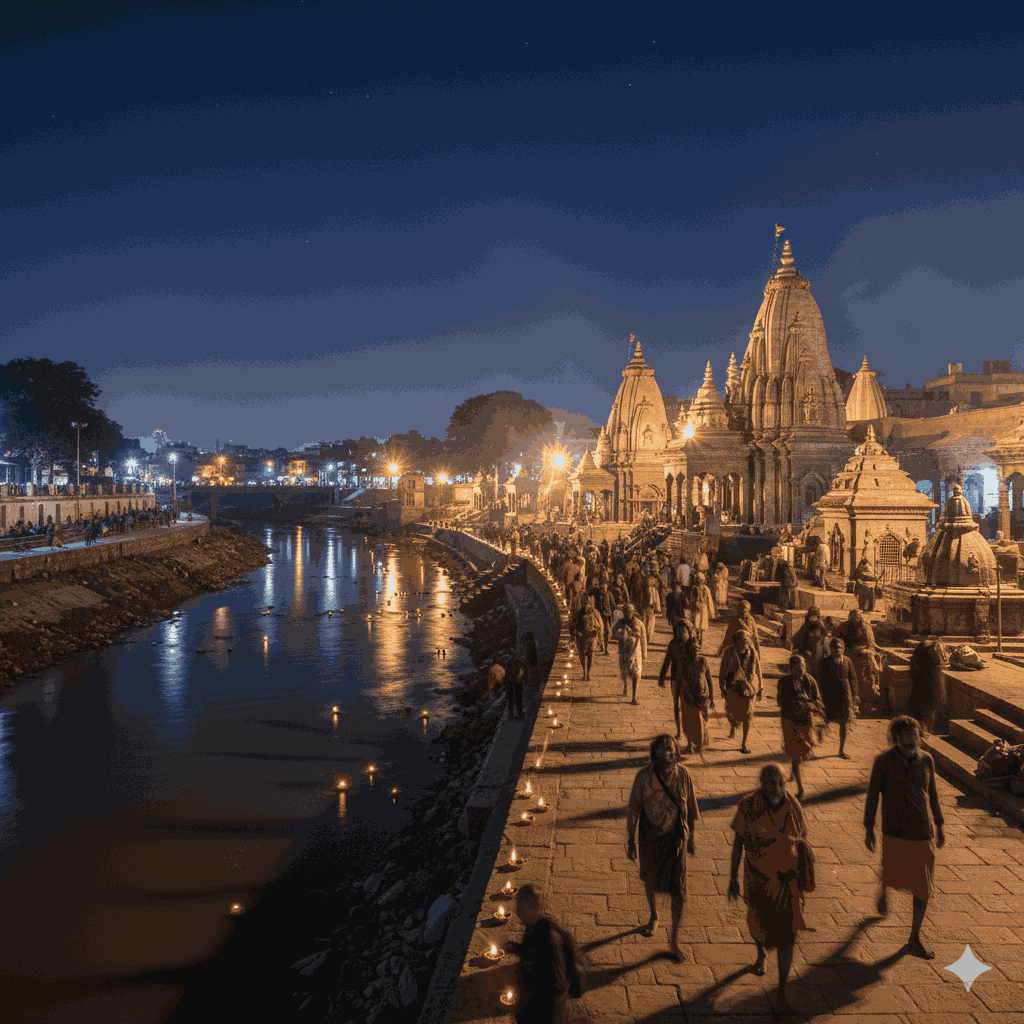
Night scene of Pashupatinath Temple with lamps during the evening Aarati, showing the spiritual serenity in Kathmandu
Since you are arriving early to beat the Pashupatinath Temple evening Aarati time, you have a few hours to explore the 264-hectare complex.
The Main Temple (For Hindus Only)
The main Pashupatinath temple is a masterpiece of Hindu architecture. It is a cubic construction with a two-tiered golden roof and silver-plated doors. While non-Hindus cannot enter, you can stand at the western gate and see the massive bronze statue of Nandi the Bull, Shiva’s mount.
The Mrigasthali Deer Park
A short hike behind the temples leads to a forested area where deer roam freely. This area is associated with the legend of Shiva taking the form of a golden deer. It is a peaceful escape before the noise of the Pashupatinath Temple evening Aarati time.
Meeting the Sadhus
The Pashupatinath complex is home to hundreds of Sadhus (wandering holy men). They live in the small caves and shrines around the site. Many are scholars of ancient texts, while others are “Aghoris” who follow more radical paths. Interacting with them is a staple of any visit, but always ask before taking a photo.
Part 6: Eating and Transportation After the Ceremony
Once the Pashupatinath Temple evening Aarati time concludes around 7:15 PM, the crowd disperses quickly.
Where to Eat
Gaushala Area: Just outside the main gate, there are several “Bhojanalayas” serving authentic vegetarian meals.
Thamel: Most travelers head back to Thamel (a 20-minute taxi ride) for a wider variety of international cuisines.
Getting Home
In 2026, the Pathao and InDrive apps are the most reliable ways to secure a ride to Pashupatinath Temple evening Aarati time. Street taxis will often double their prices after the Aarati, knowing that hundreds of tourists are looking for a ride at the same time.
FAQs: Everything You Need to Know
1. What is the exact Pashupatinath Temple evening Aarati time today?
In January 2026, the Aarati begins at 5:45 PM. However, always check the local sunset time as it follows the sun.
2. Is there a dress code for the Aarati?
While there is no “official” uniform, modesty is key. Men should wear long pants, and women should ensure their shoulders and knees are covered. Avoid wearing leather items if you intend to go near the inner sanctum areas.
3. Can non-Hindus participate in the Aarati?
Yes! The Aarati is an open ceremony. Anyone, regardless of religion, is welcome to sit, watch, and even join the singing and dancing.
4. How much time should I allocate for the whole visit?
To truly experience it, allocate at least 3 to 4 hours. Arrive at 4:00 PM, explore the site, secure your seat by 5:15 PM, and stay until the end of the Pashupatinath Temple evening Aarati time at 7:00 PM.
5. Is the site accessible for people with disabilities?
The main paths are paved, but the seating for the Aarati is on steep stone steps. For those with mobility issues, we recommend watching from the flat area near the bridge.
As the final bell tolls and the priests lower the flickering lamps into the Bagmati, a strange silence falls over the crowd. The Pashupatinath Temple evening Aarati time has ended, but the energy remains. You will walk away from the river feeling a sense of peace that is hard to find in the modern world.
Pashupatinath teaches us that life is a circle,of fire and water, of breath and stone, of life and death. If you are in Kathmandu, missing this ceremony is like visiting Paris and not seeing the Eiffel Tower at night. It is the soul of the city.
