

How Nepal is working for conservation of Red panda, showing a red panda in its Himalayan forest habitat with community members involved in conservation.
The primary answer to how Nepal is working for conservation of Red panda lies in its people. The Forest Guardian model, pioneered by the Red Panda Network (RPN), has become the backbone of in-situ conservation. In 2026, there are over 130 trained Forest Guardians across eastern and western Nepal who monitor these elusive creatures daily.
These guardians are local community members who receive a salary to protect their own backyard. By employing locals, the strategy of how Nepal is working for the conservation of red pandas ensures that conservation is not seen as an outside imposition but as a shared communal responsibility. These guardians conduct quarterly monitoring and use specialized data collection tools to track populations in the Panchthar-Ilam-Taplejung (PIT) corridor, which supports 25% of the country’s Red panda population.
This localized approach is the most effective method for how Nepal is working for conservation of red pandas because it bridges the gap between scientific data and traditional knowledge. Guardians often identify nesting trees and seasonal movement patterns that satellites might miss.
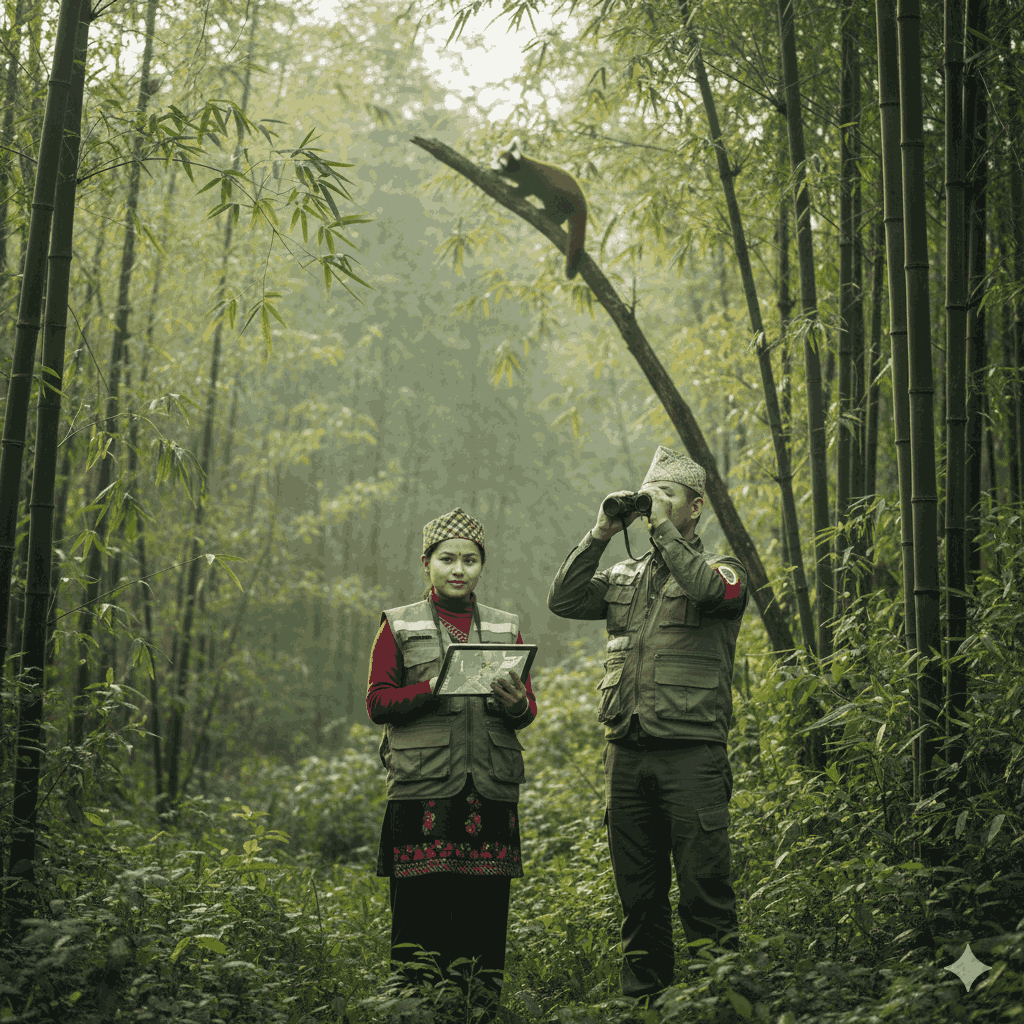
How Nepal is working for conservation of Red panda through community-based Forest Guardians patrolling their local forests.
Technology and Innovation in the Mist
In 2026, technology has revolutionised how Nepal is working for the conservation of Red panda. Researchers are no longer relying solely on chance sightings.
GPS Collaring: High-altitude tracking collars are used to understand the movement patterns of Red pandas between fragmented forest patches. This helps in understanding how Nepal is working for the conservation of Red panda by identifying which corridors need the most protection.
Tree Canopy Camera Traps: Recent studies in districts like Bhojpur have shown that cameras placed in the canopy are eight times more effective than ground-based ones. This is a critical part of how Nepal is working for conservation of red pandas in 2026.
DNA Scat Analysis: By analyzing fecal samples, scientists can determine the genetic health of subpopulations, ensuring that the flora and fauna of Nepal maintain high levels of biodiversity. This genetic monitoring is a sophisticated layer of how Nepal is working for conservation of Red panda.

How Nepal is working for conservation of Red panda using GPS collars and canopy camera traps to study movement and habitat connectivity.
The use of Global Forest Watch (GFW) tools also assists in how Nepal is working for conservation of Red panda by providing near-real-time deforestation alerts, allowing rangers to intervene before critical bamboo habitats are lost.
Habitat Restoration: Planting the Future
Habitat loss is the greatest threat to these animals, but how Nepal is working for conservation of Red panda addresses this through massive reforestation projects. Since the launch of the Plant a Red Panda Home campaign, hundreds of thousands of native trees and bamboo species have been planted in critical habitats. By 2026, the goal of How Nepal is working for conservation of Red panda is to create seamless corridors that connect fragmented forests.
The strategy of how Nepal is working for conservation of Red panda also involves purchasing private land to turn it into community forests. This land-acquisition model has successfully connected unprotected forests with the Singalila National Park, creating a transboundary sanctuary. This specific action shows how Nepal is working for conservation of the Red panda on a landscape level, rather than just in isolated pockets.
Mitigating Threats: From Stray Dogs to Stoves
Interestingly, how Nepal is working for conservation of Red panda involves managing domestic issues that indirectly affect wildlife.
Dog Vaccinations: Free-roaming dogs often attack Red pandas and spread diseases like canine distemper. Nepal has launched massive vaccination campaigns for stray dogs near pilgrimage sites. This is a niche but vital aspect of how Nepal is working for conservation of Red panda.
Improved Cookstoves: To reduce the pressure on forests for firewood, families are provided with high-efficiency stoves. This simple tech is a vital part of how Nepal is working for conservation of Red panda, as it saves thousands of trees annually.
Livestock Management: How Nepal is working for conservation of Red panda includes working with yak and cattle herders to discourage grazing in prime bamboo habitats, which is the Red panda’s primary food source. By providing animal husbandry training, Nepal is working for the conservation of Red panda reduces the accidental trampling of young bamboo shoots.
Economic Empowerment and Ecotourism

How Nepal is working for conservation of Red panda in protected areas like Ilam and Dobato, supporting biodiversity and community livelihoods.
For many, the first encounter with the results of how Nepal is working for conservation of Red panda is through sustainable tourism. In the PIT corridor, over 20 homestays operate, providing income for locals while funding conservation. 15% of the income from these homestays is often funneled back into the Red Panda Conservation Fund.
If you are a photographer looking for the best camera for professional photography and videography to capture these creatures, these community-led tours offer the most ethical and successful sighting opportunities. This green economy ensures that the question of How Nepal is working for the conservation of Red panda is answered by sustainable profit rather than exploitation.
The Mundhum Trail is another area where how Nepal is working for conservation of Red panda intersects with tourism. By protecting the red panda, the trail becomes a more attractive destination for international eco-tourists, further proving how Nepal is working for the conservation of Red panda while boosting the local economy.
Legal Framework and Government Action Plan
The Government of Nepal’s Red Panda Conservation Action Plan (2024–2028) is the legislative driver behind how Nepal is working for conservation of Red panda. This plan has allocated significant resources for anti-poaching units and transboundary cooperation. Poachers in Nepal face up to 10 years in prison, highlighting the seriousness of how Nepal is working for conservation of Red panda.
Furthermore, how Nepal is working for conservation of Red panda is supported by the 2015 Constitution, which gives local governments more authority to declare community-managed conservation areas. The Puwamajhuwa area in Ilam is a prime example of how Nepal is working for conservation of Red panda through local municipal laws. This decentralized approach is a hallmark of how Nepal is working for conservation of Red panda in the modern era.
For those interested in the history of wildlife protection, you can even explore how this compares to the best film camera in 2026 era of documentation, where recording these efforts was a much more analog process. Even then, the seeds of how Nepal is working for conservation of Red panda were being sown.
Comparison of Major Conservation Areas (2026)
| Region | Protected Area | Main Strategy for How Nepal is working for conservation of Red panda |
| Eastern Nepal | PIT Corridor | Forest Guardians & Private Land Purchase |
| Central Nepal | Langtang National Park | SMART Patrolling & Buffer Zone Management |
| Western Nepal | Rara National Park | Research, Education & Parasite Monitoring |
| Far West | Jajarkot / Jumla | Local Action Plans & School Awareness |
This table illustrates the geographical diversity of How Nepal is working for conservation of Red panda. Every region has a tailored approach to How Nepal is working for conservation of Red panda based on local threats.
Frequently Asked Questions (FAQ)
What is the single biggest threat to Red pandas in Nepal today?
While poaching exists, habitat fragmentation due to haphazard road construction is currently the biggest challenge to how Nepal is working for conservation of Red panda. The government is now using EIA (Environmental Impact Assessments) to better manage how Nepal is working for conservation of Red panda during infrastructure projects.
Can I volunteer for Red panda conservation?
Yes, organizations like the Red Panda Network often have programs for international volunteers to assist in reforestation. This is a hands-on way to see How Nepal is working for conservation of Red panda.
Where is the best place to see a Red panda in Nepal?
The Dobato and Choyatar villages in Ilam are the most famous spots, thanks to the success of How Nepal is working for conservation of Red panda in those regions.
How many Red pandas are currently left in Nepal?
Current 2026 estimates suggest between 500 and 1,000 individuals, though more elusive populations are likely hidden in the remote west. Continuous census work is part of how Nepal is working for conservation of Red panda.
How Nepal is working for conservation of Red panda regarding education?
Nepal has integrated conservation into school curriculums through eco-clubs. Over 20 eco-clubs in western Nepal specifically teach students about how Nepal is working for conservation of Red panda.
What are the penalties for harming a Red panda?
Under the National Parks and Wildlife Conservation Act, violators face fines between NPR 100,000 and 500,000 or imprisonment from one to ten years. This legal deterrence is a pillar of how Nepal is working for conservation of Red panda.
The journey of how Nepal is working for conservation of Red panda is a testament to what can be achieved when a nation values its natural heritage. Through the integration of modern technology like GPS tracking and ancient community wisdom, Nepal has created a safe haven for one of the world’s most charismatic species.
As we look toward the future, the continued success of how Nepal is working for conservation of Red panda will depend on balancing infrastructure development with environmental integrity. The fire fox is a symbol of the geography of Nepal—resilient, beautiful, and wild. By protecting the Red panda, Nepal is ultimately protecting the future of the Himalayas themselves. Every tree planted and every Forest Guardian trained contributes to the legacy of how Nepal is working for conservation of Red panda.
The global community can learn a great deal from how Nepal is working for conservation of Red panda. It proves that even for an endangered species with a narrow habitat range, recovery is possible through dedicated effort. As the story of how Nepal is working for conservation of Red panda continues to unfold, it remains a shining example of hope in the fight against biodiversity loss.
