
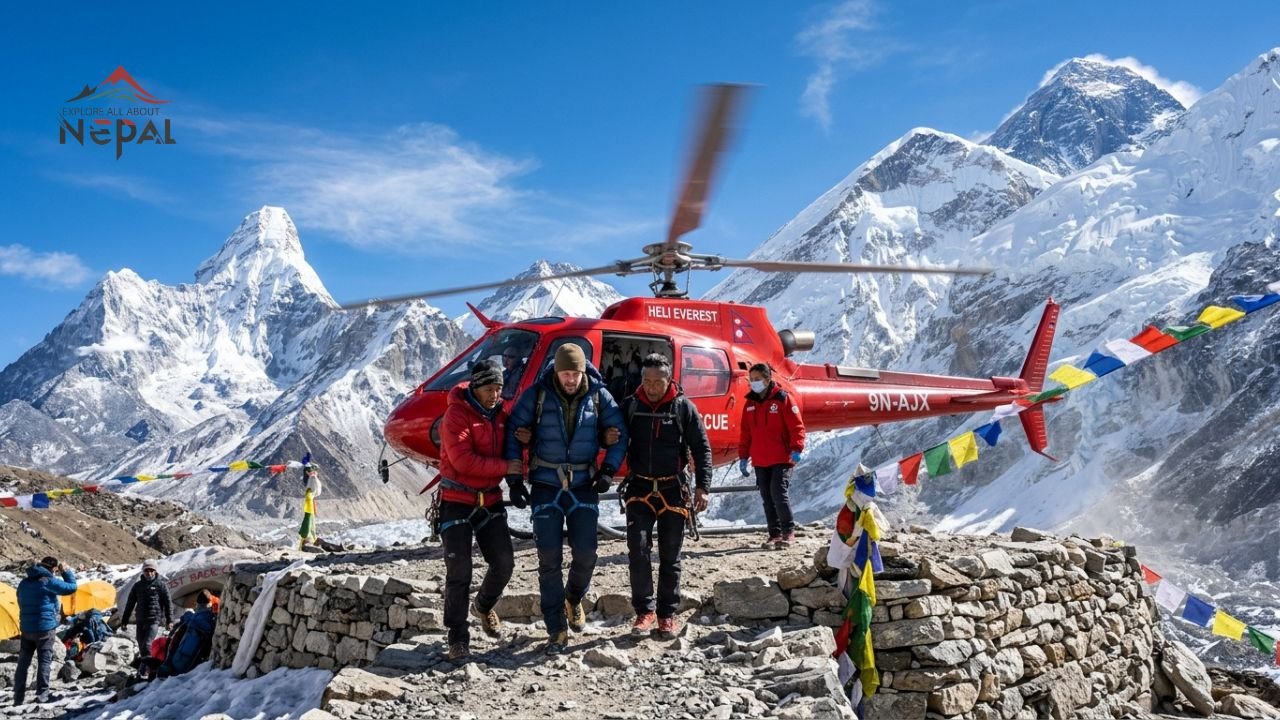
A helicopter rescue in Nepal costs between $3,000 and $10,000 depending on where you are, what time it is, and how quickly you need to get out. Without travel insurance that explicitly covers high-altitude helicopter evacuation, you pay every dollar of that yourself upfront, before the helicopter lifts off.
This guide tells you exactly what rescue costs in every major trekking region, how the rescue system works, which insurance policies actually cover it, and the practical steps that reduce your risk of needing a rescue in the first place.
Quick Reference: Helicopter Rescue Costs by Region (2026)
| Trekking Region | Evacuation To | Estimated Cost (USD) |
|---|---|---|
| Annapurna Base Camp (4,130m) | Pokhara | $3,000–$5,000 |
| Everest Base Camp (5,364m) | Kathmandu | $5,000–$8,000 |
| Manaslu Circuit (5,160m) | Kathmandu | $4,500–$7,000 |
| Langtang Valley (3,870m) | Kathmandu | $3,500–$5,500 |
| Kangchenjunga Base Camp (5,143m) | Kathmandu | $6,000–$10,000 |
| Upper Mustang (3,800m) | Pokhara/Kathmandu | $4,000–$6,500 |
| Dolpo / Phoksundo (3,600m) | Nepalgunj/Kathmandu | $5,000–$9,000 |
| Rolwaling Valley (4,580m) | Kathmandu | $5,500–$8,500 |
Costs are estimates for 2026. Actual costs vary by operator, weather conditions, and urgency. Always verify with your insurance provider before trekking.
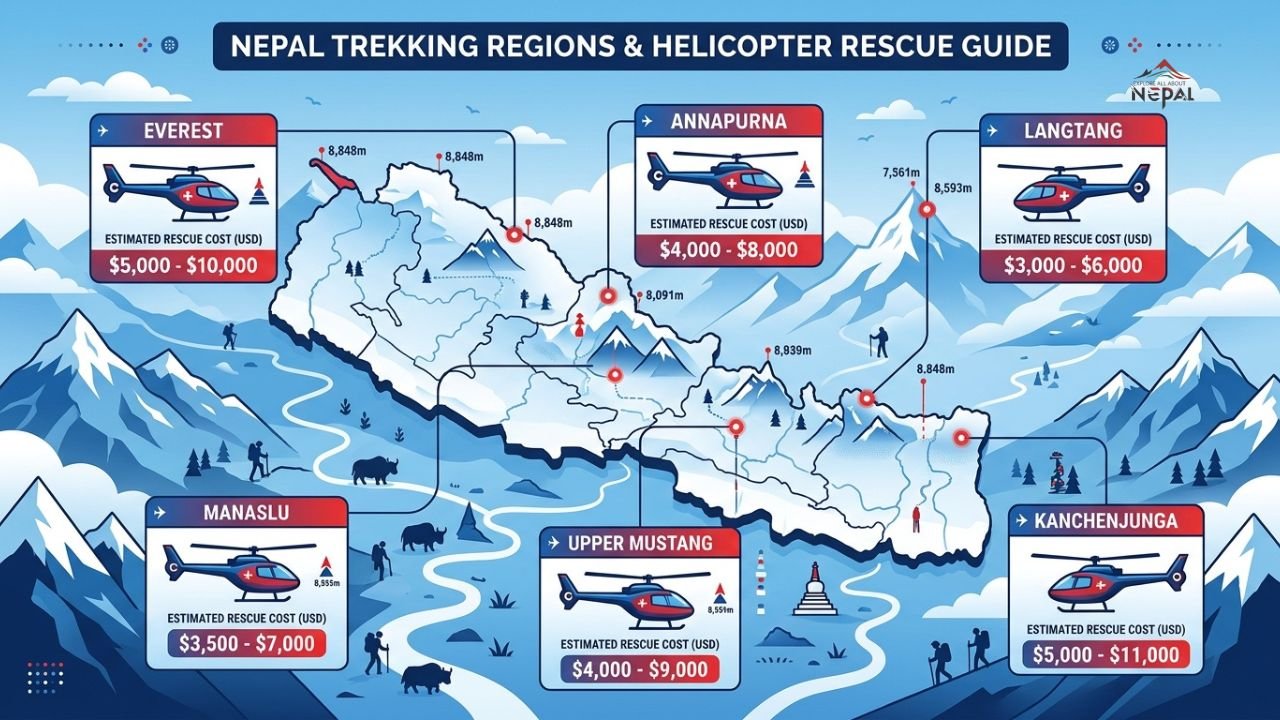
Helicopter Rescue Cost in Nepal
Why Helicopter Rescue in Nepal Is So Expensive
Before getting into the numbers, it helps to understand why these costs are so high because many trekkers are genuinely shocked when they find out.
Fuel and operating costs. High-altitude flying in the Himalayas is technically demanding and fuel-intensive. Helicopters operating above 4,000m burn significantly more fuel than at sea level and require more frequent maintenance. A single round trip from Pokhara to Annapurna Base Camp and back costs the operator $1,500–$2,500 in fuel and operating costs alone.
Specialized equipment and pilots. High-altitude rescue requires specially certified pilots and aircraft. Not every helicopter in Nepal is certified for operations above 4,000m. The operators who can do it charge accordingly.
Weather windows. Pilots often have to wait for weather windows in the Annapurna Sanctuary or Everest region, sometimes making multiple attempts before successfully reaching a patient. Each attempt has a cost.
Urgency premiums. A rescue request at 3am or during a weather system commands a higher price than a daytime calm-weather flight. Emergency surcharges are standard.
Remote location surcharges. The more remote the trekking region Dolpo, Kangchenjunga, Rolwaling the higher the base cost simply due to flight distance and time.
How the Helicopter Rescue System Works in Nepal
Understanding the process helps you plan for it properly.
Step 1: The Emergency Is Identified
A trekker develops serious altitude sickness (AMS, HACE, or HAPE), suffers a fall or injury, or becomes medically incapacitated on the trail. The guide, fellow trekkers, or tea house operator identifies that the situation requires evacuation.
Step 2: Contact Is Made
The guide contacts the nearest rescue coordination point either directly through a trekking agency in Kathmandu or Pokhara, or through the Nepal Police or Army. Most experienced guides have direct contacts with helicopter operators and know the process.
Key contacts:
- CIWEC Hospital Travel Medicine Center, Kathmandu: +977-1-4435232
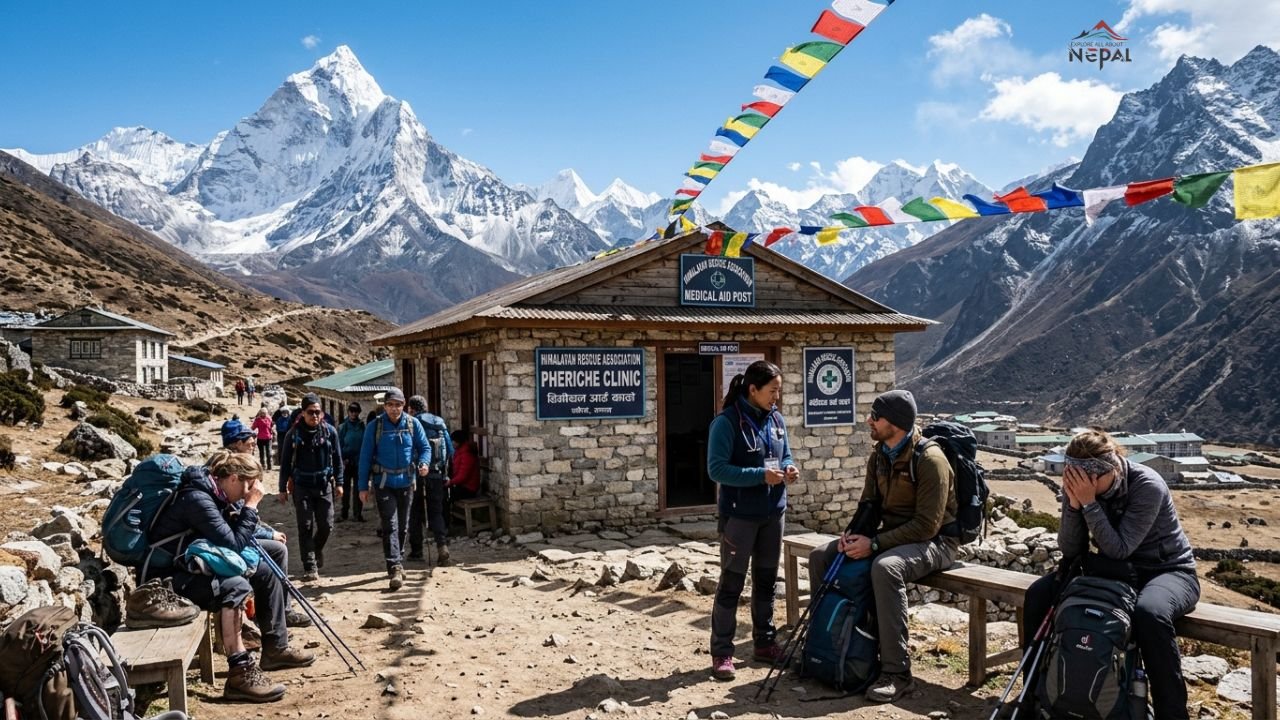
- Himalayan Rescue Association (HRA): Offices at Manang (Annapurna Circuit) and Pheriche (Everest region) — staffed by volunteer doctors during trekking seasons
- Nepal Airlines Emergency: +977-1-4220757
- Your trekking agency’s emergency line this should be saved in your phone before you leave Kathmandu
Step 3: Insurance Authorization Is Requested
This is the step most trekkers don’t know about until it’s too late. Before most licensed helicopter operators in Nepal will dispatch a rescue helicopter, they require either:
- A guarantee letter from your insurance company confirming coverage, OR
- A cash deposit or credit card hold of the estimated rescue cost
This is non-negotiable. Operators have been left with unpaid rescue bills too many times. If your insurance company cannot issue a guarantee letter within 1–2 hours, you may be asked to pay a deposit upfront.
This is why having the right insurance with a 24/7 emergency line that issues guarantee letters rapidly is not optional for Nepal trekking.
Step 4: Helicopter Dispatch
Once authorization or payment is confirmed, the helicopter is dispatched. Flight time from Pokhara to Annapurna Base Camp is approximately 30–45 minutes. From Kathmandu to Everest Base Camp region, approximately 45–60 minutes.
Step 5: Hospital Treatment
Trekkers are evacuated to the nearest appropriate hospital typically CIWEC Hospital or Norvic International Hospital in Kathmandu, or Western Regional Hospital in Pokhara. Treatment costs are separate from rescue costs and can add $500–$5,000+ depending on the condition.
Real Cost Scenarios: What Trekkers Actually Pay
Scenario 1: Altitude Sickness on Annapurna Base Camp Trek
A 38-year-old American trekker develops severe headache, vomiting, and confusion at Deurali (3,230m) on day 7 of the ABC trek. His guide correctly identifies HACE (High Altitude Cerebral Edema) and requests emergency evacuation.
- Helicopter rescue (Deurali to Pokhara): $3,800
- Hospital treatment in Pokhara (2 nights): $1,200
- Flight change fee (missed return flight): $400
- Total out-of-pocket without insurance: $5,400
With a World Nomads Explorer policy covering helicopter evacuation: $0 out of pocket (excess/deductible of $100 applies).
Scenario 2: Broken Ankle on Everest Base Camp Trek
A 45-year-old British trekker falls on the Khumbu moraine above Lobuche and fractures her ankle. She cannot walk and requires helicopter evacuation.
- Helicopter rescue (Lobuche to Kathmandu): $6,500
- Hospital treatment in Kathmandu (surgery, 4 nights): $4,200
- Medical repatriation to UK: $8,000
- Total without insurance: $18,700
With a comprehensive policy including medical repatriation: $200 out of pocket (policy excess).
Scenario 3: Dolpo Remote Region Evacuation
A 52-year-old Australian trekker in the Dolpo region (one of Nepal’s most remote) develops appendicitis symptoms at Phoksundo Lake.
- Helicopter rescue (Phoksundo to Nepalgunj, then Kathmandu): $8,500
- Emergency surgery in Kathmandu: $3,500
- Total without insurance: $12,000
Which Insurance Policies Actually Cover Helicopter Rescue in Nepal
This is where most guides get vague. Here is specific information on the major policies Western trekkers use.
helicopter rescue in Nepal
What to Look For in Any Policy
Before buying any travel insurance for Nepal trekking, verify these four things explicitly:
- Altitude limit — must cover your maximum altitude. ABC is 4,130m. EBC is 5,364m. Some policies cap at 4,000m, which doesn’t cover EBC or high passes.
- Helicopter evacuation — must explicitly state emergency helicopter evacuation is covered, not just “emergency transport”
- Search and rescue — some policies cover hospital treatment but not the cost of getting you to the hospital
- 24/7 emergency assistance line — must be able to issue guarantee letters to Nepal operators in real time
Major Policies Compared
World Nomads Explorer Plan
- Altitude coverage: Up to 6,000m (covers all standard Nepal treks)
- Helicopter evacuation: Yes covered up to policy limit
- Search and rescue: Yes
- 24/7 emergency line: Yes strong reputation for fast guarantee letters in Nepal
- Medical limit: $100,000
- Best for: US, UK, Australian, Canadian trekkers
- Approximate cost: $120–$180 for 2–3 weeks (varies by nationality and age)
SafetyWing Nomad Insurance
- Altitude coverage: Not explicitly limited but rescue coverage varies
- Helicopter evacuation: Covered under emergency medical transport
- Important caveat: SafetyWing’s guarantee letter process is slower than World Nomads this matters in a real emergency
- Medical limit: $250,000
- Best for: Long-term travelers and digital nomads already in Asia
- Approximate cost: $56/month (very affordable but verify Nepal-specific rescue coverage before buying)
Battleface
- Altitude coverage: Up to 6,000m on standard plans
- Helicopter evacuation: Yes
- Best for: US citizens (World Nomads not available to all US states)
- Approximate cost: $100–$160 for 2–3 weeks
True Traveller (UK)
- Altitude coverage: Up to 6,000m on Adventure plan
- Helicopter evacuation: Yes
- Best for: UK and EU citizens
- Strong reputation in Nepal trekking community
- Approximate cost: £60–£120 for 2–3 weeks
IMG Global (Patriot Travel)
- Popular with US trekkers
- Helicopter evacuation: Yes
- Altitude: Verify for treks above 4,500m specifically
- Best for: US citizens wanting flexible coverage periods
Policies to Avoid for Nepal Trekking
Standard holiday or vacation insurance policies from mainstream providers (many bank travel cards, basic holiday insurance) typically:
- Cap altitude coverage at 2,000m–3,000m
- Exclude “adventure activities” which can include trekking
- Do not cover search and rescue costs
- Have no Nepal-specific emergency contacts
If your insurance came free with a credit card or bank account, assume it does not cover Nepal high-altitude trekking until you have verified this in writing with the insurer.
How to Avoid Paying for Helicopter Rescue: The Practical Guide
The best rescue is the one that never happens. Here are the specific steps that reduce your risk most significantly.
1. Acclimatize Properly The Single Most Important Factor
The majority of helicopter rescues in Nepal are for Acute Mountain Sickness (AMS), High Altitude Cerebral Edema (HACE), or High Altitude Pulmonary Edema (HAPE) all altitude-related conditions that are largely preventable with proper acclimatization.
The golden rule: never ascend more than 300–500m per day above 3,000m. On the ABC trek, the itinerary naturally follows this rule if you don’t rush. On EBC, the acclimatization day at Namche Bazaar is non-negotiable, not optional.
Recognize the warning signs early:
- Persistent headache that doesn’t respond to ibuprofen
- Nausea or vomiting
- Extreme fatigue disproportionate to exertion
- Loss of coordination or confusion (emergency descend immediately)
- Dry cough that worsens (early HAPE warning)
The rule that saves lives: If symptoms are worsening, descend. Do not sleep at altitude with worsening AMS. Descending 500m resolves most AMS cases within hours.
2. Consider Diamox (Acetazolamide)
Diamox is a prescription medication that assists acclimatization by stimulating faster and deeper breathing. It is widely used by trekkers and recommended by wilderness medicine specialists for Nepal trekking above 3,500m.
Consult your doctor before departure. Standard dosage is 125mg twice daily starting 24 hours before significant altitude gain. Side effects include increased urination and tingling in the fingers both manageable. People with sulfa drug allergies should not take Diamox.
3. Hire a Qualified Licensed Guide
Since April 2023, guides are mandatory on all major Nepal treks but the quality of the guide matters enormously. An experienced licensed guide:
- Monitors trekkers daily for altitude sickness symptoms
- Knows when to push on and when to stay put
- Has established relationships with rescue operators and knows exactly who to call
- Carries a pulse oximeter and basic first aid equipment
- Can make the call to descend before a situation becomes an emergency
A guide who downplays symptoms because a client wants to push on is a safety risk. Verify your guide’s license and ask specifically about their altitude sickness training and experience.
4. Carry a Pulse Oximeter
A pulse oximeter clips to your finger and measures blood oxygen saturation (SpO2) and pulse rate. At sea level, normal SpO2 is 95–100%. At 4,000m, 85–92% is typical for acclimatizing trekkers. Below 80% is a warning sign requiring immediate descent regardless of how you feel.
A quality pulse oximeter costs $20–$40 and weighs almost nothing. It gives you and your guide objective data rather than relying entirely on subjective symptom assessment. At altitude, trekkers frequently underreport symptoms because they don’t want to slow the group or admit they’re struggling the oximeter bypasses this.
5. Don’t Rush the Itinerary
The most common reason fit, experienced trekkers end up needing rescue is self-inflicted time pressure. They have 10 days, they’ve budgeted for 10 days, and they push through warning signs because they’re not prepared to change the plan.
Build a buffer day into your itinerary. A rest day at Chhomrong (ABC) or Namche Bazaar (EBC) costs you $30–$50 in accommodation and food. A helicopter rescue costs $5,000–$8,000.
6. Get the Right Insurance Before You Leave Home
You cannot buy adequate Nepal trekking insurance once you’re in Nepal and about to start the trek. Purchase your policy before you depart your home country, verify the altitude limit, verify helicopter evacuation is explicitly covered, and save the 24/7 emergency number in your phone before you board the plane.
What to Do If You Need a Rescue: Step-by-Step
If you or someone in your group needs emergency evacuation:
Step 1: Alert your guide immediately. If you don’t have a guide, alert the tea house owner — they have experience with this situation.
Step 2: Call your insurance company’s 24/7 emergency line. Have your policy number ready. Request a guarantee letter to be sent directly to the rescue operator.
Step 3: Your guide contacts a helicopter operator directly or through your trekking agency. Key operators in Nepal: Fishtail Air, Simrik Air, Kailash Helicopter, Air Dynasty.
Step 4: Provide your exact GPS coordinates or location description to both your insurance company and the helicopter operator. Most modern smartphones have GPS share your location via WhatsApp or Google Maps.
Step 5: While waiting for the helicopter, if the condition is altitude sickness descend as far as possible. Every meter of descent improves the situation. Do not wait for the helicopter at altitude if you can move downward.
Step 6: If a Gamow Bag is available at a tea house or with a guide use it. This portable hyperbaric chamber simulates descent and can stabilize a HACE or HAPE patient while awaiting rescue.
Frequently Asked Questions
How much does a helicopter rescue cost in Nepal?
Between $3,000 and $10,000 depending on location, time of day, and urgency. Annapurna region rescues typically cost $3,000–$5,000. Everest region rescues cost $5,000–$8,000. Remote regions like Dolpo and Kangchenjunga can reach $10,000+.
Do I have to pay upfront for helicopter rescue in Nepal?
Most helicopter operators require either a guarantee letter from your insurance company or a cash/card deposit before dispatching. This is standard practice. Having insurance with a 24/7 emergency line that issues guarantee letters quickly is essential.
Does travel insurance cover helicopter rescue in Nepal?
Only if your policy explicitly covers high-altitude helicopter evacuation. Standard travel insurance and bank card travel insurance frequently do not. Always verify altitude limits (must be above your maximum trekking altitude) and that helicopter evacuation is explicitly stated in the policy.
What is the most common reason for helicopter rescue in Nepal?
Altitude sickness specifically AMS (Acute Mountain Sickness), HACE (High Altitude Cerebral Edema), and HAPE (High Altitude Pulmonary Edema). These are the cause of the majority of rescues on the Annapurna and Everest trekking routes. All are preventable with proper acclimatization.
Can I buy travel insurance in Nepal before trekking?
You can purchase some policies online while in Nepal, but many insurers require purchase before departure from your home country. Do not leave this until you arrive in Kathmandu purchase before you fly.
Is helicopter rescue available from all trekking regions in Nepal?
Yes, but response times and costs vary significantly. The Annapurna and Everest regions have the fastest response times due to proximity to Pokhara and Kathmandu respectively. Remote regions like Dolpo and Kangchenjunga have longer response times and higher costs.
What if I can’t afford helicopter rescue and don’t have insurance?
This is a genuine life-or-death situation. Embassies (US, UK, Australian) can sometimes facilitate emergency medical assistance but cannot pay for rescue costs they will expect repayment. Some operators will accept proof of funds or a family member’s credit card guarantee. This is why travel insurance is non-negotiable for Nepal trekking, not a nice-to-have.
How long does helicopter rescue take in Nepal?
From the moment a request is confirmed and authorized, flight time is 30–60 minutes to most Annapurna and Everest region locations. Weather delays can extend this significantly. Total time from initial contact to patient pickup is typically 2–6 hours under normal conditions.
