📋 Mera Peak Fast Facts 2026
- Summit Elevation: 6,476 metres (21,247 feet)
- Location: Hinku Valley, Solukhumbu District, Koshi Province
- Classification: Trekking Peak (Nepal Mountaineering Association)
- Technical Grade: PD (Peu Difficile) Alpine classification
- Permit Issuing Authority: Nepal Mountaineering Association (NMA)
- Climbing Permit Cost (2026): NPR 25,000 per person (
$188 USD) autumn/spring; NPR 20,000 ($150 USD) winter/summer- Best Seasons: October–November (autumn) and April–May (spring)
- Average Success Rate: 65–75% in good conditions; 40–55% in poor seasons
- Minimum Recommended Duration: 18–21 days from Kathmandu (including acclimatisation)
- Maximum Summit Elevation in Nepal Without Expeditionary Permit: 6,476m Mera is the highest trekking peak
- Required Guide: Mandatory a licensed high-altitude guide or climbing Sherpa
- Closest Major Peak Visible from Summit: Everest, Lhotse, Cho Oyu, Makalu, Kangchenjunga five of the world’s 14 eight-thousanders
In the constellation of Nepal’s trekking peaks those 33 summits designated by the Nepal Mountaineering Association as accessible to non-expeditionary climbers with appropriate permits and guides Mera Peak occupies a genuinely singular position.
At 6,476 metres, it is the highest trekking peak in Nepal. Standing on its summit means standing higher than any point in Europe, higher than the highest summit in the Americas outside the Andes, higher than anything in Africa or Australasia. The summit panorama five of the world’s 14 eight-thousanders visible simultaneously, including Everest’s south face in direct sightline is among the most spectacular high-altitude views available to non-technical climbers anywhere on Earth.
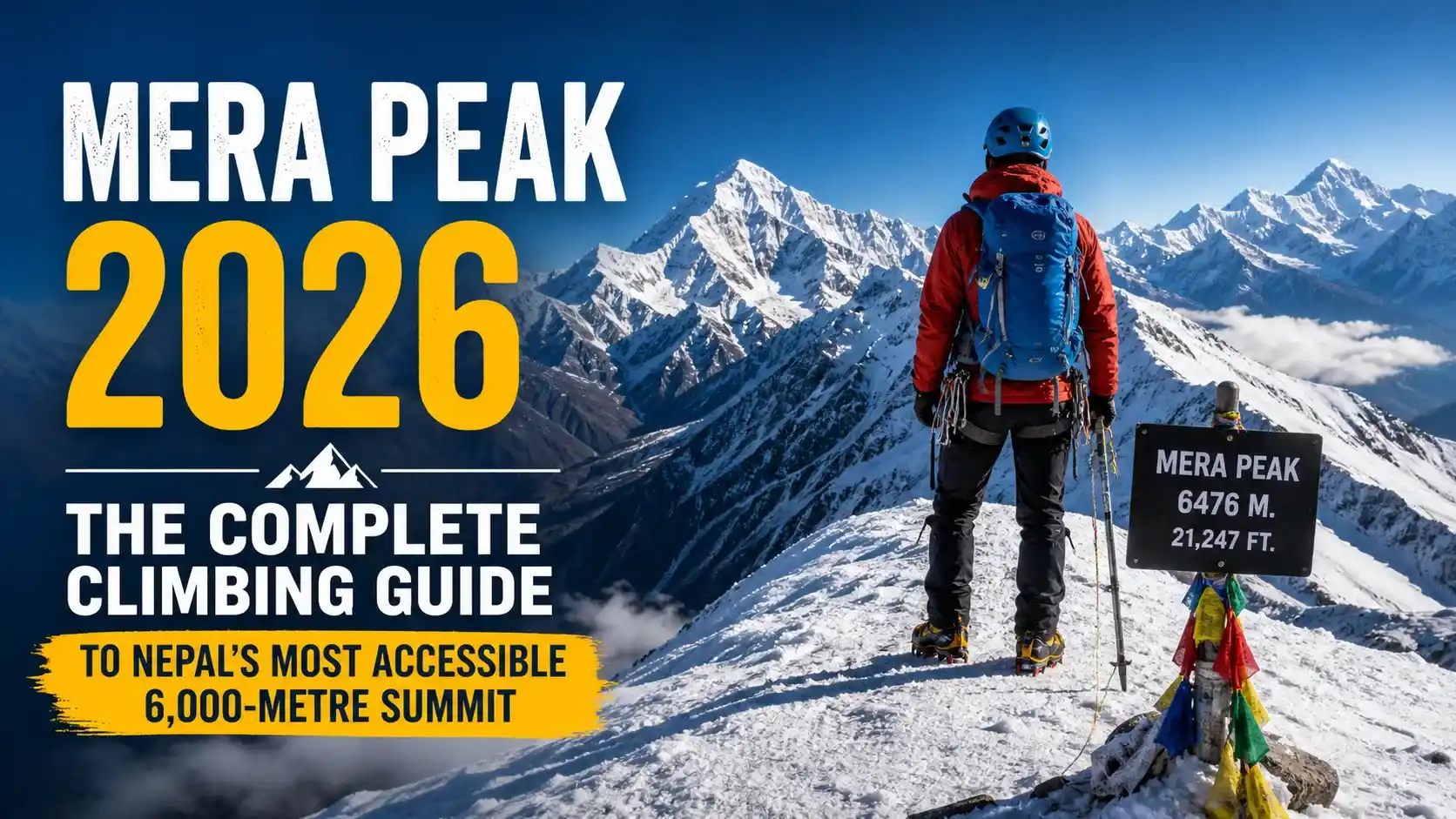 And yet, by the standards of 6,000-metre mountaineering, Mera Peak is genuinely, honestly accessible. Not easy no mountain of this altitude is but achievable for a physically fit trekker with no prior technical climbing experience who is properly prepared, properly guided, and sufficiently committed to the acclimatisation process.
This combination extraordinary altitude, extraordinary views, genuine accessibility is precisely what makes Mera Peak the logical first Himalayan summit for the ambitious trekker ready to move from trail to mountain.
Understanding what “genuinely accessible” actually means in practice, however, requires honesty about what the climb involves, what the statistics actually show, and what preparation actually looks like. This guide provides exactly that.
What Makes Mera Peak Nepal’s Most Accessible 6,000m Summit
The NMA designates trekking peaks as a specific category mountains that do not require the full expeditionary infrastructure (fixed ropes throughout, multiple established camps, dedicated logistics teams) of the 8,000-metre peaks or technical 7,000-metre summits like Ama Dablam. Trekking peaks can be climbed with a smaller team, simpler logistics, and less technical expertise.
Within this category, Mera Peak’s specific characteristics make it the most accessible option at 6,000+ metres:
The Glacier Approach is Relatively Straightforward: The standard route to Mera’s summit follows the Mera Glacier a broad, open ice field that rises at a consistent moderate angle to the summit plateau. There are no technical rock sections, no exposed ridges requiring advanced rope technique, and no dramatic seracs or icefalls comparable to the Khumbu Icefall on Everest. The glacier travel requires crampons and ice axe competence but not the advanced skills (ice climbing, vertical terrain, complex crevasse rescue) demanded by more technical peaks.
The Summit Slope is Manageable: The final push from Mera High Camp to the summit involves approximately 500 vertical metres on a snow and ice slope that reaches a maximum angle of approximately 40–45 degrees at its steepest point demanding and physically exhausting at altitude but not requiring front-point crampon technique or the sustained steep ice that defines technical mountaineering.
There Are No Genuinely Technical Sections: Unlike Island Peak (Imja Tse) the other frequently cited “accessible” trekking peak Mera has no fixed ladder sections, no near-vertical headwall requiring jumar ascender technique, and no sections that would be considered genuinely technical climbing rather than steep glacier walking. Island Peak’s technical headwall defeats a significant proportion of adequately acclimatised climbers who simply lack the technical confidence for vertical terrain; Mera’s summit slope, while demanding, is a natural progression from steep hiking.
The Route is Well-Established: The standard Mera Peak route is climbed by hundreds of teams annually in both spring and autumn seasons. The approach trail, camp locations, and glacier route are well-documented and well-guided. The mountain does not present navigation challenges or route-finding difficulties that add objective danger for less experienced parties.
Full Itinerary Lukla to Summit and Back
The following itinerary represents the standard 18-day programme operated by reputable Nepal trekking and climbing agencies. It is designed around conservative acclimatisation principles and includes appropriate buffer days for weather and recovery.
Pre-Trek: Kathmandu (Days 1–2)
The climb begins in Kathmandu with permit acquisition, gear checks, and final team briefings. Your agency arranges the NMA climbing permit, the Sagarmatha National Park entry permit, and the TIMS card ensure these are all in hand before departing for Lukla.
Use these Kathmandu days for gear verification this is your last opportunity to acquire or replace equipment before entering remote terrain where resupply is impossible.
The Approach Lukla to Khare (Days 3–10)
The approach to Mera Peak base area follows a route that deliberately avoids the main Everest Base Camp trail, instead taking the Hinku Valley a less-traveled, extraordinarily beautiful corridor that provides both acclimatisation and a genuine wilderness experience absent from the more crowded Khumbu routes.
| Day | Route | Altitude | Notes |
|---|---|---|---|
| Day 3 | Fly Kathmandu → Lukla; trek to Paiya | 2,860m → 2,730m | Lukla flight; initial descent into Hinku valley approach |
| Day 4 | Paiya → Panggom | 2,730m → 2,950m | Moderate trail through rhododendron forest |
| Day 5 | Panggom → Ningsow | 2,950m → 3,000m | Gradual ascent; excellent acclimatisation pace |
| Day 6 | Ningsow → Chhatra Khola | 3,000m → 2,800m | Brief descent before Zatrwa La approach |
| Day 7 | Chhatra Khola → Kothe (via Zatrwa La Pass 4,600m) | 2,800m → 3,600m | First high point Zatrwa La Pass (4,600m) critical acclimatisation day; full day of significant altitude gain |
| Day 8 | Kothe → Thagnak | 3,600m → 4,350m | Hinku Valley proper; dramatic landscape; Mera Peak first comes into view |
| Day 9 | Thagnak → Khare (rest/acclimatisation) | 4,350m → 5,045m | Khare is Base Camp area; rest day with short acclimatisation hike to 5,300m recommended |
| Day 10 | Rest day at Khare | 5,045m | Full acclimatisation rest; gear preparation; crampon/ice axe practice on guide’s instruction |
⚠️ The Zatrwa La Pass (Day 7) is the most physically demanding day of the approach and the first genuine test of altitude tolerance. It involves a sustained ascent to 4,600m the highest point most team members will have reached in their lives. Symptoms of AMS should be carefully monitored and any significant distress communicated immediately to your guide.
High Mountain Section Khare to Summit (Days 11–15)
| Day | Route | Altitude | Notes |
|---|---|---|---|
| Day 11 | Khare → Mera La (High Camp approach) | 5,045m → 5,800m | Glacier travel begins; crampons on from glacier entry; rope teams formed |
| Day 12 | Acclimatisation at Mera La / High Camp | 5,800m | Short summit attempt reconnaissance; return to High Camp for rest |
| Day 13 | Summit Day High Camp → Mera Peak Summit → High Camp | 5,800m → 6,476m → 5,800m | Pre-dawn departure (typically 2:00–3:00 AM); 4–6 hours ascent; 2–3 hours descent |
| Day 14 | High Camp → Khare (weather buffer / rest) | 5,800m → 5,045m | Descent from glacier; buffer day also used if summit attempt is postponed by weather |
| Day 15 | Khare → Kothe (begin return) | 5,045m → 3,600m | Significant altitude drop; most climbers report dramatic energy recovery below 4,000m |
Return to Lukla (Days 16–18)
| Day | Route | Altitude | Notes |
|---|---|---|---|
| Day 16 | Kothe → Chhatra Khola (via Zatrwa La return, or Surke alternative) | 3,600m → 2,800m | Several return route options available depending on conditions |
| Day 17 | Chhatra Khola → Lukla | 2,800m → 2,860m | Final trekking day; Lukla lodge night before flight |
| Day 18 | Lukla → Kathmandu (fly) | — | Weather-dependent; build at least one Kathmandu buffer night for flight delays |
Technical Requirements The Honest Assessment
What You Need to Know Before You Go
Mera Peak is classified PD (Peu Difficile) in the standard alpine grading system “a little difficult.” This grade places it at the gentler end of serious mountaineering, but it is essential to understand what this means in the context of 6,476m altitude rather than Alpine conditions.
The technical skills specifically required for Mera Peak:
- Crampon use: You will spend the majority of the summit day from glacier entry to summit and return wearing crampons on snow and ice. You must be comfortable walking in crampons, kicking steps in firm snow, moving efficiently on moderate slopes (25–40 degrees), and self-arresting with an ice axe if you slip. This is a learnable skill but must be genuinely practiced before you step onto the glacier
- Ice axe technique: The ice axe is carried throughout the glacier section and used actively on the summit push. You must understand correct carrying position, self-belay technique, and self-arrest. Your guide will conduct a brief skills session at Khare but arriving with zero prior ice axe exposure creates a learning curve at altitude that disadvantages you significantly
- Rope team movement: The entire glacier section is climbed roped in teams of 3–5 climbers connected to a single rope. You must understand how to move efficiently as part of a rope team maintaining consistent pace, appropriate rope tension, and awareness of your teammates’ movement
- Jumar/ascender use: Fixed ropes may be in place on the steeper upper section of the summit push depending on seasonal conditions; basic jumar technique is useful and may be demonstrated by your guide if required
- Crevasse awareness: The Mera Glacier contains crevasses particularly in the mid-section around 5,500–5,800m. Rope teams are the primary protection against crevasse falls; you must understand why the rope team discipline is non-negotiable
What You Do NOT Need for Mera Peak
- Technical ice climbing
- Front-point crampon technique (vertical or near-vertical ice)
- Lead climbing or trad climbing experience
- Complex crevasse rescue technique (your guide and team handle this)
- Prior 6,000m summit experience (though prior altitude experience above 5,000m is highly beneficial)
Recommended Pre-Climb Experience
Honest guidance from Mera Peak veteran operators suggests that the ideal candidate arrives having:
- Completed at least one major Nepal trek reaching 5,000m+ (EBC, Annapurna Circuit high point, or equivalent)
- Hiked consistently in mountainous terrain carrying a 10–15kg pack
- Completed basic crampon and ice axe familiarisation even a single day course in an Alpine country or on a guided glacier in New Zealand or Patagonia is genuinely valuable
- Maintained regular cardiovascular fitness training for 3–4 months pre-climb: running, cycling, stair training, or swimming at a level that produces sustained elevated heart rate
Gear List What to Bring to Mera Peak
Your agency will provide climbing-specific equipment ropes, glacier hardware, high camp cooking equipment. Your personal gear requirement for 2026:
Footwear and Traction:
- Double mountaineering boots rated to at least -20°C (rental available in Kathmandu but personal fit is strongly recommended)
- 12-point crampons compatible with your boots have fit confirmed before the trek begins
- Gaiters (high, waterproof)
Climbing Hardware:
- Ice axe (70cm standard for glacier walking)
- Climbing harness
- Locking carabiners (2 minimum)
- Jumar/ascender
- Prussik cord (2 x 6mm, 1.5m lengths)
- Helmet
Layering System (High Camp and Summit):
- Base layer (merino or synthetic, upper and lower)
- Mid-layer fleece or down jacket
- Summit down jacket rated to -25°C minimum
- Waterproof/windproof shell jacket and trousers (Gore-Tex or equivalent)
- High-altitude summit gloves + liner gloves + spare gloves
- Balaclava + warm hat + sun hat
- Glacier goggles (Category 4) absolutely mandatory; high-altitude UV on snow causes rapid, serious snow blindness
- Neoprene face mask or buff for wind protection
Camp and Sleeping:
- Sleeping bag rated to -20°C (High Camp nights regularly reach -15°C to -20°C)
- Sleeping mat (your agency provides tents; personal mat adds insulation from frozen ground)
Medical and Safety:
- Pulse oximeter (personal)
- Diamox (acetazolamide) discuss dosage with your physician before travel
- Comprehensive blister and foot care kit
- Sunscreen SPF 50+ (glacier UV is extreme)
- Lip balm with SPF
- Rehydration sachets
Permit Costs and Fees Complete 2026 Breakdown
Understanding the full permit fee structure prevents budget surprises:
| Permit / Fee | Cost (2026) | Issuing Body |
|---|---|---|
| NMA Climbing Permit (Autumn/Spring) | NPR 25,000 (~$188 USD) per person | Nepal Mountaineering Association |
| NMA Climbing Permit (Winter/Summer) | NPR 20,000 (~$150 USD) per person | Nepal Mountaineering Association |
| Sagarmatha National Park Entry | NPR 3,000 (~$23 USD) per person | Department of National Parks |
| TIMS Card | NPR 2,000 (~$15 USD) per person | Nepal Tourism Board |
| Garbage Deposit (refundable) | NPR 10,000 (~$75 USD) per team | Nepal Mountaineering Association |
Note: The garbage deposit is returned when your team demonstrates clean mountain practice carrying all waste off the mountain. Reputable agencies manage this process; confirm this is included in your package.
Agency Package Costs (Full Service, 18–21 days):
| Package Type | Cost Range (per person, 2026) |
|---|---|
| Budget (group, teahouse approach, basic camp) | $1,800–$4,400 USD |
| Standard (small group, guided, full camp service) | $2,400–$3,200 USD |
| Premium (private guide, helicopter backup, premium camp) | $3,500–$5,000 USD |
These packages typically include: all permits, domestic flights, guide fees, porter fees, accommodation (teahouse on approach, tented camp on glacier), all meals on trek, group climbing equipment, and emergency protocols. Confirm exactly what is included before booking.
Best Seasons Month-by-Month Honest Assessment
| Season | Months | Summit Success Rate | Conditions | Recommendation |
|---|---|---|---|---|
| Autumn Peak | October–November | 65–75% | Stable weather post-monsoon; clear skies; firm snow on summit slopes; cold but manageable | ⭐⭐⭐⭐⭐ Optimal the recommended season |
| Spring | April–May | 60–70% | Pre-monsoon; good weather windows; rhododendrons on approach; slightly warmer than autumn | ⭐⭐⭐⭐ Excellent alternative |
| Winter | December–February | 30–45% | Extreme cold (High Camp can reach -30°C); stable weather but summit temperatures life-threatening without extreme cold-weather gear; very few teams attempt | ⭐⭐ For experienced cold-weather climbers only |
| Monsoon | June–September | 15–25% | Heavy snowfall; poor visibility; avalanche risk elevated; Zatrwa La frequently snow-blocked | ⭐ Not recommended for standard attempts |
October vs November The Specific Debate: Within the autumn season, October offers the best post-monsoon snow stability and clearest skies but the highest trail crowding at the Lukla flight end. November offers slightly colder temperatures but quieter trails and excellent summit conditions. For the Mera Peak approach specifically using the Hinku Valley rather than the Everest Base Camp trail crowding is less acute than on the main Khumbu corridor, making both October and November genuinely excellent choices.
Honest Success Rates What the Numbers Actually Mean
The headline success rate figure for Mera Peak typically cited at 65–75% in good seasons deserves disaggregation to be genuinely useful.
Success rates vary significantly by:
- Season: Autumn attempts in October–November succeed at meaningfully higher rates than spring attempts, which in turn dramatically exceed winter or monsoon attempts
- Acclimatisation compliance: Teams that follow the recommended acclimatisation schedule including the Khare rest day and the High Camp acclimatisation day succeed at rates significantly higher than teams that compress the itinerary
- Prior altitude experience: Climbers who have previously reached 5,000m+ report substantially higher completion rates than those making their first significant altitude attempt
- Agency quality: Teams guided by experienced, certified high-altitude guides with specific Mera Peak knowledge make better route decisions, better weather assessments, and better turnaround call judgements than less experienced operators
Why 25–35% of Attempts Fail:
The primary causes of unsuccessful Mera Peak summit attempts, in rough order of frequency:
- AMS / altitude sickness — the most common cause; teams that feel pressure to push through early AMS symptoms frequently deteriorate and require evacuation or forced descent before reaching the summit
- Weather windows closing — summit day weather on Mera is most stable in the early morning hours; teams that start too late miss the calm window before afternoon winds and cloud build
- Fitness insufficiency — the summit day involves 6–8 hours of continuous physical effort at extreme altitude; inadequate pre-climb fitness preparation is frequently the limiting factor
- Technical confidence failure — particularly the psychological challenge of the steeper upper summit slopes in crampon and ice axe terrain; some climbers simply discover at altitude that they are not comfortable in technical terrain regardless of objective fitness
- Equipment failure — particularly boot fit issues that cause cold injury symptoms, forcing turnaround
The Summit Experience Five Eight-Thousanders at Once
If the preparation, the acclimatisation, the 3 AM alarm, the cold that bites through every layer at High Camp, and the slow, deliberate, oxygen-depleted steps up the final summit slope all come together as planned what awaits at 6,476m is genuinely extraordinary.
The Mera Peak summit is a broad, flat-topped plateau of snow and ice. There are no steep dropoffs to navigate, no cramped ridge-top to balance on. You arrive at the top with enough space to stand with your team, catch your breath, and absorb a panorama that includes:
- Mount Everest (8,849m) — south face directly visible, the recognisable pyramid unmistakable
- Lhotse (8,516m) — immediately to Everest’s right, the fourth-highest mountain on Earth
- Makalu (8,485m) — the fifth-highest, its distinctive four-sided pyramid to the southeast
- Cho Oyu (8,188m) — to the northwest, the sixth-highest mountain
- Kangchenjunga (8,586m) — the third-highest mountain visible on the far eastern horizon
Five of the world’s 14 eight-thousanders. Simultaneously. From a summit you climbed.
No photograph fully captures it. No description does it justice. It is the reason climbers who reach this summit consistently describe it as a life-defining experience not because 6,476 metres is the highest point they’ll ever stand on, but because it is the moment they understood, in their body rather than their mind, what it means to stand in the high Himalaya and look out across the roof of the world.
That moment is worth every step that leads to it. 🏔️✨
Final Checklist Before You Book
Before committing to a Mera Peak expedition in 2026, confirm the following:
- ✅ Physical fitness training programme committed to minimum 3 months cardiovascular training
- ✅ Trekking agency verified with NMA and TAAN registration confirmed
- ✅ Guide certification confirmed licensed high-altitude guide with Mera Peak specific experience
- ✅ Travel insurance confirmed covering helicopter evacuation to 6,500m this specific coverage clause is non-negotiable
- ✅ Diamox consultation completed with your physician
- ✅ Boot and crampon fit tested together before departure
- ✅ Manthali vs Tribhuvan Lukla flight situation checked for your travel dates
- ✅ Autumn season booking made 5–6 months in advance Lukla flights in October fill early
Explore All About Nepal provides Mera Peak expedition planning, agency verification, permit processing support, and pre-climb consultation for first-time and returning Himalayan climbers. Our 2026 Mera Peak season guide is updated monthly with current trail conditions, permit availability, and seasonal weather forecasts.
