
You’ve booked your flights. Everest is calling. But before you picture yourself on the Annapurna Circuit or wandering the alleys of Kathmandu’s Thamel district, there’s one thing standing between you and Nepal the visa counter at Tribhuvan International Airport.
The good news? Nepal’s visa on arrival system is one of the most straightforward in Asia. With the right preparation, the whole process takes under 30 minutes. Without it, you could be stuck for an hour or more in a queue that snakes through a crowded arrivals hall while your travel companions are already through.
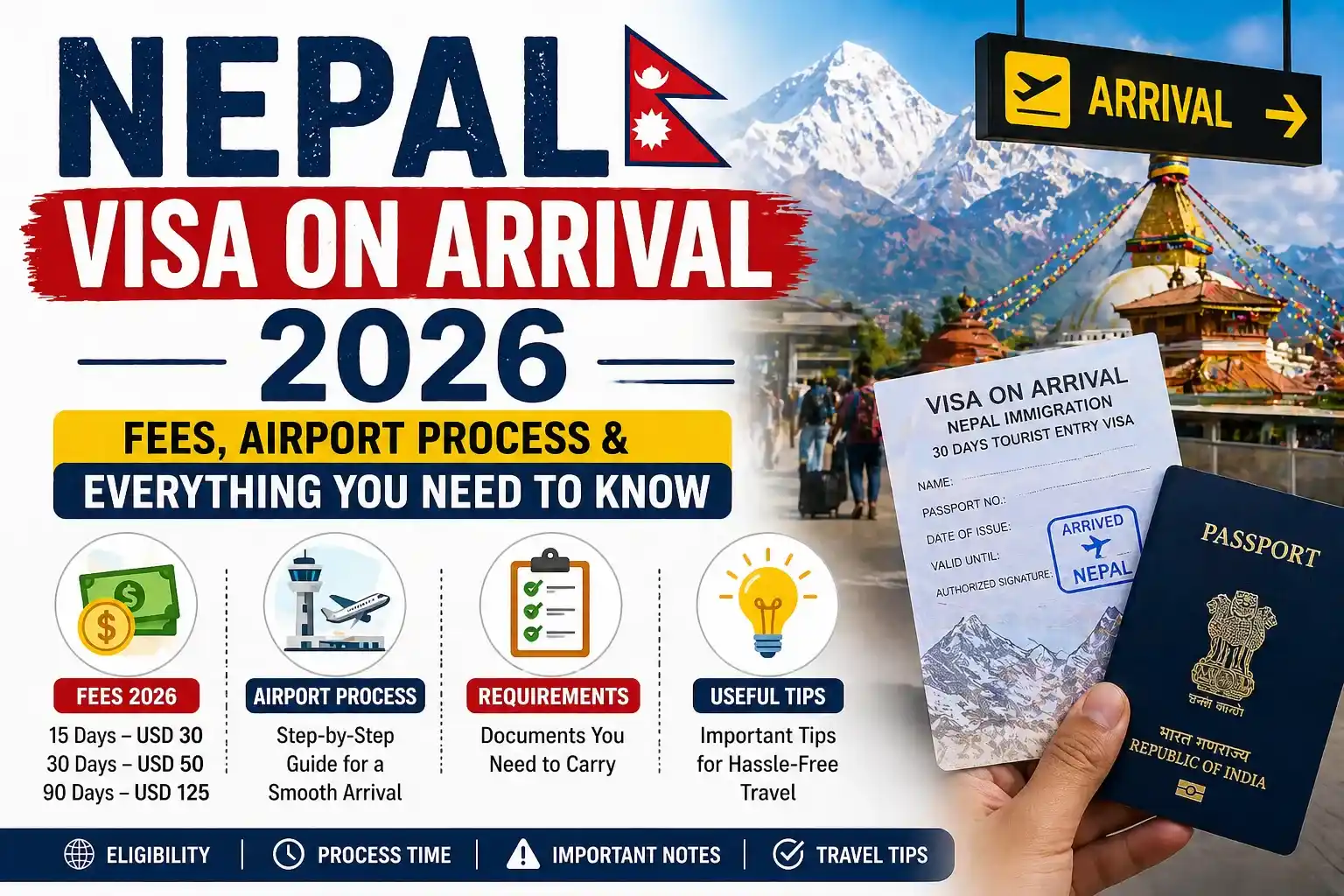
Nepal Visa on Arrival 2026
This is everything you need to know for 2026 fees, documents, the step-by-step airport process, and the one pre-arrival trick that lets you skip the longest queue entirely.
Who Can Get a Nepal Visa on Arrival?
The vast majority of international travellers are eligible for a visa on arrival (VoA) at Tribhuvan International Airport (TIA) in Kathmandu, as well as at designated land border crossings. This includes citizens of the USA, UK, Canada, Australia, all EU nations, most of Asia, and most of South America.
Indian citizens are the exception they require no visa at all to enter Nepal, under the 1950 Indo-Nepal Treaty of Peace and Friendship. SAARC citizens (Bangladesh, Bhutan, Maldives, Pakistan, and Sri Lanka) receive a free 30-day tourist visa once per calendar year.
Citizens of the following countries cannot get a visa on arrival and must apply in advance through a Nepalese embassy or consulate before travelling:
- Nigeria, Ghana, Zimbabwe, Cameroon, Ethiopia, Liberia, Somalia, Eswatini, Afghanistan, Iraq, Syria, and Palestine
If you hold a passport from one of these countries, contact the nearest Nepalese diplomatic mission well before your departure date.
Nepal Visa Fees 2026 (Current Rates)
Nepal offers three tourist visa durations. The fees below are set by the Department of Immigration and remain standard in 2026:
| Duration | Fee (USD) |
|---|---|
| 15 days | USD 30 |
| 30 days | USD 50 |
| 90 days | USD 125 |
Which duration should you choose? For most travellers especially trekkers the 30-day visa is the safest default. A 15-day visa sounds sufficient but leaves zero buffer for weather delays, altitude acclimatisation days, or simply falling in love with a place and lingering longer than planned. Many trekkers have had to cut Everest Base Camp trips short because they chose 15 days to save USD 20.
All Nepal tourist visas are multiple-entry by default, meaning you can exit to India or Tibet and return to Nepal within your visa validity window without paying again.
Children under 10 are generally exempt from visa fees entirely.
Documents Required Your Pre-Flight Checklist
Pack these before you leave home. Missing any one of them can slow you down significantly at the airport:
- Valid passport — must have at least 6 months of validity beyond your entry date and at least one blank page for the visa stamp. A passport with 5 months and 29 days of validity will be turned away. No exceptions.
- Passport-sized photograph — one recent colour photo with a light background. The airport kiosks can take a digital photo, but they add 10–15 minutes and cost NPR 500+. Bring your own and skip that step.
- Visa fee in cash (USD preferred) — more on payment methods below.
- Completed arrival card — usually distributed on your inbound flight, or available at the immigration area on arrival. Fill this out completely and legibly.
- Online barcode receipt (highly recommended) — this is the queue-saving secret explained in the next section.
- Proof of onward travel — a return or connecting flight booking. It is rarely checked, but it is technically required and smart to have on your phone.
The Smart Move: Pre-Register Online Before You Fly
This is the single most important tip in this entire guide and the one most travellers ignore.
Nepal’s Department of Immigration allows you to complete your tourist visa application online before you arrive. Visit the official website at immigration.gov.np, fill in your details, upload a passport-sized photo, and print the barcode receipt that the system generates.
This receipt is valid for 15 days from submission, so complete it within two weeks of your flight.
When you arrive at TIA, travellers with a pre-printed barcode receipt go to a separate, dedicated fast-track counter, bypassing the kiosk queue entirely. On a busy peak-season day, this shortcut can save you 30–45 minutes.
Step-by-Step: The Visa on Arrival Process at Tribhuvan Airport
Here is exactly what happens from the moment your plane lands:
Step 1 — Follow signs to the Visa on Arrival section After deplaning, follow the immigration signs through the arrival hall. The visa area is clearly marked to your left. Do not follow signs for “Baggage Claim” your bags can wait.
Step 2 — Use the kiosk (or show your pre-printed barcode) If you completed the online pre-registration, skip straight to Step 3. If not, find one of the electronic kiosk machines in the queue area. Scan your passport, fill in your details on the touchscreen, take a digital photo, and collect the printed slip the machine produces.
Step 3 — Pay your visa fee at the bank counter Take your kiosk slip or pre-printed barcode receipt to the bank/payment counter. Select your visa duration (15, 30, or 90 days) and pay the fee. The officer will issue you an official payment receipt immediately.
Step 4 — Proceed to the immigration officer Hand the immigration officer your passport, payment receipt, arrival card, and passport photo. The officer reviews your documents and stamps your visa directly into your passport.
Step 5 — Collect your bags and clear customs Your Nepal visa is now active. Proceed to baggage claim, clear customs, and walk out into Kathmandu.
Total time on a quiet day: 20–40 minutes. On peak-season afternoon arrivals when multiple international flights land together: 60–90 minutes.
Payment Methods at TIA — What’s Actually Accepted
Cash is king at the TIA visa counters in 2026, and USD is the most straightforward currency to use. The bank counters also accept EUR, GBP, JPY, and AUD at posted exchange rates, but USD gives you the most predictable, fee-free transaction.
Credit and debit cards: Machines are installed at some payment counters, and Visa and Mastercard are more widely accepted in 2026 than in previous years. However, network errors and temporary outages are still common enough that cards should be treated as a backup only, not your primary plan.
Critical note on USD bills: Nepalese bank counters are notoriously strict about the condition of US dollar notes. Bills must be from Series 2013 or newer, clean, unfolded, and with no pen marks, tears, or significant wear. If the cashier rejects your note, there is no workaround you’ll need to find a usable bill. Always bring pristine notes in the exact denominations you need.
Nepali Rupees are not accepted for visa fees. Do not use them at the payment counter.
The E-Visa Option: Apply Before You Travel
Beyond the online pre-registration shortcut, Nepal also offers a full e-visa for travellers who prefer to have everything sorted from home.
The e-visa is applied for through the Department of Immigration website and typically approved within 3–5 business days. Once approved, your visa is confirmed digitally and linked to your passport no additional payment required at the airport.
The e-visa costs the same as the on-arrival fee (USD 30, 50, or 125 depending on duration) and is available to eligible nationalities. Travellers who have obtained a visa through a Nepalese embassy or the e-visa system must enter Nepal within 6 months of the issue date. Your total stay is calculated from your actual entry date.
For those visiting during peak season March to May or September to November the e-visa is worth considering simply to eliminate any airport uncertainty.
Visa Extension: If You Want to Stay Longer
Nepal allows tourist visas to be extended up to a maximum of 150 days per calendar year. Extensions are processed at:
- Department of Immigration, Kalikasthan, Kathmandu
- Immigration Office, Pokhara
Extension fees as of 2026: USD 45 for a minimum 15-day extension, then USD 3 per additional day beyond that. Note that in practice, immigration offices also charge a small processing fee of around USD 10 at the time of billing. Bring exact cash in USD or Nepali Rupees.
Extensions cannot be processed at the airport you must visit the office in person during working hours.
Tips to Beat the Queue and Avoid Common Mistakes
Do before you fly:
- Complete the online tourist visa form at immigration.gov.np and print the barcode receipt
- Bring crisp, new USD notes in the exact fee amount (USD 30, 50, or 125)
- Carry 2 passport-sized photos you’ll also need them later for trekking permits
- Fill in your arrival card on the plane, not in the queue
Timing is everything:
- Arrive on a late-night or early-morning flight queues at those hours are a fraction of afternoon arrivals
- The busiest periods are March–May and September–November (peak trekking seasons) and Dashain/Tihar (October/November), when Nepali diaspora flood home and the airport is packed
Avoid these common errors:
- Choosing 15 days when you need 30. The USD 20 difference is not worth the stress of an extension or a cut trip.
- Bringing USD bills from 2009 or earlier, or notes that are folded and worn they will likely be rejected.
- Overstaying your visa. The fine is USD 5 per day and can result in an entry ban on future visits.
- Not having proof of onward travel on hand keep your return flight booking in your email, accessible offline.
Entry Points Beyond the Airport
While Tribhuvan International Airport in Kathmandu is the only international airport in Nepal, visa on arrival is also available at several land border crossings, including Birgunj/Raxaul, Bhairahawa/Sunauli, and Kakarbhitta the main overland routes from India. However, land borders rarely have working card machines, and digital photo facilities may be out of service. For land border crossings, always bring USD cash and physical passport photos there are no workarounds if either is missing.
Nepal’s visa on arrival process is genuinely one of the friendliest in the world. Most travellers walk through without a single issue. The ones who hit problems are almost always the ones who showed up without crisp USD notes, without a photo, or without the 30 seconds it takes to check whether their passport has six months of validity remaining.
Sort those three things before your flight, complete the online pre-registration to skip the kiosk queue, and your Nepal adventure starts the moment your wheels touch down at Tribhuvan not 90 minutes later.
Information in this guide reflects the current rules and fees set by Nepal’s Department of Immigration as of April 2026. Always verify the latest regulations at immigration.gov.np before travel, as fees and eligibility can change.
Planning your Nepal trip? Explore our guides
