In 2026, as the global landscape shifts toward digitized, ephemeral experiences, cultural events nepal stand as the ultimate physical manifestation of community resilience, profound faith, and extraordinary ancestral wisdom. To truly understand the heart of the Himalayas is to witness its calendar,seamless, vibrating tapestry where the sacred and the celebratory are inextricably woven together. This cultural events nepal guide is far more than a mere list of dates; it is a rigorous exploration of the “Living Museum” that defines the Nepali psyche. From the bone-shaking chariot-pulling frenzies of the Kathmandu Valley to the rhythmic, soulful syncopation of jazz festivals and live music in Kathmandu, every celebration serves as a vital pulse-point of national identity.
To witness cultural events nepal is to observe a society that refuses to be homogenized by the mundane forces of globalization. Here, time is not perceived as a linear arrow but as a cyclical wheel, governed by the ancient rhythms of the moon, the sun, and the shifting seasons of the Himalayas. Each festival serves as a mystical portal into a different era—be it the medieval golden age of the Kathmandu Valley or the ancient shamanic traditions of the Kirat tribes. This manual explores those portals in exhaustive detail, providing the indispensable context and the “why” behind every bell rung and every prayer whispered across the nation.
The Cultural Events Nepal: Dashain, Tihar, and Chhath
The core of cultural events nepal revolves around the post-monsoon months of September, October, and November. This is a time of cosmic victory, the return of light, and a profound sense of celestial gratitude.
Dashain: The Fifteen Days of Universal Victory
Dashain is the undisputed, magnificent king of cultural events nepal. Lasting for fifteen days, it marks the victory of Goddess Durga over the buffalo-demon Mahishasura, symbolizing the triumph of Dharma over Adharma. It is a period where the entire nation shuts down in a grand display of collective devotion.
Ghatasthapana (October 11, 2026): The event begins with the sowing of “Jamara” (barley seeds) in a sacred jar. For nine days, these seeds grow in total darkness, symbolizing the hidden, latent power of the divine feminine. This ritual is performed in every household, from the humblest village hut to the most modern Kathmandu apartment, creating a national shared rhythm of anticipation.
Phulpati (October 17, 2026): A grand parade brings sacred flowers and leaves from the ancestral palace in Gorkha to the capital, Kathmandu. In 2026, the resonance of the cannons firing at Tundikhel remains a sound every local associates with the true heart of cultural events nepal.
Vijaya Dashami (October 21, 2026): The climax of the entire fortnight. Elders apply “Tika” (a mixture of rice, yogurt, and vermilion) and give “Jamara” to the youth. This is the ultimate day of reconciliation, forgiveness, and family bonding, proving that cultural events nepal are fundamentally about the strength of the household and the continuity of lineages. For a deeper look at the processions that coincide with this period, see our guide on jatras in nepal.
Tihar: The Five Days of Luminance and Brotherhood
Following closely after the intensity of Dashain is Tihar, the “Festival of Lights.” If Dashain is about power and victory, Tihar is about harmony between humans, animals, and the divine. This five-day event is widely regarded as the most aesthetically beautiful of all cultural events nepal.
The Animal Honors (November 7–9, 2026): The first three days honor Crows (messengers), Dogs (guardians), and Cows (symbols of prosperity). The sight of street dogs wearing marigold garlands and red tikas is one of the most heartwarming and unique sights in the world of cultural events nepal.
Laxmi Puja (November 9, 2026): The night the Goddess of Wealth is invited into homes. Every doorway is decorated with oil lamps (Diyo) and “Rangoli” patterns made of colored sand. In 2026, the aerial view of a lit-up Kathmandu Valley is nothing short of a galaxy on earth, as the city transforms into a shimmering sea of light.
Bhai Tika (November 11, 2026): The final day celebrates the bond between brothers and sisters. Sisters apply a seven-colored tika to their brothers’ foreheads, praying to Yamaraj (the God of Death) for their longevity. This ritualized protection is a cornerstone of the social fabric of cultural events nepal.
Newari Masterpieces: Chariots and the Living Goddess

Bisket Jatra tug-of-war over a multi-story chariot
The Newar community of the Kathmandu Valley provides the most visually stunning and structurally complex events within the cultural events nepal spectrum. These events are often centered around “Jatras” or massive chariot processions that have occurred for over a thousand years.
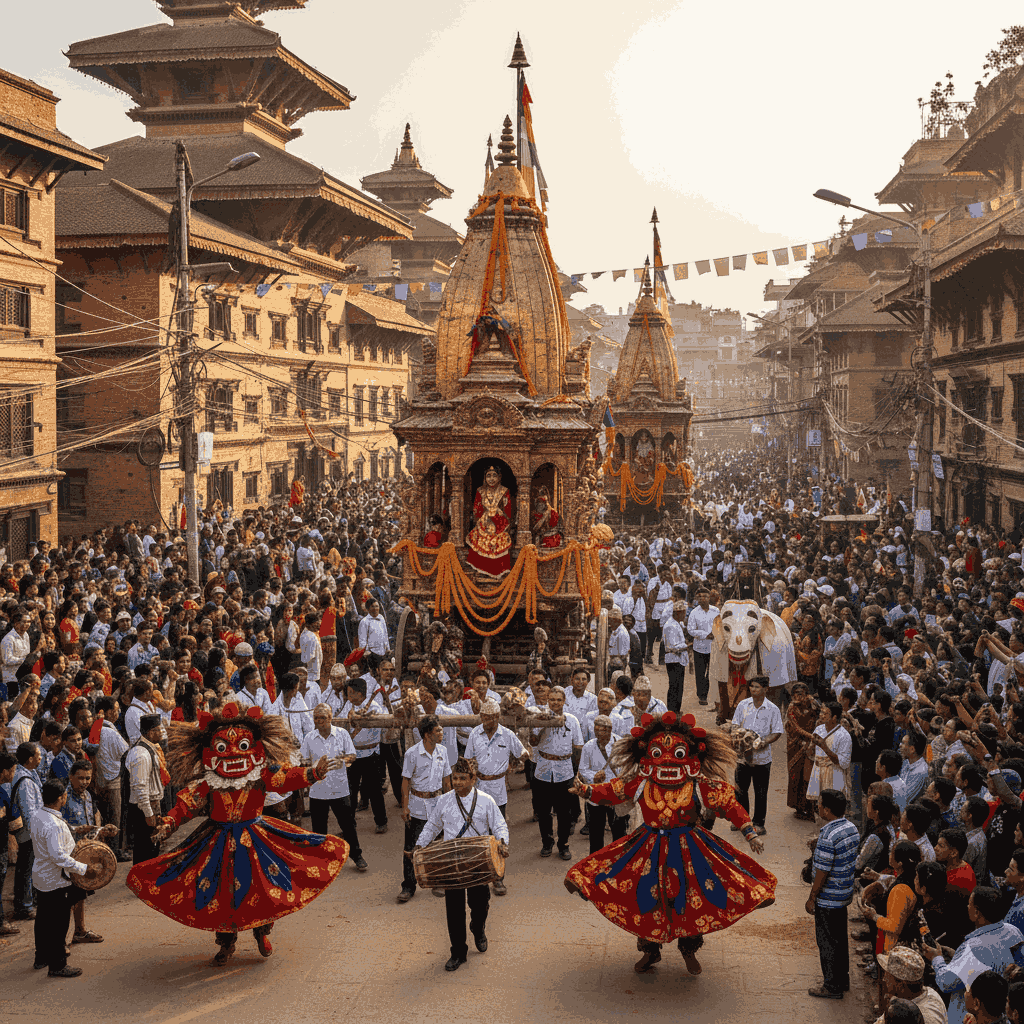
Indra Jatra (September 25, 2026): This is the event of the King of Heaven and the Living Goddess, Kumari. As the Kumari’s chariot rolls through the historic squares of Basantapur, accompanied by the masked “Lakhey” dancers and the “Pulukishi” (white elephant), the energy is electric. This event highlights the unique syncretism of cultural events nepal, where Hindu and Buddhist traditions blur into one magnificent spectacle.
Bisket Jatra (April 14, 2026): The New Year celebration of Bhaktapur. It involves a massive tug-of-war over a multi-story chariot and the erection of a “Lyo Sin Dyo” (ceremonial pole). It is an event of raw, masculine energy and ancient competition, firmly rooted in the medieval history of the valley. To understand the engineering of these chariots, refer to our manual on jatras in nepal.
Himalayan Monastic Rituals: Mani Rimdu and Tiji
In the shadows of the world’s highest peaks, cultural events nepal take on a monastic, meditative, yet intensely colorful quality. These are the festivals of the Sherpa and Loba communities, deeply influenced by Tibetan Buddhism and the environment of the high mountains.
Mani Rimdu (November 15–17, 2026): Held at the Tengboche Monastery in the Everest region, this is the most important event for the Sherpa people. It involves nineteen days of meditation, culminating in three days of public masked dances known as Chham. These dances represent the triumph of Buddhism over the ancient Bon spirits of the mountains. To witness Mani Rimdu with Everest as a backdrop is the pinnacle of the cultural events nepal experience.
Tiji Festival (May 13–15, 2026): In the “Forbidden Kingdom” of Upper Mustang, the Tiji Festival tells the story of a deity who saved the kingdom from destruction. The vibrant costumes against the stark, red-cliff desert of Mustang create a visual contrast that is unmatched in global travel. For more on the history of these regions, explore the UNESCO World Heritage Centre site.
Modern Vibrations: Jazz and Global Fusion
In 2026, cultural events nepal have evolved to include global creative movements, with the Jazzmandu festival (October 2026) standing as a premier landmark. This fusion of traditional instruments like the Sarangi and Madal with international jazz defines the 21st-century Nepali identity. Far from being static relics, cultural events nepal are vibrant, breathing organisms that bridge local heritage with global influence. For travelers, a jazz session in a 14th-century Patan courtyard is the ultimate modern experience; detailed schedules are available at jazz festivals and live music in Kathmandu.
The 2026 Master Calendar of Cultural Events Nepal
| Event Name | 2026 Main Date | Location | Cultural Significance |
| Maghe Sankranti | January 14 | Nationwide | Winter Solstice & Harvest |
| Maha Shivaratri | February 15 | Pashupatinath | The Great Night of Lord Shiva |
| Holi | March 2 | Nationwide | The massive festival of colors |
| Bisket Jatra | April 14 | Bhaktapur | Nepali New Year Chariot |
| Buddha Jayanti | May 1 | Lumbini | Birth of Lord Buddha |
| Teej | September 14 | Pashupatinath | The women’s festival of red |
| Indra Jatra | September 25 | Kathmandu | The Living Goddess Kumari |
| Dashain | Oct 17 – 31 | Nationwide | National Victory Festival |
| Tihar | Nov 7 – 11 | Nationwide | Festival of Lights |
| Mani Rimdu | Nov 15 – 17 | Tengboche | Sherpa Monastic Dances |
Historical Depth and Resilience
The origins of cultural events nepal are rooted in the Licchavi and Malla periods, where kings used public celebrations to unify diverse ethnic groups. In 2026, these events remain a pillar of social stability. The “Guthi” system, a community-based management structure, ensures that the logistics of these events,from chariot building to feast preparation,are handled with ancestral precision. This system is often cited by the Nepal Tourism Board as the reason for the country’s high cultural preservation rate despite modernization.
While the core rituals remain unchanged, cultural events nepal in 2026 have embraced the modern world with shocking efficiency. You will see youths documenting the chariot pulls on advanced cameras, and the evening air often transitions from traditional dhime drums to the vibrant sounds of jazz festivals and live music in Kathmandu. This fusion is vital; it shows that cultural events nepal are not fading memories but living traditions that the younger generation is proud to carry.
Practical Tips for Witnessing Cultural Events Nepal
Respect the Sacred Architecture: Always walk clockwise around stupas and temples. Never touch ritual offerings or the “Rangoli” on the ground. Modesty is key; covering shoulders and knees is mandatory in temples.
Photography Ethics: Photographers love cultural events nepal, but always ask before taking close-up portraits of devotees in prayer. In 2026, using drones is strictly regulated around heritage sites—ensure you have the correct permits from the Civil Aviation Authority of Nepal.
Logistics and Crowds: Major events like Indra Jatra or Dashain cause significant road closures in Kathmandu. For official details on heritage site access and transport, always check for 2026 visitor updates.
Frequently Asked Questions: Cultural Events Nepal
1. What is the best time of year to experience cultural events nepal?
The most explosive and concentrated period for cultural events nepal is during the autumn (September to November). This window features the “Great Trinity” of Dashain, Tihar, and Chhath. However, if you are looking for the raw energy of chariot pulls, the spring (April) is unbeatable due to Bisket Jatra and the start of Rato Machhindranath. For those who prefer a mix of tradition and modern vibes, the jazz festivals and live music in Kathmandu usually peak in late October, perfectly complementing the traditional festival season.
2. Are jatras in nepal open to international tourists?
Yes, almost all cultural events nepal, including the massive jatras in nepal, are public celebrations held in open streets and heritage squares. While certain inner sanctums of Hindu temples are restricted to practitioners, the street processions, chariot pulls, and masked dances are free and welcoming to all. In 2026, many local communities have even set up “Heritage Viewpoints” to help visitors witness the events safely.
3. Is it safe to participate in high-energy events like Holi or Bisket Jatra?
Safety is a priority in 2026, but these events are inherently chaotic. For Holi, expect to be drenched in water and powder; it is best to wear old clothes and protect your electronics. For jatras in nepal involving large chariots, always maintain a safe distance from the wooden wheels and the thick ropes. The energy is infectious, but the physical momentum of a 10-ton chariot requires caution. Following the lead of local guides is the most sensible way to engage with cultural events nepal.
4. How do I know the exact dates for festivals in 2026? Because most cultural events nepal
are governed by the Bikram Sambat lunar calendar, dates shift annually on the Gregorian calendar. For 2026, Dashain begins in mid-October and Tihar in early November. It is highly recommended to check a reliable “Nepali Patro” (calendar) or visit the Nepal Tourism Board website for the most accurate, real-time updates on 2026 festival timing.
5. What is the cultural etiquette for visiting temples during these events?
Respect is the cornerstone of cultural events nepal. Always remove your shoes before entering any temple courtyard or home. Ensure your shoulders and knees are covered. Avoid taking photos of people during deep prayer or animal sacrifice unless you have explicit permission. Also, remember to walk around stupas and shrines in a clockwise direction, as this represents the movement of the universe in Himalayan tradition.
As we close this formidable manual, it is clear that cultural events nepal are the glue that holds the nation’s history together. They are a reminder that some things,community, faith, and the joy of a shared goal,are timeless. In 2026, experiencing a cultural event in Nepal is not just about seeing a parade; it is about feeling the profound collective energy of a people who have refused to let their culture become a museum piece.
Nepal is a land where the gods walk the streets, and the streets are paved with history. Every chariot pull is a prayer for the future, and every masked dance is a tribute to the past. By visiting during these times, you contribute to the preservation of a heritage that is as fragile as it is formidable. The cultural events nepal invite you to be more than a spectator; they invite you to be part of the rhythm of the Himalayas.
