
Chulu Far East is the friendliest summit in the Manang valley and the one most likely to be sold to you under another name.
Four peaks carry the Chulu name, north of Manang, known locally as the Gungang Himal. One climbing permit covers all four. Two of them share a base camp. And the easiest of the four, Chulu Far East at 6,059 metres, is frequently climbed by groups who booked Chulu East at 6,584 metres.
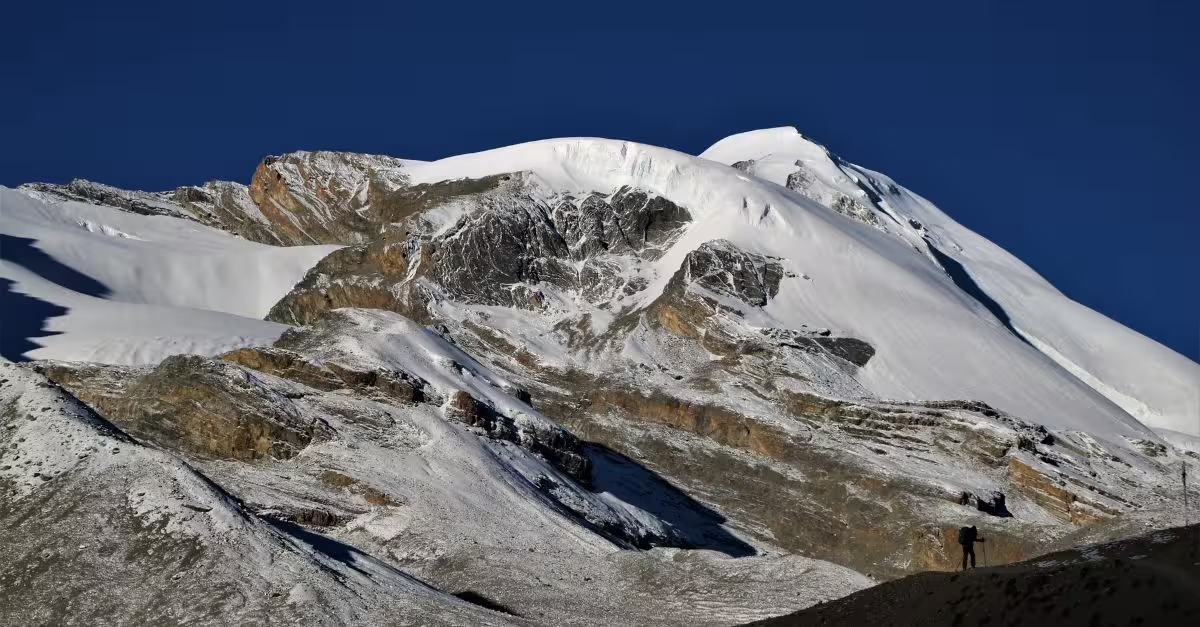
Chulu Far East Peak Climbing: Photo by Vertex Holiday
So before the route, the cost and the permits, know which mountain you are buying.
The four Chulus
| Peak | Height | Base camp | Difficulty |
|---|---|---|---|
| Chulu Far East | 6,059 m | Above Ngawal | Easiest of the four |
| Chulu East | 6,584 m | Above Ngawal, shared | Considerably harder |
| Chulu West | 6,419 m | Above Letdar | Harder |
| Chulu Central | 6,250 m | Above Letdar | Harder |
Heights vary slightly between sources; verify before relying on the exact figures.
The permit costs the same for all four, which is why the substitution is easy and why it rarely gets corrected. If your itinerary says Chulu East, check which summit the operator actually intends to climb, and get the answer in writing.
This is not necessarily a scam. Chulu Far East is a better objective for most climbers, and a good guide may switch for sound reasons of conditions or client ability. The problem is only when nobody tells you.
How hard is it, really?
Operator pages contradict each other badly here, so be sceptical of both extremes.
The balanced answer: Chulu Far East is the easiest of the Chulu group and a reasonable first Himalayan summit, but it is not a walk. The standard route follows the northeast ridge from a high camp on the moraine at around 5,330 metres, and you need competence with crampons, an ice axe and rope work on snow.
The veteran Himalayan guide Jamie McGuinness has suggested it should be the Island Peak of the Annapurnas — straightforward but enjoyable. That is a fair description, and it means roughly Island Peak’s skill level.
Any page telling you this needs no climbing skills is describing a different mountain. Any page calling it one of the most challenging peaks in the Annapurna region is describing Chulu West or Chulu East.
The route
Most itineraries run 16 to 21 days and follow the Annapurna Circuit for the approach.
Kathmandu to Besisahar by road, then up the circuit through Dharapani, Chame and Pisang. Above Pisang the route to Chulu Far East diverts near Ghyaru or Ngawal, climbing to base camp at around 4,835 metres and a high camp on the moraine at about 5,330 metres.
Summit day takes the northeast ridge. After descending, most groups rejoin the circuit at Manang and continue over Thorong La at 5,416 metres to Muktinath and Jomsom, which turns the trip into a full Annapurna Circuit with a summit in the middle.
That combination is the real appeal. You get one of the world’s classic treks and a 6,000-metre peak in one trip.
No flights, which matters more than it sounds
Chulu Far East is reached entirely by road. There is no Lukla flight, no Ramechhap transfer at 3am, no cancelled-flight contingency and no helicopter rescue bill when the weather closes the airstrip for three days.
Anyone who has lost days to Lukla will understand why this is worth something. It also makes the trip cheaper and the schedule far more reliable than an equivalent Khumbu peak.
Permits
NMA climbing permit. Chulu Far East is an NMA trekking peak and the permit covers all four Chulu summits. The NMA revised its rates on 1 September 2025, and current published figures disagree with each other, so check a dated source rather than an operator’s old table. Our Nepal climbing permit fees page carries the verified rates.
Annapurna Conservation Area Permit (ACAP). Required for the whole route.
TIMS card. Required for the circuit trekking portion.
A licensed climbing guide is mandatory. Solo climbing is not permitted on any peak in Nepal.
Some pages say the climbing permit can be obtained at Besisahar or Chame. Others say it must come from the NMA through a registered agency. Confirm this with your operator before you travel, because arriving without a valid permit is not a problem you can fix at 4,800 metres.
Fees last verified: [2026-09-20].
What it costs
Guided packages run roughly $2,890 to $3,590 per person on published 2026 rates, with some operators quoting toward $4,500 for longer or more supported itineraries.
Hiring separately, a climbing guide runs about $25 to $50 a day and a porter $15 to $25. Over a 16 to 20 day trip, that is a substantial part of the bill.
What moves the price: trip length, whether Thorong La is included, group size, and whether the quote covers the climbing gear or expects you to bring it.
Not included in most packages: international flights, insurance covering climbing above 6,000 metres, personal gear and tips.
When to go
Spring, March to May, and autumn, September to November, with some operators extending into mid-December. Autumn gives the most stable weather.
Winter ascents are possible but cold and snow-loaded. The monsoon is not worth attempting.
Who it suits
Good choice if you want a first 6,000-metre summit, you would rather drive than fly, and the Annapurna Circuit appeals as much as the peak.
Look elsewhere if you need a peak with heavy infrastructure and frequent departures Island Peak runs weekly in season and is the better-supported equivalent.
Before you book
- Which Chulu summit does this itinerary climb, and is that in writing?
- What does the NMA permit line say, and for which season?
- Is Thorong La included, and what does the trip cost without it?
FAQ
What is the difference between Chulu Far East and Chulu East?
Chulu Far East is 6,059 m and the easiest of the four Chulu peaks. Chulu East is 6,584 m and considerably harder. They share a base camp above Ngawal and the same climbing permit, and groups booked on Chulu East are sometimes taken up Chulu Far East instead.
How difficult is Chulu Far East?
It is the easiest of the Chulu group and a reasonable first Himalayan peak, roughly comparable to Island Peak. You need competence with crampons, an ice axe and rope work on snow. Operator pages claiming it needs no climbing skills are inaccurate.
How much does Chulu Far East peak climbing cost?
Published 2026 packages run roughly $2,890 to $3,590 per person, with longer or more supported itineraries quoted higher. Flights, insurance and personal gear are extra.
Do I need a permit for Chulu Far East?
Yes. An NMA climbing permit, which covers all four Chulu peaks, plus ACAP and a TIMS card for the trekking portion. A licensed climbing guide is mandatory.
How long does the trip take?
Typically 16 to 21 days, depending on whether you cross Thorong La after the summit.
Do I need to fly to get there?
No. The approach is entirely by road from Besisahar along the Annapurna Circuit, which avoids the flight cancellations common on Khumbu peaks.
