

Authentic traditional lifestyle Nepal at dawn with villagers performing rituals and community bonding in a rural setting.
In 2026, as the world becomes a blur of high-speed fiber optics and urban sprawl, traditional lifestyle in Nepal remains an anchor for those seeking authentic human connection. To understand the “Soul of the Himalayas,” one must look past the neon lights of Thamel and step into the red-brick alleys where time behaves differently. Traditional life in Nepal is not a stagnant relic of the past; it is a living, breathing symphony of rhythmic work, communal prayer, and a deep, ancestral respect for the earth.
Whether you are in town for the jazz festivals and live music in Kathmandu or trekking the high-altitude trails, the true “Highlight of Nepal” is the resilience found in traditional lifestyle Nepal. Here, the morning begins with the resonant sound of a conch shell, and the evening ends with the soft glow of a butter lamp. In 2026, the concept of “Rurbanomics” has made the elements of the traditional lifestyle in Nepal even more valuable to the global traveler seeking meaning and mindfulness.
Chapter 1: The Dawn Rhythms and Spiritual Architecture
The day in traditional-lifestyle Nepal does not begin with an alarm clock; it starts with the sun. This “Auspicious Hour” is when the physical and spiritual worlds meet.
The Morning Puja and Chautari Chiya
Before the peaks catch the first light, the practitioners of traditional lifestyles in Nepal are already awake. Women sweep the stone courtyards with twig brooms, a cleansing ritual that prepares the home for the gods. The first task is always the Puja—lighting incense and offering fresh marigolds to the family deity. Afterward, the community gathers at the Chautari (resting platform) for chiya (milk tea).
Communal Connection: The Chautari is the social heart where elders exchange news and young people learn the community’s oral history.
Auspicious Start: The 4:30 AM rising time is believed to capture the “Brahma Muhurta,” a time of peak spiritual energy.
Communal Taps and Social Flow
In many heritage towns, the water tap is the center of the social universe. In traditional lifestyle Nepal, fetching water in a copper gagri is a daily exercise in patience and community. It is here that the bonds of the village are forged, as women exchange updates on the harvest or upcoming weddings.
Chapter 2: Life Stages: The “Ceremony Called Life”
A defining feature of traditional lifestyle in Nepal is the series of Sanskars or rituals that mark every major transition of a human being.
Childhood: Nwaran and Pasni
On the sixth or eleventh day after birth, the Nwaran (naming ceremony) takes place. Following this, at five to seven months, the Pasni (Rice Feeding Ceremony) introduces the baby to solid food. In traditional lifestyle Nepal, the child is dressed in red and gold silk, reinforcing familial bonds from infancy.
Coming of Age: Bel Bibaha and Bratabandha
In the Newari community, young girls undergo Bel Bibaha (marriage to the Bel fruit), ensuring they are never truly “widowed.” For boys, the Bratabandha marks their transition into manhood. These rituals are the backbone of traditional lifestyle Nepal, ensuring that every generation understands their role within the cosmic and social order.
Chapter 3: Agriculture: The Sustenance of Traditional Lifestyle Nepal

Farming in traditional lifestyle Nepal with terraced fields and community cooperation.
For the majority of the population, traditional lifestyle Nepal is synonymous with the land. Agriculture is not just a job; it is a sacred duty.
Terraced Landscapes and Indigenous Mastery
The iconic “staircase” fields that drape the hills are a hallmark of traditional lifestyle Nepal. In 2026, these terraces remain a marvel of ancestral engineering.
The Parma System: A communal labor exchange where neighbors help neighbors without the need for cash.
Crop Cycles: The year is dictated by the monsoon—Ashadh (planting) is a time of mud-caked celebration.
Organic Sovereignty: Even in 2026, most mountain households in traditional lifestyle Nepal use local “Gobar” (cattle manure), rejecting chemical fertilizers for a healthier soil.
Chapter 4: The Culinary Soul: Food as Medicine
Diet is the cornerstone of health in traditional lifestyle Nepal. Every meal is prepared with the intention of balancing the body’s energies.
The Dal Bhat Powerhouse
“Dal Bhat Power 24 Hour” is the truth of traditional lifestyle Nepal. This balanced meal of lentil soup, rice, and vegetable curry provides the protein and carbohydrates needed for rigorous physical labor. For a deep dive into the heritage behind these meals, look at the Sankhu heritage town traditions.
Fermentation and Preservation
To survive the harsh winters, traditional lifestyle Nepal developed ingenious preservation methods. Gundruk (fermented leafy greens) and Sinki (fermented radish) are probiotic-rich staples that provide essential vitamins when fresh vegetables are scarce.
Chapter 5: Social Architecture: Caste, Clan, and Community
Traditional lifestyle Nepal is built on the foundation of the Guthi (community organization) and the extended family.
The Guthi System
The Guthi is a unique socio-economic trust that manages temples, festivals, and even funeral rites. It is the invisible glue that keeps traditional lifestyle Nepal functioning, ensuring that cultural monuments are maintained and social welfare is provided.
The Extended Family Unit
Unlike the nuclear families of the West, traditional lifestyle Nepal thrives on multi-generational living. Grandparents, parents, and children often live under one roof, ensuring that wisdom is passed down directly through storytelling and shared work.
Chapter 6: 2026 Challenges: The Modernization Paradox
While traditional lifestyle Nepal is resilient, it faces the “Brain Drain” of migration. Many young people leave for cities, leaving the elderly to maintain the farms. However, 2026 has seen a “Reverse Migration” trend where youths are returning to embrace community tourism in Nepal as a way to monetize and preserve their heritage.
Chapter 7: Traditional Festivals: The Rhythm of the Year
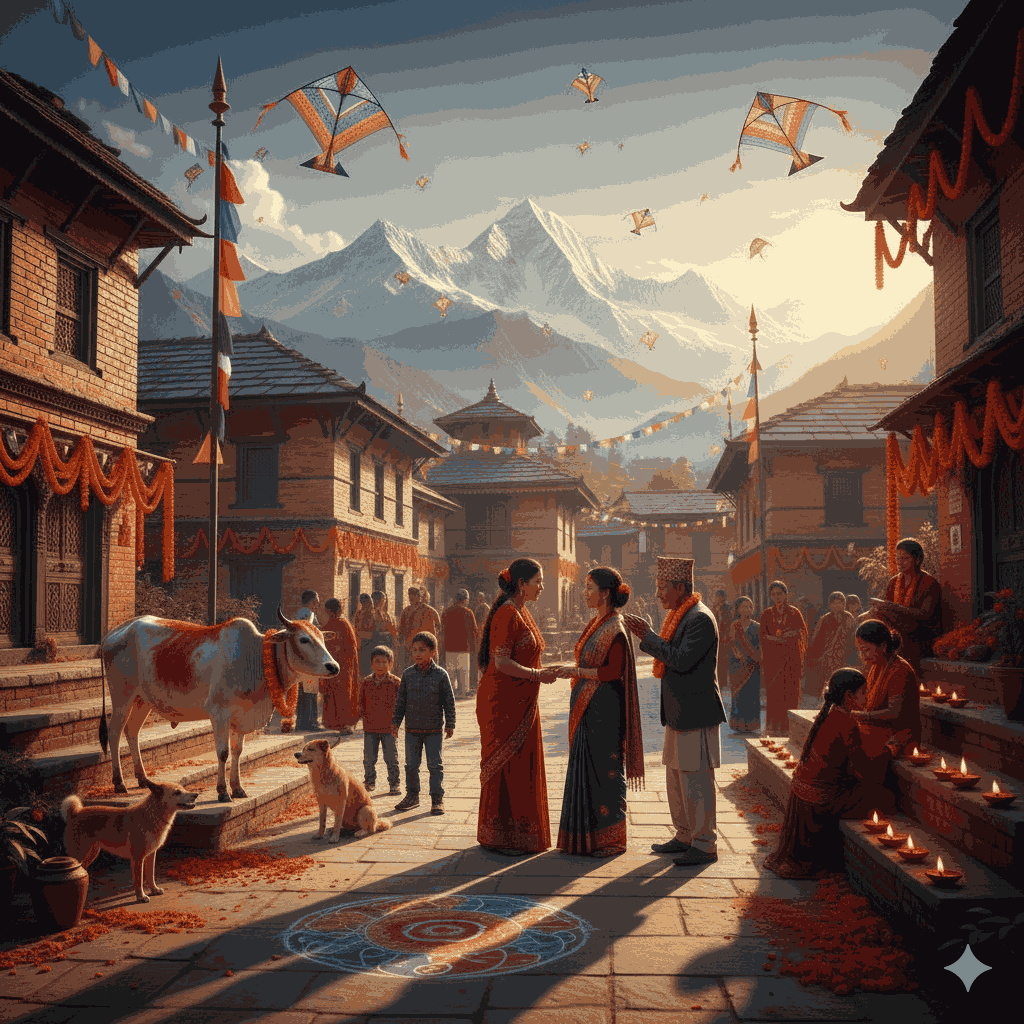
Festivals of traditional lifestyle Nepal with vibrant rituals, kite flying, and community celebrations
No description of traditional lifestyle Nepal is complete without its festivals. In 2026, these celebrations remain the primary way the community reconnects with its roots.
Dashain: The Victory of Good
Dashain is the longest and most significant festival in traditional lifestyle Nepal, spanning 15 days. It commemorates the victory of Goddess Durga over the demon Mahishasura.
The Tika Ritual: Elders place a mixture of rice, yogurt, and vermilion on the foreheads of juniors, offering blessings for prosperity.
The Kite Flying: The skies during Dashain are filled with colorful kites, symbolizing a message to the gods that the harvest season is over.
Tihar: The Festival of Lights
Tihar is perhaps the most visually stunning aspect of traditional lifestyle Nepal. Over five days, various animals—crows, dogs, and cows—are worshipped. The final day, Bhai Tika, celebrates the bond between brothers and sisters.
Frequently Asked Questions (FAQs)
Q1: What defines the traditional lifestyle Nepal? A: It is defined by a close relationship with nature, communal labor (Parma), a diet centered on organic Dal Bhat, and a daily schedule governed by ritual.
Q2: How has traditional lifestyle Nepal changed in 2026? A: While core values remain, traditional lifestyle Nepal now integrates digital connectivity (4G in the hills) and sustainable tourism.
Q3: Is traditional lifestyle Nepal accessible to tourists? A: Yes, through “Heritage Homestays,” travelers can immerse themselves in the traditional lifestyle Nepal by living with families.
Q4: What is the significance of “Namaste” in traditional lifestyle Nepal? A: It means “the divine in me bows to the divine in you,” reflecting the deep spiritual thread in traditional lifestyle Nepal.
Q5: What are the main festivals of traditional lifestyle Nepal? A: Dashain and Tihar are the national staples, while ethnic festivals like Lhosar or Indra Jatra highlight regional diversity.
Traditional lifestyle Nepal is not a fading memory; it is a blueprint for a sustainable future. In 2026, as the world looks for ways to live more simply and harmoniously, the lessons of traditional lifestyle Nepal are more relevant than ever. By valuing community over competition and the earth over the ego, the people of Nepal offer a masterclass in human dignity. To experience traditional lifestyle Nepal is to come home to a part of yourself that you may have forgotten.
Traditional lifestyle Nepal is not just a subject to be studied; it is a frequency to be tuned into. It teaches us that the greatest heights in Nepal aren’t the summits of the 8,000-meter peaks, but the depths of a tradition that has refused to die. In 2026, the conch shell still sounds at dawn, the butter lamps still flicker in the dark, and the heart of traditional lifestyle Nepal beats stronger than ever.
