Safe Route to Mount Everest: The Historic Path Reopening That’s About to Transform Everest Climbing
For decades, the dream of standing on the summit of Mount Everest has remained the world’s greatest mountaineering achievement. But for many climbers, one obstacle has always stood between them and the summit: the notorious Khumbu Icefall one of the most dangerous sections of the entire Everest climb.
Now, a historic breakthrough is set to change everything.
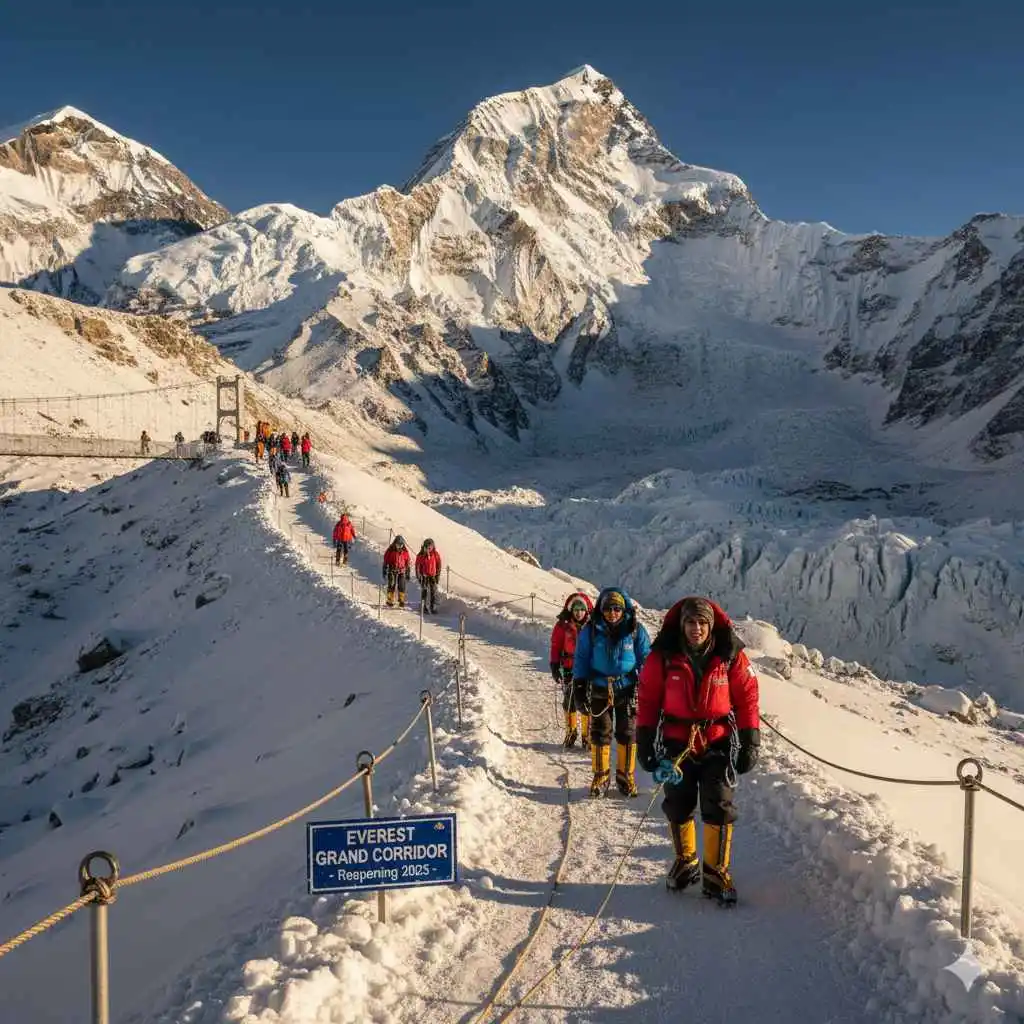
A brand-new Safe Route to Mount Everest, inspired by the original 1953 Hillary Tenzing path, is expected to reopen by March next year. With 80% of construction already completed, this project is shaping up to be the biggest safety upgrade Everest has seen in decades.
This revival isn’t just about building a trail it’s about rewriting Everest’s future. It’s about making expeditions safer, reducing fatalities, improving climber confidence, and renewing global interest in Nepal’s mountaineering industry. For adventure seekers, trekking companies, guides, and local businesses, this is a monumental opportunity.
If you are planning to climb Everest or if you operate trekking and guiding services this is the perfect time to prepare, promote, and position yourself ahead of one of the most important changes in Himalayan mountaineering history.
In this comprehensive guide, we break down everything you need to know about the Safe Route to Mount Everest, why it matters, who’s behind it, when it opens, and how it will benefit climbers and the tourism industry.
What Is the New Safe Route to Mount Everest?
The newly reopened trail follows the legendary passage used by Sir Edmund Hillary and Tenzing Norgay Sherpa during their first successful ascent in 1953. For years, this trail was overshadowed by the more widely used Khumbu Icefall route but the dangers of the icefall eventually made it clear that climbers needed a safer alternative.
This revived Safe Route to Mount Everest bypasses the deadly icefall, replacing ladders, shifting seracs, collapsing ice blocks, and unpredictable avalanches with a more stable and secure approach via the Nuptse side.
The updated route is:
Only about 200 meters longer
Dramatically safer
More predictable
Designed with fixed steps, ropes, and technical equipment
Built with sustainability and environmental protection in mind
Mountaineering experts believe this route may reduce accidents during Everest ascents by a significant margin. For years, climbers have been hoping for such an alternative and now it’s finally happening.
Why Nepal Needed a Safer Route
Let’s be clear: the Khumbu Icefall is one of the most dangerous sections of any mountain on earth.
Every year, roughly 25% of all Everest fatalities occur in the Icefall alone. Climbers describe it as a constantly shifting maze of deep crevasses, massive ice towers, and unstable blocks that can collapse without warning.
Veteran mountaineer Bijay Ghimire explains that the Icefall is the “first and greatest danger” of the Everest climb. Even highly experienced Sherpas have lost their lives there.
This is why the announcement of a Safe Route to Mount Everest has already created a buzz among climbers worldwide. Imagine:
Fewer delays in acclimatization
Lower risk of injury or death
Increased summit success rate
Higher confidence for new climbers
Smoother operations for guiding companies
This trail is not just a new path it is a transformation of the Everest experience.
80% of the Work Completed: What Has Been Built So Far?
The government has confirmed that 80% of the Safe Route to Mount Everest is already finished. The work includes:
220 out of 270 fixed steps installed
Technical equipment placed to ensure climber safety
New base camp area developed at the foot of Nuptse
Surveying and mapping of terrain
Installation of safety ropes and anchoring systems
Environmental impact assessment measures
Trail clearing and stabilization
The team behind the project includes some of the world’s best-known mountaineers:
Kaji Sherpa (Nepal) – legendary climber and researcher
Marc Batard (France) – world-famous French mountaineer
Antoine Erol (France) – technical mountaineering expert
These experts have spent over three years rediscovering, restoring, and modernizing the historical route. Their collaboration with Nepali authorities, local communities, and international donors has turned the project into a symbol of global mountaineering unity.
Government Authorization and Safety Standards
The project received official approval on January 5 through a Cabinet decision, granting permission to open and operate the trail up to 6,100 meters (Camp I).
Safety and sustainability have been prioritized through:
Technical inspections
Environmental clearances
Engineering consultations
Equipment quality assessments
International-standard trail planning
According to Himal Gautam, Director of the Department of Tourism, the Safe Route to Mount Everest will significantly reduce congestion, noise, and environmental pressure around the current base camp.
This means a cleaner environment, fewer bottlenecks, and a more organized climbing season.
A Model of Local and International Collaboration
The revival of the Safe Route to Mount Everest stands as a shining example of collaboration between:
Nepal’s government
Local Sherpa communities
International climbers
Tourism organizations
Private donors
Global mountaineering associations
Financial contributions have come from French mountaineering groups, the Greek Honorary Consul, and private donors. Former Director General of Tourism Dr. Narayan Prasad Regmi also played a key role in policy coordination.
This teamwork shows the world what Nepal can achieve when local expertise and global resources come together.
Estimated Cost and Funding: USD 400,000 Project
The total cost of the project is estimated at USD 400,000.
Already, USD 300,000 has been spent on:
Fixed lines
Technical gear
Safety equipment
Anchoring systems
Trail maintenance
Engineering assessments
The remaining amount is being raised from international donors, mostly from France. This ensures the project progresses without delays and without heavy financial pressure on Nepal’s government.
How the Safe Route to Mount Everest Benefits Climbers and the Tourism Industry
This is where the real transformation begins.
Beyond safety and history, the Safe Route to Mount Everest will unlock opportunities across the entire mountaineering ecosystem.
Below are the biggest benefits:
1. Dramatically Reduced Risk for Climbers
With fewer ice collapses, fewer crevasses, and no unstable glacier blocks, climbers can approach Camp I with far more confidence.
Guiding companies can offer enhanced safety guarantees, which is extremely valuable in a competitive market.
2. Higher Summit Success Rate
When the Icefall’s risks are eliminated, climbers can:
Preserve energy
Maintain better focus
Reduce altitude-related stress
Move steadily without panic
Avoid unnecessary wait times
A safer, more stable path increases the likelihood of reaching higher camps smoothly boosting summit success rates.
3. More Climbers Will Want to Attempt Everest
Right now, many climbers hesitate because of the Icefall dangers.
With the Safe Route to Mount Everest, that hesitation will shrink.
Agencies can expect:
Higher inquiries
More bookings
Increased international interest
More repeat climbers
Higher expedition demand
This isn’t just a route it’s a marketing advantage.
4. More Job Opportunities for Nepali Guides and Porters
Dawa Sherpa from the Everest region explains that the new route will create:
Expanded guiding opportunities
More porter jobs
More accommodation demand
More local business activity
More seasonal tourism revenue
Sherpa communities will directly benefit from the increased flow of climbers.
5. A Revival of Nepal’s Mountaineering Heritage
This project is more than construction it’s a reconnection with history.
Reopening the original Hillary–Tenzing route reinforces:
Nepal’s mountaineering identity
National pride
Nepal’s global reputation
Historical continuity
It also repositions Nepal as a pioneer in safe, sustainable mountain tourism.
6. A Boost for International Trust in Nepal’s Tourism Safety
When climbers see that Nepal is investing in safety, they feel more confident in choosing Nepal over other high-altitude destinations.
Adding a Safe Route to Mount Everest to promotional materials is a major selling point for agencies.
Why the Safe Route to Mount Everest Is a Game-Changer for Adventure Companies
If you run a trekking or expedition business, you should immediately begin preparing:
✔ Update your expedition packages
Highlight the new route in your 2025/2026/2027 itinerary.
✔ Promote “safer expeditions” in marketing campaigns
This is a huge selling point for climbers who want reduced risk.
✔ Add new training and preparation programs
Guides and climbers need to learn the new path.
✔ Build SEO content around the keyword “Safe Route to Mount Everest”
This blog post is the perfect foundation.
✔ Start taking pre-bookings early
Demand will rise once the route officially opens.
A New Era of Safer, Smarter, and More Accessible Everest Climbing
With the construction nearly complete and the opening date approaching fast, the world is watching Nepal. The Safe Route to Mount Everest is expected to revolutionize how climbers approach the world’s highest peak.
It reduces risk.
It honors history.
It boosts tourism.
It strengthens communities.
It builds confidence.
It enhances sustainability.
And above all it saves lives.
Whether you’re a climber dreaming of the summit or a trekking company preparing your next season, this historic revival marks the beginning of a new Everest era.
The introduction of the Safe Route to Mount Everest is more than a safety upgrade it’s a business opportunity, a tourism revival, and a historic moment for Nepal.
For climbers, it means a safer journey.
For guiding companies, it means higher demand.
For Nepal’s tourism industry, it means renewed global attention.
Now is the best time to:
Write content
Promote packages
Update your booking funnels
Prepare guides
Inform your audience
Boost your SEO rankings
Use this historic moment to position your brand ahead of your competitors.
