Nepal revised its climbing royalties on 1 September 2025, the first change in a decade. A year on, most published fee tables are still wrong, and the errors run in both directions we have found the Manaslu permit published at everything from $125 to $5,500 for a fee that is actually $3,000.
This page lists the current rates by peak and season, with the date each was checked. If a figure here is out of date, tell us and we will fix it.
Nepal climbing permit fees
Why so many published fees are wrong
Two reasons, and understanding them tells you which figures to distrust.
The 2015 rates circulated for ten years. Pages written before September 2025 carry them, and plenty have never been updated. If a site quotes the Everest spring permit at $11,000, everything else on that page predates the revision too.
Two peaks are priced against the general pattern. Most 8,000-metre peaks are expensive in spring and half price in autumn. Manaslu is the reverse, because autumn is its climbing season. Ama Dablam costs the same in both. Operators applying the general rule to those two publish figures that are wrong by thousands of dollars.
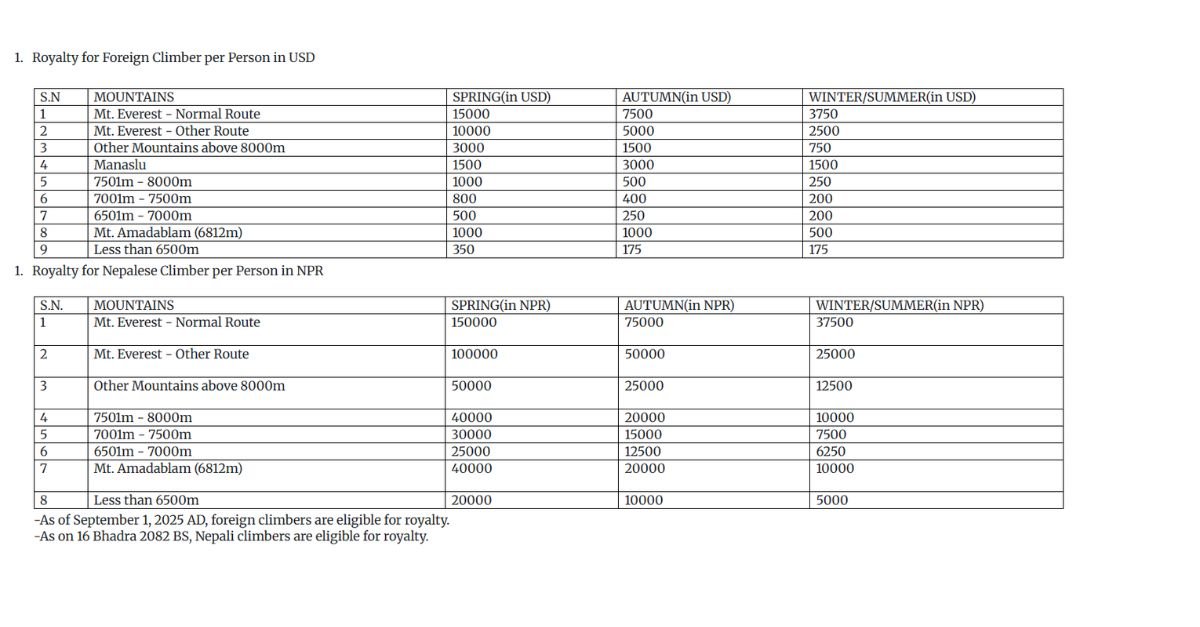
Everest royalty (south route, per foreign climber)
| Season | Fee | Previous rate |
|---|---|---|
| Spring (Mar–May) | US$15,000 | $11,000 |
| Autumn (Sep–Nov) | US$7,500 | $5,500 |
| Winter (Dec–Feb) and monsoon (Jun–Aug) | US$3,750 | $2,750 |
Nepali climbers pay NPR 150,000 for the spring normal route, doubled from NPR 75,000.
Everest is rarely climbed outside spring, so the autumn and winter figures matter mostly for expedition planning rather than practice.
Peaks above 8,000 m, other than Everest
| Season | Fee | Previous rate |
|---|---|---|
| Spring (Mar–May) | US$3,000 | $1,800 |
| Autumn (Sep–Nov) | US$1,500 | $900 |
| Winter and monsoon | US$750 | $450 |
Applies to Kangchenjunga, Lhotse, Makalu, Dhaulagiri, Annapurna I, Cho Oyu from the Nepal side, and the rest of Nepal’s 8,000-metre peaks with the exception of Manaslu, below.
Manaslu — its own rate
| Season | Fee |
|---|---|
| Autumn (Sep–Nov) | US$3,000 |
| Spring (Mar–May) | US$1,500 |
| Winter and monsoon | US$750 |
Manaslu is the one peak where autumn costs more than spring. The Department of Tourism’s own autumn 2026 figures confirm the autumn rate: 422 permits issued, $1,266,000 collected, which is exactly $3,000 each.
If an operator quotes you $1,500 or $900 for an autumn Manaslu permit, they are applying the general 8,000-metre rule to a peak that does not follow it.
Ama Dablam — its own rate
| Season | Fee |
|---|---|
| Spring and autumn | US$1,000 |
| Winter and monsoon | US$500 |
Ama Dablam is charged the same in both main seasons. It is an expedition peak under the Department of Tourism, not one of the NMA’s 27 trekking peaks, which is worth knowing because several operator pages send climbers to the NMA for a permit it does not issue.
Nepal climbing permit fees
Peaks 7,501 m to 8,000 m
Figures for this band are unresolved verify at the Department of Tourism before relying on them.
Covers Himlung Himal, Baruntse, Putha Hiunchuli and similar. These are among the most popular 7,000-metre objectives in Nepal and the rate is worth getting right.
NMA trekking peaks (Island Peak, Mera Peak, Lobuche East and 24 others)
Rates for the NMA’s 27 peaks are set by the NMA separately and are currently published inconsistently verify before relying on them.
Three things about NMA peaks that are not in dispute:
- The fee is charged per climber, not per group. At least one operator page states the opposite, which is wrong.
- Rates changed on 1 September 2025 alongside the government schedule.
- Group size affects the total on some peaks, so a solo climber and a member of a large team may not pay the same rate.
What else changed in September 2025
The fee rise came with rules that affect what a climb costs and how it is organised.
Guides are mandatory. Solo climbing is no longer permitted on any peak. Above 8,000 metres you need one guide for every two climbers. Below 8,000 metres the ratio is far looser, but at least one guide per group is required.
Permit validity cut from 75 days to 55. This matters for long expeditions and for anyone planning a weather-delayed season.
Insurance minimums raised. Cover for high-altitude guides rose to NPR 2 million, and for base camp workers to NPR 1.5 million. Your operator pays this, but it is part of why package prices rose.
Waste rules. Climbers on 8,000-metre peaks must carry their waste off the mountain, and may not carry items not listed on their permit.
Fees this page does not cover
The royalty is one line on a permit bill. Depending on the peak you will also pay national park or conservation area entry, a rural municipality fee, a garbage deposit, and liaison officer costs. Those vary by region and are usually inside your operator’s package.
How to check a quote
Ask your operator for the royalty as a separate written line, with the season stated. Then compare it to the table above. If the figures do not match, ask why before you pay a deposit it is the fastest way to find out how current the rest of their pricing is.
(Peak by peak: Manaslu · Ama Dablam · Island Peak · Cho Oyu)
FAQs About Nepal Climbing Permit Fees
How much is a climbing permit for Everest in 2026?
US$15,000 per foreign climber for the spring season on the south route, up from $11,000 before the September 2025 revision. Autumn costs $7,500, and winter or monsoon $3,750. Nepali climbers pay NPR 150,000 for the spring normal route.
Why is the Manaslu permit more expensive in autumn than in spring?
Because autumn is Manaslu’s climbing season. Most 8,000-metre peaks are priced high in spring and half price in autumn, but Manaslu is charged $3,000 in autumn. This is the single most misreported fee in Nepal, because operators apply the general rule to a peak that does not follow it.
Why do different websites show different permit fees for the same peak?
Nepal revised its royalties on 1 September 2025, the first change in a decade. Pages written before that date still carry 2015 rates, and many have never been updated. A site quoting Everest at $11,000 is running on the old schedule, and everything else on it is likely stale too.
Is the climbing permit fee charged per person or per group?
Per person. Nepal moved from a group-based system to a uniform per-climber fee in January 2015, and the 2025 revision kept that structure. Any page describing a permit as a group fee is describing a system that ended a decade ago.
Who issues climbing permits in Nepal?
It depends on the peak. The Department of Tourism issues permits for expedition peaks, including all the 8,000-metre mountains and Ama Dablam. The Nepal Mountaineering Association handles its own 27 designated trekking peaks, such as Island Peak, Mera Peak and Lobuche East. Several operator pages send Ama Dablam climbers to the NMA, which does not issue that permit.
Can I climb solo in Nepal?
No. Solo climbing is no longer permitted on any peak. Above 8,000 metres you need one guide for every two climbers, and below that at least one guide per group. This came in with the same 2025 amendment that raised the fees.
Do I need a permit for trekking peaks like Island Peak and Mera Peak?
Yes. All 27 NMA peaks require a climbing permit charged per climber, alongside any national park or conservation area entry fee for the region. The rates changed on 1 September 2025, so check a current figure rather than an older published table.
Can I apply for a climbing permit myself?
No. Permits are issued through a government-registered Nepali trekking or expedition agency, which submits the application on your behalf. You will need your passport, and for technical peaks most operators also ask for a climbing résumé and a medical certificate.
How long is a climbing permit valid?
Fifty-five days, reduced from 75 in the 2025 revision. That matters on long expeditions and in seasons where weather forces extended waiting.
Does the permit fee cover everything I have to pay the government?
No. The royalty is one line. Depending on the peak you will also pay national park or conservation area entry, a rural municipality fee, a garbage deposit and liaison officer costs. These are usually inside your operator’s package rather than billed to you directly.