Ama Dablam is the most photographed mountain in Nepal and, for many climbers, the last serious test before an 8,000-metre peak. At 6,812 metres it is technical, exposed and steep, and the autumn queue on the Yellow Tower is proof of how many people want it.
Finding out what it costs is harder than it should be.
Six operator websites, checked this week, give six different figures for the same government permit: $200, $400, $500, $600, $1,000, and $4,000. One page manages two of those numbers in a single article. Several state the permit comes from the Nepal Mountaineering Association, which is not where an Ama Dablam permit comes from at all.
Package prices vary too, from about $3,600 for base camp service to $15,000 for a fully guided place. That spread is normal and explainable. The permit confusion is not.
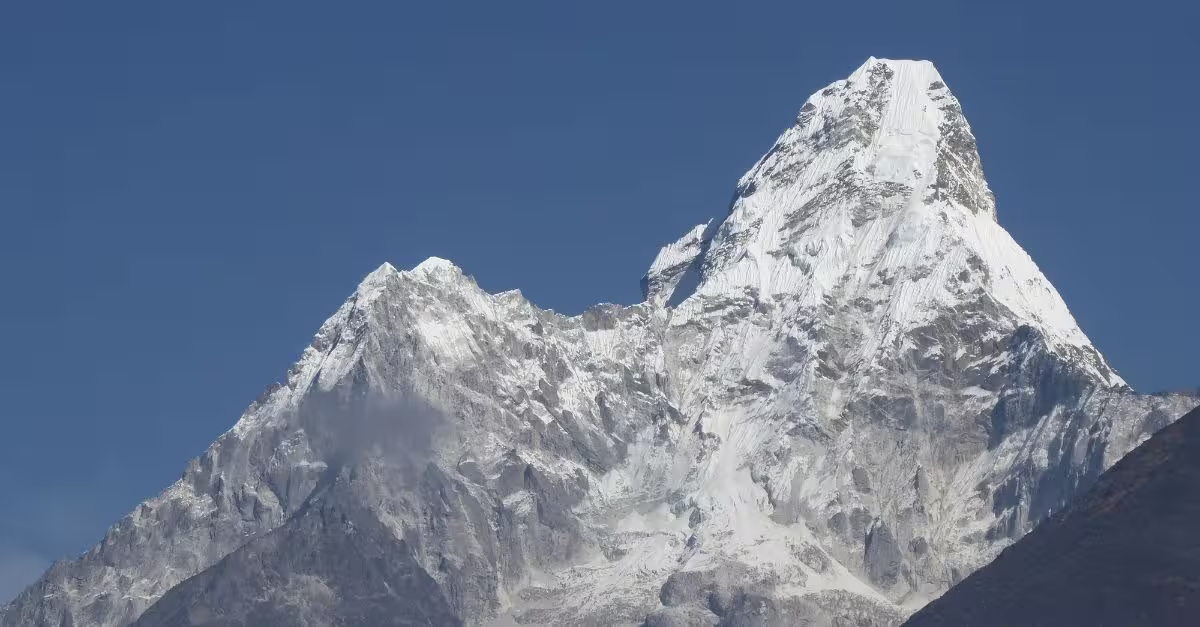
Ama Dablam expedition cost: Photo by discover altittude
Why the permit numbers disagree
Two things caused this.
Ama Dablam is not an NMA trekking peak. The NMA administers 27 designated trekking peaks. Ama Dablam is not one of them it is an expedition peak, and its royalty is set and collected by the Department of Tourism. Operator pages that send you to the NMA for an Ama Dablam permit are describing a process that does not exist.
The royalty schedule was revised effective 1 September 2025. It was the first change since 2015. Pages written before that date carry old figures, pages written after carry new ones, and plenty carry a mix.
The result is a set of published numbers that cannot all be right and mostly are not. Before you budget, check the current royalty on our Nepal climbing permit fees page, where each figure is dated and sourced.
Alongside the royalty you will pay two smaller fees that no one disputes: Sagarmatha National Park entry and the Khumbu Pasang Lhamu Rural Municipality fee, together roughly $30 per person.
What Ama Dablam costs in autumn 2026
Published rates for 2026, collected 12 September 2026.
| Tier | Price range (USD) | What defines it |
|---|---|---|
| Base camp service | $3,600–4,800 | Permits, base camp logistics, food. No climbing Sherpa above base camp. For self-sufficient teams. |
| Budget full service | $4,800–6,000 | Shared or add-on Sherpa, group departures, Lukla flights included |
| Standard full service | $6,000–8,000 | 1:1 Sherpa ratio, full logistics, emergency oxygen at camps |
| Premium / Western-led | $8,000–15,000 | Western guide, small teams, upgraded base camp, extended support |
Reference points from published 2026 rates: Makalu Adventure lists $5,200 full service and $3,600 base camp service. Mountain Rock Treks advertises from $4,850. Adventure Mountain Treks lists three tiers at $5,200, $6,000 and $7,200 with a 1:1 Sherpa ratio. Several operators quote $8,000 to $15,000 for premium guided places.
Watch what sits outside the headline price. One operator lists the base package, then charges a climbing Sherpa at $1,200 on top. Another prices supplementary oxygen at $550 per bottle with regulator. A $3,600 package and a $6,000 package can end up much closer together once those are added.
Where the money goes
The royalty. Fixed by the government, varies by season, and is the number most often published wrong. Get it in writing in your quote.
The climbing Sherpa. The biggest variable and the one worth paying for on this mountain. Ama Dablam is technical steep rock, fixed lines, the Yellow Tower, an exposed ridge and a dedicated Sherpa is a different proposition from a shared one. Check whether the quoted price includes one or adds $1,200.
Lukla flights. Included in most packages. Confirm whether that means Kathmandu or Ramechhap, since peak-season departures shift to Ramechhap, five hours’ drive east. Fares rose sharply in 2026.
Oxygen. Most climbers do not use supplementary oxygen on Ama Dablam, but emergency bottles at base camp and high camp should be part of the package. If personal oxygen is offered, it is an extra.
Time. A typical itinerary runs 28 to 30 days door to door. That is the real cost for most working climbers.
Never included. International flights, personal gear, insurance, tips and summit bonuses.
The insurance clause that matters
Ama Dablam is 6,812 metres and technical. You need cover that explicitly extends to technical climbing at 7,000 metres and includes helicopter evacuation. Standard travel insurance stops far below that.
Read the altitude ceiling before the price.
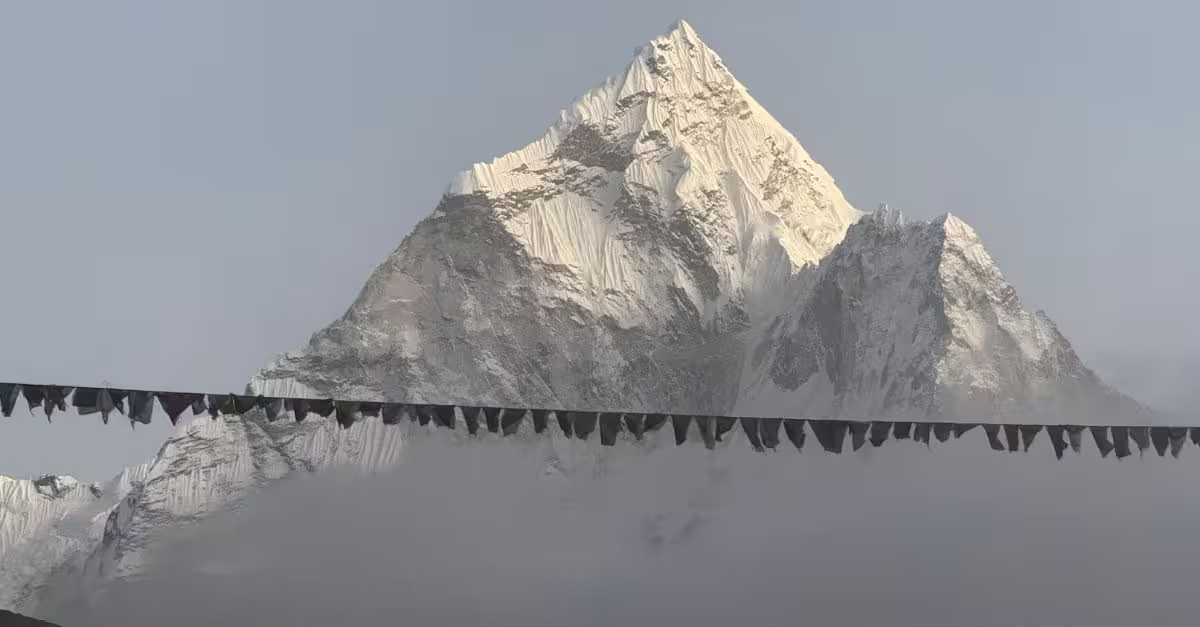
Ama Dablam expedition cost
Prerequisites, and why they affect the quote
Reputable operators will not take a first-time climber up Ama Dablam. The usual requirement is two or more 6,000-metre ascents plus multi-pitch rock or ice experience. Island Peak, Lobuche East and Chulu West are the standard stepping stones.
Some operators sell a combined itinerary pairing Island Peak as a warm-up with Ama Dablam as the main climb. It costs more but solves acclimatisation and prerequisite in one trip.
If an operator quotes you without asking what you have climbed, treat that as information about the operator.
A realistic all-in budget
Package price plus flights, gear, insurance and tips:
- Base camp service, self-sufficient: $7,000–9,500 all-in
- Budget full service: $9,000–12,000 all-in
- Standard, 1:1 Sherpa: $11,000–16,000 all-in
- Premium Western-led: $16,000–24,000 all-in
Before you pay a deposit
- What is the royalty line, in writing, for my season?
- Is a climbing Sherpa included, or added at around $1,200?
- Are Lukla flights from Kathmandu or Ramechhap, and who pays if they cancel?
(Stepping up from here: Manaslu is the usual first 8,000-metre peak, at roughly three times the cost.)