
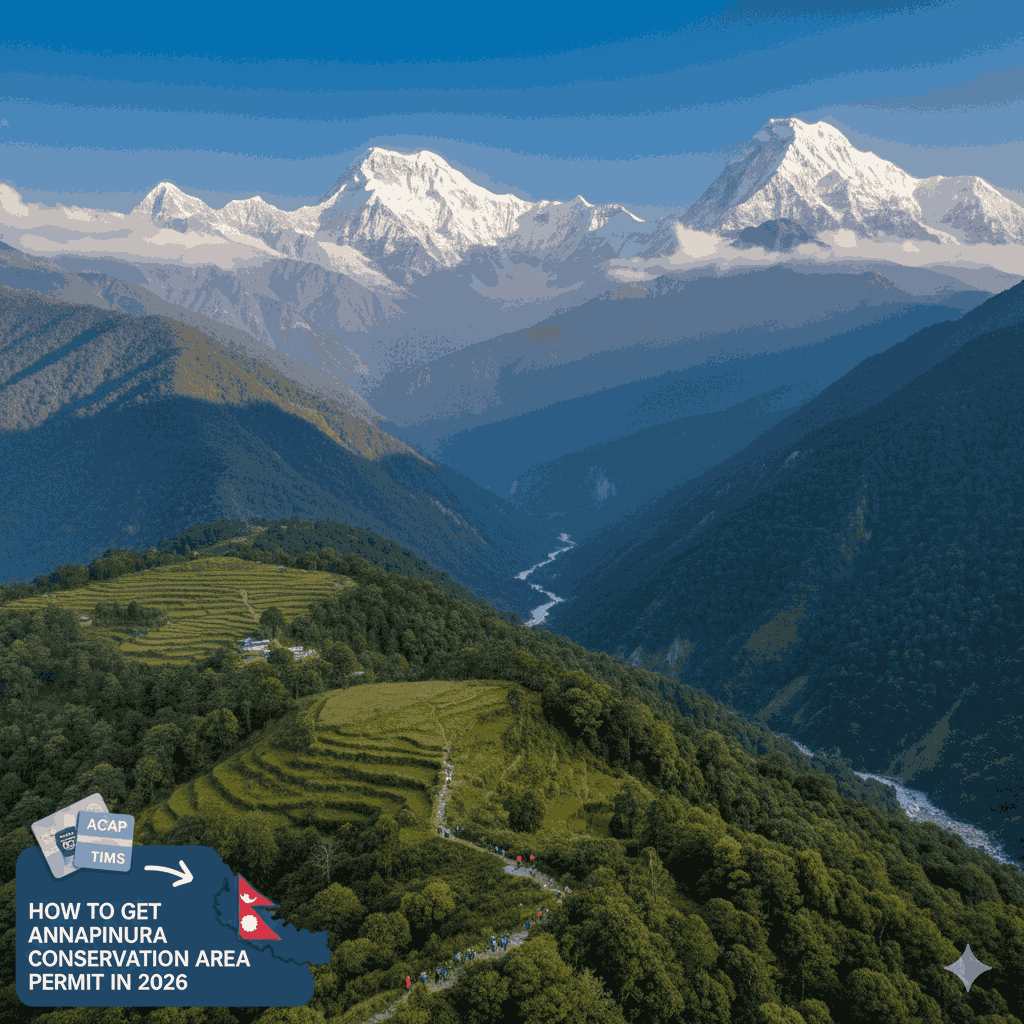
How to get Annapurna Conservation Area Permit in 2026: A picturesque view of the Annapurna Conservation Area in Nepal, perfect for trekking enthusiasts.
Trekking through the heart of the Himalayas is a dream for many, but before you can stand at the base of Machhapuchhre or cross the Thorong La Pass, there is one critical administrative hurdle you must clear. Understanding how to get Annapurna Conservation Area Permit in 2026 is the first step toward a successful journey. This guide provides the most current information for international travelers, SAARC nationals, and independent explorers visiting the Annapurna region.
Why You Need an ACAP Permit
The Annapurna Conservation Area (ACA) is the largest protected area in Nepal, covering over $7,629 \text{ sq. km}$. Managed by the National Trust for Nature Conservation (NTNC), the entry fees collected from the permits are funneled directly back into local communities and environmental preservation. When you learn how to get Annapurna Conservation Area Permit in 2026, you aren’t just buying a ticket; you are contributing to trail maintenance, wildlife protection, and sustainable tourism.
In 2026, the emphasis on “Green Trekking” has increased. The funds from your permit specifically support the conservation of over 1,200 species of flowering plants and rare animals like the snow leopard and red panda. By following the legal process of how to get Annapurna Conservation Area Permit in 2026, you ensure that the delicate ecosystem of the Annapurna Sanctuary remains pristine for future generations.
1. Understanding the Permit Types for 2026

Guide to permit types for trekking in Nepal in 2026, including how to get Annapurna Conservation Area Permit in 2026 and TIMS card.
To trek anywhere in the Annapurna region, you generally need two distinct documents. As of 2026, regulations have become stricter regarding safety and guide requirements.
Annapurna Conservation Area Permit (ACAP)
This is the primary entry permit. It is a single-entry permit, meaning once you exit the conservation area, you cannot re-enter using the same document. It is valid for the duration of your trek as specified in your itinerary. If you are doing the Annpurna Circuit, this permit is mandatory from the moment you enter the Besisahar checkpoint.
Trekkers’ Information Management System (TIMS) Card
As of 2026, the Nepal Tourism Board (NTB) requires a TIMS card for most trekking routes to ensure hiker safety. in the process of how to get Annapurna Conservation Area Permit in 2026 Under the revised 2023 regulations (which remain strictly enforced in 2026), most trekkers must now be accompanied by a licensed guide to obtain this card. The card now features a QR code for digital tracking at checkpoints.
2. Updated Fees: How Much Does it Cost in 2026?
The cost of your permit depends on your nationality. Please note that fees must be paid in Nepalese Rupees (NPR) on the process of how to get Annapurna Conservation Area Permit in 2026. While some offices in Kathmandu are beginning to accept cards, cash remains the most reliable method in the process of how to get Annapurna Conservation Area Permit in 2026.
| Category | ACAP Fee (NPR) | TIMS Fee (NPR) | Total (Approx. USD) |
| Foreign Nationals | 3,000 | 2,000 | ~$38 |
| SAARC Nationals | 1,000 | 1,000 | ~$15 |
| Nepali Citizens | 100 | Free | < $1 |
| Children Under 10 | Free | Free | $0 |
Always carry a little extra cash for photocopies and small administrative needs during the process of how to get Annapurna Conservation Area Permit in 2026.
3. Required Documents for the Application
Before heading to the permit office, ensure you have the following in your folder. Missing even one document can delay your trek.
Original Passport: You will need this for verification at the counter.
Passport Photocopies: Bring at least 2 clear copies.
Passport-Sized Photos: You need at least 4 photos (2 for ACAP, 2 for TIMS). Even if you apply online, carry physical copies for checkpoints.
Trek Itinerary: A general idea of your route, including entry and exit points.
Travel Insurance: Proof of insurance that covers high-altitude rescue up to $6,000\text{m}$ is now mandatory for permit issuance.
Emergency Contact Details: Both local (Nepal) and international.
4. Step-by-Step: How to Get Annapurna Conservation Area Permit in 2026
Method A: In-Person Application (Kathmandu or Pokhara)
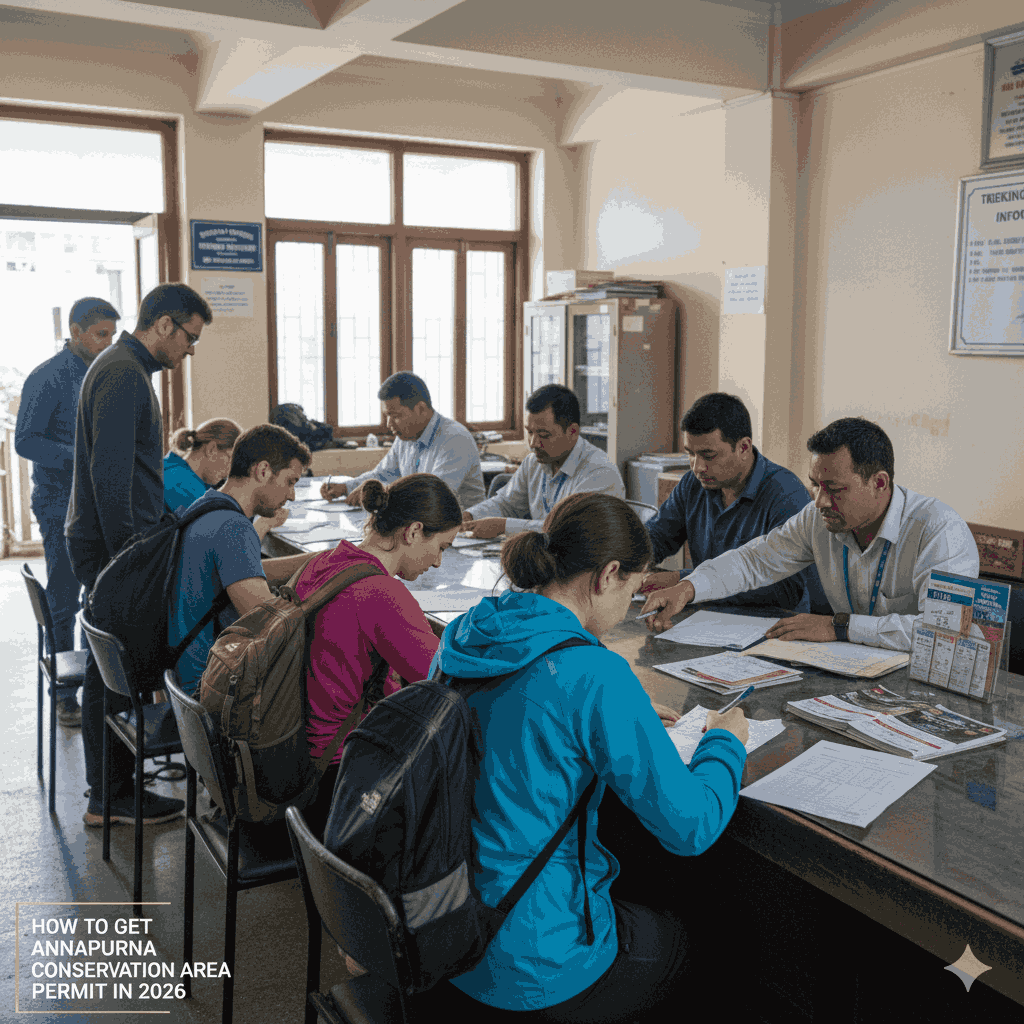
How to get Annapurna Conservation Area Permit in 2026: Trekker applying in person at the Kathmandu tourism office in Nepal.
The most common way to secure your permit is by visiting the Nepal Tourism Board offices.
In Kathmandu:
Location: Bhrikutimandap (about a 15-minute walk from Thamel).
Hours: Sunday–Friday, 10:00 AM to 5:00 PM. (Closed Saturdays and Public Holidays).
- Process: 1. Collect the forms at the entrance.2. Fill out the ACAP and TIMS forms carefully.
3. Attach your photos to the designated areas.
4. Submit at the counter and pay the fee in NPR.
5. Receive your permits within 20–30 minutes during off-peak hours.
In Pokhara:
Location: Nepal Tourism Board Office, Damside.
Hours: Similar to Kathmandu.
Process: Generally faster and less crowded than the Kathmandu office. Many hikers find it more convenient to handle how to get Annapurna Conservation Area Permit in 2026 here if they are flying directly to Pokhara.
Method B: Online Application (The Digital Shift)

How to get Annapurna Conservation Area Permit in 2026 through online application, with digital forms filled out on a laptop against Himalayan scenery.
For 2026, the NTNC has improved its e-permit portal.
Visit the official NTNC e-permit website.
Register an account and fill in your trekking details.
Upload digital copies of your passport and photo.
Pay the fee via integrated digital wallets (like eSewa or Khalti) or international credit cards.
Download and print the permit. Digital copies on phones are often not accepted at remote mountain checkpoints where electricity is scarce.
Method C: Through a Trekking Agency
If you have booked a guided trek, your agency will handle the entire process of how to get Annapurna Conservation Area Permit in 2026. This is the safest way to ensure compliance with the latest safety rules. Agencies have direct access to the e-TIMS system, which is sometimes restricted for individual users.
5. Major Trekking Routes Requiring the ACAP

rekking in the Annapurna Conservation Area in Nepal, made possible by knowing how to get Annapurna Conservation Area Permit in 2026
Understanding how to get Annapurna Conservation Area Permit in 2026 is essential for all the following popular routes:
Annapurna Base Camp (ABC): A 7–10 day trek reaching $4,130\text{m}$.
Annapurna Circuit: A classic 12–21 day trek crossing the Thorong La Pass at $5,416\text{m}$.
Ghorepani Poon Hill: A short 4–5 day trek famous for its sunrise views. Learn more in our Ghorepani Poon Hill trek guide.
Mardi Himal Trek: A newer, quieter trail that offers incredible views of Mount Fishtail.
Upper Mustang: While this is inside the ACA, it requires an additional Restricted Area Permit (RAP) costing $USD 500$ for the first 10 days.
6. Important Rules and Regulations
Single Entry: The permit is non-refundable and non-transferable. Once you leave the area (marked by specific exit gates), your permit expires.
Respect Local Culture: The Annapurna region is home to Gurung, Magar, and Thakali communities. Always ask before taking photos of people or religious ceremonies.
Waste Management: “Pack it in, pack it out.” Plastic bottles are banned in certain parts of the Annapurna region to protect the water sources.
Guide Requirement: As of 2026, solo trekking is officially restricted in most of Nepal’s high-altitude regions. When looking up how to get Annapurna Conservation Area Permit in 2026, check if your specific trail requires a licensed guide.
7. Helpful Tips for a Smooth Process
Go Early: Offices are busiest between 11:00 AM and 1:00 PM. Arriving at 10:00 AM sharp can save you significant time.
Avoid Holidays: Nepal has a complex calendar of public holidays. Check the official Nepal Government Calendar before planning your how to get Annapurna Conservation Area Permit in 2026 permit day.
Laminate Your Permit: Mountain weather is unpredictable. Rain or snow can easily ruin paper permits.
Check Your Details: Ensure the dates on your permit cover your entire trek duration. Staying longer than the permit’s validity can lead to fines at the exit checkpoints.
Currency Exchange: Most permit offices do not have ATMs. Ensure you exchange your currency for NPR in Thamel or Lakeside before heading to the Tourism Board.
8. Frequently Asked Questions (FAQs)
Q1: Can I get the ACAP permit at the trail entry point?
While some checkpoints (like Birethanti) can issue permits, they often charge a double fee (6,000 NPR) as a penalty. It is significantly better to learn how to get Annapurna Conservation Area Permit in 2026 in the city.
Q2: Do I need a permit for a day hike?
If the trail enters the Conservation Area boundary, yes. Even for a 1-day hike beyond the checkpoints, a permit is required.
Q3: Is the permit valid for the Annapurna Circuit and Base Camp?
Yes, one ACAP permit covers the entire region. However, if you cross into the Manaslu region, you will need an additional MCAP permit.
Q4: Do children need permits in the process of how to get Annapurna Conservation Area Permit in 2026?
Children under the age of 10 do not need to pay for or obtain an ACAP or TIMS permit, but they must be accompanied by a guardian with valid permits.
Q5: What happens if I lose my permit on the trail?
You should report it to the nearest police station or checkpoint. You will likely be required to pay for a new one at the next major administrative hub. Always keep a digital photo and a physical photocopy as a backup.
Securing your paperwork is the final hurdle before the adventure of a lifetime. By following this guide on how to get Annapurna Conservation Area Permit in 2026, you ensure that your trek starts smoothly, legally, and with a contribution to the beautiful environment you are about to explore.
Whether you are walking through the rhododendron forests or standing in awe of the Annapurna Massif, having the right permits in your pocket is your ticket to a worry-free Himalayan experience. For more in-depth planning, check out our Ultimate Nepal Trekking Guide.
